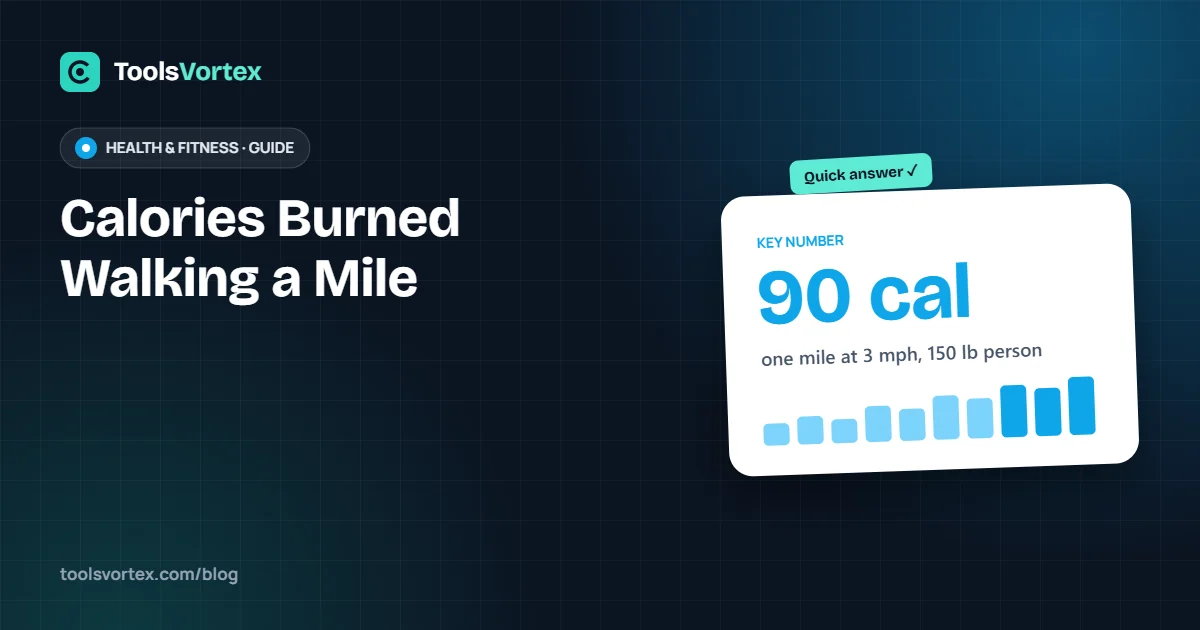
Walking a mile burns about 70 to 160 calories for most adults, depending mostly on body weight. At 3 mph, a 150 pound person burns about 90 calories per mile and a 180 pound person about 109. Subtract resting burn and the extra, or net, calories drop to about 67 and 80.

You finished a one mile walk and your watch says one number while the treadmill says another. So how many calories burned walking a mile is right? For most adults the answer falls between about 70 and 160 calories, and your body weight decides most of it.
This guide shows calories per mile by weight and speed, computed from published MET values, plus the effect of incline, a backpack and running. Enter your own numbers in the walking calories burned calculator to get a personal estimate.
How Many Calories Do You Burn Walking a Mile?
A 150 pound person burns about 86 to 111 calories walking one mile, and a 210 pound person burns about 120 to 156, depending on speed. These are gross calories, which include the energy your body would use at rest.
We computed every number from MET values in the 2024 Adult Compendium of Physical Activities, the research list updated by Stephen Herrmann and colleagues. One MET is the energy you burn sitting quietly. Brisk walking at 3.5 to 3.9 mph (code 17200) is 4.8 METs, so it burns 4.8 times your resting rate.
Gross calories per mile, flat ground
| Speed (MET) | Min per mile | 120 lb | 150 lb | 180 lb | 210 lb | 240 lb |
|---|---|---|---|---|---|---|
| 2.0 mph (2.8) | 30:00 | 80 | 100 | 120 | 140 | 160 |
| 2.5 mph (3.0) | 24:00 | 69 | 86 | 103 | 120 | 137 |
| 3.0 mph (3.8) | 20:00 | 72 | 90 | 109 | 127 | 145 |
| 3.5 mph (4.8) | 17:09 | 78 | 98 | 118 | 137 | 157 |
| 4.0 mph (5.5) | 15:00 | 79 | 98 | 118 | 138 | 157 |
| 4.5 mph (7.0) | 13:20 | 89 | 111 | 133 | 156 | 178 |
Compendium codes used: 17152 (2.0 to 2.4 mph, 2.8 METs), 17170 (2.5 mph, 3.0), 17190 (2.8 to 3.4 mph, 3.8), 17200 (3.5 to 3.9 mph, 4.8), 17220 (4.0 to 4.4 mph, 5.5), 17230 (4.5 to 4.9 mph, 7.0). Numbers are rounded.
Notice that 2.0 mph burns more per mile than 2.5 mph. The MET is only a little lower, but the mile takes 6 minutes longer. Between 2.5 and 4.0 mph, calories per mile stay fairly close, and they jump again near 4.5 mph, where walking gets awkward and less efficient.
How Do You Calculate Calories Burned Walking?
Multiply the MET value by 3.5, then by your weight in kilograms, then divide by 200. That gives calories per minute. Multiply by your minutes per mile to get calories per mile.
Minutes per mile = 60 / speed (mph)
Calories per mile = calories per minute x minutes per mile
Net calories = (MET minus 1) x 3.5 x weight (kg) / 200 x minutes
To convert pounds to kilograms, divide by 2.2046. The 3.5 is the standard resting oxygen use of 3.5 mL per kg per minute, and dividing by 200 turns oxygen into calories.
Jordan weighs 165 pounds and walks 2 miles at a brisk 3.5 mph. How many calories does that burn?
- Weight in kg: 165 / 2.2046 = 74.8 kg.
- MET for 3.5 mph (Compendium code 17200): 4.8.
- Calories per minute: 4.8 x 3.5 x 74.8 / 200 = 6.29.
- Minutes per mile: 60 / 3.5 = 17.1 minutes, so one mile burns 6.29 x 17.1 = about 108 calories.
- Two miles: 108 x 2 = about 216 calories gross.
- Net: (4.8 minus 1) x 3.5 x 74.8 / 200 x 34.3 minutes = about 171 calories.
So Jordan’s 2 mile walk burns about 216 calories in total, and about 171 of those are extra calories from the walk itself.
Need to know how long your mile will take first? See how long it takes to walk a mile or use the pace calculator.
What Is the Difference Between Gross and Net Calories?
Gross calories are everything you burn during the walk. Net calories are only the extra calories caused by walking, found by subtracting your resting burn of about 1 MET.
Net matters if you are planning a calorie deficit. You would have burned the resting part anyway, even sitting on the couch. At a normal 3 mph pace, gross calories are about a third higher than net, and at a slow stroll the gap is even bigger.
Net calories per mile, flat ground
| Speed | 120 lb | 150 lb | 180 lb | 210 lb | 240 lb |
|---|---|---|---|---|---|
| 2.0 mph | 51 | 64 | 77 | 90 | 103 |
| 2.5 mph | 46 | 57 | 69 | 80 | 91 |
| 3.0 mph | 53 | 67 | 80 | 93 | 107 |
| 3.5 mph | 62 | 78 | 93 | 109 | 124 |
| 4.0 mph | 64 | 80 | 96 | 113 | 129 |
| 4.5 mph | 76 | 95 | 114 | 133 | 152 |
Net = (MET minus 1) x 3.5 x kg / 200 x minutes per mile.
If you are using walking for weight loss, add net calories to the budget from the calorie deficit calculator, not gross. For how deficits and weekly loss work, read how many calories to eat to lose weight.
Do You Burn More Calories Walking or Running a Mile?
Running a mile burns more calories than walking it at a normal pace, but the gap is smaller than most people think. At 150 pounds, a 3 mph walking mile burns about 90 calories and a 6 mph running mile burns about 111.
| Activity | MET | 150 lb, gross | 150 lb, net | 180 lb, gross |
|---|---|---|---|---|
| Walk 3.0 mph | 3.8 | 90 | 67 | 109 |
| Walk 4.5 mph | 7.0 | 111 | 95 | 133 |
| Run 5.0 mph | 8.5 | 121 | 107 | 146 |
| Run 6.0 mph | 9.3 | 111 | 99 | 133 |
| Run 7.0 mph | 11.0 | 112 | 102 | 135 |
Running MET values from the 2024 Compendium: 12030 (5.0 to 5.2 mph, 8.5), 12050 (6 to 6.3 mph, 9.3), 12070 (7 mph, 11.0).
Two things stand out. First, a very fast 4.5 mph walk burns about the same per mile as an easy run, because race-pace walking is hard work. Second, running per mile stays almost flat from 5 to 7 mph. Running faster burns more per minute, not much more per mile. The real advantage of running is time: you burn the same calories in about half the minutes.
How Much Does Incline Add to Calories Burned Walking?
Incline adds a lot. Walking a mile at 3 mph on a 10% treadmill grade burns about 2.2 times the calories of the same mile on flat ground.
For this table we used the ACSM walking equation, a standard formula from the American College of Sports Medicine that adds oxygen cost for each percent of grade. Its flat ground value (3.3 METs) is a bit lower than the Compendium’s 3.8, so compare rows within the table rather than mixing with the tables above.
| Treadmill grade at 3.0 mph | Estimated MET | 150 lb, per mile | 180 lb, per mile |
|---|---|---|---|
| 0% | 3.3 | 79 | 94 |
| 3% | 4.5 | 108 | 130 |
| 5% | 5.4 | 128 | 153 |
| 10% | 7.4 | 177 | 213 |
| 15% | 9.5 | 226 | 272 |
ACSM walking: VO2 = 3.5 + 0.1 x speed (m/min) + 1.8 x speed x grade. MET = VO2 / 3.5. 3 mph = 80.5 m/min.
Two treadmill edge cases. Holding the handrails takes weight off your legs and lowers the real burn, so the console number will be too high. And treadmill consoles often use a default body weight if you skip the setup, which can throw the estimate off by 20% or more for heavier or lighter users.
Does a Weighted Vest or Backpack Burn More Calories?
Yes, carrying extra weight burns more calories per mile, roughly in step with the added load. A simple estimate is to add the load to your body weight and use the formula as usual.
For a 180 pound walker at 3 mph (3.8 METs), that gives about 109 calories per mile with no load, 115 with a 10 pound vest, 121 with 20 pounds and 127 with 30 pounds. That is about 6 extra calories per mile for each 10 pounds.
This shortcut works best for moderate loads on flat ground. Heavy packs, hills and rough trails cost more than the simple math shows. Start light, keep your posture tall, and skip a vest if you have back, hip or knee problems.
Why Do Fitness Trackers Show Different Calories Burned?
Fitness trackers show different numbers because each one estimates calories from its own mix of heart rate, motion and the profile you entered. None of them measures calories directly.
A 2017 Stanford study in the Journal of Personalized Medicine tested seven wrist devices on 60 adults. Heart rate was fairly accurate, but no device measured energy expenditure within 20%, and the best had a median error of about 27%.
Common reasons your numbers differ:
- Gross vs net: some devices count resting calories, some do not.
- Wrong profile: an old weight or height skews every estimate.
- Arm motion: pushing a stroller or holding rails hides steps.
- Distance errors: a bad stride setting changes the miles, which changes calories. Check yours with the steps to miles calculator.
Use any tracker for trends, not exact totals. To compare your walking burn with your daily needs, try the TDEE calculator or recheck a walk in the walking calories calculator. This is general information, not medical advice. Ask your doctor before starting a new exercise plan if you have a health condition.
Quick Recap
- Walking a mile burns about 70 to 160 calories, mostly depending on body weight.
- Calories per minute = MET x 3.5 x kg / 200; multiply by minutes per mile.
- Net calories (minus resting burn) are about 15% to 45% lower than gross, depending on speed.
- Running burns somewhat more per mile, but its main advantage is speed.
- Incline is the biggest booster: a 10% grade more than doubles calories per mile.
Frequently Asked Questions
How many calories does walking a mile burn for a 200 pound person?
At 3 mph, a 200 pound person burns about 121 calories per mile gross, or about 89 net after removing resting burn. At a brisk 3.5 mph the gross number is about 131. Speed matters less than weight for calories per mile on flat ground.
Does walking faster burn more calories per mile?
Only a little between 2.5 and 4 mph. A faster walk burns more per minute, but you finish the mile sooner, so calories per mile change only slightly. Above about 4.5 mph, walking becomes less efficient and calories per mile rise more clearly.
How many calories does walking 1 mile burn on a treadmill?
On a flat treadmill, about the same as walking outside on firm ground, roughly 80 to 110 calories for a 150 to 180 pound person at 3 mph. Adding a 5% incline raises it to about 128 to 153. Holding the rails lowers the real burn.
How many miles do I need to walk to burn 500 calories?
A 150 pound person at 3 mph burns about 90 gross calories per mile, so about 5.5 miles burns 500. A 200 pound person needs about 4.1 miles. Using net calories, both numbers rise by roughly a third.
Is MET accurate for calories burned?
MET values give a solid average for groups of people, not an exact number for you. Fitness, walking style, terrain and body makeup can move your real burn up or down. Treat MET results as a good estimate, accurate enough for planning.
Why does my treadmill say more calories than my watch?
Many treadmills report gross calories using a default or entered weight, while some watches lean on heart rate and may report active calories only. Different methods and settings lead to different numbers. Neither measures calories directly, so look at trends over time.
Do I burn more calories walking a mile than sitting?
Yes. Sitting quietly burns about 1 MET. A 3 mph walk is about 3.8 METs, so during those 20 minutes you burn nearly four times as much. For a 150 pound person that is about 90 calories versus about 24 sitting.
Sources
- Journal of Sport and Health Science: 2024 Adult Compendium of Physical Activities (Herrmann et al.), MET method and 2024 update
- Adult Compendium of Physical Activities: Walking, MET values for walking codes 17152 to 17230
- Adult Compendium of Physical Activities: Running, MET values for running codes 12030 to 12070
- Journal of Personalized Medicine: Accuracy in wrist-worn, sensor-based measurements of heart rate and energy expenditure (Shcherbina et al., 2017), no device within 20% for energy expenditure