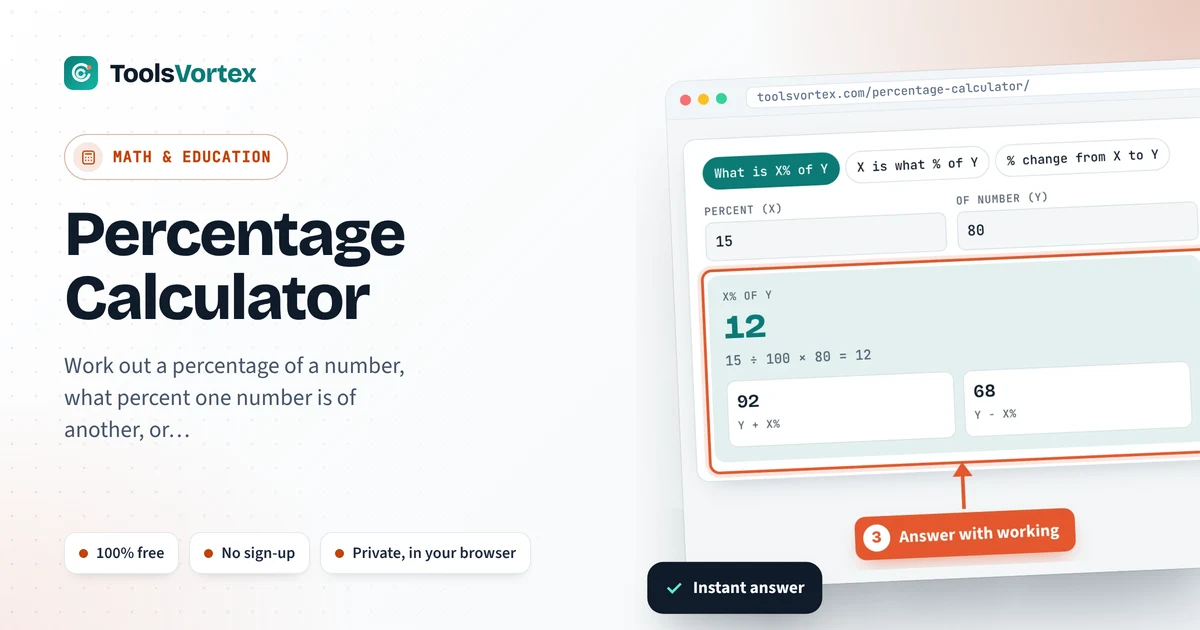
Find X% of a number, what percent one number is of another, or how much something went up or down. Three buttons, and the working shows every time.

I made this percentage calculator after botching a tip on a $64 dinner bill, in front of people, which was not my finest moment. Most percent questions boil down to three. What’s 15% of 80? What percent is 12 out of 80? And how much did the grocery run jump when it went from $80 to $92? They sound alike. They aren’t, and grabbing the wrong formula is how a “20% raise” ends up feeling like a lot less on payday. So: tap the button that matches your question, type two numbers, done. The working prints right under the answer, which is nice for homework or for figuring out what your spreadsheet thinks it’s doing.
How do I calculate a percentage?
Turn the percent into a decimal (divide by 100) and multiply. That’s the usual case, so 15% of 80 is 0.15 × 80 = 12. The percentage calculator also does the flip side, like 12 is what percent of 80 (12 ÷ 80 × 100 = 15%), and percent change, where you divide the difference by where you started. A bill that creeps from $80 to $92? Up 15%.
The three formulas
X as a percent of Y = (X ÷ Y) × 100
Percent change = (new − old) ÷ |old| × 100
Little party trick I lean on at restaurants. X% of Y equals Y% of X. So 8% of 50 sounds annoying, but flip it and it’s half of 8. Four. Phone stays in your pocket.
Common percentages at a glance
| Percent | of $40 | of $75 | of $200 | of $1,500 |
|---|---|---|---|---|
| 5% | $2.00 | $3.75 | $10 | $75 |
| 10% | $4.00 | $7.50 | $20 | $150 |
| 15% | $6.00 | $11.25 | $30 | $225 |
| 20% | $8.00 | $15.00 | $40 | $300 |
| 25% | $10.00 | $18.75 | $50 | $375 |
| 50% | $20.00 | $37.50 | $100 | $750 |
Four mistakes that trip people up
| Situation | Tempting answer | Right answer |
|---|---|---|
| 10% off, then another 20% off | 30% off | 28% off (0.90 × 0.80 = 0.72) |
| Removing 8% sales tax from a $108 total | $108 − 8% = $99.36 | $108 ÷ 1.08 = $100 |
| A price fell 25% (60 to 45). How much to get back? | +25% | +33.3% |
| A rate went from 4% to 5% | “Up 1%” | Up 1 percentage point, which is a 25% rise |
Spot the pattern? Every one of these goes wrong because the “of what” sneaks off and changes halfway through. When I’m stuck I ask myself one dumb question, what’s the 100% here, and nine times out of ten the fog lifts.
How to use the Percentage Calculator
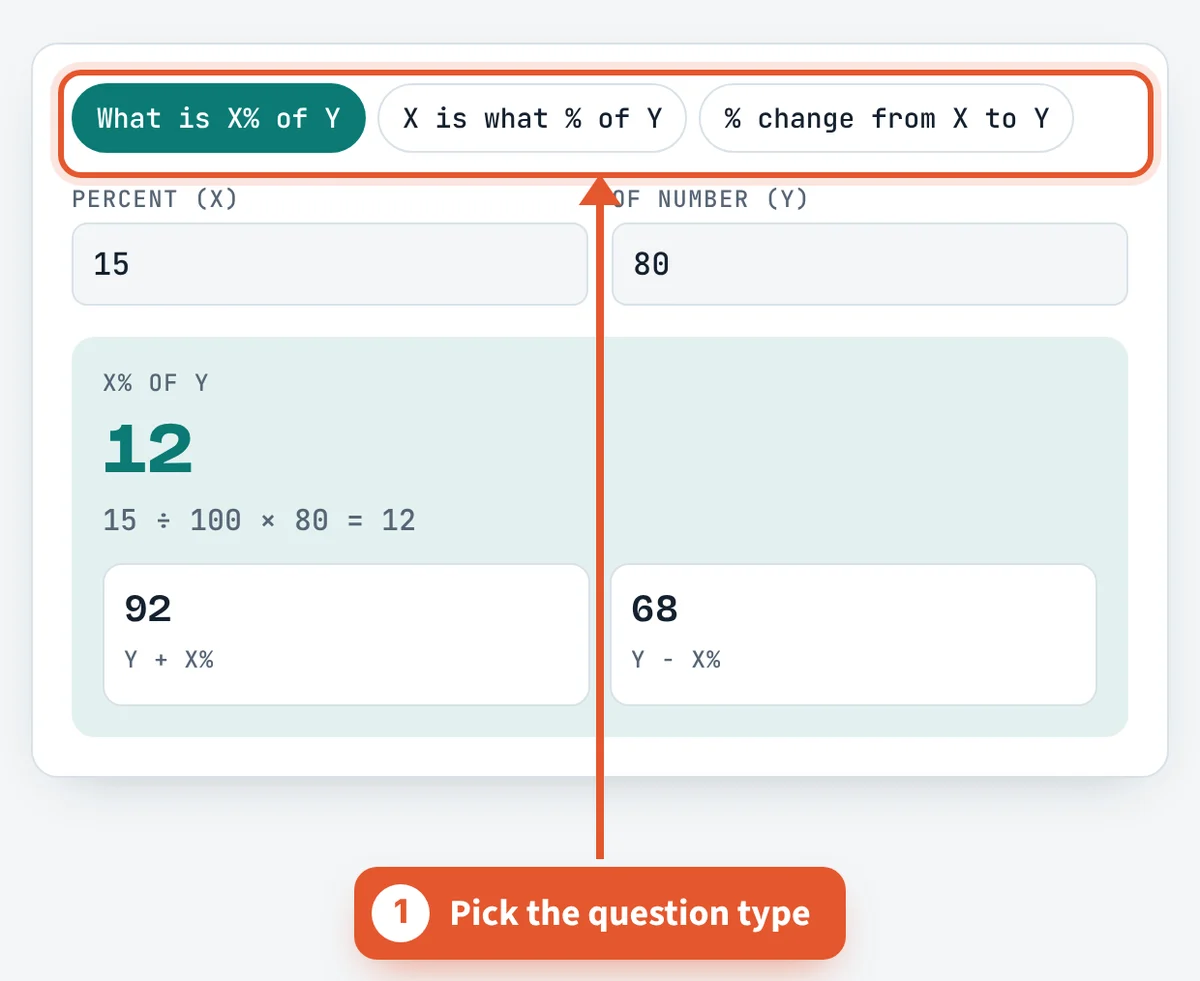
Pick the type of question
Tap whichever button sounds like you: “What is X% of Y”, “X is what % of Y” or “% change from X to Y”. The labels on the boxes swap to match, so you can’t really mix them up.

Enter the two numbers
X goes in one box, Y in the other. Decimals? Fine. Negatives? Also fine. Skip the % sign, it isn’t needed.
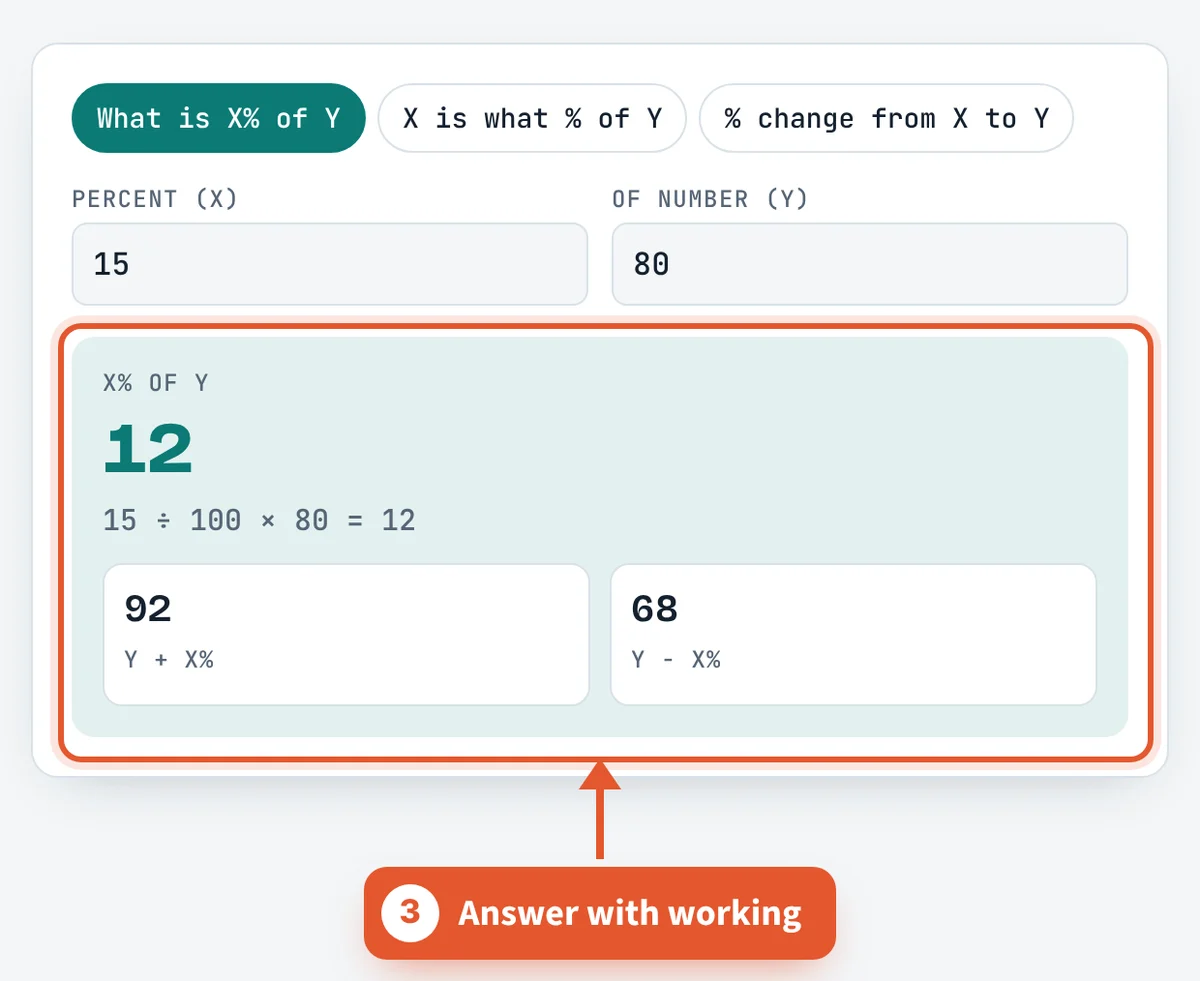
Read the answer and the working
Big number on top, the formula with your numbers in it right below. There are a couple of extras too, like the total once the percent’s added on, which I use for sales tax.

How do I find the original price before tax or a discount?
This is the reverse percentage problem, and the common mistake is to subtract the percentage from the final number. If a price of 118 includes 18% tax, taking 18% off 118 gives 96.76, which is wrong. The tax was 18% of the original price, not of the total.
The fix is to divide by the multiplier:
- After an increase: original = final ÷ (1 + rate). 118 ÷ 1.18 = 100.
- After a decrease: original = final ÷ (1 − rate). A jacket that costs 60 after a 25% discount was 60 ÷ 0.75 = 80.
Real examples: Pakistan’s standard sales tax rate is 18% and the UK’s standard VAT rate is 20%, so a UK price including VAT divided by 1.2 gives the net price. US sales tax is set by states and cities, so the rate depends on where you buy.
For these specific jobs there are dedicated tools: the VAT calculator adds or removes VAT, the sales tax calculator handles US-style tax, and the discount calculator shows the sale price and savings.
What are basis points, per mille and parts per million?
Percent means per hundred, written %. Smaller changes are often expressed in finer units so the numbers stay readable.
| Unit | Symbol | Fraction | As a percent |
|---|---|---|---|
| Percent | % | 1/100 | 1% |
| Per mille | ‰ | 1/1,000 | 0.1% |
| Basis point | bp | 1/10,000 | 0.01% |
| Parts per million | ppm | 1/1,000,000 | 0.0001% |
Basis points are standard in finance. When the Federal Reserve raises its target rate from 4.25% to 4.50%, that is a 25 basis point move, which avoids the confusion between a 0.25 percentage point change and a 0.25% relative change. Per mille shows up in blood alcohol limits in many European countries. Parts per million is used for air and water quality, such as carbon dioxide concentration.
The international standard ISO 80000-1 treats % simply as the number 0.01, so the same arithmetic applies to all of these units.
Frequently asked questions
How do I find 20% of a number?
Times 0.2. On $65 that’s $13. Phone dead? Slide the decimal one spot left to get 10% ($6.50) and double it, which is how I tip when I’ve had a long day.
What percent is 42 out of 50?
42 divided by 50, times 100. 84%. Works for any quiz too, your points over the points possible, then times 100.
How do I calculate percent change?
New minus old, then divide by old, then times 100. Say rent goes from $1,500 to $1,620. That’s $120 more, and 120 ÷ 1,500 is 0.08. So 8%, and yes, your landlord did the math too.
How do I find the original price before tax or a markup?
Divide by 1 plus the rate. $108 with 8% tax baked in? 108 ÷ 1.08 = $100. People love to just knock 8% off the $108 and get $99.36. Close, but wrong.
Is 10% off and then 20% off the same as 30% off?
Nope, and stores are counting on you not noticing. The second cut comes off the already-lower price, so you pay 0.90 × 0.80 = 72% and save 28%. Order doesn’t matter though, 20 then 10 lands in the same spot.
Can a percentage be more than 100?
Sure can. 150 is 150% of 100. And a stock that triples? Up 200%, not 300%, since you measure the rise from where it started. That one trips up a lot of headlines.
Why can't I get a percent change from 0?
Because you’d be dividing by zero, and math just shrugs. Going from 0 subscribers to 40 isn’t some infinite percent jump. Just say you gained 40 and enjoy it.
Sources and further reading
Related tools
Last reviewed: October 2026