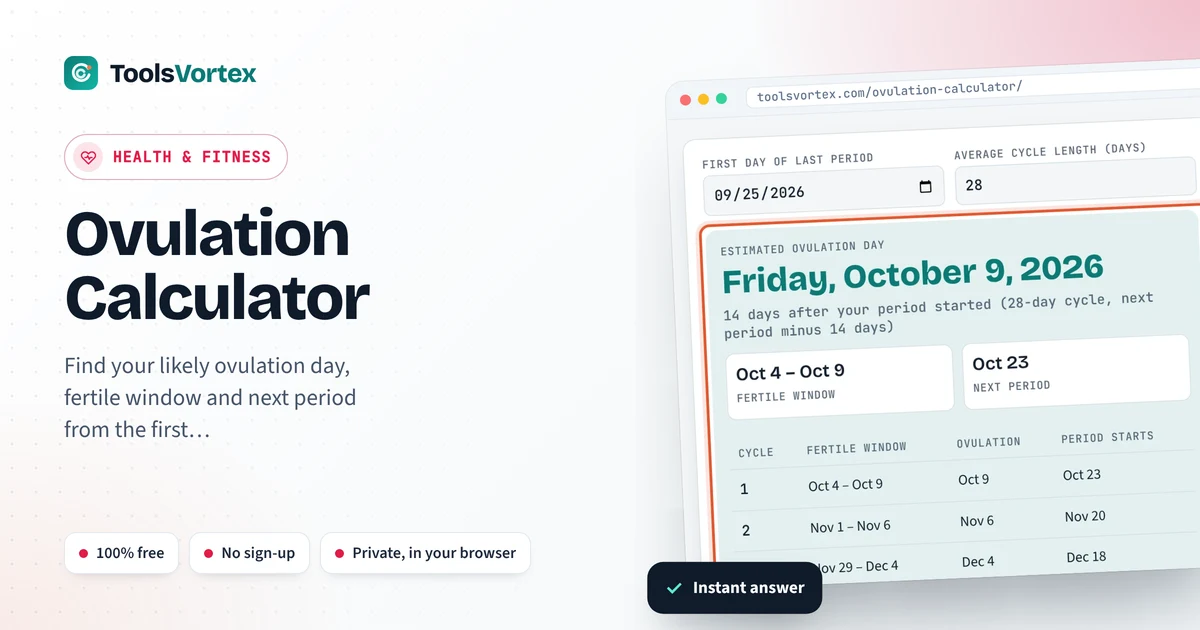
Put in the day your last period started and how long your cycles usually run. You’ll get your likely ovulation day, the fertile window around it and when your next period should show up.
| Cycle | Fertile window | Ovulation | Period starts |
|---|

An ovulation calculator is honestly just a calendar that counts backward for you. That’s all. Trying for a baby? Then it’s a timing game, and a slightly unfair one. The egg lasts about a day. Sperm can hang around for up to five. So your best shot is the few days before ovulation, not after. This one finds your next expected period, steps back 14 days, and marks the six days that count. Then it does it again for the next three cycles. No paper calendar on the fridge, no pen that never works.
How do I calculate when I ovulate?
Take the first day of your last period, add your cycle length, then back up 14 days. That’s roughly ovulation, and an ovulation calculator does nothing fancier. Example. Period started September 20, 2026, cycle runs 28 days. Next period lands October 18. Ovulation? Around October 4. Fertile window, September 29 through October 4.
The counting-back trick
Ovulation ≈ next period − 14 days
Fertile window = 5 days before ovulation through ovulation day
Why backward? Because the back half of the cycle (the luteal phase, if you want the word) runs about 14 days for most people and barely budges. The front half is the wobbly bit. So a 32-day cycle doesn’t mean your period’s late. Usually ovulation just showed up later.
Ovulation day by cycle length
| Cycle length | Ovulation (days after period starts) | Fertile window (days after period starts) |
|---|---|---|
| 24 days | 10 | 5 to 10 |
| 26 days | 12 | 7 to 12 |
| 28 days | 14 | 9 to 14 |
| 30 days | 16 | 11 to 16 |
| 32 days | 18 | 13 to 18 |
| 35 days | 21 | 16 to 21 |
Day one is real flow. Not spotting. And these dates are a first draft, nothing more. Test strips, basal temperature and cervical mucus tell you what your body’s actually up to. Please, please don’t use this as birth control.
My cycle’s all over the place. Now what?
Super common. One neat date stops making sense, though. Here’s my workaround. Dig up your last six cycles, find the shortest and the longest, and run both. Say they bounce between 26 and 32 days. Ovulation could land anywhere from about 12 to 18 days after your period starts, so the possible fertile days stretch from roughly day 7 to day 18. Wide, I know. That’s exactly where test strips earn their money.
And the calendar gets shakier still in a few spots. Right after stopping the pill. Breastfeeding. PCOS. The years creeping up on menopause. In any of those, a doctor beats a formula.
How to use the Ovulation Calculator
First day of your last period
Pick the date it started. Real flow counts, the light spotting before it doesn’t.

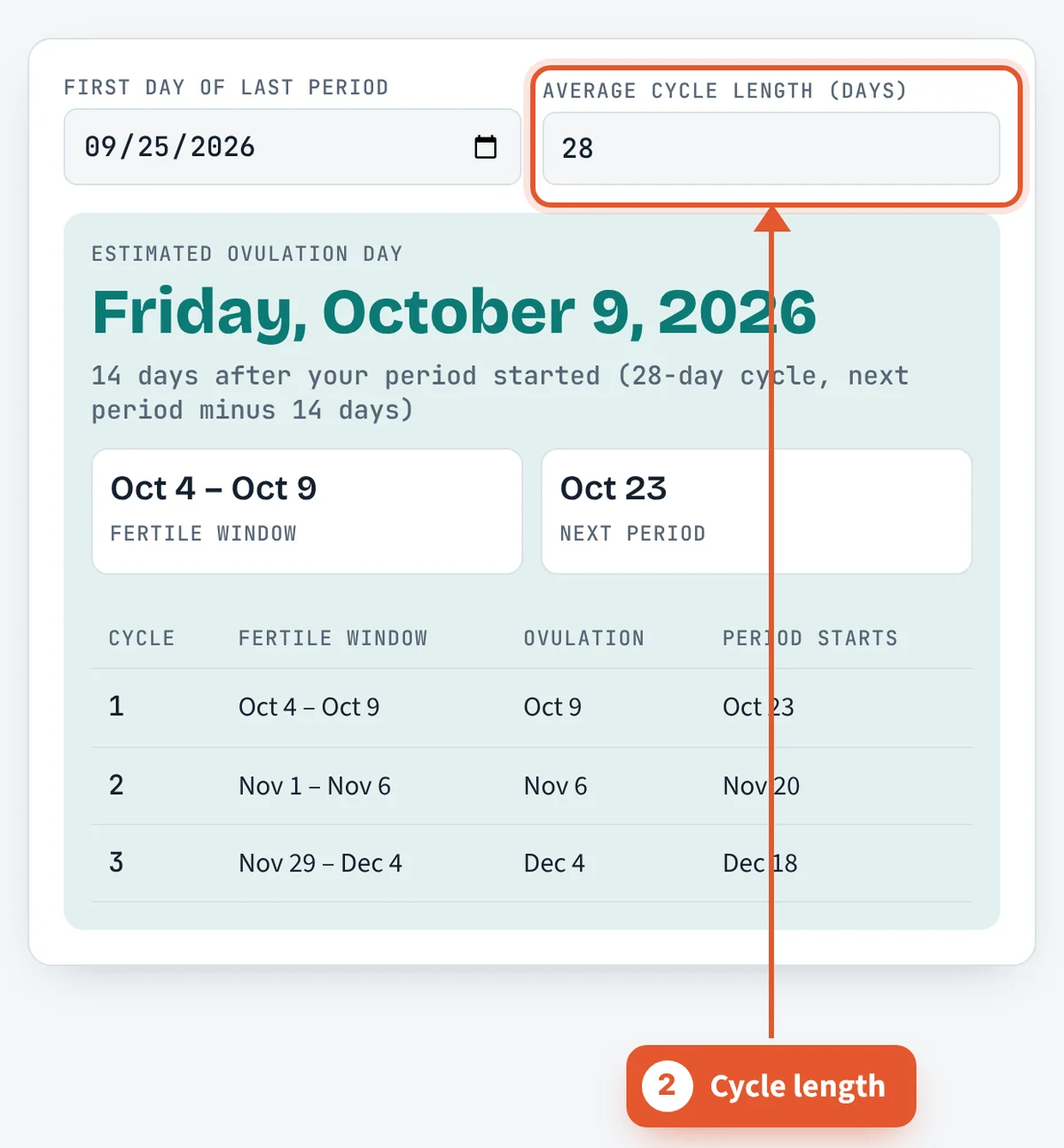
Your usual cycle length
Type how many days it usually runs. Bounces around? Average your last three to six.
Look at your fertile days
Ovulation day, fertile window, next period. Plus a little table for the next three cycles so you can plan ahead.


How can I confirm that I actually ovulated?
A calendar estimate assumes ovulation happens about 14 days before your next period. Your body gives more direct signs you can track alongside it.
- LH surge: luteinizing hormone rises sharply before the ovary releases an egg, and ovulation usually follows within about 24 to 36 hours. Urine ovulation predictor kits detect this surge, so a positive test means your most fertile days are now.
- Basal body temperature: after ovulation, progesterone raises your resting temperature slightly, often by about half a degree Fahrenheit, and it stays up until your period. Take it with a basal thermometer before getting out of bed. The rise confirms ovulation after the fact, so it is best for learning your pattern over several cycles.
- Cervical mucus: rising estrogen makes it clear, slippery and stretchy, like raw egg white, in the days before ovulation.
- Progesterone blood test: a doctor can order one about 7 days after suspected ovulation to confirm it.
The American College of Obstetricians and Gynecologists (ACOG) describes combining these signs as the symptothermal method.
How long is the fertile window each cycle?
The fertile window is about six days long: the five days before ovulation plus ovulation day itself. This comes from a 1995 study by Allen Wilcox and colleagues at the National Institute of Environmental Health Sciences, published in the New England Journal of Medicine, which tracked daily hormone levels and intercourse timing in women trying to conceive.
The window is set by two lifespans:
- Sperm can survive in the female reproductive tract for up to about five days when fertile cervical mucus is present.
- The egg survives only about 12 to 24 hours after release.
Because of that, the chance of conception is highest from intercourse in the two days before ovulation and on the day itself, and drops sharply after. Waiting for a positive ovulation test before trying can miss part of the window, so many couples aim for every one or two days through the fertile days.
If you conceive, the due date calculator estimates your delivery date, and the pregnancy week calculator tells you how far along you are.
Frequently asked questions
How accurate is an ovulation calculator?
Decent, if your cycles are regular. But stress, a cold, a red-eye flight or a lousy week of sleep can shove ovulation a few days either way. Test strips give you a firmer answer.
What are my most fertile days?
The two or three days before ovulation, plus the day itself. Sex then gives you the best odds. Yes, it’s a little unromantic to schedule.
Does this work with irregular periods?
Sort of. Hold the dates loosely and try the shortest-and-longest trick up above. If your cycles swing by more than a week, mention it to your doctor.
Can I get pregnant outside the fertile window?
Less likely, not impossible. Ovulation doesn’t always keep its appointment, and a late one turns a ‘safe’ day into a fertile day.
When should I take a pregnancy test?
On the day your period’s due, if you can stand the wait. That’s about 14 days after ovulation, so October 18 in my example. Earlier and you might see a negative even though you’re pregnant.
Can I use this to avoid pregnancy?
No. Calendar guesses miss too often to be birth control.
Do you save my cycle dates?
Nope. Everything’s worked out inside your browser. Nothing stored, nothing sent.
Sources and further reading
Related tools
Last reviewed: October 2026