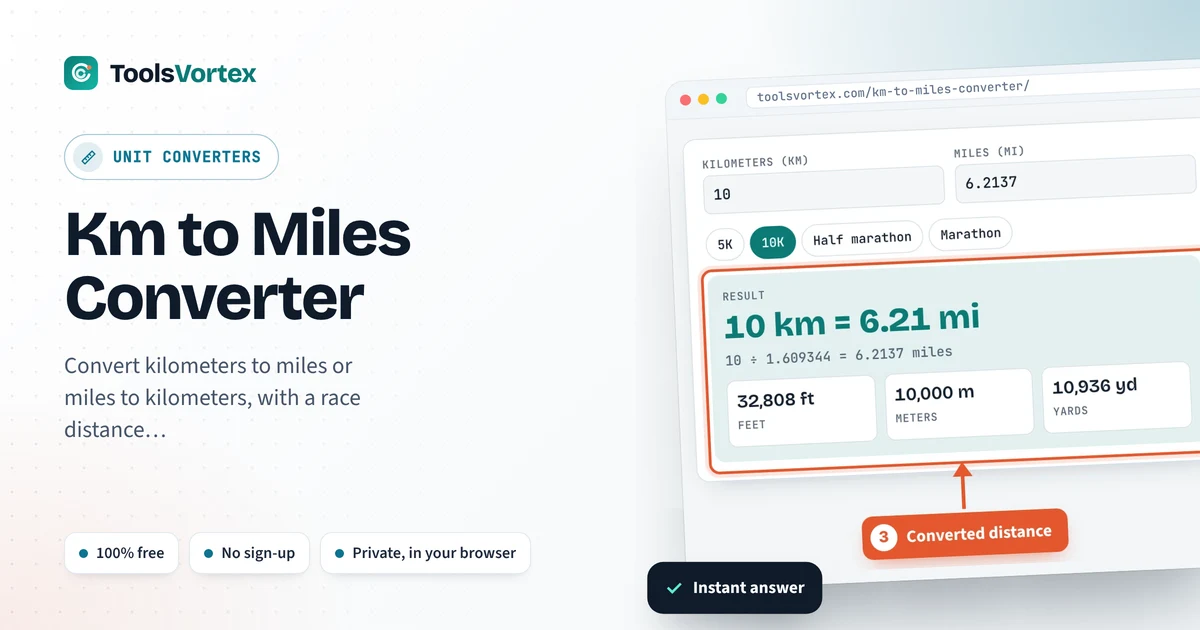
Convert kilometers to miles or miles to kilometers, with a race distance chart for the 5K, 10K, half marathon and marathon.

Race bibs say 5K and 10K, car dashboards in Canada and Mexico show km/h, and fitness apps flip between units depending on your settings. Type a distance in either box to convert kilometers to miles or miles to kilometers. The race chips fill in the official 5K, 10K, half marathon and marathon distances, so you don’t have to remember that a marathon is 42.195 km.
How do I convert km to miles?
Divide kilometers by 1.609344, or multiply by 0.621371. Going the other way, multiply miles by 1.609344, the exact length of a mile in km. For example, a 10K race is 10 × 0.621371 = 6.21 miles. A handy shortcut: multiply km by 0.6, or use Fibonacci pairs like 5 mi ≈ 8 km and 8 mi ≈ 13 km.
Km to miles formula
km = miles × 1.609344
The international mile is exactly 1,609.344 meters, or 5,280 feet of 0.3048 m each. So the km to mile factor is exact, and only the reverse (0.621371) gets rounded.
Race distances in miles
| Race | Kilometers | Miles |
|---|---|---|
| 1 mile | 1.6093 km | 1 mi |
| 5K | 5 km | 3.11 mi |
| 10K | 10 km | 6.21 mi |
| 15K | 15 km | 9.32 mi |
| Half marathon | 21.0975 km | 13.11 mi |
| Marathon | 42.195 km | 26.22 mi |
| 50K ultra | 50 km | 31.07 mi |
| 100K ultra | 100 km | 62.14 mi |
Notice that a “half marathon” is often called 13.1 miles and a marathon 26.2 miles. Both are rounded. The official marathon distance has been 42.195 km since 1921, which is 26.22 miles.
Speed: km/h to mph
| km/h | mph |
|---|---|
| 30 km/h | 18.6 mph |
| 50 km/h | 31.1 mph |
| 80 km/h | 49.7 mph |
| 100 km/h | 62.1 mph |
| 110 km/h | 68.4 mph |
| 120 km/h | 74.6 mph |
Same factor works for speed. If you’re driving a rental in Canada and the sign says 100, that’s about 62 mph.
How to use the Km to Miles Converter
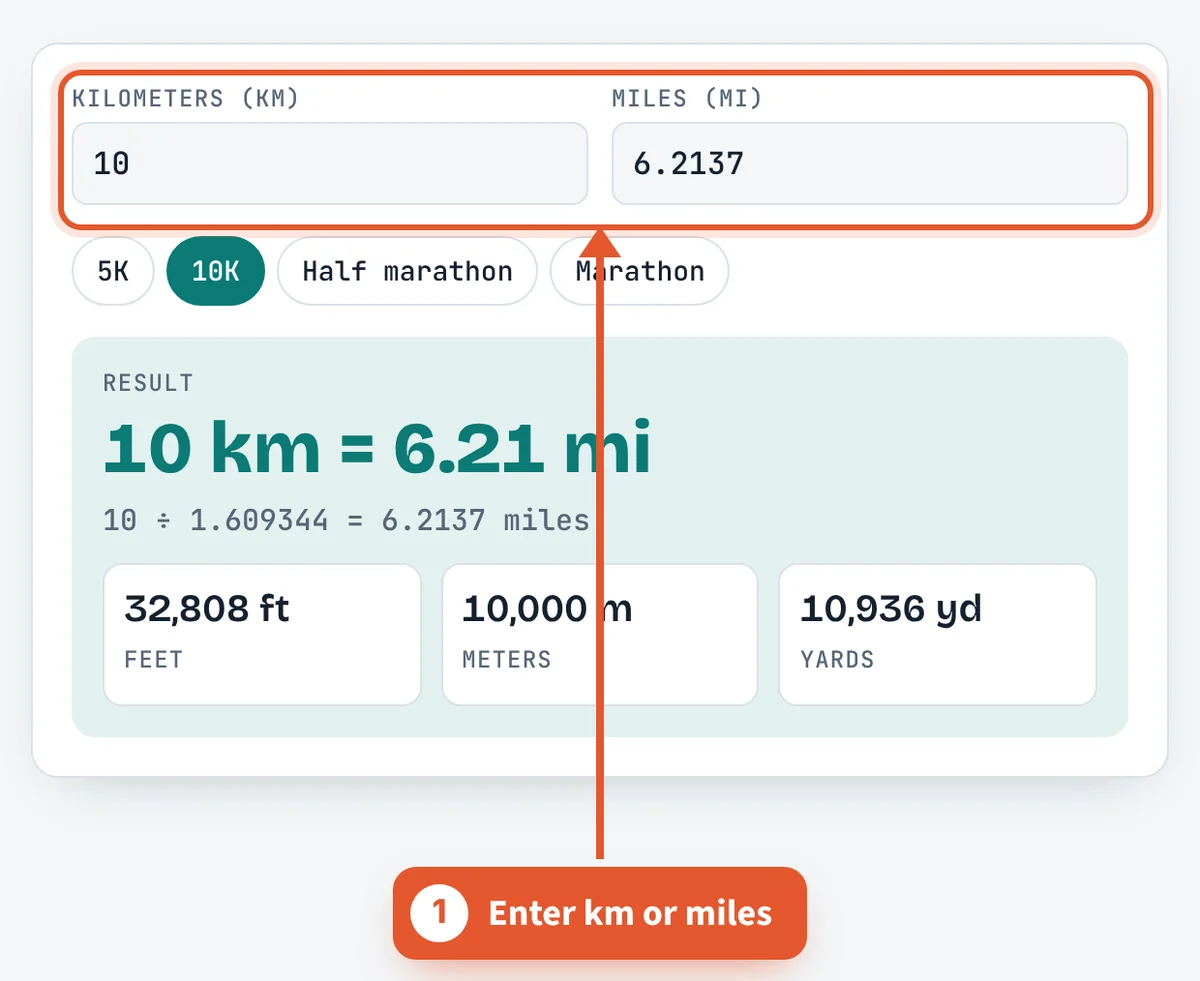
Type kilometers or miles
Enter a distance in either box. The other box fills in automatically.

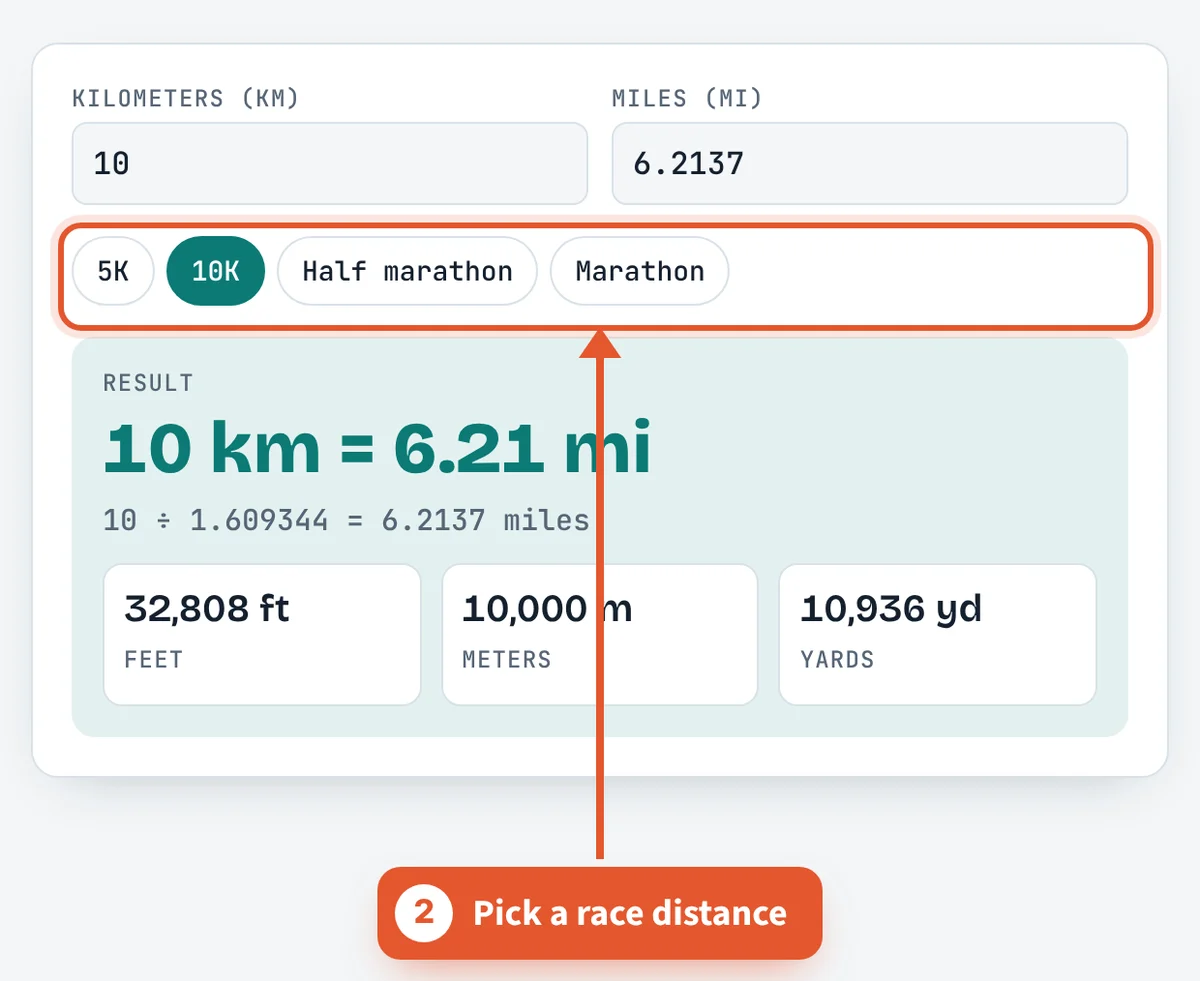
Or tap a race distance
Use the 5K, 10K, half marathon or marathon chips to load the official distance.
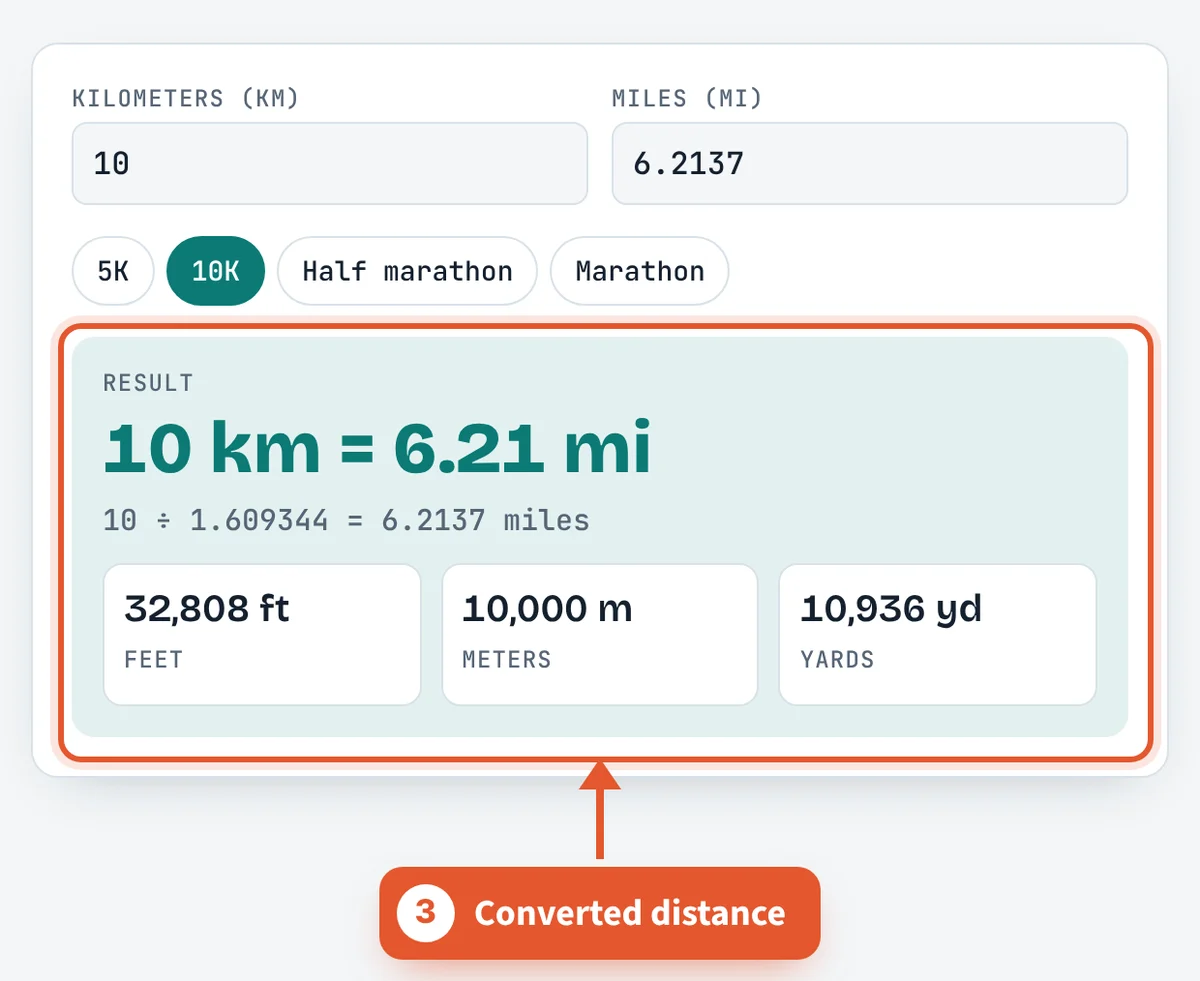
Read the result
See the converted distance, plus the same length in feet, meters and yards.
Why is a mile exactly 1.609344 kilometers?
The statute mile of 5,280 feet was set by an English Act of Parliament in 1593, during the reign of Elizabeth I. It equals 8 furlongs of 660 feet each, a compromise between the older Roman mile and English farming measures.
For centuries the foot itself had slightly different lengths in different countries. The International Yard and Pound Agreement of 1959 fixed the yard at exactly 0.9144 meter for the United States, the United Kingdom and other Commonwealth nations. Since a mile is 1,760 yards, it became 1,760 × 0.9144 = 1,609.344 meters exactly.
The US kept an older version for land surveying, based on the US survey foot of 1200/3937 meter. A survey mile came out about 3.2 millimeters longer. The National Institute of Standards and Technology retired the survey foot after December 31, 2022, so the international mile is now the only US statute mile.
Shorter lengths use the same 1959 definition, which you can apply with the feet to meters converter.
How is a nautical mile different from a regular mile?
A nautical mile is exactly 1,852 meters, or about 1.1508 statute miles. The value was adopted internationally by the International Hydrographic Conference in Monaco in 1929. It was chosen because one minute of latitude along a meridian is close to 1,852 meters, which makes chart navigation simple: 60 nautical miles equal about one degree of latitude.
Ships and aircraft use nautical miles, and their speed is given in knots, where one knot is one nautical mile per hour. Road signs, running races and car odometers use statute miles or kilometers instead.
Quick comparisons for 100 units:
| Distance | Kilometers | Statute miles |
|---|---|---|
| 100 km | 100 | 62.14 |
| 100 statute miles | 160.93 | 100 |
| 100 nautical miles | 185.2 | 115.08 |
If a speed is listed in km/h rather than knots, use the mph to km/h converter.
Is there an easy way to convert km to miles in your head?
Yes. Neighboring numbers in the Fibonacci sequence (1, 2, 3, 5, 8, 13, 21, 34, 55) work as a ready-made conversion table. Read a number as kilometers and the number before it is roughly the same distance in miles.
- 5 km ≈ 3 miles (actual 3.11)
- 8 km ≈ 5 miles (actual 4.97)
- 13 km ≈ 8 miles (actual 8.08)
- 21 km ≈ 13 miles (actual 13.05)
It works because the ratio between consecutive Fibonacci numbers approaches the golden ratio, about 1.618, which is within 0.6% of the 1.609 kilometers in a mile.
For numbers that are not in the sequence, split them into Fibonacci parts. For 30 km, use 21 + 8 + 1 km, which gives 13 + 5 + 0.6 = 18.6 miles; the exact answer is 18.64. Another quick method is to multiply by 6 and move the decimal one place left, then add a little: 30 × 0.6 = 18, plus about 3%.
Runners converting race splits can go one step further with the pace calculator.
Frequently asked questions
How many miles is 5 km?
5 km is about 3.11 miles, which is why a 5K is often called a 3.1-mile race.
How many km is a mile?
Exactly 1.609344 km.
How many miles is a marathon?
A marathon is 42.195 km, or about 26.22 miles.
Is a kilometer longer than a mile?
No. A mile is about 1.6 times longer than a kilometer.
What is 100 km/h in mph?
About 62.1 mph. Divide by 1.609344, or multiply by 0.6214.
Sources and further reading
Related tools
Last reviewed: October 2026