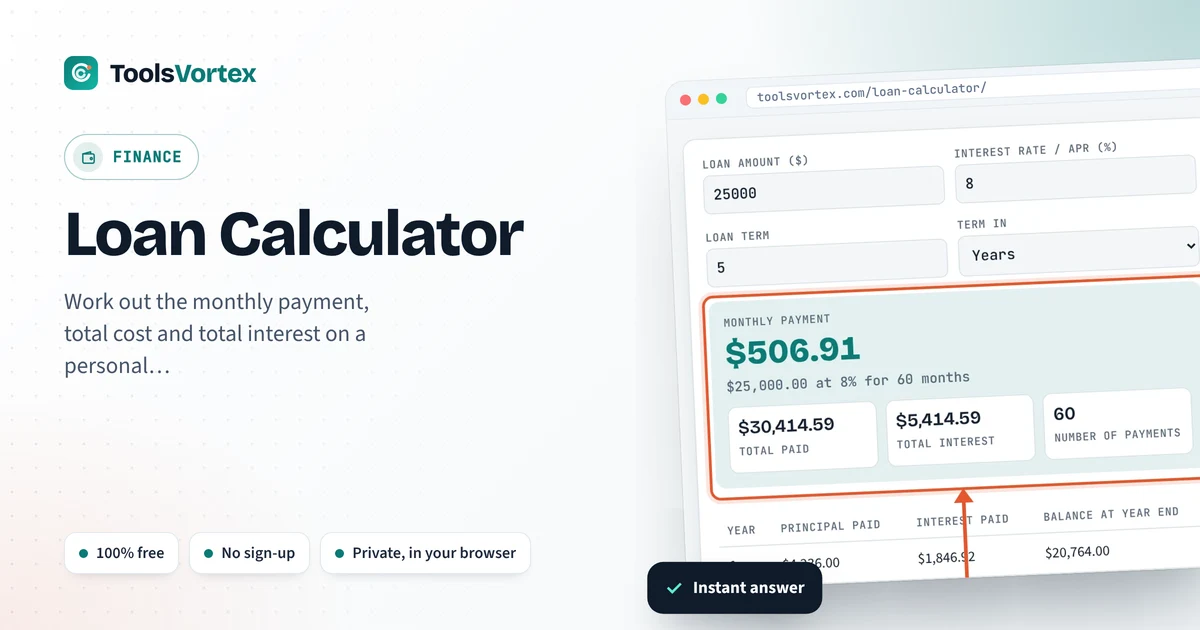
See the monthly payment, the total you’ll pay back and how much of it is interest on a car loan, personal loan or any fixed-rate loan. A yearly payoff table comes with it.
| Year | Principal paid | Interest paid | Balance at year end |
|---|

Here’s what a loan calculator is for: the dealer or the bank tells you the monthly payment, because that’s the number that sounds fine, and you want the number they didn’t mention. How much you’ll hand back in total. Put both side by side and a lot of “great deals” look different. This one shows the payment, the total, the interest, and a year-by-year table so you can watch the balance shrink (slowly at first, annoyingly). Use it for a car, a personal loan, a student loan, a used boat. Anything with a fixed rate and the same payment every month.
How do you calculate a loan payment?
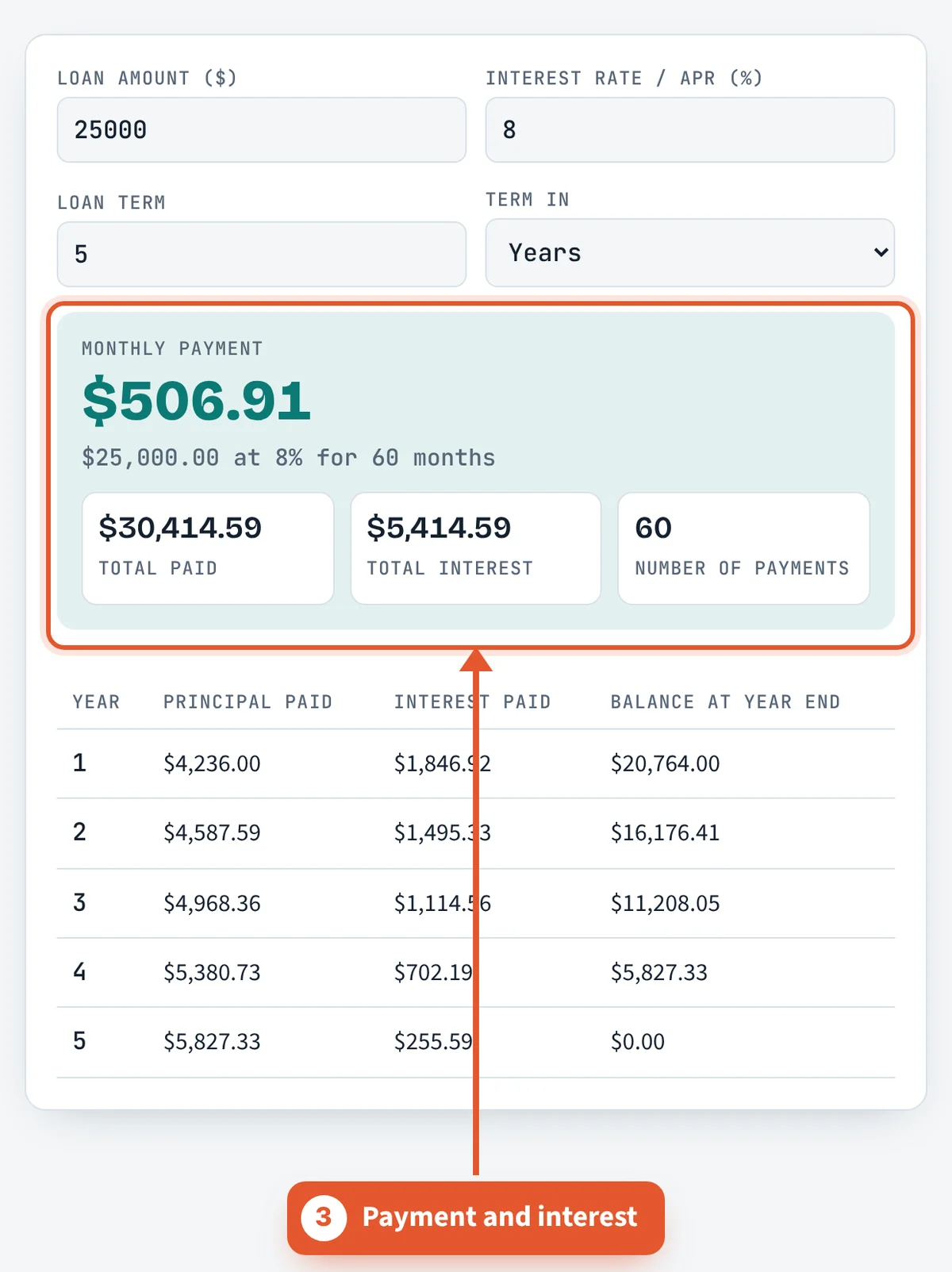
A loan calculator plugs your numbers into the amortization formula: payment = P × i ÷ (1 − (1 + i)−n), where P is the amount borrowed, i is the yearly rate divided by 12 and n is the number of months. Borrow $25,000 at 8% for 5 years, that’s 60 payments, and you’ll pay $506.91 a month. Over the whole term that adds up to $30,414.59. So the loan itself costs you $5,414.59.
Loan payment formula
Total interest = Payment × n − P
Why are the first payments mostly interest? Because interest is charged on what you still owe, and early on you owe almost all of it. The split tips toward principal month by month. You can watch it happen in the yearly table up in the tool.
Same $25,000 at 8%, different terms
| Term | Monthly payment | Total interest |
|---|---|---|
| 24 months | $1,130.68 | $2,136.37 |
| 36 months | $783.41 | $3,202.73 |
| 48 months | $610.32 | $4,295.51 |
| 60 months | $506.91 | $5,414.59 |
| 72 months | $438.33 | $6,559.83 |
Go from 3 years to 6 and the payment falls by about $345. The interest roughly doubles. Car dealers love the long term for exactly that reason, and now you know why.
The origination fee trick
Lots of personal loans take a fee off the top, and most calculators just ignore it. Say you’re approved for $25,000 at 8% for 5 years with a 5% origination fee. The lender keeps $1,250, you get $23,750, and you still pay $506.91 a month on the full $25,000. Measured against the cash you actually received, that’s closer to a 10.2% rate. If you need the full $25,000 in hand, you’ll have to borrow more. Always compare offers by APR, which is supposed to include that fee.
How to use the Loan Calculator
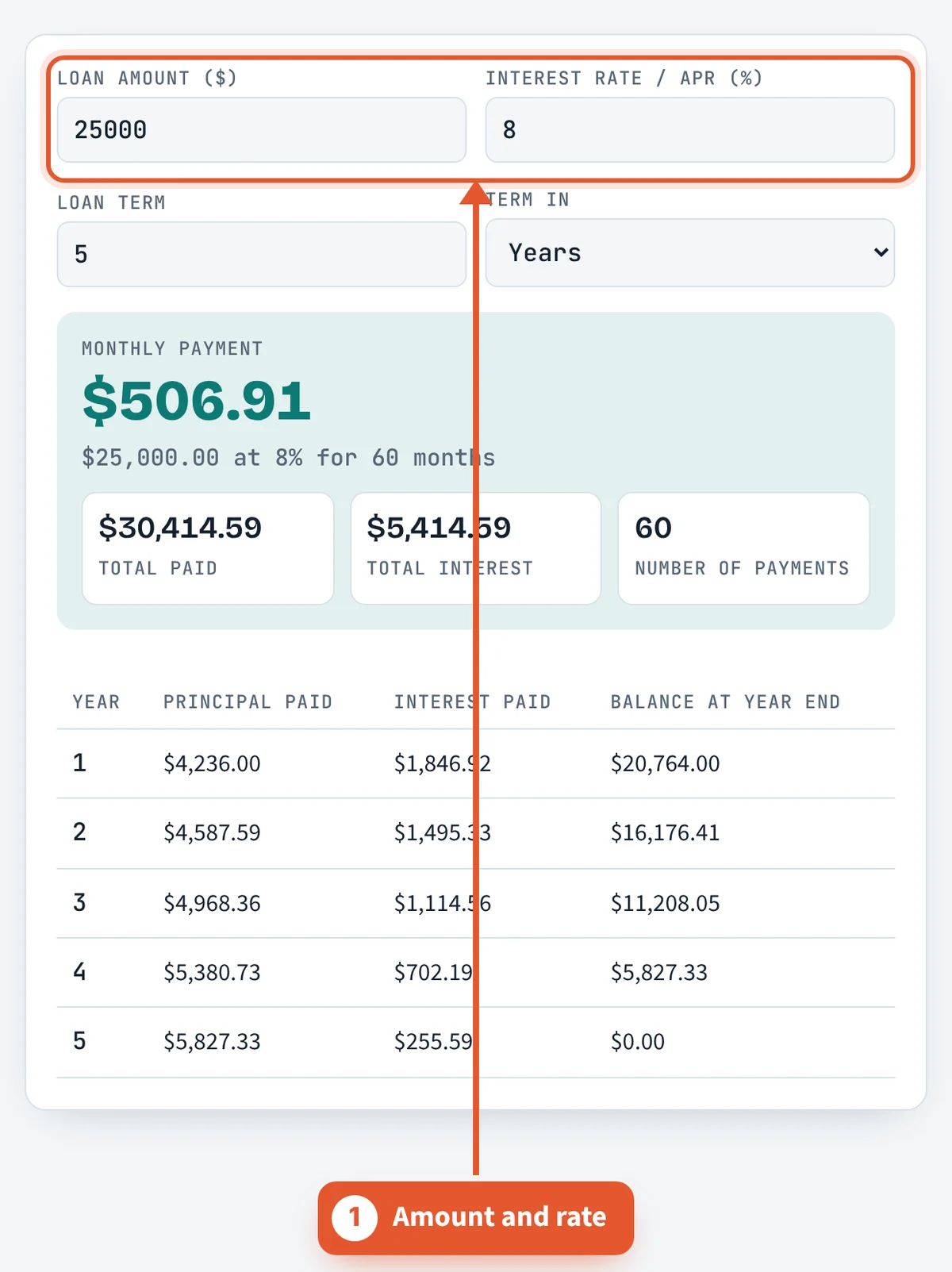
Enter the loan amount and rate
Type what you plan to borrow and the yearly rate on your offer. If you have the APR, use it, it’s the more honest number.

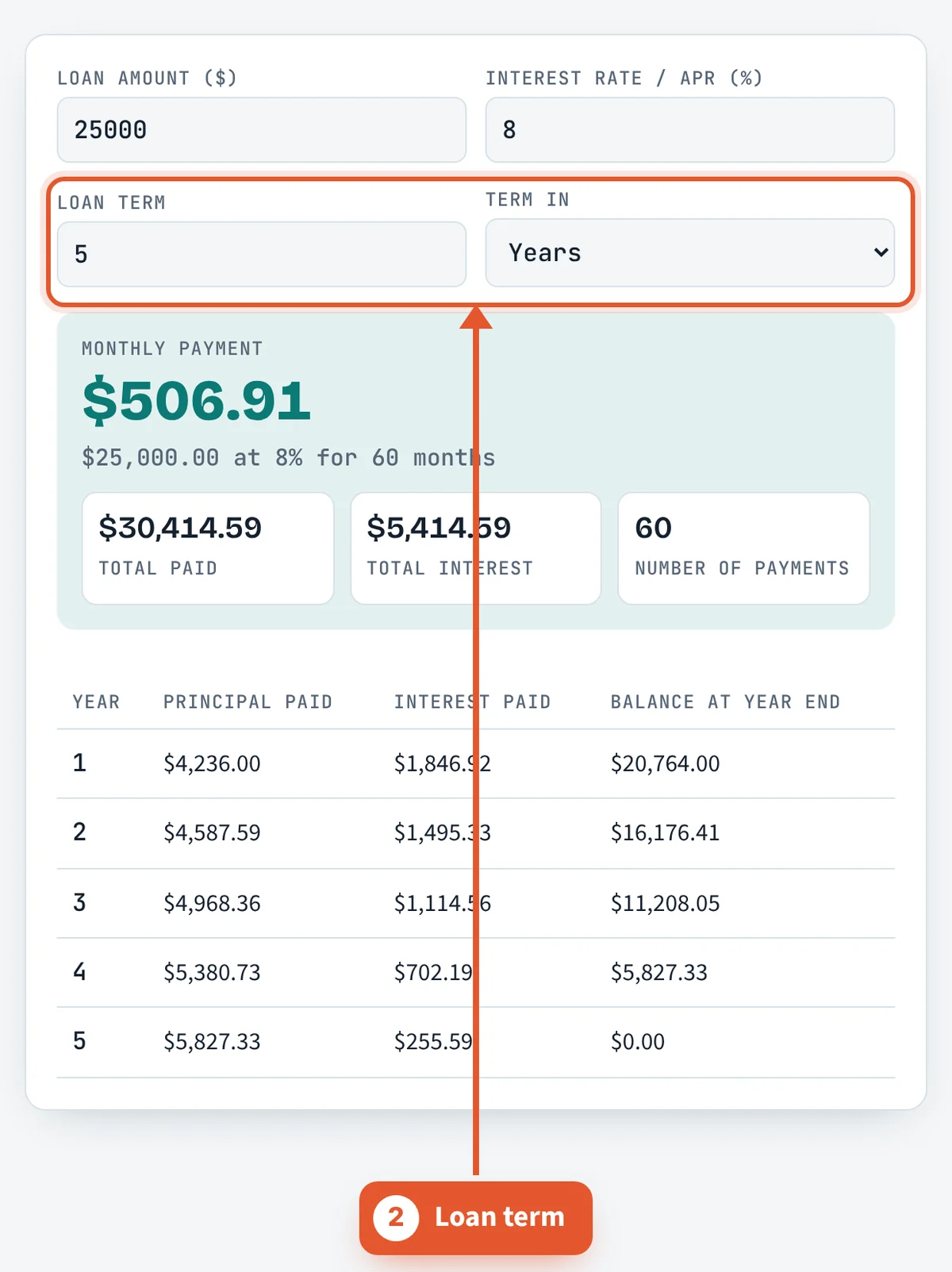
Set the loan term
Enter the length, then choose years or months. 5 years and 60 months give the same answer.
Check the payment and payoff
Read the monthly payment first, then look right at the total interest. The yearly table shows what’s left after each 12 payments.
How does an amortization schedule split each payment?
An amortization schedule is the month-by-month table showing how each fixed payment divides between interest and principal. Interest is always charged on the balance still owed, so the split changes every month even though the payment stays the same.
Take a $10,000 loan at 6% APR for 36 months. The payment is $304.22. In month one, interest is $10,000 × 0.005 = $50.00, so only $254.22 reduces the balance. By month 18 interest has fallen to $27.51 and $276.71 goes to principal. The final payment is almost all principal, with about $1.51 of interest. Total interest over the loan is about $952.
| Month | Interest | Principal | Balance after |
|---|---|---|---|
| 1 | $50.00 | $254.22 | $9,745.78 |
| 12 | $35.66 | $268.56 | $6,864.06 |
| 18 | $27.51 | $276.71 | $5,224.29 |
| 36 | $1.51 | $302.71 | $0.00 |
This front-loading is why refinancing or selling early saves less interest than people expect. The same math drives a car loan payment and a 30-year mortgage.
Does paying extra on a loan actually save money?
On a standard simple interest loan, yes. Any extra amount goes straight to principal, so every later month is charged interest on a smaller balance. Adding $50 a month to the $10,000, 6%, 36-month loan above pays it off in 31 months and cuts total interest from about $952 to about $807.
Two things can reduce that benefit. The first is a prepayment penalty, a fee for paying off early. Under the Truth in Lending Act and its rules in Regulation Z, lenders must tell you in the loan disclosure whether a penalty applies, so check that box before signing. The Consumer Financial Protection Bureau enforces these disclosure rules.
The second is a precomputed loan that uses the Rule of 78s, which assigns more of the total interest to early months than true amortization does. Paying off such a loan early refunds less interest. Federal law bans this method for consumer loans longer than 61 months, but it can still appear on shorter loans.
If you also carry card debt, compare rates first: extra money usually does more against a higher-rate balance, which you can test with the credit card payoff calculator.
Frequently asked questions
Is APR the same as the interest rate?
Not quite. APR adds certain fees to the rate, so it’s the better yardstick for comparing offers. No fees? Then they match. Typing the APR here gives a slightly higher, more cautious payment, which isn’t a bad thing.
Does this work for car loans?
Sure. Take the price, subtract your down payment and trade-in, and type what’s left. If the dealer is rolling sales tax and fees into the loan, add those back in first.
Why does so much of my payment go to interest at first?
Interest is figured on the balance you still owe, and that balance is biggest on day one. Each month a little more of the same payment chips away at principal.
Can I pay a loan off early?
Most personal and auto loans let you, but a few charge a prepayment penalty. Read the agreement, or just call and ask, before you send extra money.
What does an extra $50 a month do?
On the $25,000, 8%, 60-month loan, paying $556.91 instead of $506.91 clears it in 54 months instead of 60 and saves about $607 of interest. Not life-changing, but it’s six fewer payments.
How does an origination fee change my real rate?
The fee comes out of the money you receive, but you repay the full amount. A 5% fee on a $25,000, 8%, 5-year loan leaves you $23,750, and the payments work out to roughly a 10.2% rate on that cash.
What about interest-only or balloon loans?
This calculator assumes equal payments that pay the loan off completely. Interest-only and balloon loans run on a different schedule, so the numbers here won’t match them.
Sources and further reading
Related tools
Last reviewed: October 2026