
To find how much concrete you need, multiply length by width by thickness in feet, then divide by 27 to get cubic yards. A 10 by 10 foot slab 4 inches thick needs 1.23 cubic yards, or about 56 bags of 80 lb mix. Add 5 to 10% extra for spills and uneven ground.

You have the forms half built, the weekend is booked, and now you need to call the supplier or load the truck. Before you do, answer one question: how much concrete do I need? Order too little and you get a cold joint in the middle of your patio. Order too much and you pay for concrete you have to dump.
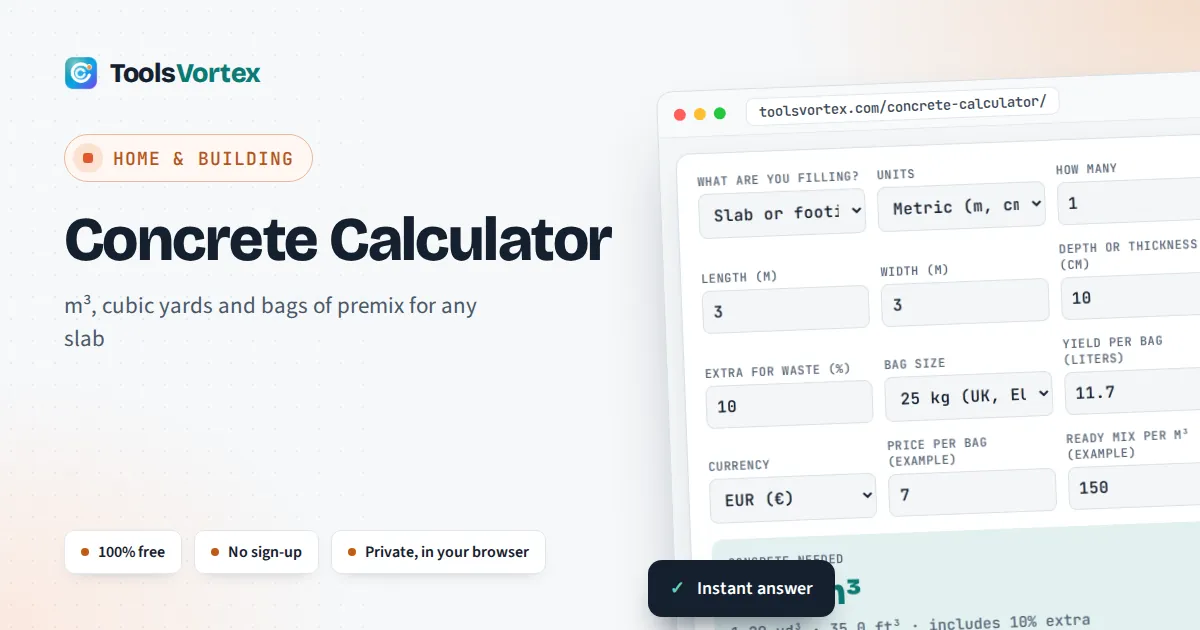
This guide gives you the formula, charts for common slabs and post holes, bag counts for 40, 60 and 80 lb mixes, and the extra you should add. Skip the math by entering your sizes in the concrete calculator.
How Much Concrete Do You Need for a Slab?
Multiply the slab’s length and width in feet by its thickness in feet, then divide by 27 to get cubic yards. A 4 inch thick slab needs about 1 cubic yard for every 81 square feet.
The 27 comes from the size of a cubic yard: 3 feet x 3 feet x 3 feet, which is 27 cubic feet according to NIST Handbook 44. Most patios, walks and shed floors are 4 inches thick. The chart below uses that thickness.
Concrete needed for common 4 inch slabs
| Slab size (ft) | Cubic feet | Cubic yards | Cubic yards + 10% | 80 lb bags + 10% | 60 lb bags + 10% |
|---|---|---|---|---|---|
| 4 x 4 (landing) | 5.3 | 0.20 | 0.22 | 10 | 14 |
| 10 x 10 | 33.3 | 1.23 | 1.36 | 62 | 82 |
| 10 x 12 | 40.0 | 1.48 | 1.63 | 74 | 98 |
| 12 x 12 | 48.0 | 1.78 | 1.96 | 89 | 118 |
| 12 x 16 | 64.0 | 2.37 | 2.61 | 118 | 157 |
| 20 x 20 | 133.3 | 4.94 | 5.43 | 245 | 326 |
| 24 x 24 | 192.0 | 7.11 | 7.82 | 353 | 470 |
Bags are rounded up. Yields used: 0.60 cubic feet per 80 lb bag and 0.45 per 60 lb bag, from the manufacturer data sheet for a common premixed concrete.
Notice how fast bag counts climb. A 10 by 10 slab is a hard day with bags. A 20 by 20 garage pad is a ready-mix truck job.
How Do You Calculate Concrete in Cubic Yards?
Convert every measurement to feet, multiply them together for cubic feet, and divide by 27 for cubic yards. Thickness is the step people get wrong, because it is measured in inches.
Cubic yards = cubic feet / 27
Order amount = cubic yards x 1.05 to 1.10
Round column = 3.1416 x radius (ft) x radius (ft) x depth (ft)
Kim is pouring a 12 by 16 foot patio, 4 inches thick, on gravel. How much concrete should she order?
- Thickness in feet: 4 / 12 = 0.333 ft.
- Cubic feet: 12 x 16 x 0.333 = 64 cubic feet.
- Cubic yards: 64 / 27 = 2.37 cubic yards.
- Add 10% for waste and low spots: 2.37 x 1.10 = 2.61 cubic yards, or 70.4 cubic feet.
- In 80 lb bags: 70.4 / 0.60 = 117.3, so 118 bags.
Kim needs about 2.6 cubic yards. At 118 bags, which is more than 4.7 tons of dry mix, a ready-mix delivery makes far more sense than bags.
If your patio is an L shape or has a curve, split it into rectangles and circles first. Our guide on how to calculate square footage shows how to handle odd shapes. Then multiply the total area by thickness.
Measure the inside of your forms, not the outside, and take the thickness at a few spots across the base. If the depth varies, average your readings. Writing each number down before you calculate saves a second trip to the store.
How Thick Should a Concrete Slab Be?
Most patios, sidewalks and shed slabs are 4 inches thick, and driveways or slabs that carry heavier loads are often 5 to 6 inches. Under the International Residential Code, a concrete slab-on-ground floor in a house must be at least 3 1/2 inches thick (Section R506.1).
Thickness changes your order more than people expect. Going from 4 to 6 inches adds 50% more concrete.
Concrete for a 10 x 10 slab by thickness
| Thickness | Cubic feet | Cubic yards | Cubic yards + 10% | 80 lb bags, no extra |
|---|---|---|---|---|
| 3 1/2 in | 29.2 | 1.08 | 1.19 | 49 |
| 4 in | 33.3 | 1.23 | 1.36 | 56 |
| 5 in | 41.7 | 1.54 | 1.70 | 70 |
| 6 in | 50.0 | 1.85 | 2.04 | 84 |
Code rules vary by city and county. Check with your local building department before pouring a slab for living space, a garage or a driveway.
The same code section calls for a 4 inch base course of clean sand, gravel or crushed stone under slabs below grade in many soils. If you need to order base rock too, the gravel calculator handles it the same way.
How Many Bags of Concrete Make a Cubic Yard?
It takes 45 bags of 80 lb concrete mix, 60 bags of 60 lb mix or 90 bags of 40 lb mix to make one cubic yard. Divide 27 cubic feet by the yield printed on the bag.
| Bag size | Yield per bag | Bags per cubic foot | Bags per cubic yard |
|---|---|---|---|
| 40 lb | 0.30 cu ft | 3.3 | 90 |
| 60 lb | 0.45 cu ft | 2.2 | 60 |
| 80 lb | 0.60 cu ft | 1.7 | 45 |
Yields from the QUIKRETE Concrete Mix No. 1101 data sheet. Other brands and fast setting mixes can yield less, so always read the bag.
So when do bags stop making sense? There is no fixed rule, but think about labor. Every 80 lb bag must be lifted, opened, mixed with about 6 to 9 pints of water and placed before the batch starts to set. For anything over about 1 cubic yard, many people price out a ready-mix truck or a rented mixer. When you call a supplier, ask about the minimum order and any short load fee, since those change the math.
To convert other volumes, such as cubic feet from a form or cubic meters from plans, use the cubic yard calculator.
How Much Concrete Do You Need for a Fence Post?
A 4×4 post set in a 10 inch wide, 3 foot deep hole needs about 1.4 cubic feet of concrete, or 3 bags of 80 lb mix. Find the hole volume with the cylinder formula, then subtract the space the post takes up.
Concrete per post hole (4×4 post)
| Hole diameter | Hole depth | Hole volume (cu ft) | Concrete after post (cu ft) | 80 lb bags |
|---|---|---|---|---|
| 8 in | 24 in | 0.70 | 0.53 | 1 |
| 10 in | 36 in | 1.64 | 1.38 | 3 |
| 12 in | 36 in | 2.36 | 2.10 | 4 |
| 12 in | 48 in | 3.14 | 2.80 | 5 |
A 4×4 post measures 3 1/2 x 3 1/2 inches. Bags rounded up from a 0.60 cubic foot yield. Leave a few inches at the bottom for gravel if you plan drainage, which lowers the concrete slightly.
For round piers, deck footings or tube forms, measure the diameter, halve it for the radius and use the circle calculator to get the area. Multiply by depth in feet for cubic feet. Your local frost depth decides how deep footings must go, so check it before you dig.
How Much Extra Concrete Should You Order?
Order 5 to 10% more than your calculated volume. Use the low end for a small slab with straight forms on a flat, compacted base, and the high end for large pours, uneven ground or hand-dug footings.
Real slabs are rarely the exact thickness on paper. If your base dips just half an inch across a 12 by 16 patio, that hidden low spot uses 8 more cubic feet of concrete, about 13 more bags. Spills, concrete left in the mixer and forms that bow outward add more.
A few edge cases most guides skip:
- Thickened edges: many slabs have a deeper edge along the outside. Figure the edge as its own long box and add it.
- Steps: calculate each step as a separate block, from the bottom up, then add them.
- Running short: stopping halfway and waiting for more concrete can leave a weak seam. That is the best reason to round up.
- Leftovers: plan a small form for a splash block or stepping stone so extra concrete has somewhere to go.
Run your final numbers through the concrete calculator one last time before you place the order, and you will know both the cubic yards and the bag count.
Quick Recap
- Concrete in cubic yards = length x width x thickness in feet, divided by 27.
- At 4 inches thick, one cubic yard covers about 81 square feet.
- One cubic yard takes 45 bags of 80 lb mix or 60 bags of 60 lb mix.
- Add 5 to 10% extra so you never run short mid pour.
- For post holes, subtract the post’s volume from the hole’s volume.
Frequently Asked Questions
How many bags of concrete do I need for a 10×10 slab?
A 10 by 10 foot slab 4 inches thick holds 33.3 cubic feet. That is 56 bags of 80 lb concrete or 75 bags of 60 lb concrete with no extra. With 10% added for waste, buy 62 bags of 80 lb or 82 bags of 60 lb.
How much concrete do I need for a 12×12 slab?
A 12 by 12 foot slab 4 inches thick needs 48 cubic feet, which is 1.78 cubic yards. Add 10% and order about 1.96 cubic yards, or 89 bags of 80 lb mix if you plan to mix it yourself.
How many square feet does a yard of concrete cover?
One cubic yard of concrete covers 81 square feet at 4 inches thick, 108 square feet at 3 inches, 65 square feet at 5 inches and 54 square feet at 6 inches. Divide 324 by the thickness in inches to get the coverage.
How much concrete is in an 80 lb bag?
A standard 80 lb bag of premixed concrete yields about 0.60 cubic feet once mixed with water. A 60 lb bag yields about 0.45 cubic feet and a 40 lb bag about 0.30 cubic feet. Check the bag, because some mixes differ.
Is it cheaper to buy bags or ready-mix concrete?
Bags are usually easier for small jobs like post holes, landings and repairs. For larger pours, ready-mix often costs less per yard and saves heavy labor. Get a local quote that includes any minimum order or short load fee before deciding.
How do I calculate concrete for a round slab?
Find the radius in feet by halving the diameter, then multiply 3.1416 by the radius squared to get the area. Multiply the area by the thickness in feet for cubic feet, and divide by 27 for cubic yards.
Can I pour concrete thinner than 4 inches?
Thin overlays and small pads can be thinner, and many bagged mixes are made for pours of 2 inches or more. For a slab-on-ground floor in a home, the residential code requires at least 3 1/2 inches, and 4 inches is the common choice.
Sources
- NIST Handbook 44 (2024), Appendix C: General Tables of Units of Measurement, 27 cubic feet equals 1 cubic yard
- QUIKRETE Concrete Mix No. 1101 product data sheet, bag yields of 0.30, 0.45 and 0.60 cubic feet, water per bag, 2 inch minimum pour
- Residential Code Section R506, Concrete Floors (On Ground), California edition based on the IRC, 3 1/2 inch minimum slab thickness and 4 inch base course