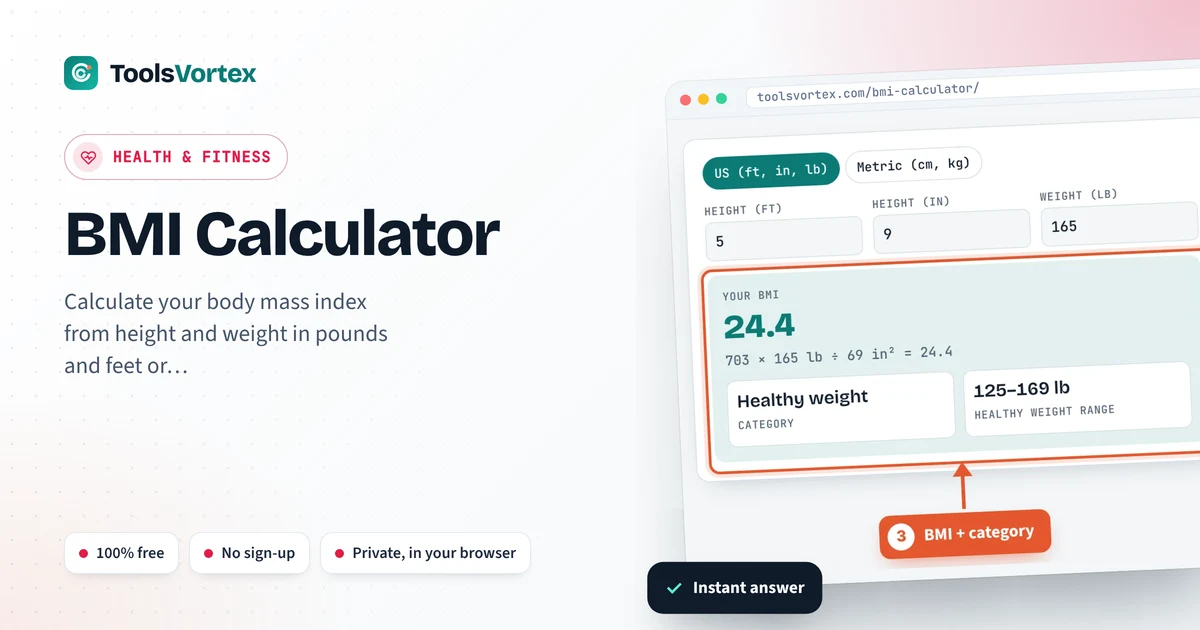
Calculate your body mass index from height and weight in pounds and feet or kilograms and centimeters, and see your CDC weight category and healthy weight range.

Body mass index (BMI) is a quick screening number doctors use to compare weight with height. It does not measure body fat directly, but it is the standard first check used by the CDC and the World Health Organization. Enter your height and weight to get your BMI, your weight category and the weight range that counts as healthy for your height.
How do I calculate BMI?
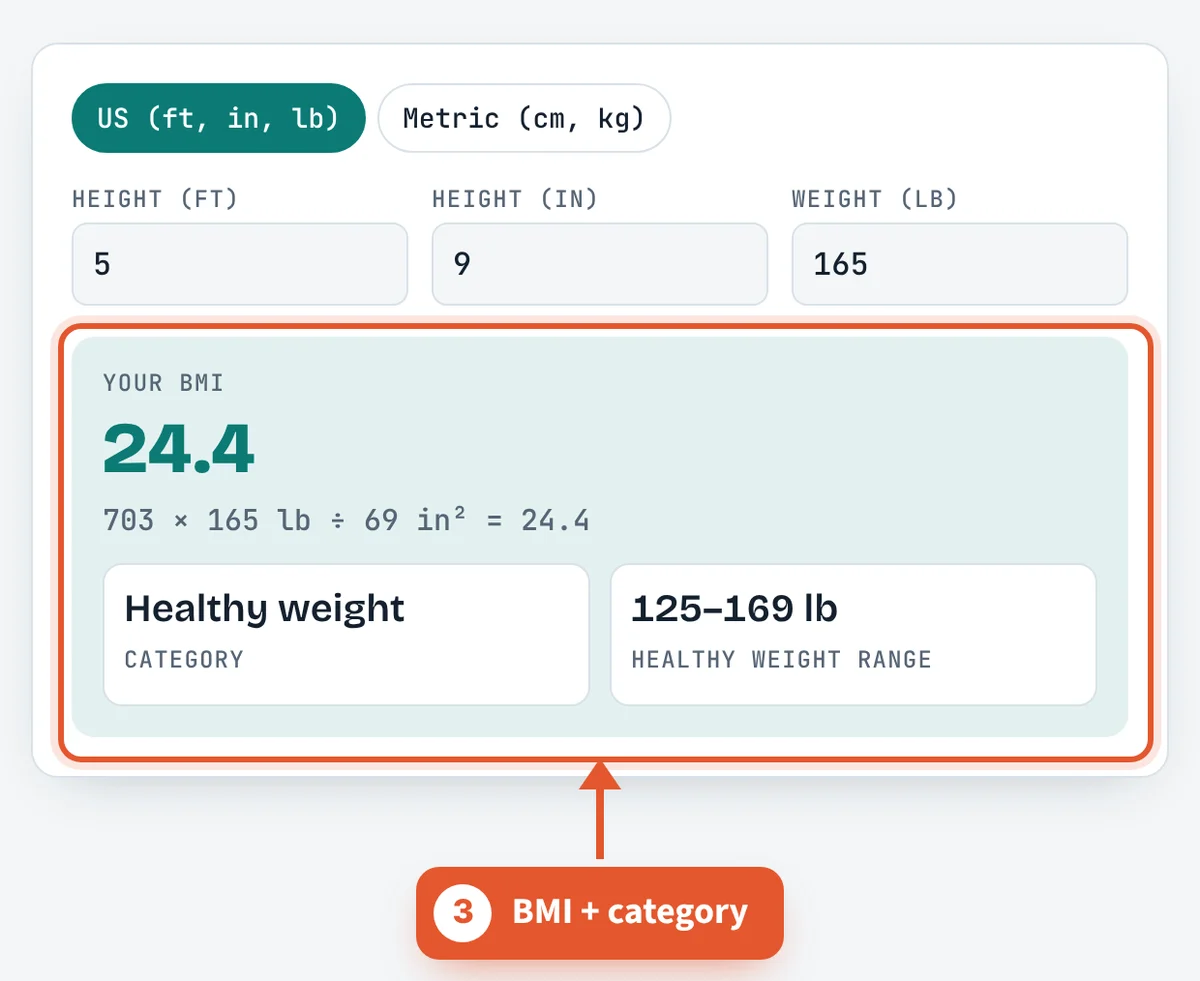
Divide your weight in kilograms by your height in meters squared. In US units, multiply your weight in pounds by 703 and divide by your height in inches squared. For example, 165 lb at 5 ft 9 in (69 in) gives 165 × 703 ÷ 69² = BMI 24.4, which is in the healthy weight range.
BMI categories for adults
| BMI | Weight category |
|---|---|
| Below 18.5 | Underweight |
| 18.5 to 24.9 | Healthy weight |
| 25.0 to 29.9 | Overweight |
| 30.0 and above | Obesity |
BMI formula
US: BMI = 703 × weight (lb) ÷ height (in)²
Limits of BMI
BMI does not tell muscle from fat, so very muscular people can score as overweight, and older adults can have a normal BMI with low muscle mass. It is also not used the same way for children and teens, who are compared with growth charts by age and sex. Use BMI as a starting point and talk to a doctor about your health.
How to use the BMI Calculator
Enter your height
Choose US or metric units, then type your height in feet and inches or in centimeters.

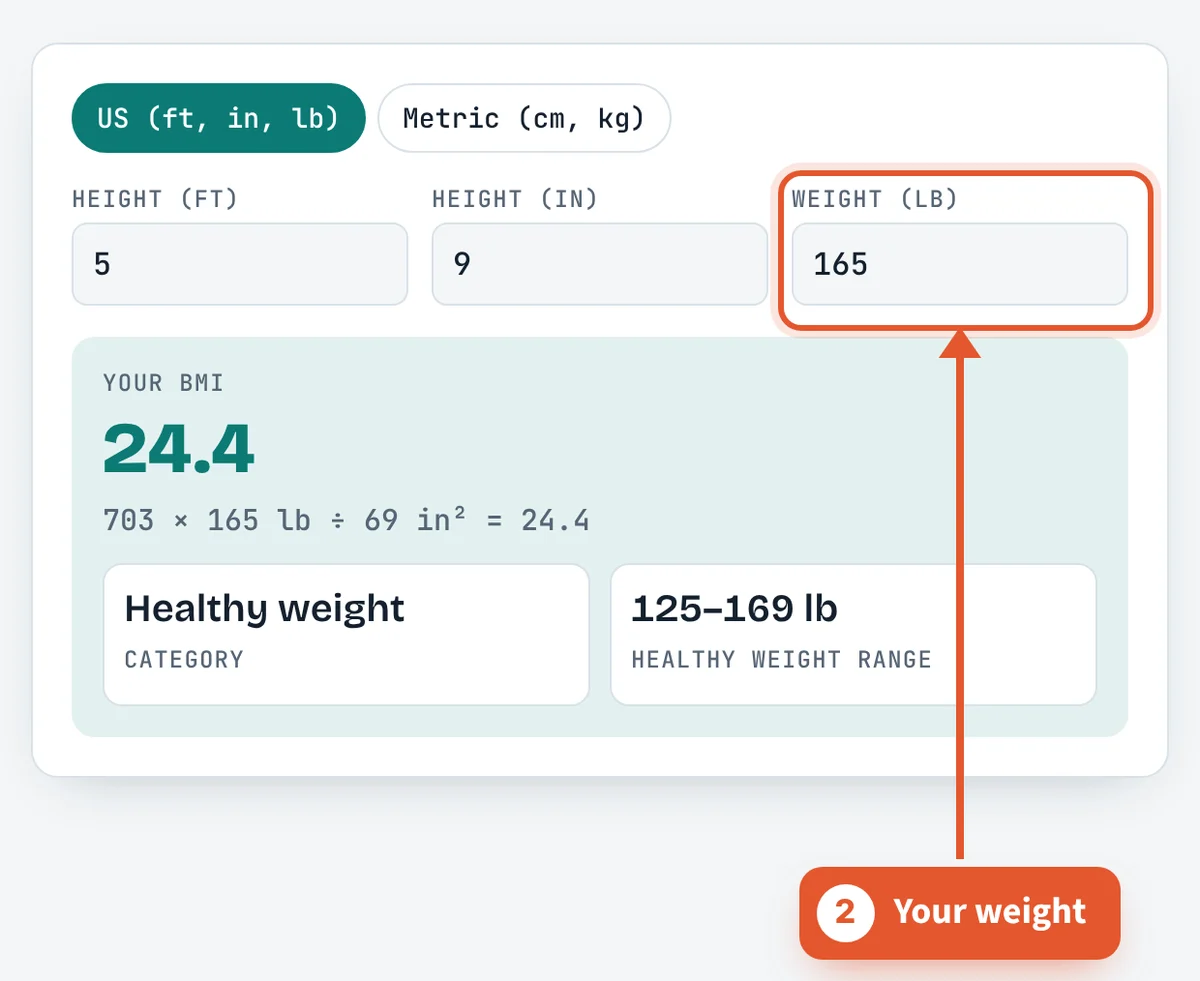
Enter your weight
Type your weight in pounds or kilograms. The result updates as you type.
Read your BMI and category
Your BMI appears with your CDC weight category and the healthy weight range for your height.

How is BMI used for children and teens?
Adult cutoffs such as 25 and 30 do not apply to anyone under 20. For ages 2 through 19, the Centers for Disease Control and Prevention (CDC) compares a child’s BMI with others of the same age and sex using the CDC growth charts. The result is a BMI-for-age percentile.
| Category | Percentile range |
|---|---|
| Underweight | Below the 5th percentile |
| Healthy weight | 5th to below the 85th percentile |
| Overweight | 85th to below the 95th percentile |
| Obesity | 95th percentile or higher |
Percentiles are needed because body fat changes naturally as children grow, and boys and girls develop at different rates. A BMI of 20 can be healthy for a 15-year-old but high for a 7-year-old. In 2022 the CDC released extended BMI-for-age charts to track severe obesity, defined as 120% of the 95th percentile or higher. For children under 2, the CDC recommends the World Health Organization growth standards, which use weight-for-length instead of BMI.
Are BMI cutoffs different for Asian adults?
Yes, in many guidelines. A 2004 World Health Organization expert consultation published in The Lancet found that many Asian populations face higher risks of type 2 diabetes and heart disease at lower BMI values than European populations. It kept the standard categories but proposed extra public health action points at 23 and 27.5.
Several countries use lower thresholds in practice. Under these cutoffs, overweight often starts at 23 and obesity at 25 or 27.5, depending on the country. In the United States, the American Diabetes Association recommends diabetes screening for Asian American adults starting at a BMI of 23, instead of 25 for most other adults.
The reason is body composition: at the same BMI, many people of South Asian and East Asian descent carry more body fat and more fat around the abdomen. Measuring the waist adds that missing information. The waist-to-height ratio calculator checks central fat, and the body fat calculator estimates total body fat using tape measurements.
Frequently asked questions
What is a healthy BMI?
For adults, a BMI from 18.5 to 24.9 is classed as healthy weight by the CDC and WHO.
Is BMI accurate?
BMI is a useful screening tool for groups, but it does not measure body fat. Waist size, body composition and a doctor’s check give a fuller picture.
What BMI is considered obese?
A BMI of 30 or higher is classed as obesity for adults.
Can I use this BMI calculator for children?
No. Children and teens use BMI-for-age percentiles from growth charts, which this adult calculator does not apply.
Does BMI differ for men and women?
The adult BMI formula and categories are the same for men and women.
Sources and further reading
Related tools
Last reviewed: October 2026