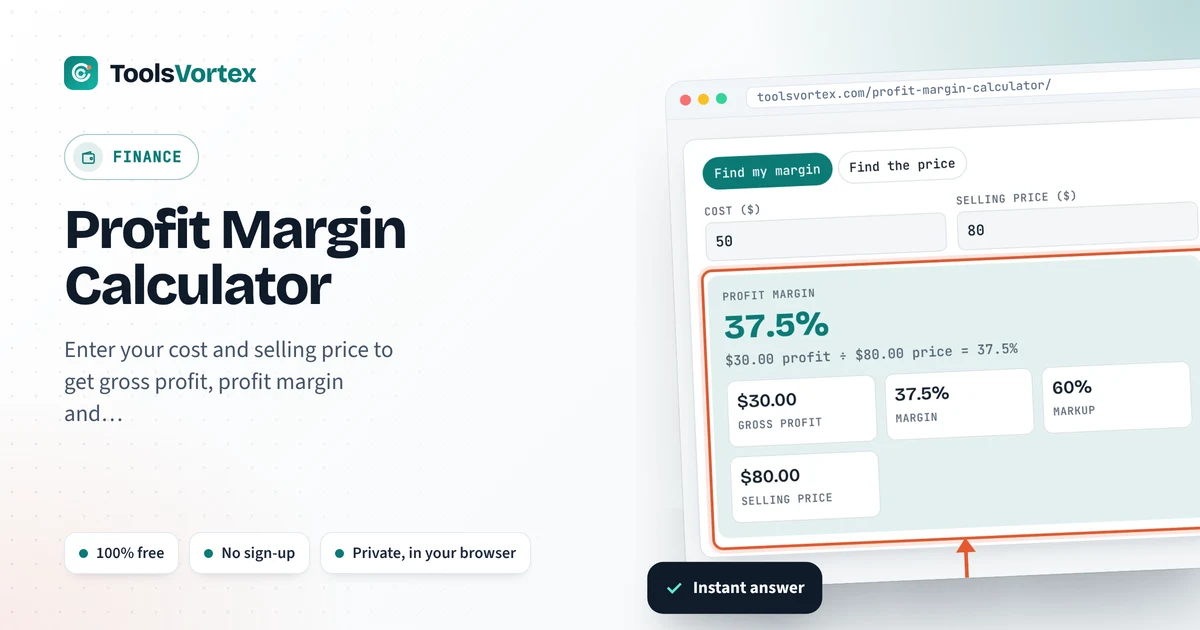
Type your cost and selling price to get profit, margin and markup. Or start from the margin you want and get the price to charge.

If you sell anything, a profit margin calculator will save you from the mix-up that bites almost every new seller: margin and markup aren’t the same number. Both start from the same profit. Margin divides it by the price, markup divides it by the cost. So the thing you buy for $50 and sell for $80 has a 60% markup and only a 37.5% margin. It’s an easy way to price a whole product line thinking you’ve got 60% and then wonder where the money went. Type your cost and price and you get both. Know the margin you want? Switch modes and it’ll tell you what to charge.
How do you calculate profit margin?
Take the selling price minus the cost, divide that profit by the selling price, and times it by 100. That’s what this profit margin calculator does. Buy at $50, sell at $80, and the $30 profit gives you 30 ÷ 80 = 37.5% margin. Markup divides by cost instead, so it’s 30 ÷ 50 = 60%. Want a 40% margin on that $50 item? Charge 50 ÷ (1 − 0.40) = $83.33.
Margin and markup formulas
Margin % = Gross profit ÷ Price × 100
Markup % = Gross profit ÷ Cost × 100
Price for a target margin = Cost ÷ (1 − margin ÷ 100)
Margin to markup conversion
| Margin | Markup needed |
|---|---|
| 10% | 11.1% |
| 20% | 25% |
| 25% | 33.3% |
| 30% | 42.9% |
| 40% | 66.7% |
| 50% | 100% |
Margin can’t hit 100%. That would mean the thing cost you nothing. Markup has no ceiling at all, which is why a “100% markup” sounds juicy and still only leaves you a 50% margin.
What a sale does to your margin
Discounts eat margin a lot faster than people expect, because the whole discount comes out of your profit. Same $50 cost, $80 regular price:
| Discount | Sale price | Profit per sale | Margin | Sales needed to earn the same profit |
|---|---|---|---|---|
| None | $80 | $30 | 37.5% | 1× |
| 10% off | $72 | $22 | 30.56% | 1.36× |
| 20% off | $64 | $14 | 21.88% | 2.14× |
| 25% off | $60 | $10 | 16.67% | 3× |
A 25% off weekend means you have to sell three times as many just to stand still. Worth knowing before you run one.
Gross margin isn’t net profit
What you get here is gross margin, based on what the product costs you. Rent, payroll, card fees, shipping and ads still come out of that $30. Want them counted? Spread them over your units and add them to the cost before you calculate.
How to use the Profit Margin Calculator
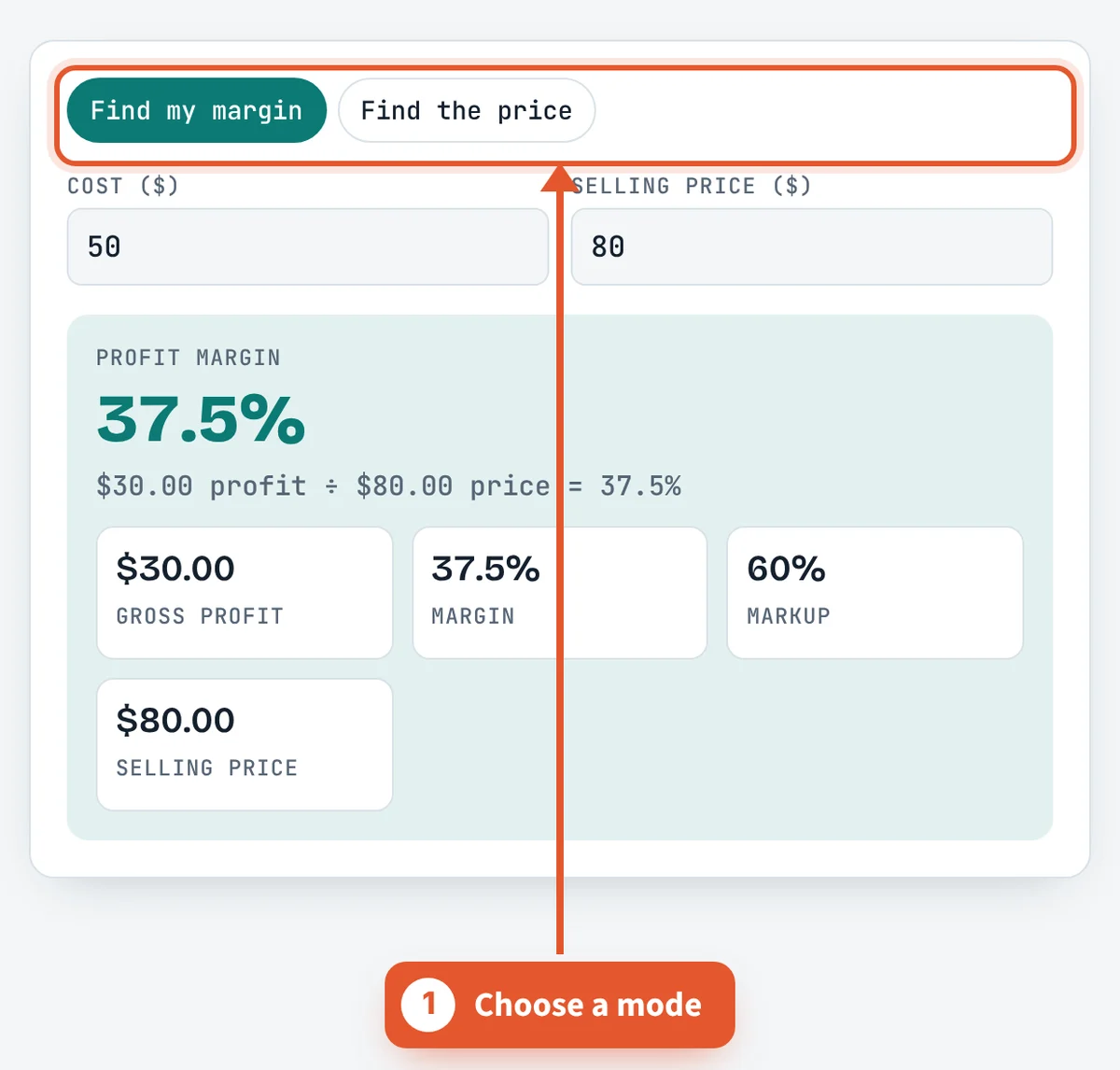
Choose a mode
Tap “Find my margin” if you already have a price. Tap “Find the price” if you know the margin you’re after.

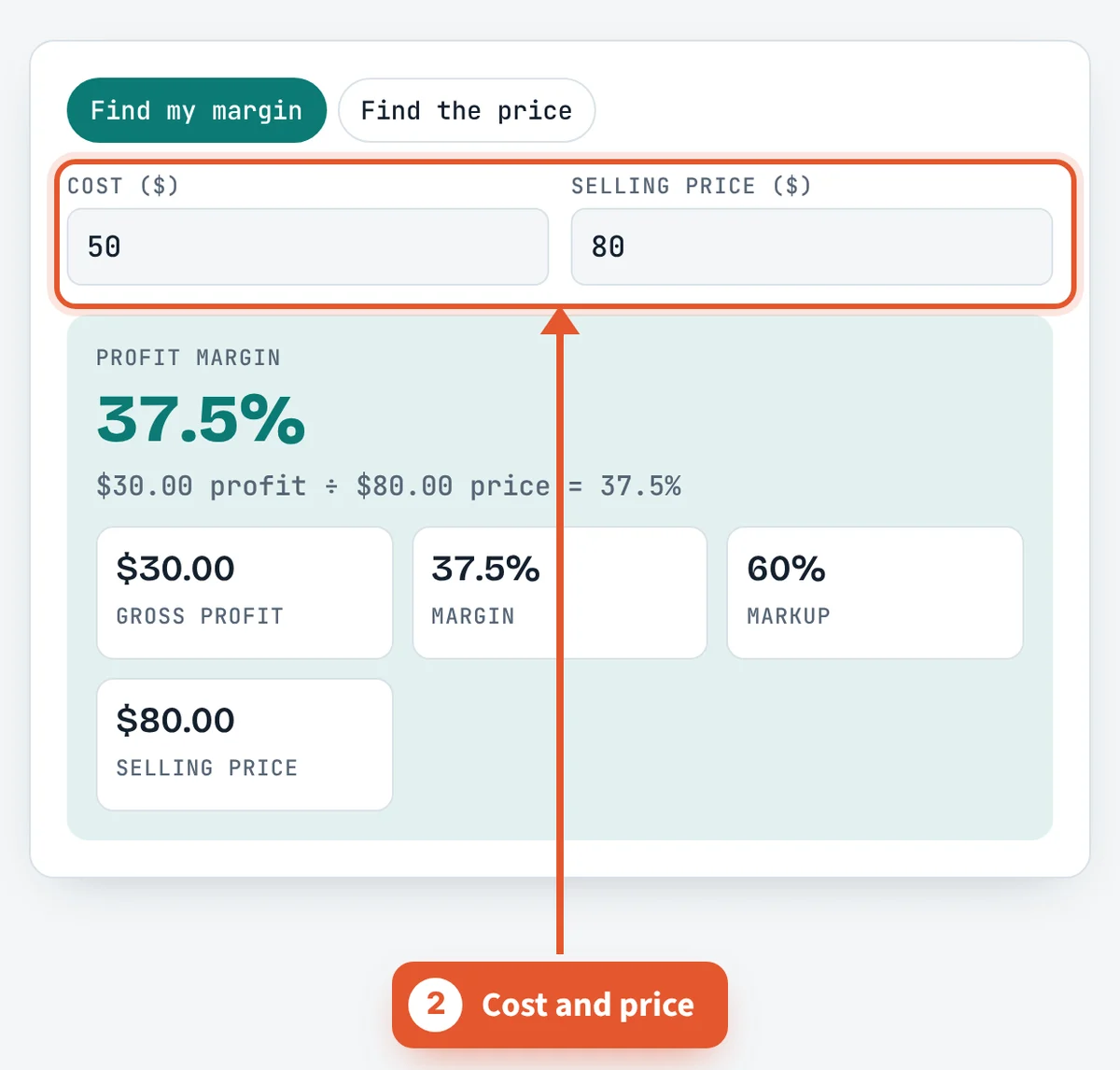
Enter cost and price or margin
Type what one unit costs you, landed, with shipping in. Then the selling price or the margin you want.
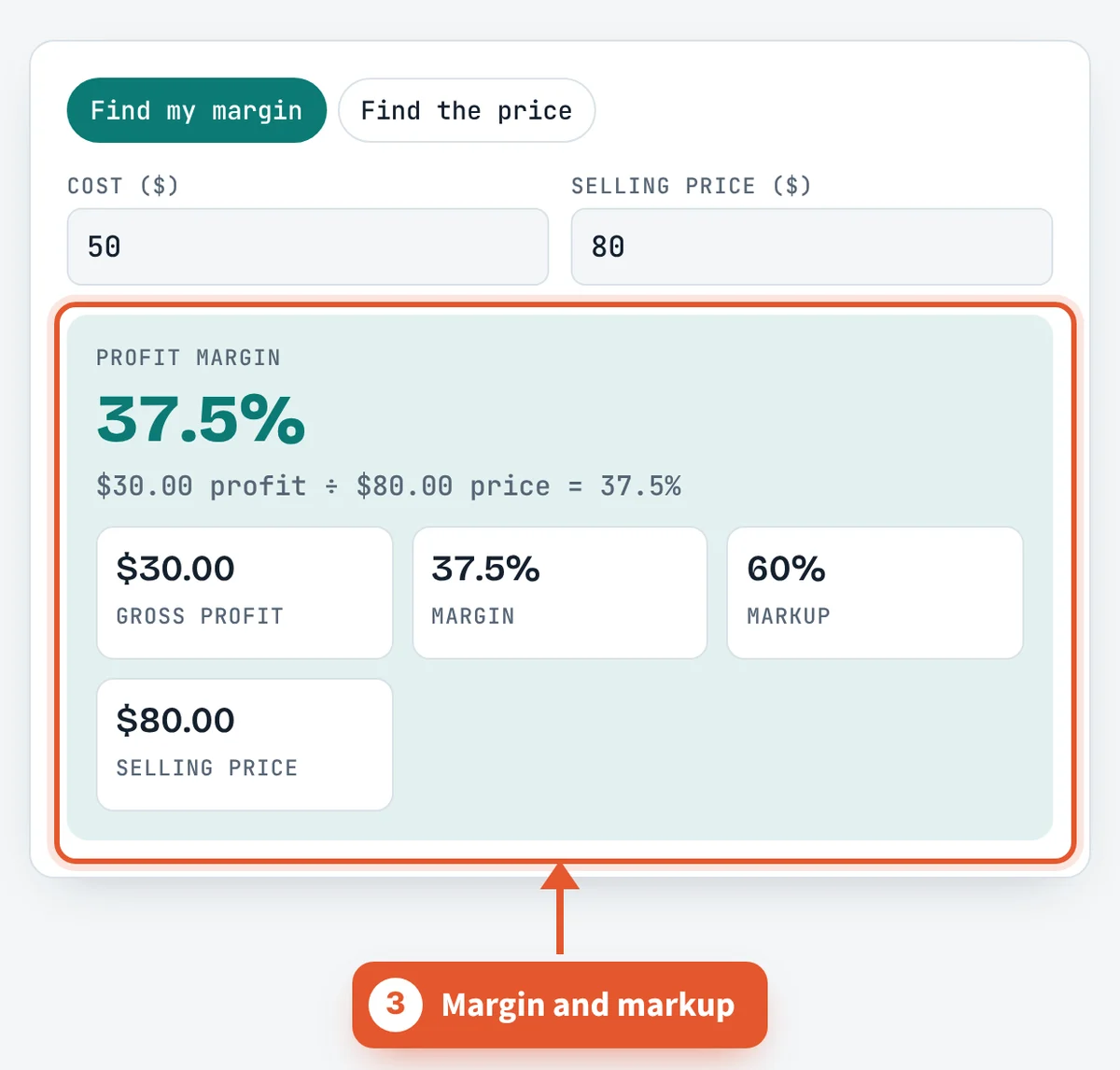
Read margin, markup and profit
Margin is the big number. Markup and profit per sale sit right below, so you can quote whichever one someone asks for.
How many units do I need to sell to break even?
Margin tells you how much of each sale you keep. To know how many sales cover your overhead, you need the contribution margin: the selling price minus the variable costs that rise with each unit, such as materials, packaging, payment fees and shipping.
The break-even point in units is:
break-even units = fixed costs ÷ contribution margin per unit
Fixed costs are the bills that stay the same whether you sell one unit or a thousand: rent, software subscriptions, insurance, salaried staff.
Example: you sell a product for $40, it costs $22 in variable costs, and your fixed costs are $9,000 a month. Contribution margin is $18 per unit, so you need 9,000 ÷ 18 = 500 sales a month to break even. Sale 501 is where profit starts.
The contribution margin ratio, $18 ÷ $40 = 45%, gives break-even in revenue: $9,000 ÷ 0.45 = $20,000. If you pay salespeople per sale, count that as a variable cost too; the commission calculator helps you work out the amount per unit.
How is cost of goods sold reported for taxes?
Gross margin depends on cost of goods sold (COGS), and the US tax return asks for the same number. Sole proprietors report it in Part III of Schedule C, and corporations and partnerships use Form 1125-A. The basic calculation is:
COGS = beginning inventory + purchases and production costs − ending inventory
COGS should only include costs of making or buying what you sold, such as materials, direct labor and freight in. Rent for an office, advertising and most salaries are operating expenses, not COGS. Putting them in the wrong place makes your gross margin look worse than it is.
How you value inventory changes the answer when prices move. Under FIFO (first in, first out), the oldest costs are expensed first, so rising prices make COGS lower and profit higher. Under LIFO (last in, first out), newer costs are expensed first. The Internal Revenue Service explains the allowed methods in Publication 334 and Publication 538, and changing methods generally needs IRS consent.
Remember that gross revenue for margin purposes excludes the sales tax you collect; the sales tax calculator helps you strip it out.
Frequently asked questions
What is a good profit margin?
Depends a lot on what you sell. Grocery stores live on thin margins, while software and plenty of service businesses run far higher. Compare yourself to shops like yours, not some all-industry average.
What is the difference between margin and markup?
Margin divides profit by the selling price. Markup divides it by the cost. That same $30 profit on a $50 item sold for $80 is a 37.5% margin but a 60% markup.
How do I price a product for a 30% margin?
Divide the cost by 0.70. Something that costs you $14 should sell for $20 to keep a 30% margin.
Can profit margin be negative?
Yep. Sell below cost and the profit goes negative, so does the margin. The calculator flags it as a loss.
Is this net or gross margin?
Gross. Net margin also takes out operating costs, interest and taxes, and for that you need your full income statement, not one product.
How much more do I have to sell after a discount?
Divide your normal profit per sale by the discounted profit. At $50 cost and $80 price, 20% off cuts profit from $30 to $14, so you need about 2.14 times the sales to make the same money.
Should I raise prices or cut costs to fix my margin?
Run both in the calculator. On the $50 to $80 product, a $5 price bump lifts margin from 37.5% to about 41.2%, and a $5 cost cut takes it to 43.75%. Both add the same $5 of profit per sale, but the cost cut looks better as a percentage.
Sources and further reading
Related tools
Last reviewed: October 2026