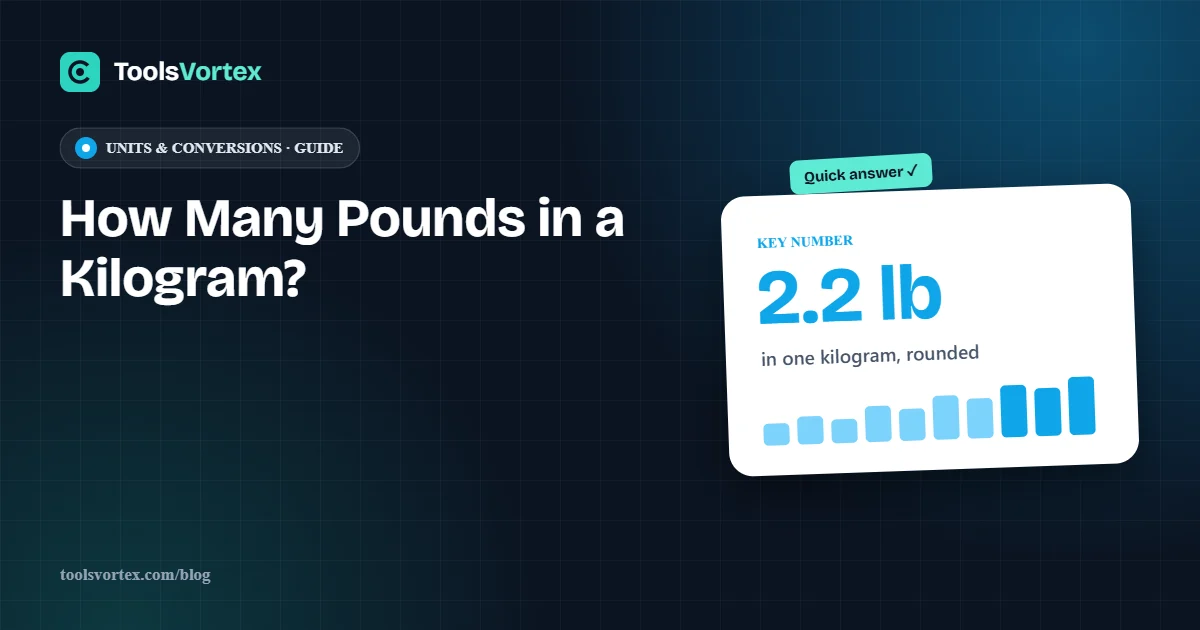
One kilogram equals 2.20462 pounds, or about 2.2 lb for quick math. The exact link runs the other way: one pound is defined as 0.45359237 kilograms. So to turn kilograms into pounds, multiply by 2.20462. To turn pounds into kilograms, multiply by 0.45359237. For example, 70 kg is 154.3 lb.

If you are asking how many pounds in a kilogram, the answer is 2.20462 pounds. For everyday use, 2.2 is close enough. That small rounding only matters when the numbers get big or the stakes get high.
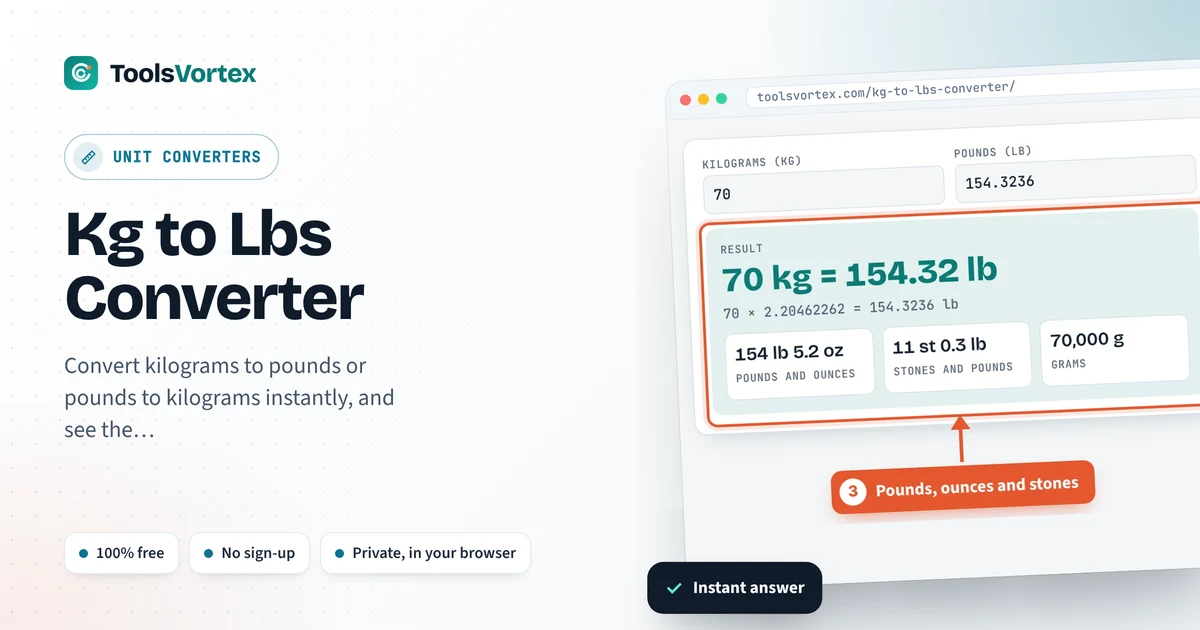
This guide gives you the exact factor, where it comes from, and charts you can scan in seconds. You will also get a mental math trick, the pounds and ounces split for baby weights, and the stone used in the UK. To skip the math entirely, use the kg to lbs converter.
How Many Pounds Are in One Kilogram?
There are 2.20462 pounds in one kilogram. More precisely, 1 kg equals 2.2046226 lb, and NIST Handbook 44 rounds it to 2.205 lb in its quick table.
The factor looks messy because the pound is defined in kilograms, not the other way around. Since July 1, 1959, the US avoirdupois pound has been exactly 0.45359237 kilogram, as recorded in NBS Miscellaneous Publication 233. Divide 1 by that number and you get the kilogram in pounds.
Kilograms = pounds x 0.45359237
1 kg = 1 / 0.45359237 = 2.2046226 lb
Notice that only one of those factors is exact. The pound to kilogram factor, 0.45359237, has no rounding at all. The kilogram to pound factor goes on forever, so any version you see has been cut short. When you need full precision, divide by 0.45359237 instead of multiplying by 2.2046.
What Is a Kilogram to Pound Conversion Chart?
A kg to lb chart lists common kilogram values next to their weight in pounds. The values below use the exact factor and are rounded to two decimals.
| Kilograms | Pounds (exact factor) | Pounds (quick x 2.2) |
|---|---|---|
| 0.5 kg | 1.10 lb | 1.10 lb |
| 1 kg | 2.20 lb | 2.20 lb |
| 2 kg | 4.41 lb | 4.40 lb |
| 5 kg | 11.02 lb | 11.00 lb |
| 10 kg | 22.05 lb | 22.00 lb |
| 23 kg | 50.71 lb | 50.60 lb |
| 50 kg | 110.23 lb | 110.00 lb |
| 70 kg | 154.32 lb | 154.00 lb |
| 80 kg | 176.37 lb | 176.00 lb |
| 100 kg | 220.46 lb | 220.00 lb |
Using 2.2 instead of 2.20462 makes every answer about 0.21% low. At 100 kg that is less than half a pound.
Going the other way is just as common in the US, where most scales read in pounds. Here are the reverse values.
| Pounds | Kilograms |
|---|---|
| 1 lb | 0.45 kg |
| 5 lb | 2.27 kg |
| 10 lb | 4.54 kg |
| 50 lb | 22.68 kg |
| 100 lb | 45.36 kg |
| 150 lb | 68.04 kg |
| 200 lb | 90.72 kg |
| 250 lb | 113.40 kg |
For any value not on the chart, type it into the kilograms to pounds converter. It runs both directions.
How Do You Convert Kg to Pounds in Your Head?
Double the kilograms, then add 10% of that result. The answer lands within about 0.2% of the exact value, which is fine for almost anything you weigh at home.
- Start with 80 kg.
- Double it: 80 x 2 = 160.
- Take 10% of 160: that is 16.
- Add them: 160 + 16 = 176 lb.
The exact answer is 176.37 lb, so you are off by about a third of a pound. This works because doubling and adding 10% is the same as multiplying by 2.2.
For pounds to kilograms, reverse it: halve the pounds, then take away 10% of that. For 200 lb, half is 100, minus 10 gives 90 kg. The exact answer is 90.72 kg. This shortcut runs about 0.8% low, so it is a little rougher than the other direction. If you need a closer answer, add back 1 kg for every 120 lb or so.
How Do You Show Kilograms as Pounds and Ounces or Stone?
Take the whole pounds first, then turn the decimal part into ounces by multiplying by 16. For stone, divide the pounds by 14 and keep the remainder in pounds.
This matters most for babies. Hospitals often weigh newborns in grams or kilograms, but many parents in the US want pounds and ounces. A pound has 16 ounces, so 0.5 lb is 8 oz, not 5 oz. It is an easy mistake to make with decimal pounds.
| Kilograms | Decimal pounds | Pounds and ounces |
|---|---|---|
| 2.5 kg | 5.51 lb | 5 lb 8.2 oz |
| 3.2 kg | 7.05 lb | 7 lb 0.9 oz |
| 3.5 kg | 7.72 lb | 7 lb 11.5 oz |
| 4 kg | 8.82 lb | 8 lb 13.1 oz |
Ounces here are avoirdupois ounces, the kind used for food and body weight. One kilogram holds about 35.27 of them.
In the UK and Ireland, people often give body weight in stone. NIST Handbook 44 lists 1 stone as 14 pounds. So 70 kg is 154.3 lb, which is 11 stone and 0.3 lb. And 90 kg is 198.4 lb, or 14 stone 2.4 lb. The stone to lbs converter handles that split for you. For smaller kitchen weights, the grams to ounces converter is the faster route.
How Do You Check a Kilogram Weight Limit in Pounds?
Convert the limit into pounds once, then compare every reading on your scale to that number. It is easier than converting each weigh-in back to kilograms.
Your checked bag limit is 23 kg. Your home scale reads in pounds and shows 49.5 lb. Are you under?
- Convert the limit: 23 / 0.45359237 = 50.71 lb.
- Compare: 49.5 lb is less than 50.71 lb.
- Find your margin: 50.71 minus 49.5 = 1.21 lb.
- Check it in kilograms: 49.5 x 0.45359237 = 22.45 kg.
You are under by about 1.2 lb, or roughly 0.55 kg. That is about the weight of a pair of sneakers, so leave room for souvenirs.
Notice the trap here. Many people round 23 kg down to 50 lb. That is the safe direction, since you leave 0.71 lb unused. The risky mistake is the opposite one: treating a 50 lb limit as 23 kg. The real figure is 22.68 kg, so a bag at 22.9 kg would be over. Home bathroom scales can also drift, so leave a buffer either way.
The same habit helps with any limit set in one unit and checked in the other. Convert the limit once, write it down, and compare your readings to it.
Is a Kilogram a Unit of Mass or Weight?
A kilogram is a unit of mass, and so is the avoirdupois pound. In daily life, both are used for weight, and the conversion between them is the same everywhere on Earth.
Physics draws a line between mass, which is how much matter something has, and weight, which is the pull of gravity on it. Scientists measure force in newtons or in pounds force. Your bathroom scale measures force but displays mass, because it assumes Earth gravity. On the Moon, the same scale would read about one sixth as much, while your mass would not change at all.
The kilogram itself got a new definition recently. Since May 20, 2019, it has been defined through a fixed value of the Planck constant, a number from quantum physics, according to NIST. Before that, it was tied to a physical reference object. The change did not alter the size of a kilogram in any way you could notice, so 2.20462 lb per kg still holds.
One more edge case: gold and silver use the troy pound, which is a different unit. A troy pound is 12 troy ounces, about 0.373 kg, so it is about 82% of a regular pound. If you see “pound” on a grocery label or a scale, it means the avoirdupois pound.
Where Do You Still Need to Convert Kg and Lbs?
You will run into kilograms and pounds side by side in gyms, travel, shipping, cooking, and health care. The US uses pounds for most daily weights, while most of the world uses kilograms.
- Gym plates: many gyms mix plates. A 20 kg plate is 44.09 lb, a little lighter than a 45 lb plate. A 25 kg plate is 55.12 lb.
- Shipping: carriers that serve other countries often quote rates per kilogram. Always round up to the next billing step after you convert.
- Recipes: 1 kg of flour is 2.2 lb, so a 5 lb bag holds about 2.27 kg.
- Body weight: health tools often ask for kilograms. A reading of 154 lb is 69.85 kg.
Doctors and vets often figure doses per kilogram of body weight. If a pound value gets typed in as kilograms by mistake, the dose would be about 2.2 times too large. Always confirm which unit a form wants. To see a healthy weight range for your height in either unit, try the ideal weight calculator. This is general information, not medical advice.
Quick Recap
- One kilogram equals 2.20462 pounds; use 2.2 for quick math.
- One pound is exactly 0.45359237 kg, the legal US definition since 1959.
- Mental trick: double the kilograms, then add 10%.
- For pounds and ounces, multiply the decimal part of the pounds by 16.
- One stone is 14 pounds, so 70 kg is about 11 stone.
Frequently Asked Questions
Is a kilogram 2.2 pounds exactly?
No. A kilogram is 2.2046226 pounds, so 2.2 is a rounded value. The rounding makes answers about 0.21% low, which is under half a pound at 100 kg. For exact results, divide the kilograms by 0.45359237.
How many pounds is 1 kg of weight?
One kilogram weighs about 2.2 pounds on Earth, or 2.20462 pounds to five decimals. Both units are used for weight in daily life, so the same factor works for groceries, luggage and body weight.
Which is heavier, a kilogram or a pound?
A kilogram is heavier. It is a little more than twice a pound, at 2.20462 pounds. Put the other way, one pound is about 45% of a kilogram, or 453.59 grams.
How many ounces are in a kilogram?
There are about 35.27 avoirdupois ounces in one kilogram. A pound has 16 ounces, and 2.20462 x 16 = 35.27. For gold or silver in troy ounces, a kilogram is about 32.15 troy ounces.
How many kilograms is 150 pounds?
150 pounds is 68.04 kilograms. Multiply 150 by 0.45359237 to get 68.0389, then round. A quick check: half of 150 is 75, minus 10% is 67.5, which is close.
How do I convert kg to lbs and ounces?
Multiply the kilograms by 2.20462 to get decimal pounds. Keep the whole pounds, then multiply the decimal part by 16 for ounces. For 3.5 kg, that gives 7.72 lb, which is 7 lb 11.5 oz.
Why is the pound defined in kilograms?
US customary units are defined from metric ones. Under the refinement that took effect on July 1, 1959, the avoirdupois pound is exactly 0.45359237 kg, so every scale and lab uses one shared value.
Sources
- NBS: Miscellaneous Publication 233, Units of Weight and Measure, Avoirdupois pound of exactly 0.45359237 kg, effective July 1, 1959
- NIST: Handbook 44 Appendix C, General Tables of Units of Measurement, 1 kg = 2.205 lb, 16 ounces per pound, 14 pounds per stone, troy pound of 12 troy ounces
- NIST: Guide to the SI, Appendix B.8, Factors for Units Listed Alphabetically, Conversion factors for the avoirdupois and troy pound and ounce
- NIST: The Kilogram’s Future, Kilogram defined through the Planck constant since May 20, 2019