
Add, subtract, multiply and divide fractions and mixed numbers. Get the simplified answer as a fraction, a mixed number and a decimal, with the steps.

Fractions still run a lot of daily life in the US. Recipes call for 2/3 cup, lumber is cut to 5 3/8 inches, and wrench sizes jump from 7/16 to 1/2. Doing the arithmetic by hand means finding a common denominator, then reducing, and that’s where small slips happen. Enter two fractions or mixed numbers in this fraction calculator, pick an operation, and you’ll get the reduced answer as an improper fraction, a mixed number and a decimal. The steps are written out underneath so you can follow along or check a worksheet.
How do you add fractions with different denominators?
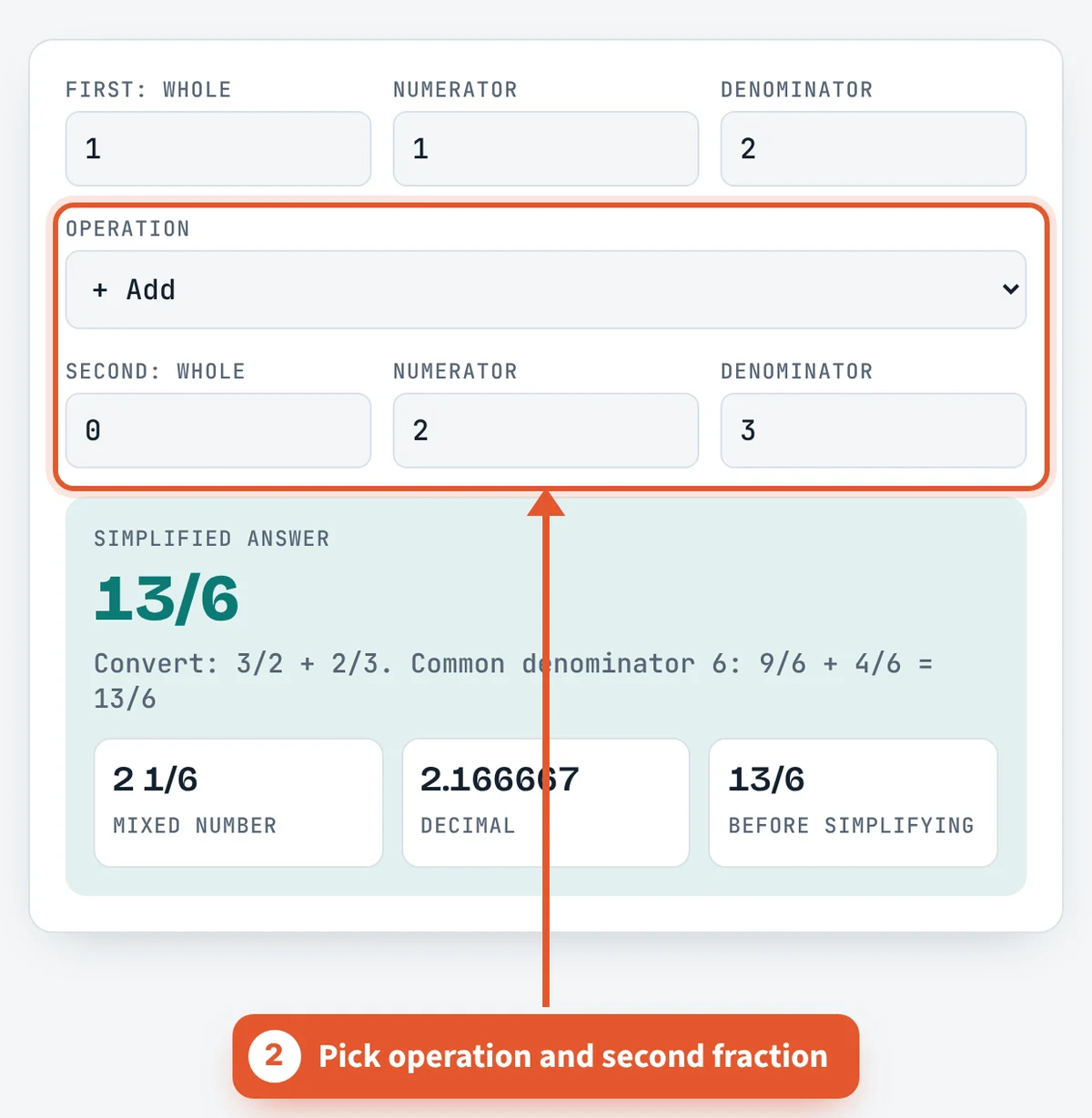
Rewrite both fractions over a common denominator, usually the least common multiple, then add the numerators and simplify. Mixed numbers get converted to improper fractions first. For example, 1 1/2 + 2/3 becomes 3/2 + 2/3, then 9/6 + 4/6 = 13/6, which is 2 1/6 or about 2.1667. The fraction calculator shows each of those steps.
Fraction formulas
a/b − c/d = (a×d − c×b) ÷ (b×d)
a/b × c/d = (a×c) ÷ (b×d)
a/b ÷ c/d = a/b × d/c = (a×d) ÷ (b×c)
After any operation, divide the top and bottom by their greatest common divisor to simplify. For example, 7/8 × 4/5 = 28/40, and since both numbers divide by 4, the answer is 7/10. Dividing works by flipping the second fraction: 3/4 ÷ 2/5 = 3/4 × 5/2 = 15/8, or 1 7/8.
Common fractions as decimals
| Fraction | Decimal | Fraction | Decimal |
|---|---|---|---|
| 1/8 | 0.125 | 5/8 | 0.625 |
| 1/4 | 0.25 | 2/3 | 0.667 |
| 1/3 | 0.333 | 3/4 | 0.75 |
| 3/8 | 0.375 | 7/8 | 0.875 |
| 1/2 | 0.5 | 15/16 | 0.9375 |
Mixed numbers and negatives
To turn a mixed number into an improper fraction, multiply the whole number by the denominator and add the numerator: 2 3/4 = (2 × 4 + 3)/4 = 11/4. For a negative mixed number, put the minus sign on the whole number, so −1 1/2 means −3/2. If there’s no whole part, leave it at 0 and put the sign on the numerator.
How to use the Fraction Calculator
Enter the first fraction
Fill in the whole number (0 if none), numerator and denominator. For 3/4, use 0, 3 and 4.

Choose the operation and second fraction
Pick add, subtract, multiply or divide, then enter the second fraction the same way.
Read the simplified answer
See the reduced fraction, the mixed number, the decimal and the steps used to get there.


How do you reduce a fraction to lowest terms?
Divide the numerator and denominator by their greatest common divisor (GCD), the largest whole number that divides both. The result is the simplest equal fraction.
For large numbers, the fastest method is the Euclidean algorithm, described in Euclid’s Elements around 300 BC and still used by computers today. Divide the larger number by the smaller, keep the remainder, and repeat with the smaller number and that remainder until the remainder is zero. The last nonzero remainder is the GCD.
Example with 84/126:
- 126 ÷ 84 = 1 remainder 42
- 84 ÷ 42 = 2 remainder 0
- The GCD is 42, so 84/126 = 2/3.
You can also use prime factorization: 84 = 2 × 2 × 3 × 7 and 126 = 2 × 3 × 3 × 7. The shared factors 2 × 3 × 7 = 42 cancel, leaving 2/3. This works well for small numbers but becomes slow when the numbers have large prime factors.
To find the GCD on its own, use the GCF calculator.
Which fractions turn into repeating decimals?
Write the fraction in lowest terms and look only at the denominator. If its prime factors are only 2s and 5s, the decimal ends. If any other prime appears, the decimal repeats forever. The rule follows from the fact that our number system is based on 10, and 10 = 2 × 5.
| Fraction | Denominator factors | Decimal |
|---|---|---|
| 3/8 | 2 × 2 × 2 | 0.375 |
| 7/20 | 2 × 2 × 5 | 0.35 |
| 1/3 | 3 | 0.333… |
| 1/12 | 2 × 2 × 3 | 0.08333… |
| 1/7 | 7 | 0.142857142857… |
A repeating decimal is often written with a bar over the repeating block, so 1/7 is 0.142857 with a bar over all six digits. For a prime denominator p, the repeating block can be at most p minus 1 digits long, and 1/7 reaches that maximum of six.
To go the other way and turn a decimal back into a fraction, use the decimal to fraction calculator.
How did ancient Egyptians write fractions?
Egyptian scribes wrote almost every fraction as a sum of different unit fraction values, meaning fractions with 1 on top. The main exception was 2/3, which had its own symbol. So instead of 2/5 they wrote 1/3 + 1/15, and instead of 3/4 they wrote 1/2 + 1/4.
Our best source is the Rhind Mathematical Papyrus, copied by the scribe Ahmes around 1550 BC and now held by the British Museum. It opens with a table that splits 2/n into unit fractions for every odd n from 3 to 101, which scribes used as a lookup table, much like a times table.
The system was practical for sharing goods. To divide 5 loaves among 8 people, 5/8 = 1/2 + 1/8: give each person half a loaf, then cut the last loaf into eighths. Mathematicians still study Egyptian fraction problems today, and any positive fraction can be written this way using a greedy method that always takes the largest unit fraction that fits.
Adding many unit fractions requires a common denominator, which the LCM calculator finds quickly.
Frequently asked questions
How do I simplify a fraction?
Divide the numerator and denominator by their greatest common divisor. For 18/24, the GCD is 6, so it reduces to 3/4.
How do I multiply fractions?
Multiply the numerators together and the denominators together, then simplify. 2/3 × 3/5 = 6/15 = 2/5.
How do I divide fractions?
Flip the second fraction and multiply. 3/4 ÷ 2/5 is 3/4 × 5/2 = 15/8, which is 1 7/8.
Can I enter mixed numbers?
Yes. Put the whole number in the first box and the fraction part in the other two. 2 1/4 is 2, 1 and 4.
Why does the decimal look rounded?
Fractions like 1/3 repeat forever as decimals, so the calculator shows up to 6 decimal places. The fraction answer is exact.
Sources and further reading
Related tools
Last reviewed: October 2026