
Find the sale price after a percent off, add an extra discount or coupon, include sales tax, and see exactly how much you save.

Shopping sales, Black Friday deals and coupon codes are easier when you know the real price before you reach the checkout. This discount calculator works out the sale price, stacks an extra percent-off coupon the way stores apply it, adds sales tax, and shows your total savings.
How do I calculate a discount?
Multiply the original price by the discount percentage and divide by 100 to get the savings, then subtract it from the price. For 25% off $80: 80 × 25 ÷ 100 = $20 off, so the sale price is $60. Another way: multiply by (1 − 0.25).
Discount formula
You save = Original price − Sale price
Stacked discounts are not added together
A 20% discount plus an extra 10% off is not 30% off. The second discount applies to the already reduced price: $100 × 0.80 × 0.90 = $72, which is 28% off in total. The calculator shows the real combined percentage.
Quick discount chart
| Price | 10% off | 20% off | 25% off | 30% off | 50% off |
|---|---|---|---|---|---|
| $25 | $22.50 | $20.00 | $18.75 | $17.50 | $12.50 |
| $50 | $45.00 | $40.00 | $37.50 | $35.00 | $25.00 |
| $100 | $90.00 | $80.00 | $75.00 | $70.00 | $50.00 |
| $200 | $180.00 | $160.00 | $150.00 | $140.00 | $100.00 |
How to use the Discount Calculator
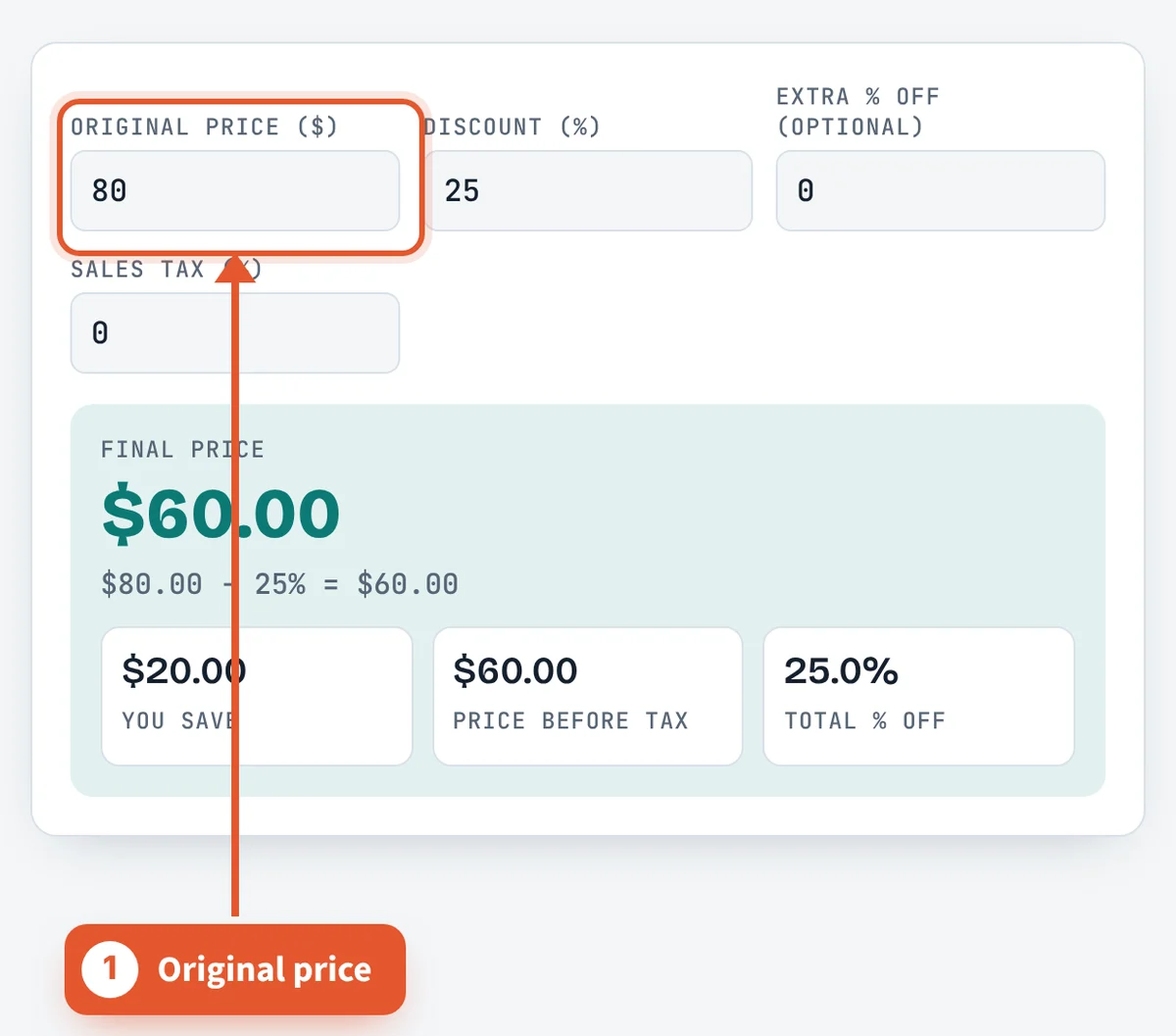
Enter the original price
Type the full price before any discount.

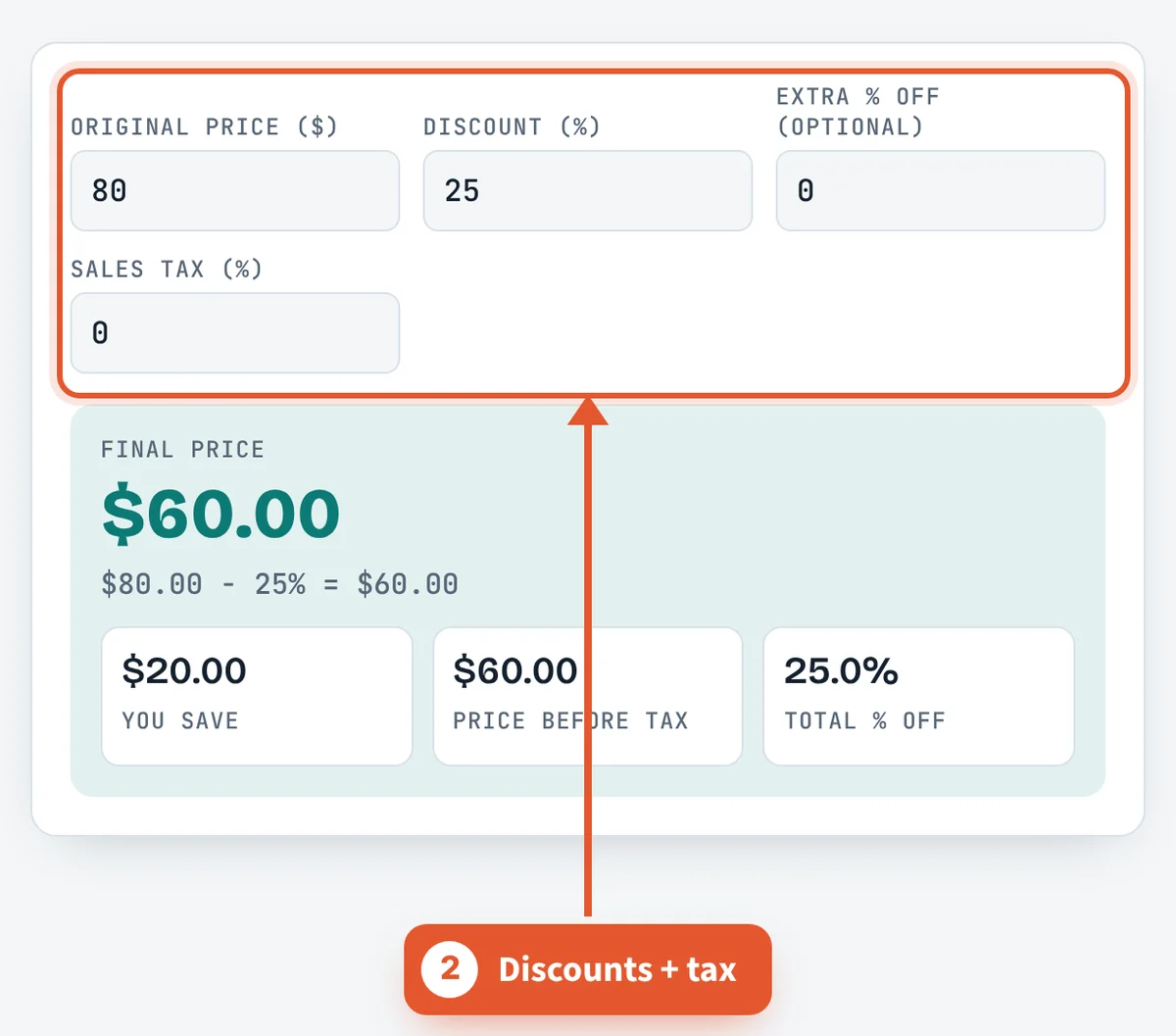
Add the discounts and tax
Enter the percent off, any extra coupon percentage and your local sales tax rate.
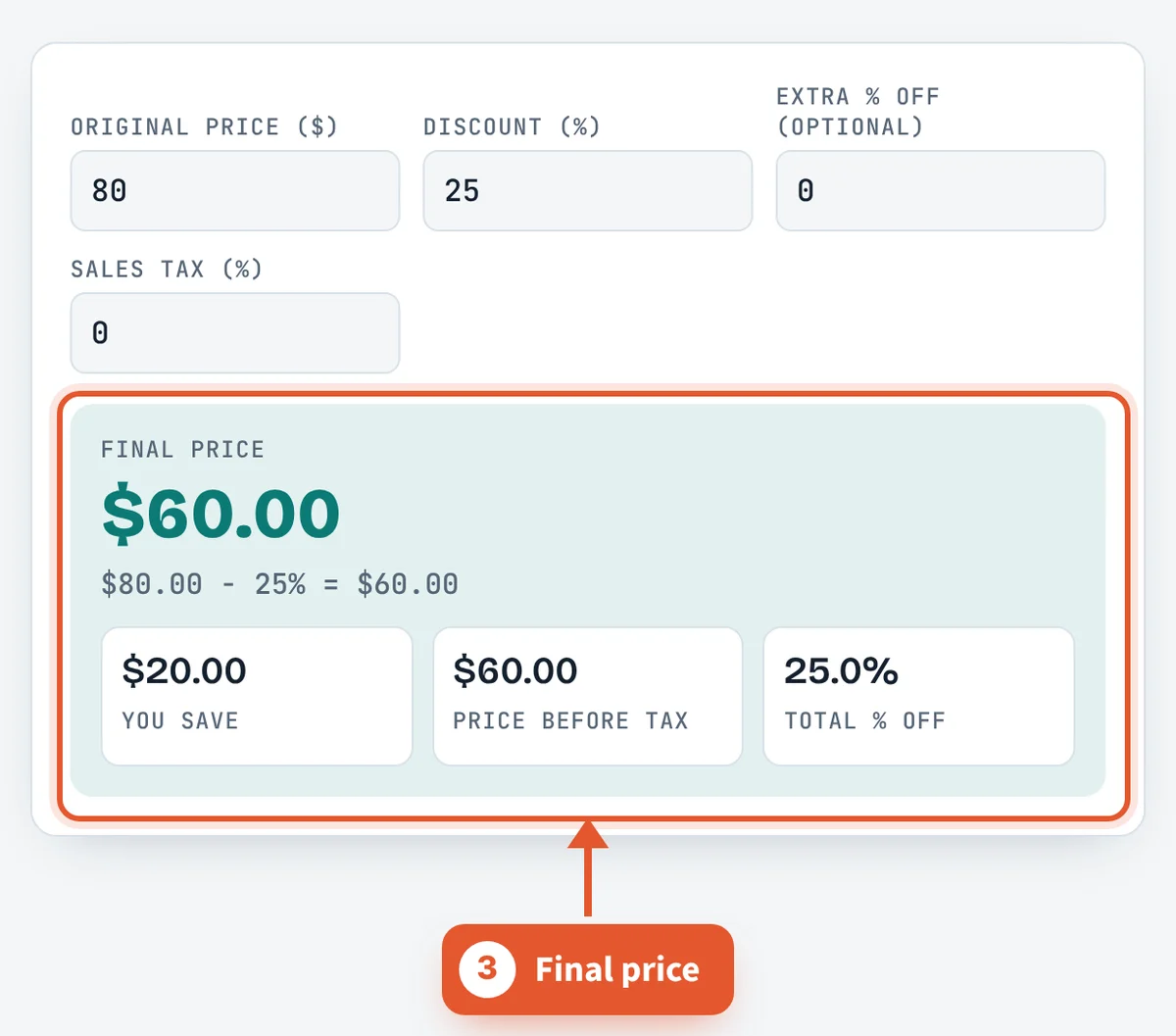
Read the final price
See the final price, how much you save and the true total discount.
Is sales tax charged before or after a discount?
In most US states, a store discount or retailer coupon lowers the taxable price, so sales tax is figured on what you actually pay. A $100 jacket marked 30% off costs $70, and at a 7% tax rate you pay $4.90 in tax for a total of $74.90.
A manufacturer’s coupon often works differently. Because the manufacturer reimburses the store for the coupon, many states treat that amount as part of the sale price and charge tax on the price before the coupon. Rules differ by state, so the receipt is the final word.
- Apply the discount first, then the tax, for store promotions.
- For manufacturer coupons, expect tax on the pre-coupon price in many states.
- Countries with a value added tax usually show shelf prices with tax included, so the discount applies to the full tax-inclusive price.
To add tax to your discounted price, use the sales tax calculator. For prices in VAT countries, the VAT calculator separates the tax from the total.
Is the “original price” on a sale tag always real?
Not always. In the United States, the Federal Trade Commission covers this in its Guides Against Deceptive Pricing, found at 16 CFR Part 233. The guides say a former price used in a “was $80, now $50” comparison should be a genuine price at which the item was openly and actively offered for a reasonably substantial period in the recent, regular course of business. A price set only so it can be marked down is a fictitious former price.
The same guides cover comparisons with other sellers’ prices and with a manufacturer’s suggested retail price. A comparison to an MSRP can mislead when few stores in the area ever charge that amount. State consumer protection laws add their own rules, and California’s Business and Professions Code also limits how former prices may be advertised.
A simple habit helps: before trusting the percentage on the tag, check the price history or compare with other sellers. If you sell products yourself, the profit margin calculator shows how much a markdown cuts into your margin.
Frequently asked questions
How do I calculate 30% off?
Multiply the price by 0.70. For $60, that is $42, a saving of $18.
Is 20% off plus 10% off the same as 30% off?
No. Stacked discounts give 28% off in total, because the second one applies to the reduced price.
Is sales tax charged before or after the discount?
In most US states, sales tax is charged on the discounted price, which is how this calculator works.
How do I find the original price from a sale price?
Divide the sale price by (1 − discount ÷ 100). A $60 price after 25% off was originally $80.
How do I work out the percentage off?
Divide the amount saved by the original price and multiply by 100.
Sources and further reading
Related tools
Last reviewed: October 2026