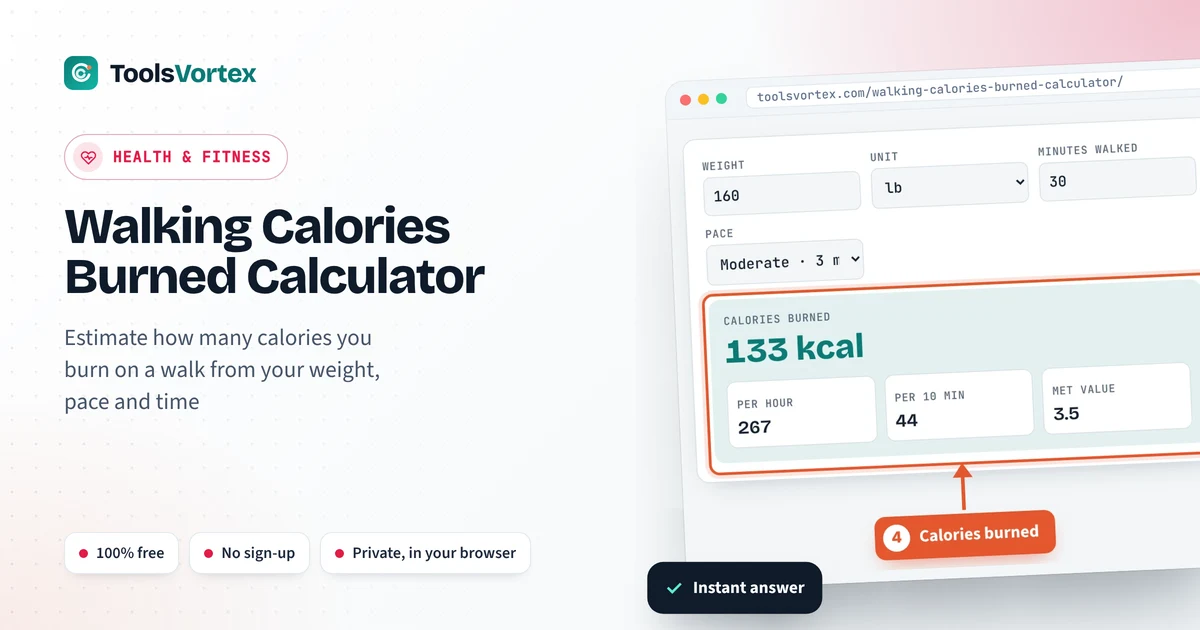
Estimate how many calories you burn on a walk from your weight, pace and time. Based on published MET values.

Walking is the easiest exercise to keep up, and it burns more energy than many people expect. The number depends mostly on how much you weigh and how fast you walk. This calculator uses MET values from the Compendium of Physical Activities, the reference most fitness researchers rely on, to estimate calories from your own details.
How many calories does walking burn?
A 70 kg person walking at a moderate 4.8 km/h (3 mph) burns about 130 calories in 30 minutes. Heavier people and faster or uphill walks burn more. Enter your weight, pace and time above for your own estimate.
The formula
MET stands for metabolic equivalent. Sitting quietly is 1 MET. Moderate walking is about 3.5 MET, so it uses three and a half times the energy of rest.
Calories burned in 30 minutes
| Pace | 60 kg | 70 kg | 85 kg | 100 kg |
|---|---|---|---|---|
| Slow (3.2 km/h) | 88 | 103 | 125 | 147 |
| Moderate (4.8 km/h) | 110 | 129 | 156 | 184 |
| Brisk (5.6 km/h) | 135 | 158 | 192 | 226 |
| Very brisk (6.4 km/h) | 158 | 184 | 223 | 263 |
These are estimates. Fitness level, terrain, wind and how you swing your arms all change the real figure a little.
How to use the Walking Calories Burned Calculator
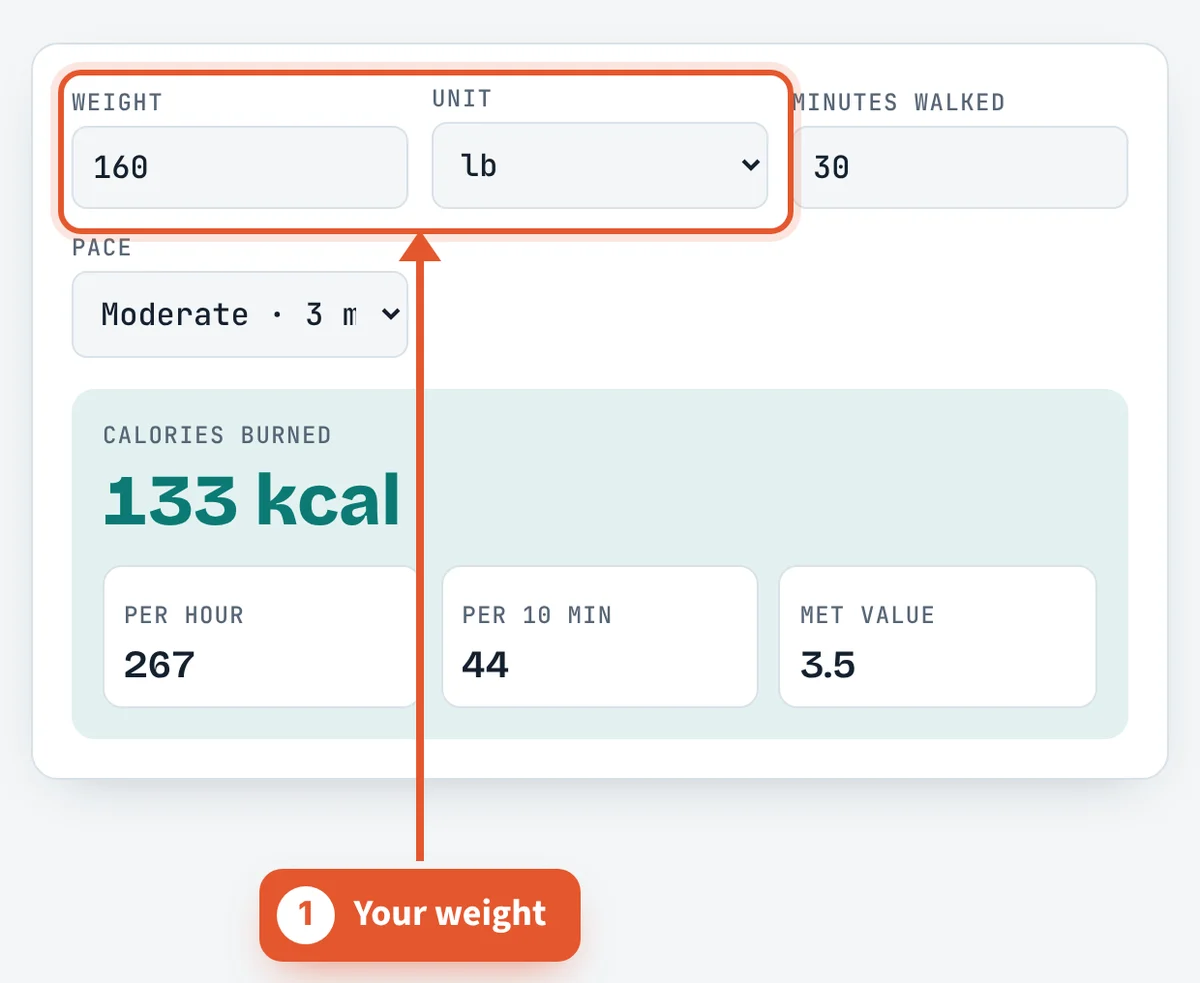
Enter your weight
Type your weight and choose kg or lb.
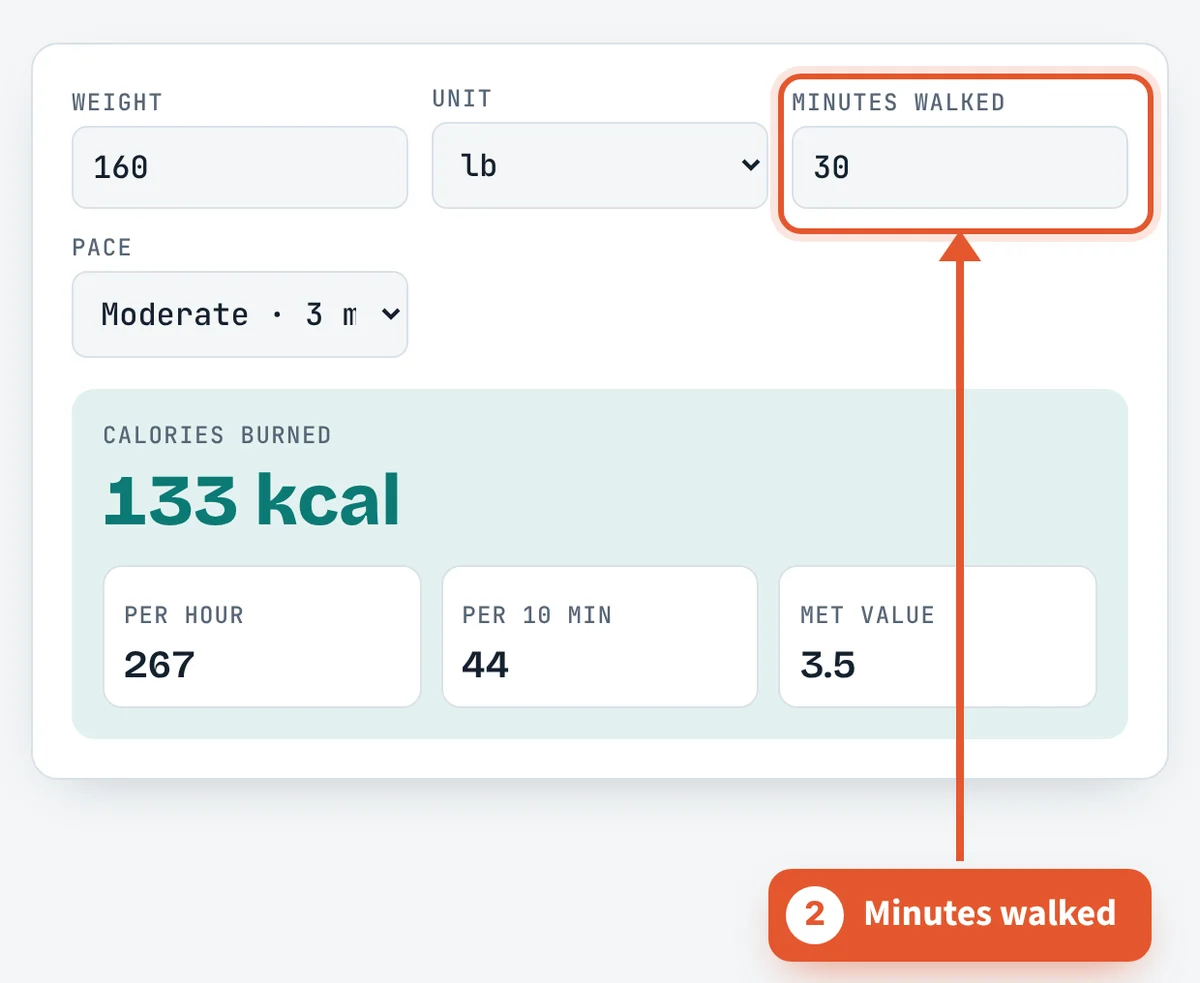
Enter how long you walked
Type the minutes, for example 30 or 45.
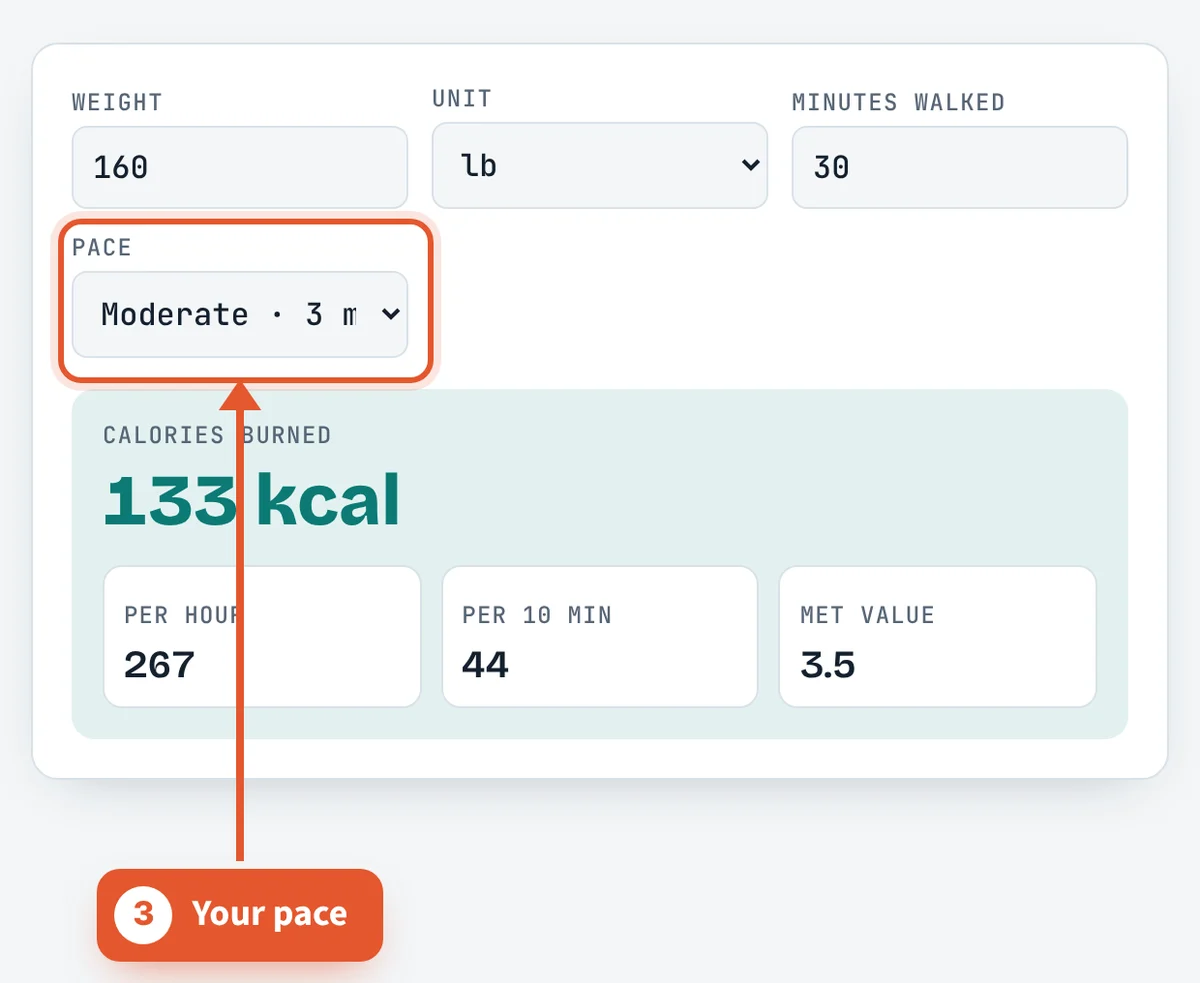
Choose your pace
Pick the speed closest to your walk. Uphill walking burns noticeably more.
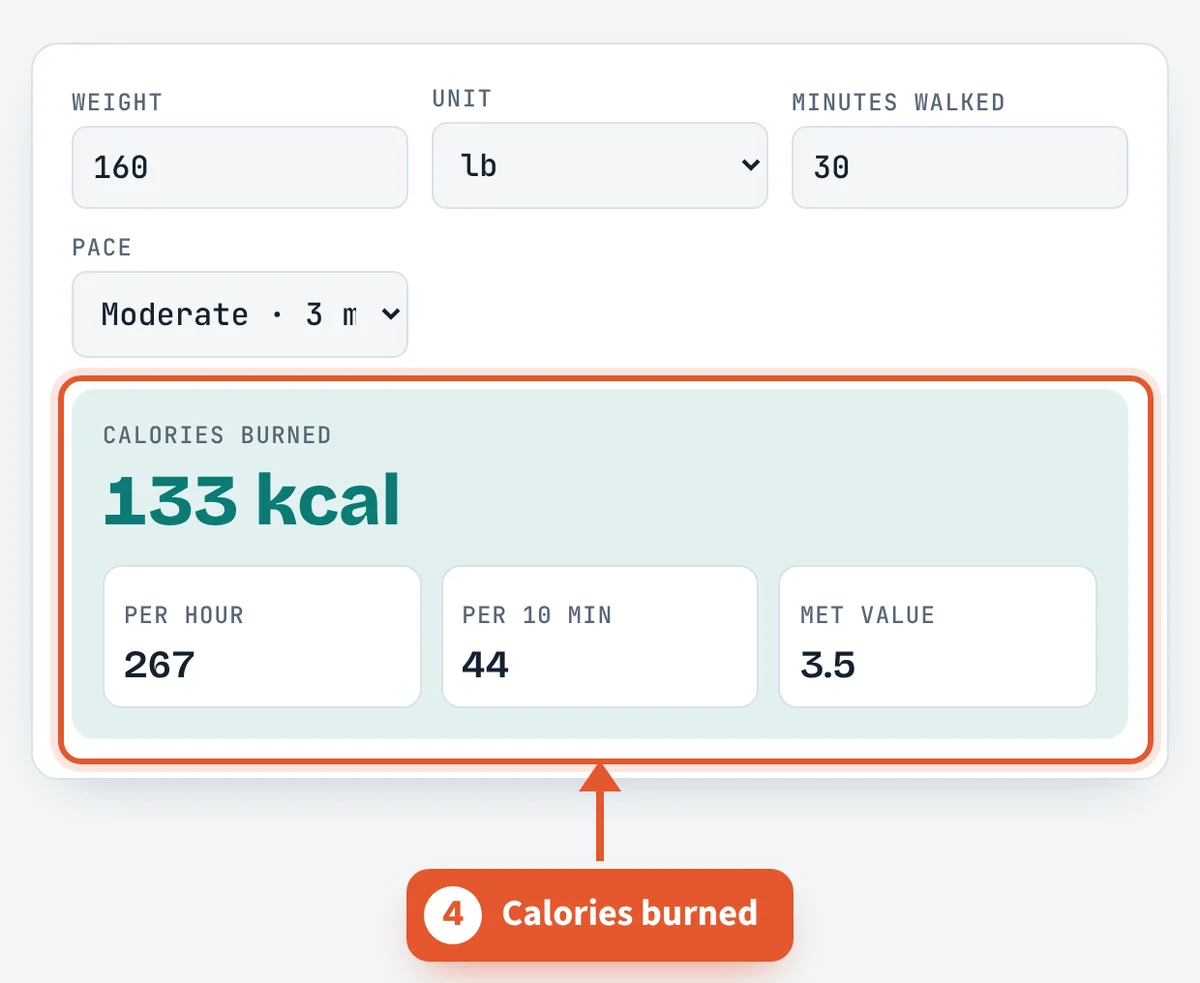
Read your calories
Total calories appear in large text, with the hourly rate, the rate per 10 minutes and the MET value used.
Frequently asked questions
Does walking faster burn more calories?
Yes. Brisk walking at 5.6 km/h burns about 20% more per minute than walking at 4.8 km/h.
How many calories do 10,000 steps burn?
Roughly 300 to 500 kcal for most adults, depending on weight and pace. 10,000 steps usually takes 80 to 100 minutes.
Is walking good for weight loss?
Walking adds to your daily calorie burn and is easy to sustain. Combined with a modest calorie deficit from diet, it supports steady weight loss.
Why does my watch show a different number?
Watches use heart rate and their own formulas. Both are estimates, so use one method consistently to track progress.
What does MET mean?
MET, or metabolic equivalent of task, compares an activity’s energy use with sitting at rest, which is 1 MET.
Sources and further reading
Related tools
Last reviewed: October 2026