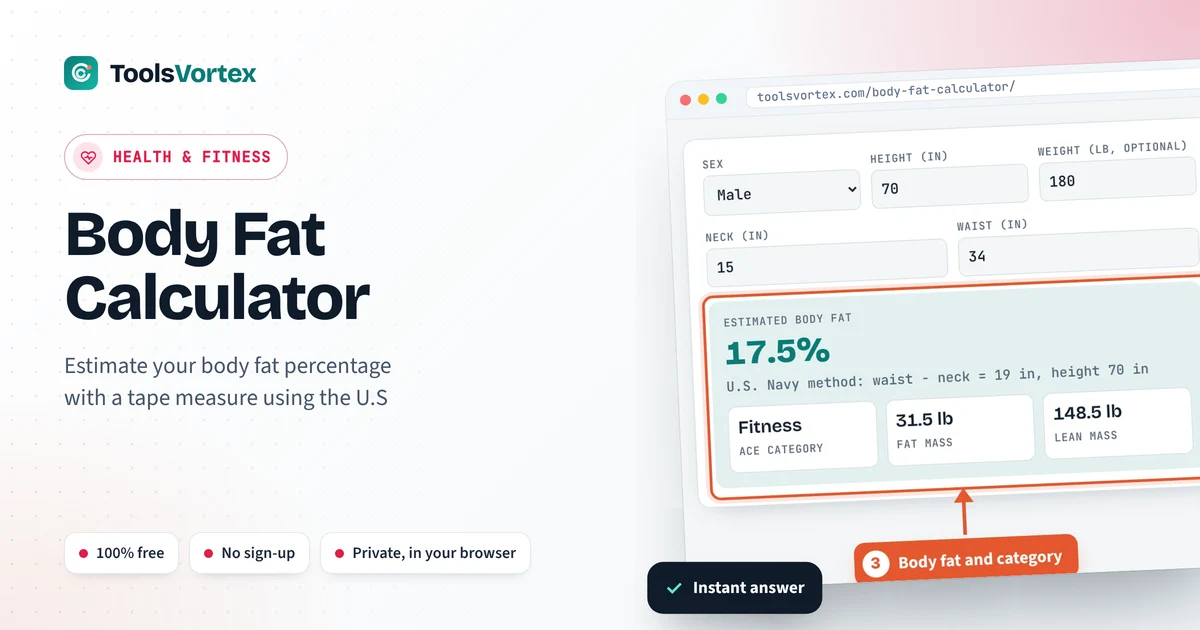
Estimate your body fat percentage with a tape measure using the U.S. Navy method, and see where you fall on the ACE body fat chart.

Bathroom scales can’t tell you how much of your weight is fat. A soft tape measure can get you a decent estimate, though. The U.S. Navy developed this method so it could check sailors’ body composition without lab equipment, and it’s still one of the most popular home methods. Enter your height and a few circumference measurements to get your body fat percentage, the matching category, and how many pounds are fat versus lean mass.
How do I calculate body fat percentage at home?
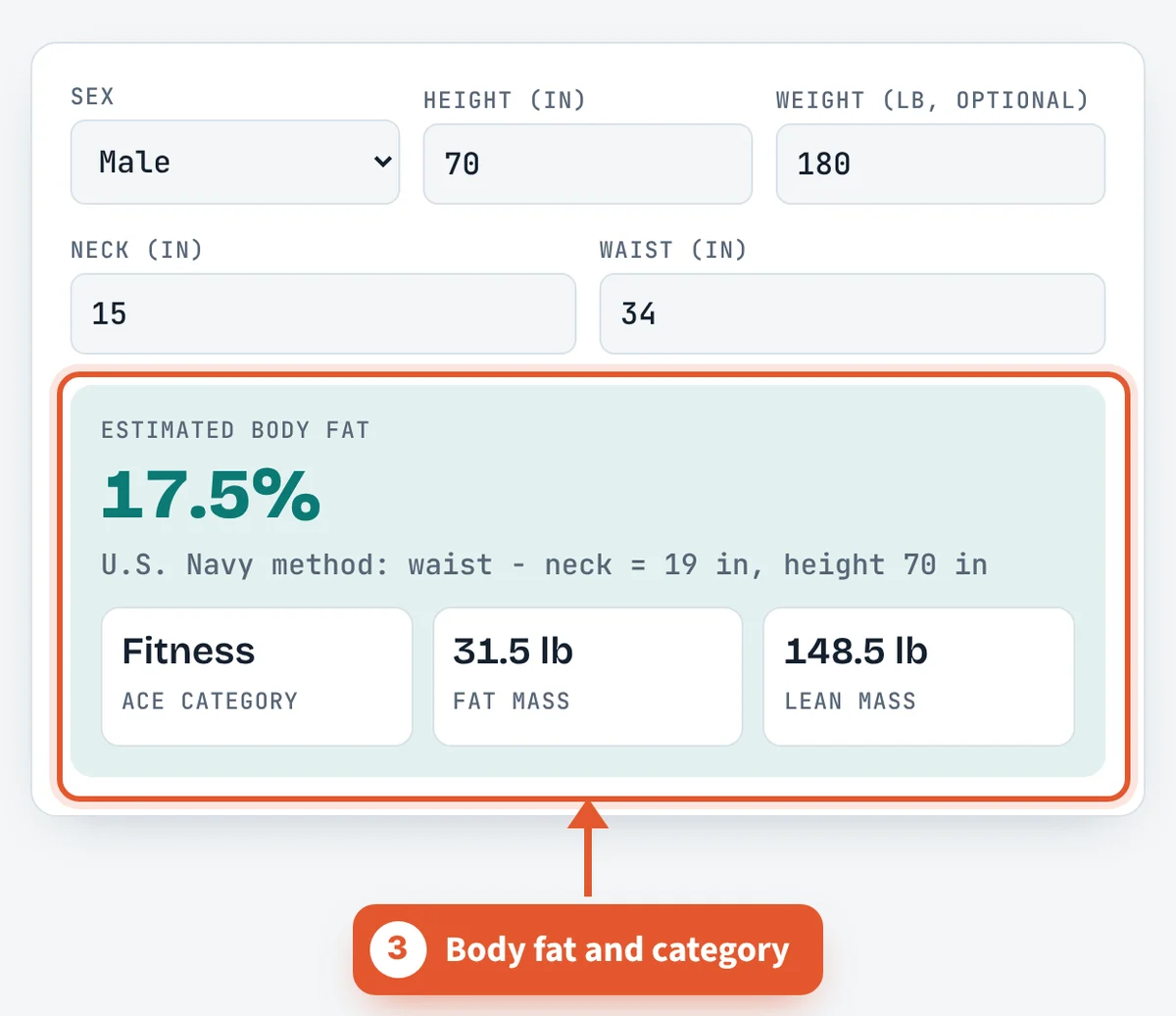
Measure your neck and waist (and hips if you are a woman), then plug them into the U.S. Navy formula along with your height in inches. A man who is 70 in tall with a 34 in waist and a 15 in neck works out to 86.010 × log10(19) − 70.041 × log10(70) + 36.76 ≈ 17.5% body fat, which is in the ACE “fitness” range.
U.S. Navy body fat formula (inches)
Women: % fat = 163.205 × log10(waist + hip − neck) − 97.684 × log10(height) − 78.387
Take the waist at the navel for men and at the narrowest point for women. The neck goes just below the Adam’s apple, and the hip measurement goes around the widest part of the buttocks. Keep the tape level and snug without pressing into the skin.
ACE body fat categories
| Category | Women | Men |
|---|---|---|
| Essential fat | 10 to 13% | 2 to 5% |
| Athletes | 14 to 20% | 6 to 13% |
| Fitness | 21 to 24% | 14 to 17% |
| Average | 25 to 31% | 18 to 24% |
| Obese | 32% and up | 25% and up |
How accurate is it?
Tape methods usually land within about 3 to 4 percentage points of a DEXA scan. That’s fine for tracking a trend over months, not for splitting hairs. Measure at the same time of day, ideally in the morning before eating, and average two or three readings.
How to use the Body Fat Calculator
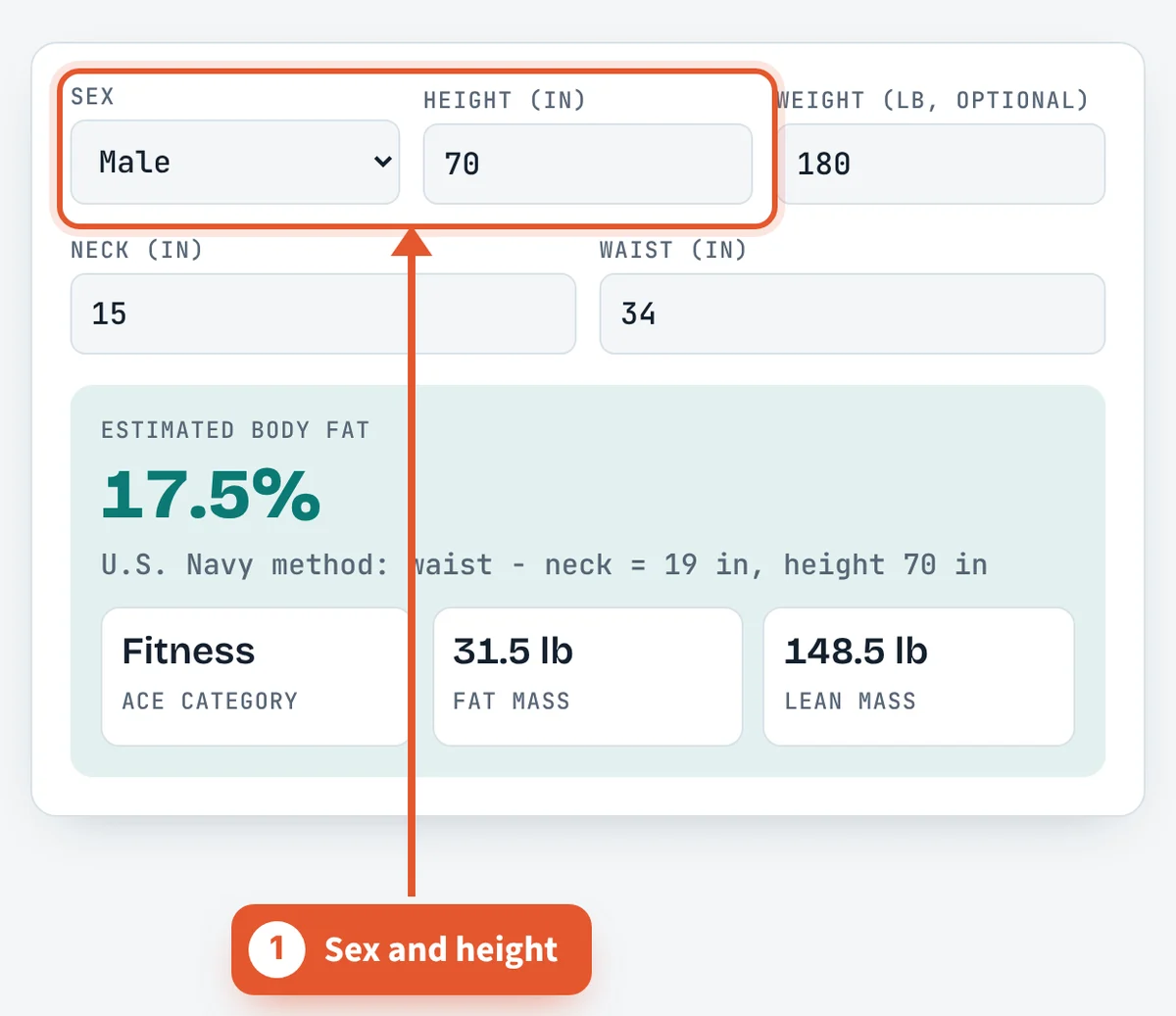
Choose sex and enter height
Pick male or female and type your height in inches (5 ft 10 in is 70 in). Weight is optional and only used for fat and lean pounds.

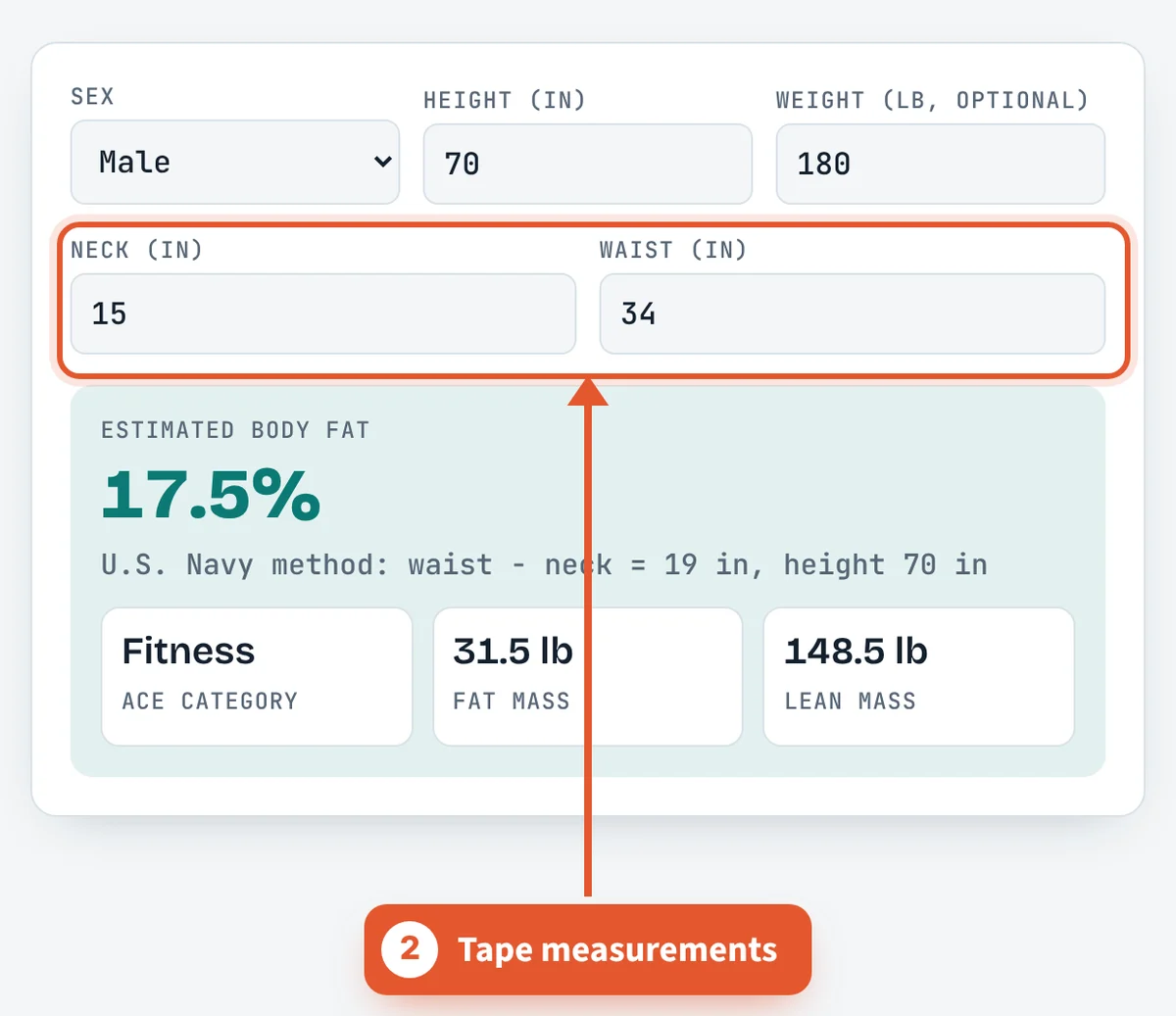
Enter your tape measurements
Type your neck and waist in inches. Women also add the hip measurement.
Read your body fat
Your body fat percentage appears with its ACE category and, if you entered weight, your fat and lean mass in pounds.
Who developed the Navy body fat formula?
The tape-measure equations used here were developed by James Hodgdon and Marcie Beckett at the Naval Health Research Center in San Diego and published in 1984 as two technical reports, one for men and one for women. The Navy wanted a method that needed nothing more than a tape measure and could be used on thousands of sailors.
The researchers measured body fat in volunteers with hydrostatic weighing, then tested which tape measurements predicted those results best. For men, the winning inputs were neck and abdomen circumference plus height. For women, the best set was neck, waist and hip circumference plus height. The equations use logarithms of these values, which is why small measuring errors at the waist change the result more than you might expect.
The Department of Defense has used circumference-based body fat estimates to check service members who exceed weight-for-height screening tables. The method is a screening estimate, not a lab measurement.
Since waist size drives much of the result, the waist-to-height ratio calculator is a useful second check on the same tape measurement.
How do labs measure body fat directly?
Laboratory methods are the reference standards that tape and scale methods try to match.
- Hydrostatic weighing uses Archimedes’ principle. You are weighed on land and again fully underwater after breathing out. Fat is less dense than water and lean tissue is denser, so the difference gives body density. The Siri equation from 1961 then converts density to body fat: percent fat = 495 ÷ density minus 450.
- Air displacement plethysmography works on the same density idea but measures the air you displace while sitting in a sealed egg-shaped chamber, so no dunking is needed.
- Dual-energy X-ray absorptiometry (DXA) passes two low-dose X-ray beams through the body and separates fat, lean tissue and bone mineral, region by region.
- Bioelectrical impedance analysis, used in smart scales, sends a small current through the body. Results shift with hydration, meals and exercise.
Each method has its own error range, so track trends with one method over time. Pair it with the BMI calculator for a broader picture.
Frequently asked questions
Is the Navy body fat method accurate?
For most people it lands within a few percentage points of lab tests. It can be less accurate for very lean athletes or people who carry fat mostly on the hips and thighs.
Why do women need a hip measurement?
Women tend to store more fat around the hips, so the Navy formula for women adds hip circumference to get a better estimate.
What is a healthy body fat percentage?
ACE ranges put fitness levels at 14 to 17% for men and 21 to 24% for women, with average at 18 to 24% and 25 to 31%.
How often should I measure body fat?
Every two to four weeks is plenty. Day-to-day changes are mostly water and measuring error.
Why does the calculator show a dash?
The waist must be bigger than the neck (and waist plus hip bigger than neck for women), or the log in the formula has no real answer. Double-check your numbers.
Sources and further reading
Related tools
Last reviewed: October 2026