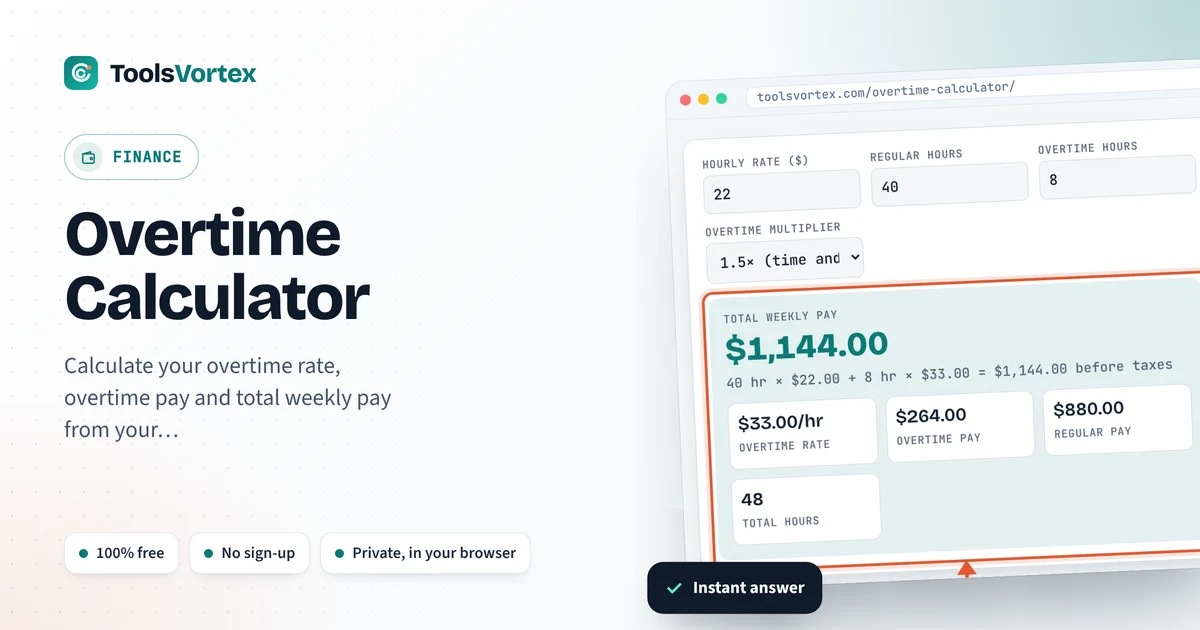
Check your overtime rate, overtime pay and the week’s total from your hourly wage and hours, at time and a half or double time.

Extra shifts feel great right up until the paycheck lands and you can’t tell whether the overtime was paid right, which is exactly when an overtime calculator helps. Federal law says most hourly workers in the US get at least one and a half times their regular rate for every hour past 40 in a workweek. Not past 8 in a day, not on Sundays, past 40 in the week (some states are stricter, more on that below). Type your wage and hours. You’ll see the overtime rate, what those extra hours are worth and the week’s total before taxes. Then hold it up next to the pay stub.
How do you calculate overtime pay?
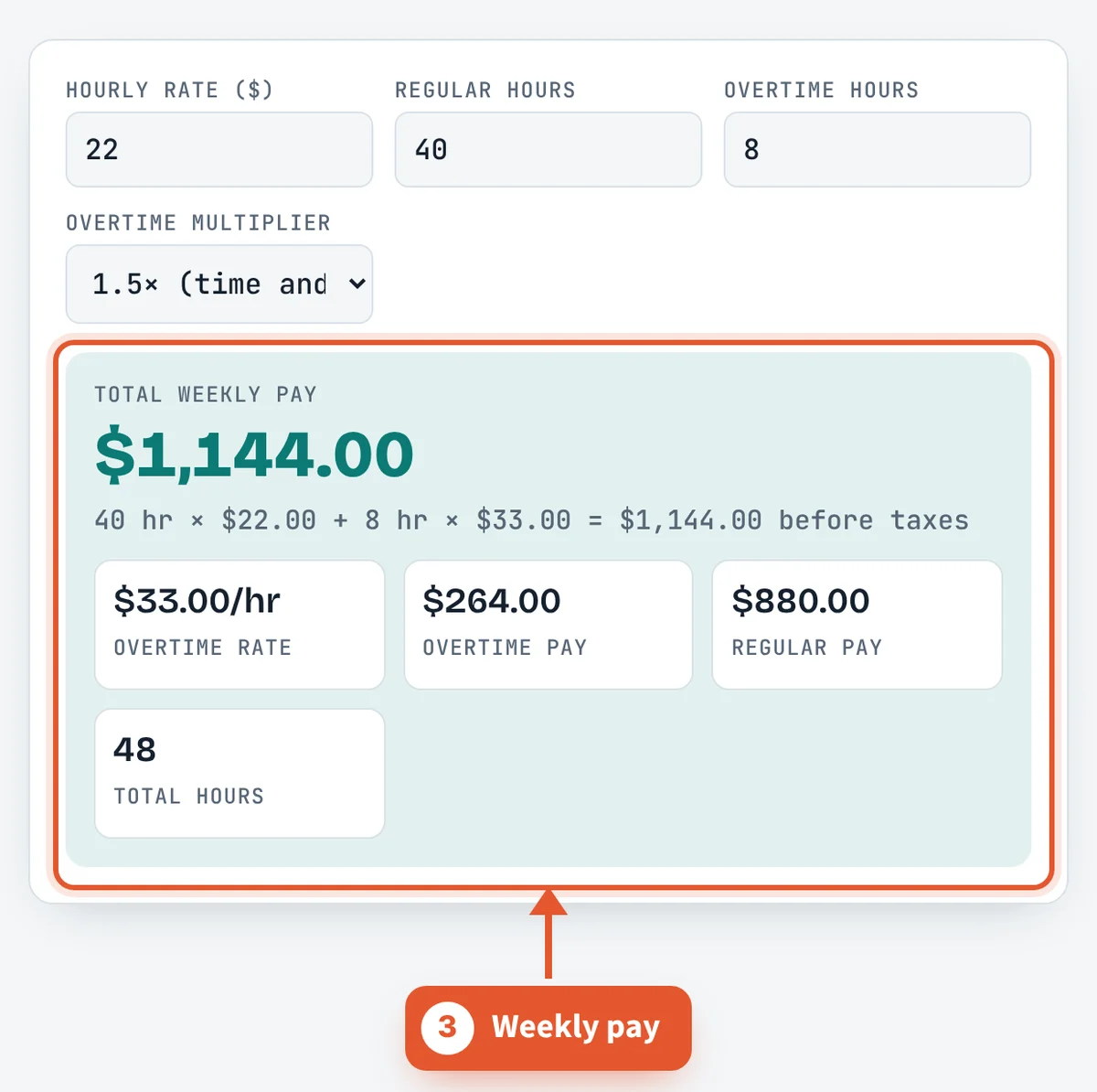
Multiply your hourly rate by 1.5 for the overtime rate, multiply that by your overtime hours, and add your regular pay. That’s all this overtime calculator does. At $22 an hour and a 48-hour week, the overtime rate is $33. Eight overtime hours pay 8 × $33 = $264, the first 40 pay 40 × $22 = $880, and the week comes to $1,144 before taxes.
Overtime pay formula
Overtime pay = Overtime rate × overtime hours
Total pay = Hourly rate × regular hours + Overtime pay
Time and a half at common hourly wages
| Hourly rate | Overtime rate (1.5×) | 10 OT hours | 50-hour week total |
|---|---|---|---|
| $15 | $22.50 | $225 | $825 |
| $20 | $30.00 | $300 | $1,100 |
| $25 | $37.50 | $375 | $1,375 |
| $30 | $45.00 | $450 | $1,650 |
| $40 | $60.00 | $600 | $2,200 |
What federal overtime law actually says
Under the Fair Labor Standards Act, non-exempt employees get at least 1.5 times their regular rate after 40 hours worked in a workweek. That’s the whole federal rule. No required extra pay for weekends, holidays or one brutal 14-hour day, and no federal double time at all. States can go further. California pays daily overtime after 8 hours and double time after 12 in a workday. Some salaried executive, administrative and professional employees are exempt. And your regular rate may have to include shift differentials and certain bonuses, which pushes the overtime rate up.
Two pay rates in one week
Most calculators skip this one. If you work two jobs for the same employer at different rates, say 30 hours at the register for $20 and 15 hours in the stockroom for $26, the overtime rate isn’t time and a half of either. Under the federal rules the usual method is a weighted average. Straight-time pay is $600 + $390 = $990 for 45 hours, so the regular rate is $22. The 5 overtime hours already got paid at straight time, so you add a half-rate premium: 5 × $11 = $55. Total for the week: $1,045. To use the tool above for this, enter $22 as the rate, 40 regular hours and 5 overtime hours and you’ll land on the same $1,045.
How to use the Overtime Calculator
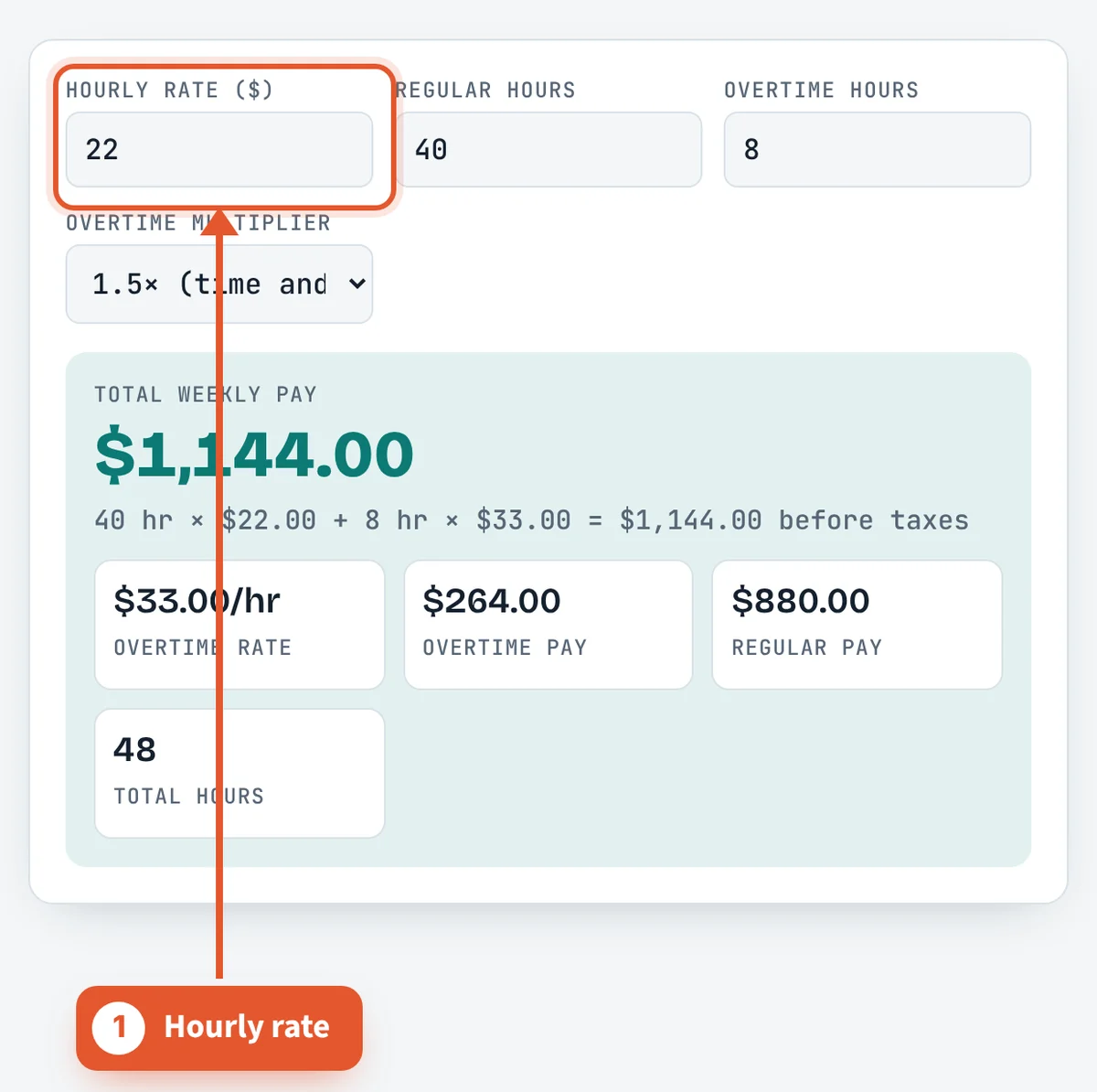
Enter your hourly rate
Type your base hourly pay, before taxes. Shift differential? Fold it in.

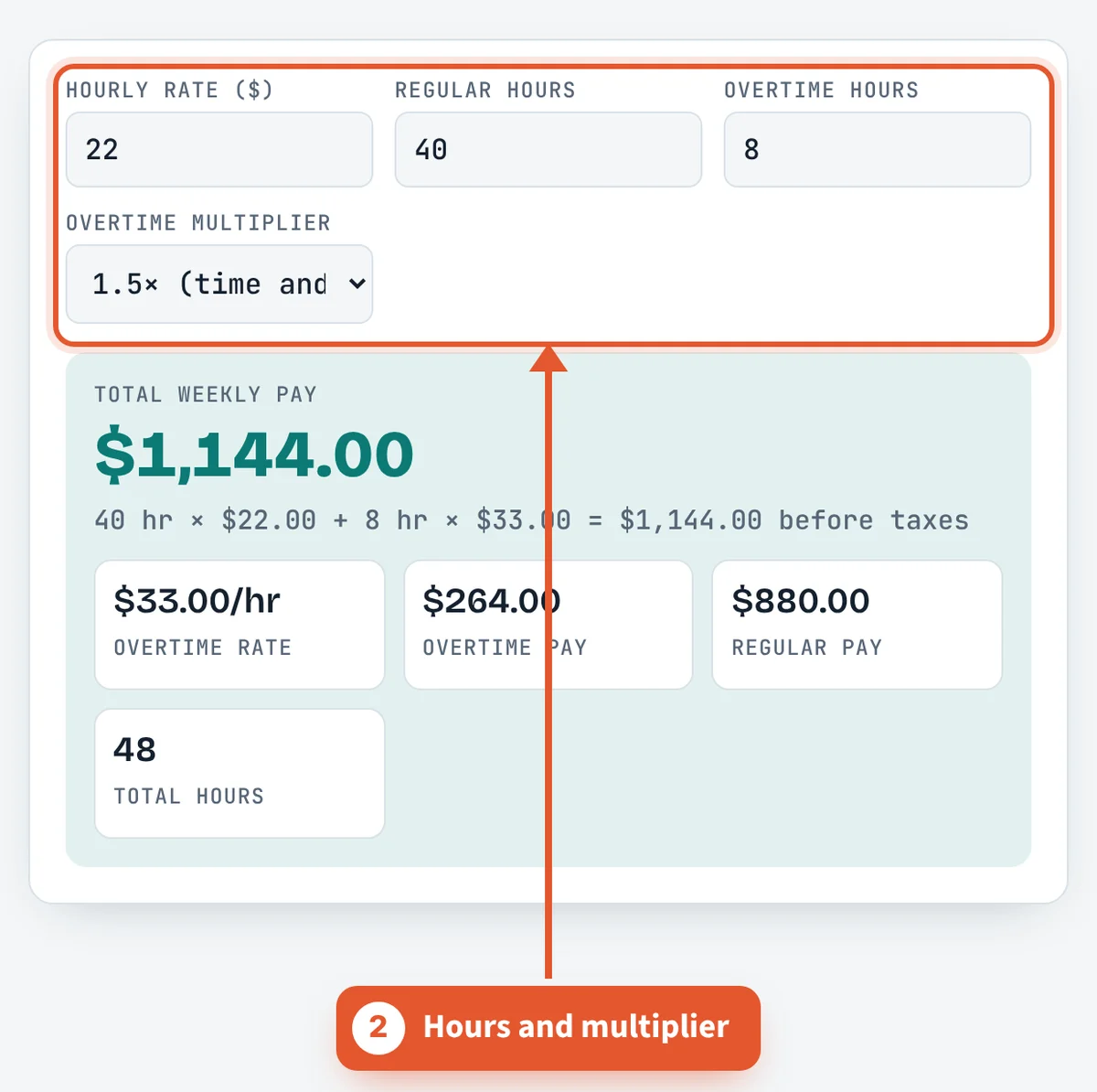
Add regular and overtime hours
Regular hours are usually 40. Type your overtime hours, then pick 1.5× or 2×.
Check your weekly pay
Read the total, then the overtime rate and overtime pay under it. Compare that with the stub line by line.
Which states pay overtime after 8 hours in a day?
Federal law only looks at the week, but some states add a daily limit. When state and federal rules both apply, the employer must follow whichever gives the worker more.
| State | Daily overtime rule |
|---|---|
| California | 1.5× after 8 hours in a workday, 2× after 12 hours, plus special rules for the seventh consecutive day of work |
| Alaska | 1.5× after 8 hours in a day for covered employers |
| Nevada | 1.5× after 8 hours in a 24-hour period for workers earning under 1.5 times the state minimum wage |
| Colorado | 1.5× after 12 hours in a workday or 12 consecutive hours |
Under the California Labor Code, a 10-hour Monday creates 2 overtime hours even if the week totals under 40. Hours are not counted twice: hours already paid as daily overtime are not counted again toward the weekly 40.
California and Alaska both allow approved alternative or flexible schedule agreements that change these rules, so check with your state labor department. To total hours across shifts first, use the time card calculator.
Is overtime pay tax free now?
Partly, for federal income tax, and only for a few years. The One Big Beautiful Bill Act, signed in July 2025, created a federal deduction for “qualified overtime compensation” for tax years 2025 through 2028.
- Only the premium counts. At time and a half, the deductible part is the extra half, not the whole overtime paycheck. Overtime paid only because of a state rule or a union contract, and not required by the Fair Labor Standards Act, does not qualify.
- Annual limit: up to $12,500, or $25,000 on a joint return.
- Income phase-out: the deduction shrinks once modified adjusted gross income passes $150,000, or $300,000 for joint filers.
- You do not need to itemize to claim it.
It is a deduction, not an exemption from withholding. Social Security and Medicare taxes still apply, and state income tax depends on your state. The Internal Revenue Service has issued guidance on how workers and employers figure the qualified amount.
Example: 10 overtime hours a week at a $24 base rate gives a $12 premium per hour, or about $6,240 over 52 weeks. To see what that overtime does to annual pay, try the hourly to salary calculator.
Frequently asked questions
Is overtime after 40 hours or 8 hours a day?
Federally, after 40 hours in a workweek. A few states, California being the famous one, add daily overtime too. Your state labor department’s site will say.
Do I get double time on holidays?
Not under federal law. Holiday or weekend premium pay comes from your employer’s policy, a union contract or state law, if it comes at all.
Who is exempt from overtime?
Certain salaried people in executive, administrative, professional, outside sales and some computer jobs, if they pass both the salary test and the duties test. The federal salary floor the Labor Department enforces is $684 a week. Most hourly workers aren’t exempt, whatever their job title says.
Do paid holidays or PTO count toward the 40 hours?
Not under federal law. The FLSA counts hours actually worked, so a paid holiday on Monday plus 40 working hours the rest of the week is no overtime. Some union contracts and employer policies count them anyway.
Can my employer give comp time instead of overtime pay?
Private employers generally can’t trade paid overtime for comp time under the FLSA. Some state and local government employers can.
Is overtime taxed more?
No, it’s taxed as regular wages. A fatter check can mean more withholding that pay period, so it can look that way. Separately, starting with 2025 pay there’s a federal income tax deduction for some of the half-time premium. Your W-2 and tax return settle it, not the stub.
What if I earn two different hourly rates?
Federal rules generally use a weighted average. Add up all straight-time pay, divide by total hours, then pay half that rate on top for each hour over 40. 30 hours at $20 plus 15 at $26 works out to a $22 regular rate and $1,045 for the week.
Sources and further reading
Related tools
Last reviewed: October 2026