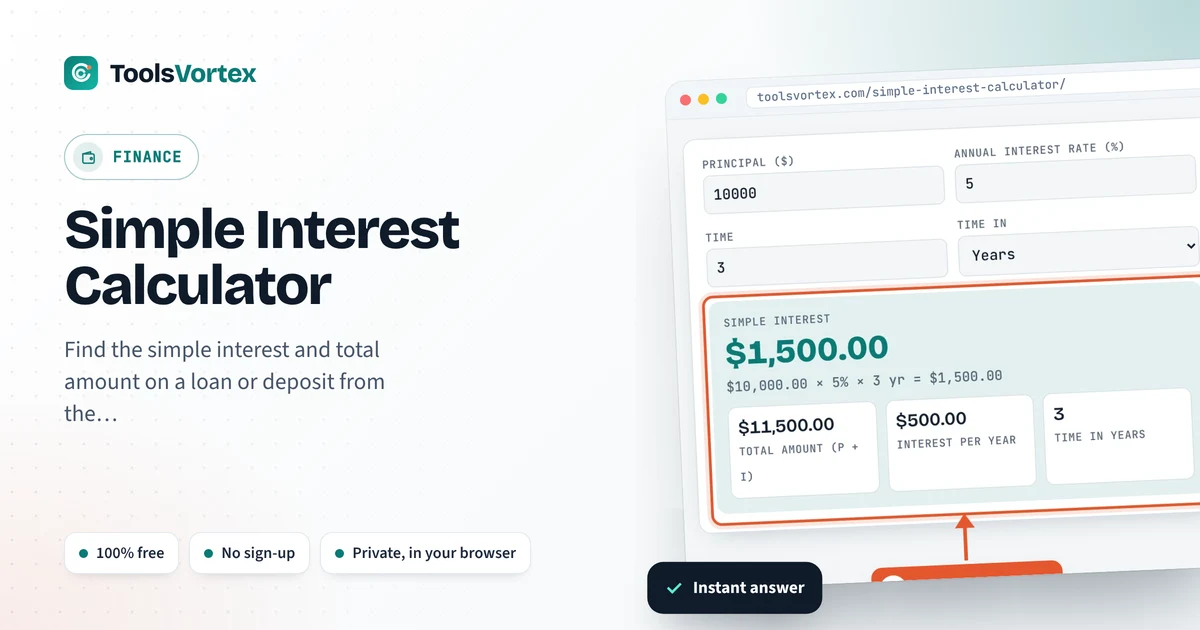
Get the simple interest and the total owed or earned from the principal, the yearly rate and the time, in years, months or days.

Okay, so a simple interest calculator does one job: it tells you how much interest piles up when the lender only charges on the amount you started with. Never on old interest. Honestly that’s rarer than you’d think these days. You’ll still bump into it with plenty of car loans, a few short personal loans, Treasury bills, that IOU your brother-in-law keeps “forgetting” about, and roughly half the word problems in Algebra I. Punch in the amount. Then the yearly rate, then how long. Years, months, days, whatever your paperwork uses. Pick days and I divide by 365, and you’ll see the interest plus the grand total you’d pay back (or collect, if you’re the one doing the lending).
How do you calculate simple interest?
Multiply the principal by the rate and then by the time (I = P × r × t, rate as a decimal, time in years), and honestly that’s all this simple interest calculator is doing under the hood. So $10,000 at 5% for 3 years? You’d get $1,500 in interest, and $11,500 once the principal’s added back. Got days instead of years? Divide by 365 first. $5,000 at 6% for 90 days comes to $73.97, a little less than you’d guess.
Simple interest formula
A = P + I = P × (1 + r × t)
t in years: months ÷ 12, or days ÷ 365
Before anything, slide that decimal point over. Five percent means 0.05. Plug in a plain 5 and you’ll get an answer a hundred times too big, which is the classic homework blunder (teachers see it every single semester, I promise).
365 days or 360? It changes the answer
Weird but true, some banks and money market funds pretend a year has 360 days. People call it the banker’s rule. Same rate, same days, and the bank quietly collects a bit more. How much more? Not a lot:
| Loan | Days | 365-day year | 360-day year |
|---|---|---|---|
| $5,000 at 6% | 90 | $73.97 | $75.00 |
| $10,000 at 5% | 180 | $246.58 | $250.00 |
| $50,000 at 7% | 30 | $287.67 | $291.67 |
I stuck with 365 here. So is your statement a few cents (or a few bucks) above my number? Look for the 360-day thing before you call anybody and wait on hold.
Simple vs. compound interest on $10,000 at 5%
| Years | Simple interest | Compound (yearly) |
|---|---|---|
| 1 | $500 | $500 |
| 3 | $1,500 | $1,576 |
| 5 | $2,500 | $2,763 |
| 10 | $5,000 | $6,289 |
| 20 | $10,000 | $16,533 |
Year one, dead even. At three years you’d hardly care about $76. Leave it alone for twenty, though, and compound pulls ahead by $6,533, since it’s been earning interest on its interest that whole time while simple just plods along.
How to use the Simple Interest Calculator
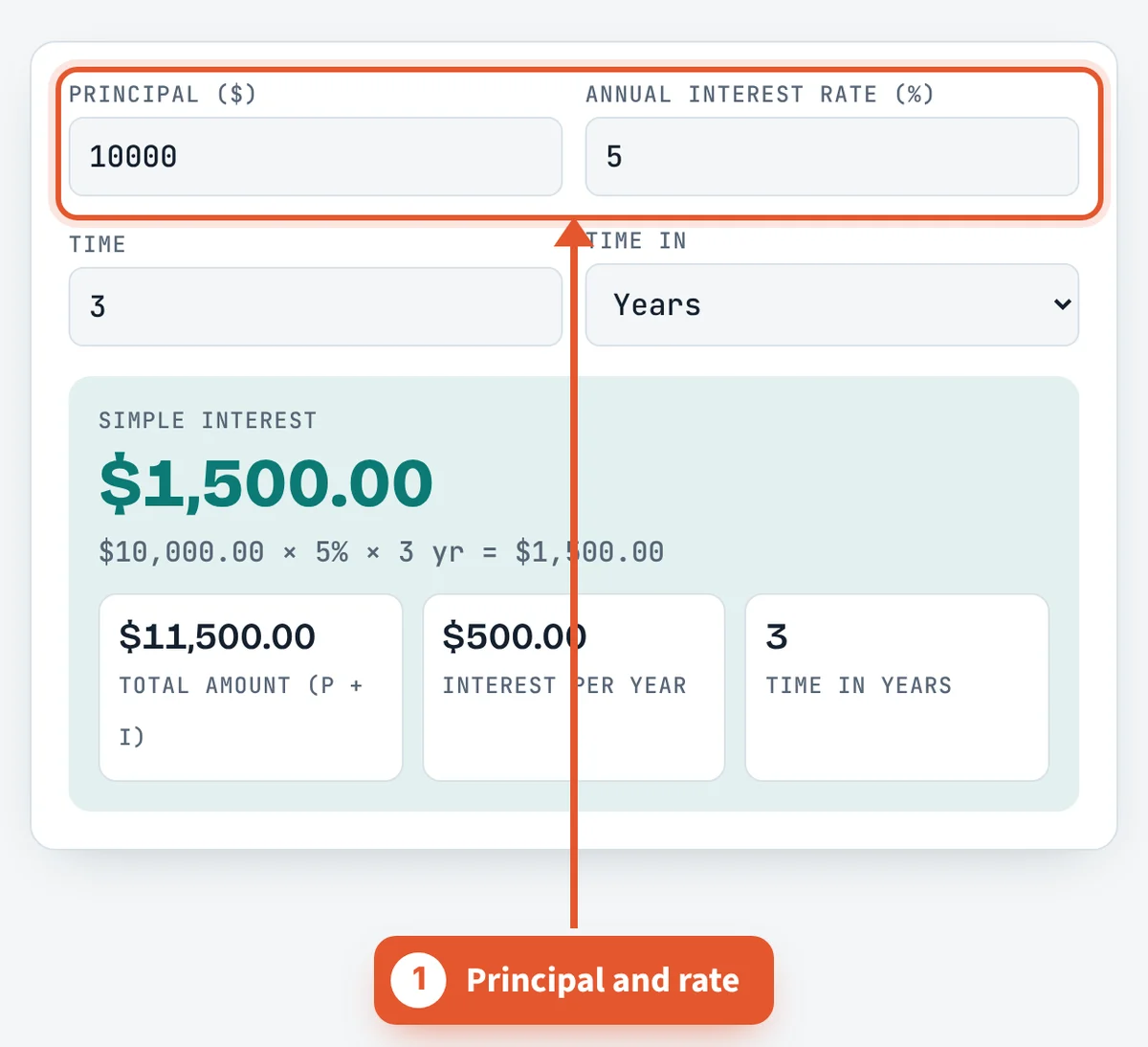
Enter the principal and rate
Start with what was borrowed or deposited, then the yearly rate as a plain percent, like 5. I’ll do the decimal for you.

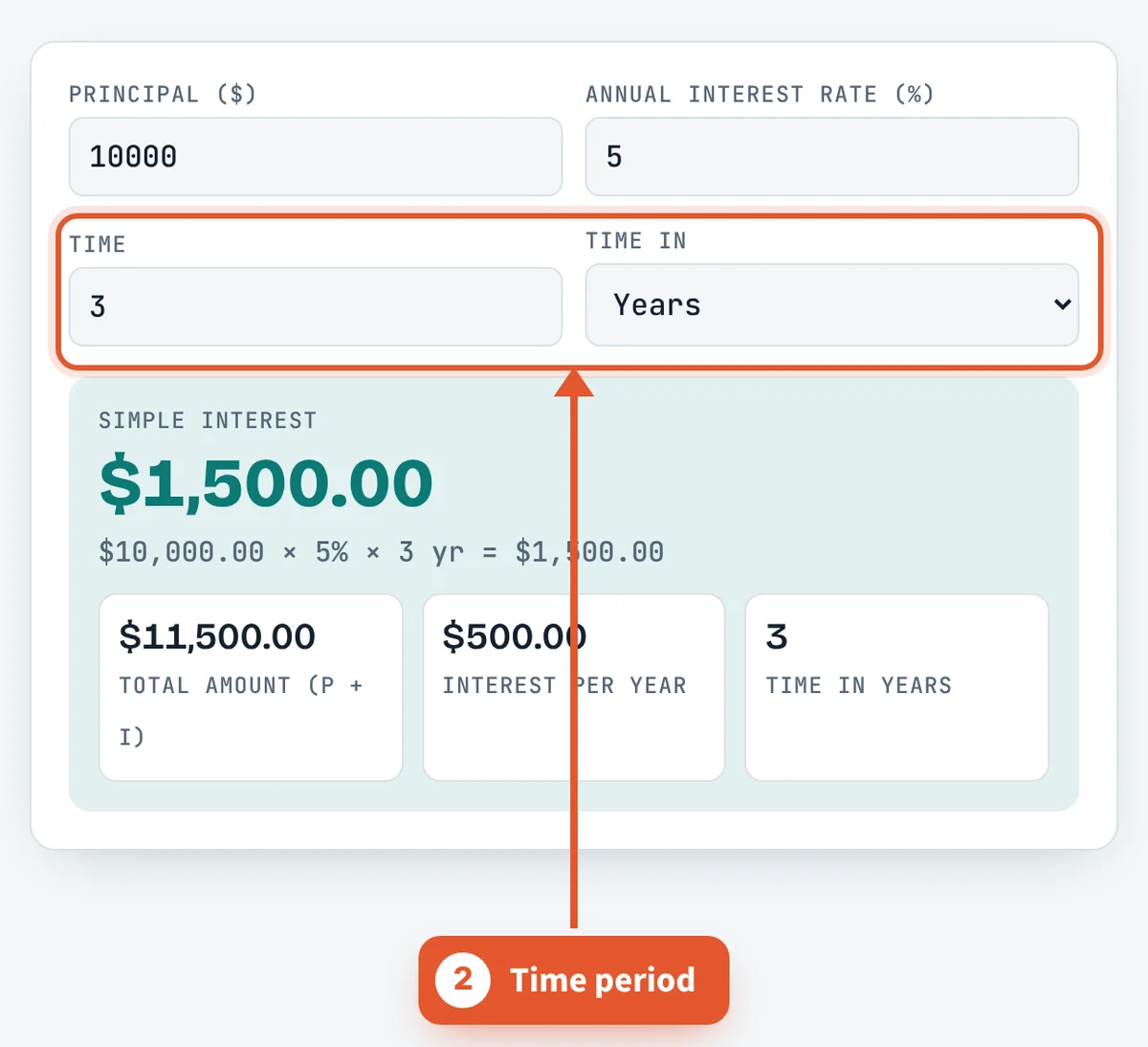
Enter the time
How long? Type it and pick years, months or days. Got a 90-day note? Pick days. Don’t sit there guessing what fraction of a year that is.
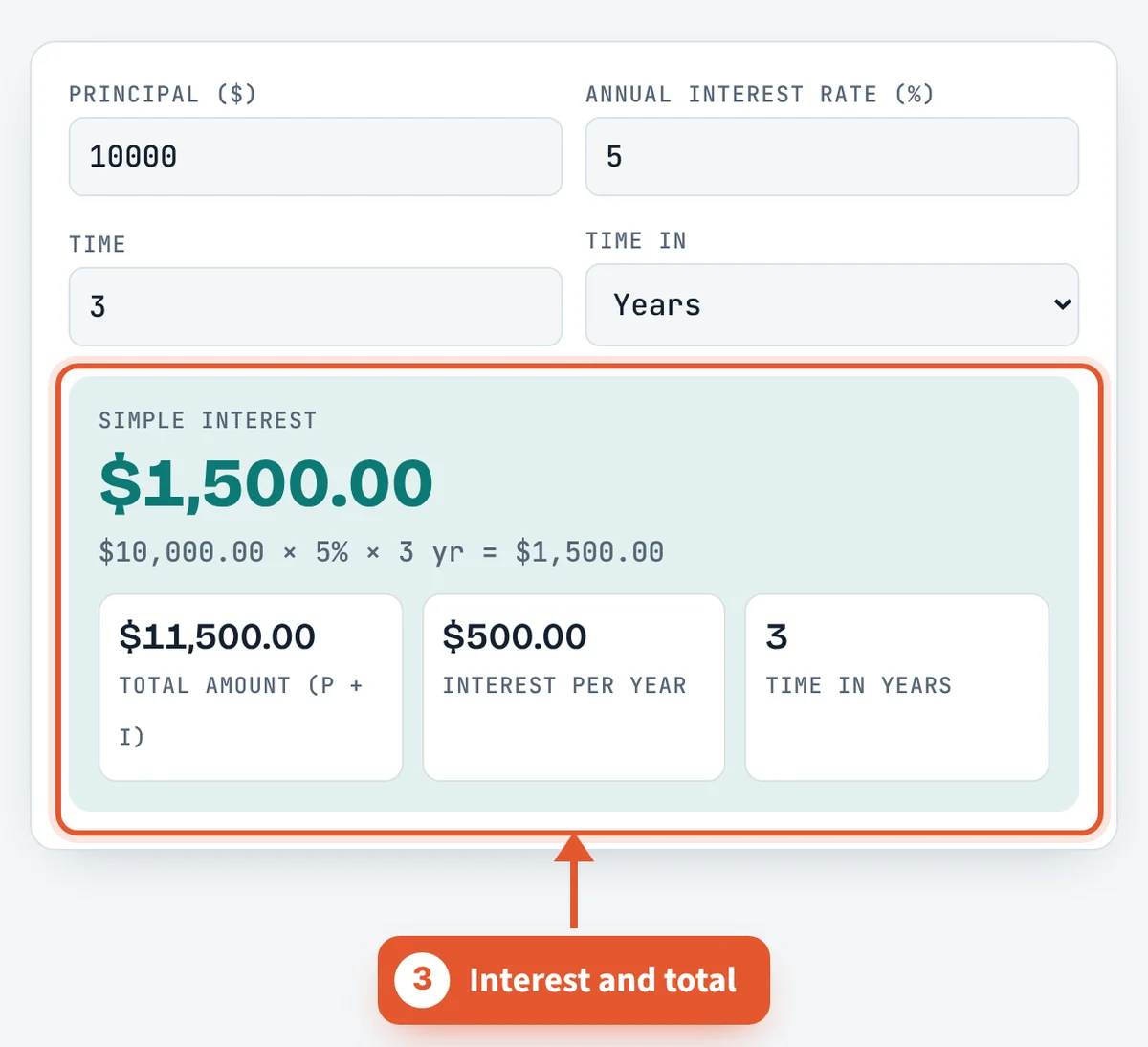
Read the interest and total
Big number up top is your interest. Under that sits the total you’d repay, and also what one full year of interest costs, which I find handy when two offers look alike.
Which loans use simple interest?
Simple interest is more common in everyday borrowing than many people expect. The key feature is that interest is charged only on the principal you still owe, never on unpaid interest.
- Auto loans: many car loans in the US are simple interest loans that accrue interest daily on the remaining balance. Paying a few days early slightly reduces the interest in that payment, and paying late increases it. The car loan calculator shows the full payment schedule.
- Federal student loans: the US Department of Education uses a simple daily interest formula on Direct Loans. Interest can still grow your balance, though, through capitalization, when unpaid interest is added to principal at certain events such as the end of a deferment.
- Short-term notes: promissory notes between businesses or family members often state a flat annual rate for a set term.
Credit cards and most savings accounts are different. They compound, so interest earns or costs interest. For those, the compound interest calculator gives a truer picture.
Is the interest rate the same as the APR?
Not quite. The interest rate is the price of borrowing the principal. The annual percentage rate (APR) is a broader yearly cost that folds in certain finance charges, such as many origination fees, so two loans with the same interest rate can show different APRs.
APR disclosure comes from the Truth in Lending Act of 1968, carried out through Regulation Z, now overseen by the Consumer Financial Protection Bureau. Lenders must state the APR on consumer credit so borrowers can compare offers on equal terms.
Savings products use a different measure. The annual percentage yield (APY), required under the Truth in Savings Act and Regulation DD, includes the effect of compounding. With simple interest there is no compounding, so the simple rate and the yield are equal. With monthly compounding, a 5% rate becomes about a 5.12% APY.
When you compare loans, use the APR. When you compare accounts, use the APY. Use the simple interest formula on this page when a contract plainly says interest is charged only on principal, and the loan calculator when payments are amortized.
Frequently asked questions
What is the simple interest formula?
I = P × r × t. Principal, times the yearly rate written as a decimal, times years. Yep, that’s the entire thing. People always expect more.
How do I calculate simple interest for months?
Divide the months by 12 so you’re working in years. Say you owe $3,000 at 6% for eight months. That’s 3,000 × 0.06 × 8 ÷ 12, so $120.
Do car loans use simple interest?
Lots of US auto loans do, yep. Interest gets tacked on each day based on what’s left. So paying a few days early, or tossing in an extra $50 when you can, means less interest over the life of the loan.
How much interest am I paying per day?
Take the balance, times the rate, then divide by 365. On $20,000 at 7% that’s about $3.84 a day. Pay a week late? Roughly $27 extra, which stings more than it should.
Why doesn't my answer match my bank's?
Most of the time it’s that 360-day year. If not, they might compound, or count days their own way. Your loan agreement says which, usually in the boring fine print near the back.
How do I find the rate or the time from the interest?
Turn the formula around. Rate = I ÷ (P × t), so $600 in interest on $5,000 over 2 years means 6%. And time = I ÷ (P × r). That’s how you’d figure $450 on $6,000 at 5% took a year and a half.
Sources and further reading
Related tools
Last reviewed: October 2026