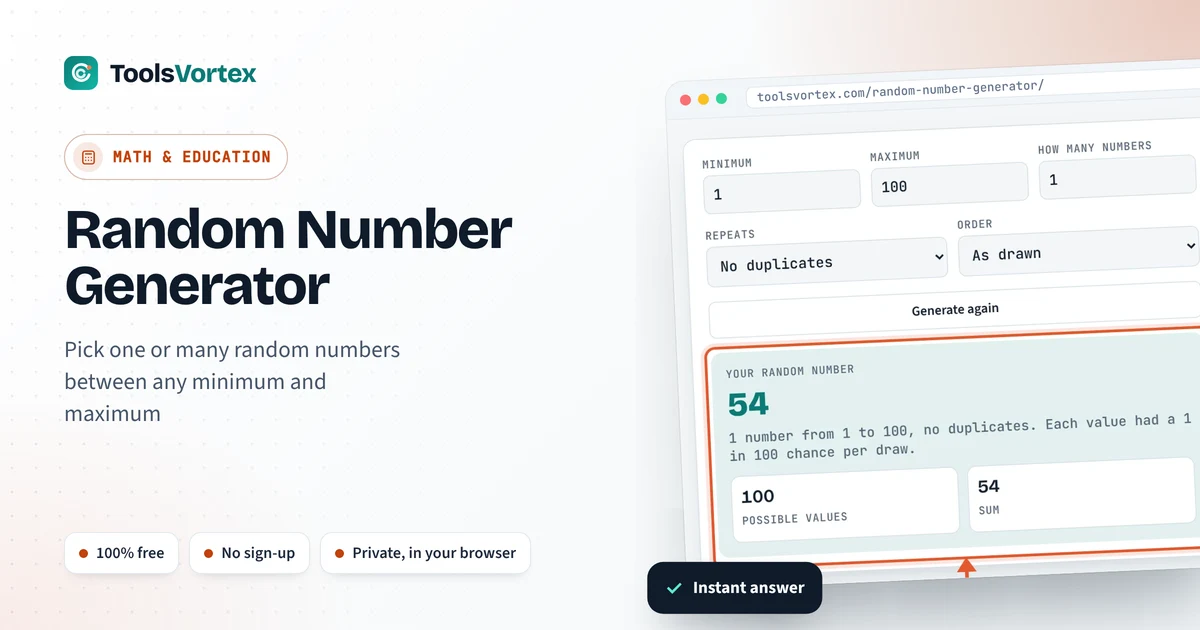
Draw one random number or a whole batch between any minimum and maximum. Block repeats, sort the list, and hit Generate again whenever you want a fresh pull.

A random number generator sounds like the simplest tool on the internet, and mostly it is. Raffle tickets, picking which kid answers question 4, the giveaway winner, who goes first in Catan. The one thing I cared about: this one pulls from your browser’s cryptographic random source, the same place your browser gets randomness for encryption, not the basic Math.random() most quick pickers use. Set a range. Say how many numbers. Decide if a number can show up twice. That’s the whole job.
How do I pick a random number between two numbers?
Low number in one box, high number in the other, then hit Generate again. That’s it. The random number generator treats every whole number in there the same, and yes, both ends count. So 1 to 100? A hundred possible values, and any one of them has a 1 in 100 (1%) shot each time you draw.
How the numbers are picked
Under the hood it calls crypto.getRandomValues() for raw random bits, then fits them onto your range. The lazy way to do that, plain modulo, makes some numbers a hair more likely than others. So any value that would tilt the odds gets tossed and drawn again (that’s called rejection sampling). Every number in your range really does get the same chance.
Duplicates on or off?
With duplicates off it’s like pulling tickets out of a hat and not putting them back. Raffles, seating charts, lottery-ish stuff? This one. Flip duplicates on and every draw forgets the last, the way a die has no memory of the six it just rolled. One catch. A range of 1 to 5 only holds five numbers, so if you ask it for 10 different ones it’ll just complain at you (fair enough).
Why you keep seeing repeats
Leave duplicates on, grab a handful from 1 to 100, and bam, a repeat, way earlier than your gut says. It’s the birthday problem wearing a different hat. Here are the odds of at least one match:
| Numbers drawn from 1 to 100 (repeats allowed) | Chance of at least one repeat |
|---|---|
| 2 | 1% |
| 5 | 9.7% |
| 10 | 37.2% |
| 12 | 49.7% |
| 20 | 87% |
| 30 | 99.2% |
So if 47 comes up twice in a draw of ten, nothing’s broken. Turn duplicates off if a repeat would cause an argument.
Handy presets
| Use | Min | Max | How many | Duplicates |
|---|---|---|---|---|
| Coin flip (1 = heads) | 1 | 2 | 1 | n/a |
| Six-sided die | 1 | 6 | 1 | n/a |
| Two dice | 1 | 6 | 2 | Allowed |
| Powerball-style white balls | 1 | 69 | 5 | No |
| Raffle with 250 tickets | 1 | 250 | 3 | No |
How to use the Random Number Generator
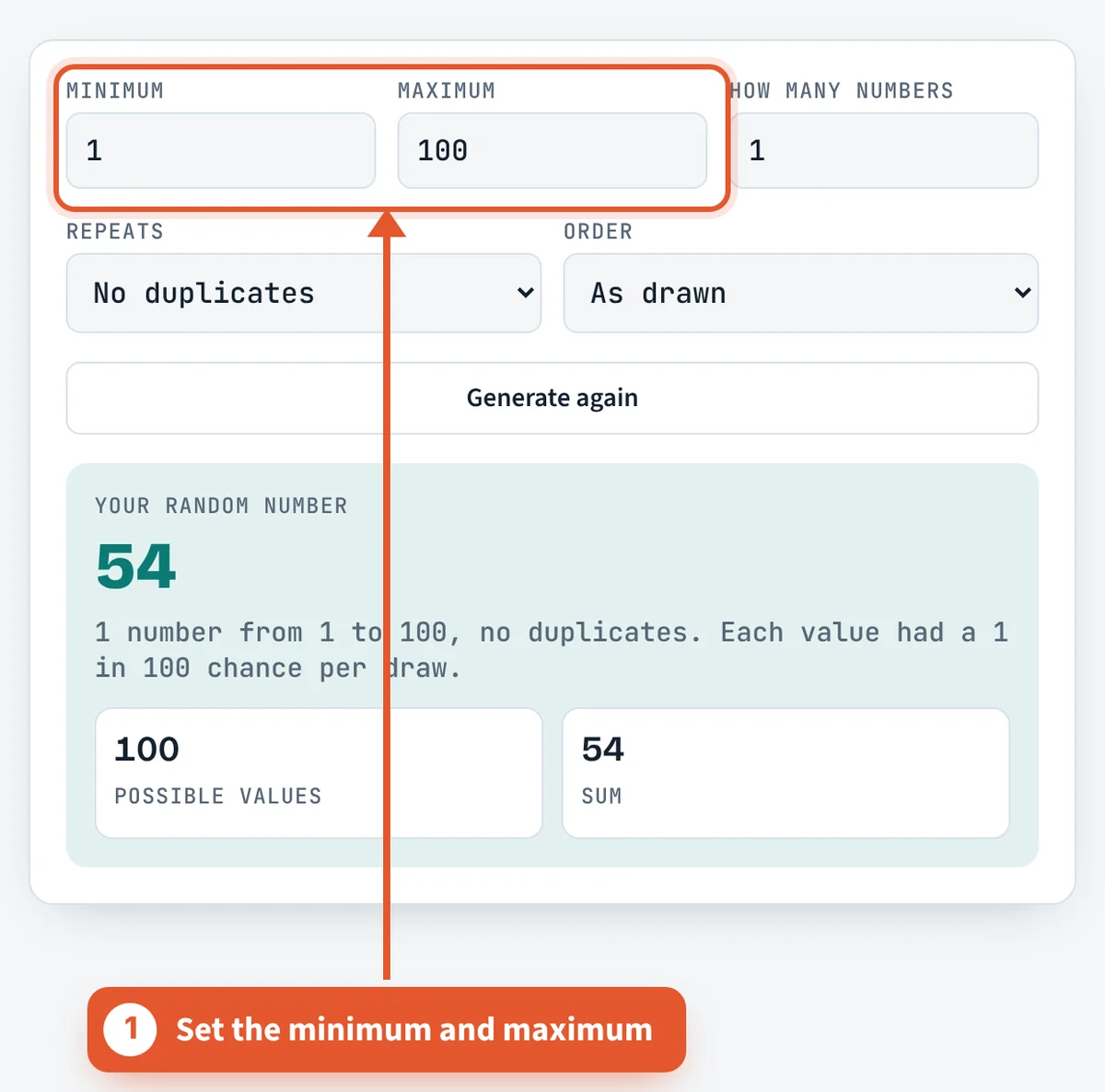
Set the range
Type the minimum and the maximum. Both ends can come up, and negative numbers are fine.

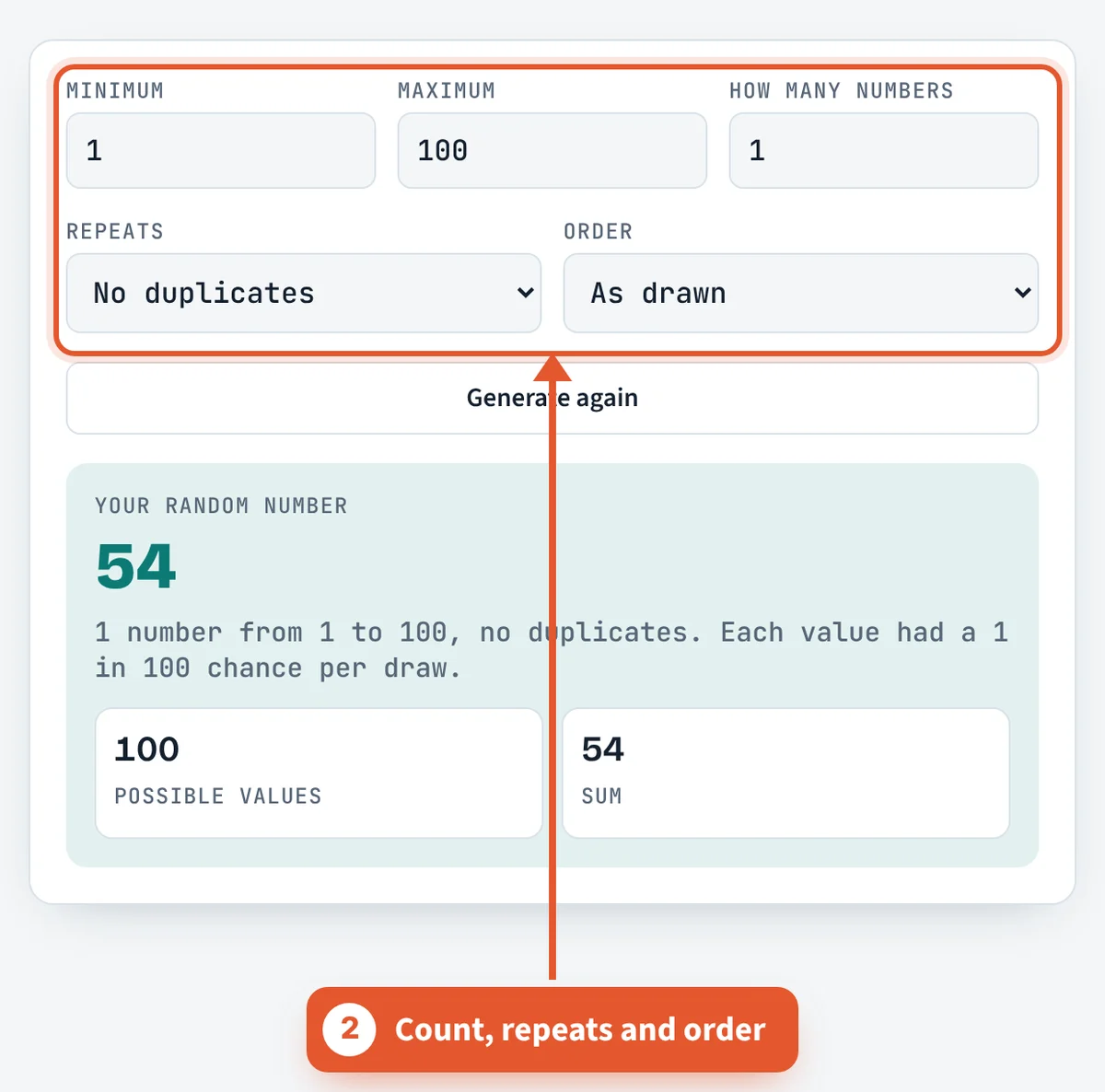
Choose count, repeats and order
How many? Can the same one show up twice? Sorted or messy? Pick and move on.
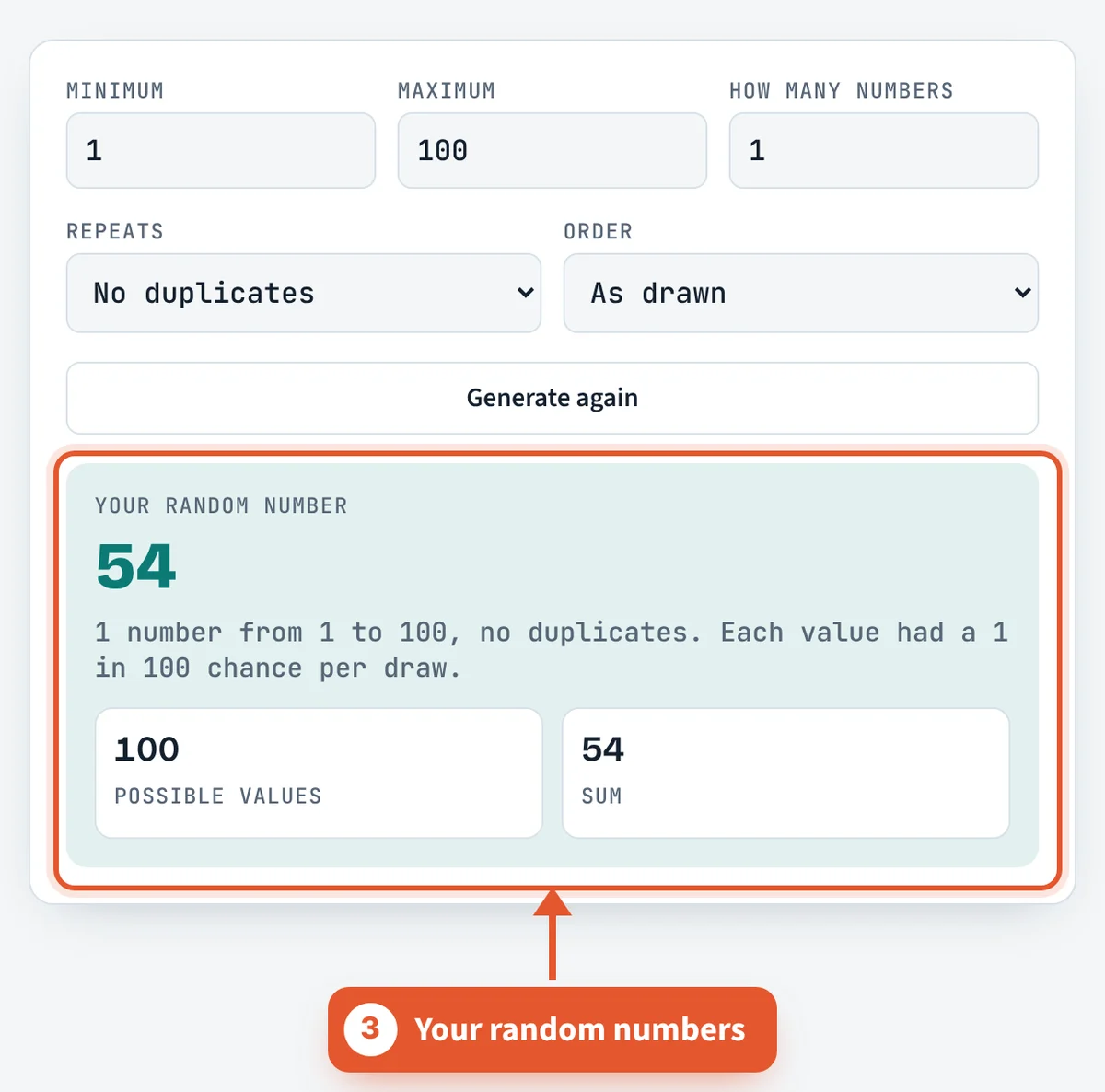
Draw and read
They pop up instantly. Didn’t like the result? Hit Generate again (we won’t tell).
Is a computer random number truly random?
Usually not in the strict sense, and for most uses that is fine. Computers mostly use a pseudorandom number generator (PRNG): an algorithm that starts from a seed value and produces a sequence that passes statistical tests for randomness. Run it again from the same seed and you get the same sequence. A well-known example is the Mersenne Twister, published by Makoto Matsumoto and Takuji Nishimura in 1998, with a period of 2 to the power of 19937 minus 1 before it repeats.
For anything where someone might try to predict the output, such as passwords or keys, software uses a cryptographically secure generator. In browsers that is the Web Crypto API method crypto.getRandomValues(), which draws on entropy collected by the operating system from unpredictable hardware events. NIST sets out approved designs for these generators in Special Publication 800-90A.
True random number generators measure a physical process, like electrical noise, instead of running a formula. For picking a raffle number or a classroom order, a good PRNG is more than enough. For credentials, use a secure source, which is how the password generator works.
How do you pick a fair winner from a list of names?
Give every entry exactly one number, then draw from that range. Before you start, clean the list. Duplicate entries give someone extra chances, so run the names through remove duplicate lines and sort them with the alphabetical order tool so anyone can check their position.
If you need a full ranking or several winners, shuffle the whole list instead of drawing numbers one at a time. The standard method is the Fisher-Yates shuffle, described by statisticians Ronald Fisher and Frank Yates in 1938 and adapted for computers by Richard Durstenfeld in 1964. It walks the list from the end, swapping each item with a randomly chosen item at or before its position, so every ordering is equally likely.
Watch out for modulo bias if you write your own code. Taking a large random integer and using the remainder after division to fit a small range makes some results slightly more likely when the range does not divide evenly. Good generators reject and redraw those values.
For transparency, record the draw on screen and post the numbered list before you pick.
Frequently asked questions
Is this random number generator truly random?
It uses the browser’s cryptographically secure generator, which is seeded from unpredictable activity on your device. That’s plenty for raffles, games and the classroom. State lotteries use audited machines, though, so this isn’t a stand-in for those.
Why did I get the same number twice?
Almost certainly because duplicates were allowed. Draw 12 numbers from 1 to 100 with repeats on and there’s about a 50% chance two of them match. Switch Repeats to “No duplicates” and it can’t happen.
Can I use it to pick a winner from a list of names?
Sure. Number the names down your list, so if 37 people entered the giveaway, set it to 1 through 37 and draw once. Whoever sits at that spot wins. Got three prizes? Ask for 3 with duplicates off, or Aunt Linda might win twice and nobody wants that conversation.
Does it include the minimum and maximum?
Yep, both. Set 1 to 10 and you can land on the 1 or the 10 just as easily as a 6.
Is there a limit on how many I can draw?
A thousand per click. And with repeats off you’re capped by the range itself, since 1 to 50 only has 50 numbers to give.
Can it pick lottery numbers?
It’ll give you five numbers from 1 to 69 with no repeats, Powerball style. It can’t improve your odds, though. The Powerball jackpot is still about 1 in 292.2 million however you choose.
Is the result saved anywhere?
No. The numbers are made in your browser and vanish when you leave or draw again. Running a giveaway on Instagram? Screenshot it before you close the tab, people love to ask.
Sources and further reading
Related tools
Last reviewed: October 2026