Work out how many calories to eat each day to lose weight at a steady pace. Enter your details and goal weight to get a daily calorie target, your weekly loss and a realistic date to reach your goal, in kg, stone or pounds.
An estimate for healthy adults, not medical advice.

This calorie deficit calculator is for adults who want to lose weight and need a daily calorie number they can actually plan meals around. It estimates the calories you burn now, takes off the deficit you choose and shows how long your goal should take. Unlike most deficit tools, it gives two timelines: the quick textbook rule, and a more realistic estimate that allows for your body burning less as you get lighter. If you only want your maintenance calories, the calorie calculator is the simpler tool.
How big should a calorie deficit be to lose weight?
For most adults, a calorie deficit of about 500 to 600 kcal a day below maintenance is a sensible start. UK NICE guidance uses 600 kcal a day, which by the common 7,700 kcal per kg rule is about 0.5 kg a week. NICE describes 0.5 to 1 kg a week as the usual recommended rate.
How Does the Calorie Deficit Calculator Work?
It works in three steps: estimate your resting burn, scale it up for activity, then subtract your deficit.
Maintenance = BMR × activity level (1.40 to 2.00)
Daily target = maintenance − deficit
Weekly loss (simple rule) = deficit × 7 ÷ 7,700 kcal per kg
The activity levels come from the joint FAO, WHO and UNU report on human energy requirements, which rates 1.40 to 1.69 as sedentary, and from the UK’s Scientific Advisory Committee on Nutrition, which uses 1.63 as the typical adult value. The 7,700 kcal figure is the metric version of the old rule that a pound of body weight holds about 3,500 kcal. Your BMR appears in the results too, so you can see how much of your daily burn happens at rest.
How Much Weight Will I Lose With a Calorie Deficit?
A daily deficit of 500 kcal works out at roughly 0.45 kg (1 lb) a week by the simple rule. This table shows the first few weeks for each deficit level; real loss slows over time, as explained below.
| Daily deficit | Weekly loss (kg) | Weekly loss (lb) | Weeks to lose 5 kg |
|---|---|---|---|
| 250 kcal | 0.23 | 0.5 | 22.0 |
| 500 kcal | 0.45 | 1.0 | 11.0 |
| 600 kcal (NICE) | 0.55 | 1.2 | 9.2 |
| 750 kcal | 0.68 | 1.5 | 7.3 |
| 1,000 kcal | 0.91 | 2.0 | 5.5 |
The first week often shows a bigger drop, because stored carbohydrate and the water held with it go first. Judge your progress on the trend over three or four weeks, weighing at the same time of day.
Why Is the Realistic Goal Date Later Than the Simple Rule?
Because a lighter body burns fewer calories, a fixed intake creates a smaller deficit every week. A 2011 study in The Lancet by Kevin Hall and colleagues at the US National Institutes of Health showed that the 3,500 kcal per pound rule predicts about twice as much loss in the first year as actually happens, and a 2013 paper in the International Journal of Obesity found it grossly overestimates weight loss. To allow for this, the realistic date in the calculator recalculates your maintenance calories each day at your new, lower weight. It is still an estimate, but it is closer to what people experience. If you stall, recalculate with your current weight rather than cutting calories sharply.
Worked Example: How Long Will It Take Aoife to Lose 10 kg?
Aoife is 40, lives in Cork, is 165 cm tall and weighs 80 kg (12 st 8 lb). She wants to reach 70 kg (11 st) and has a typical, fairly active routine.
- BMR: 800 + 1,031.25 − 200 − 161 = 1,470 kcal
- Maintenance: 1,470 × 1.63 = 2,397 kcal
- Daily target with a 600 kcal deficit: 2,397 − 600 = 1,797 kcal (about 7,517 kJ)
- Simple rule: 600 × 7 ÷ 7,700 = 0.55 kg a week, so 10 kg takes about 18 weeks
- Realistic estimate: eating 1,797 kcal a day the whole way, her deficit shrinks as she loses weight, so it takes about 21 to 22 weeks
Her goal of 70 kg gives a BMI of 25.7, just above the healthy range. Our BMI calculator shows that 67.8 kg would bring her under 25. A good protein intake and some strength training help make sure most of what she loses is fat rather than muscle.
What Is the Lowest Safe Calorie Intake?
There is no single safe minimum for everyone, but UK NICE guidance says very low calorie diets of 800 kcal a day or less should not be used routinely, and only with clinical support. The calculator warns you if your target falls below your BMR, because eating less than your body needs at rest makes it hard to get enough protein, vitamins and minerals, and can lead to muscle loss and fatigue.
It also warns if your goal weight is below a BMI of 18.5. This is an estimate, not medical advice. Speak to your GP before dieting if you are pregnant or breastfeeding, have diabetes or another long term condition, take regular medicines, have a BMI over 40, or are under 18.
How Do You Use the Calorie Deficit Calculator?
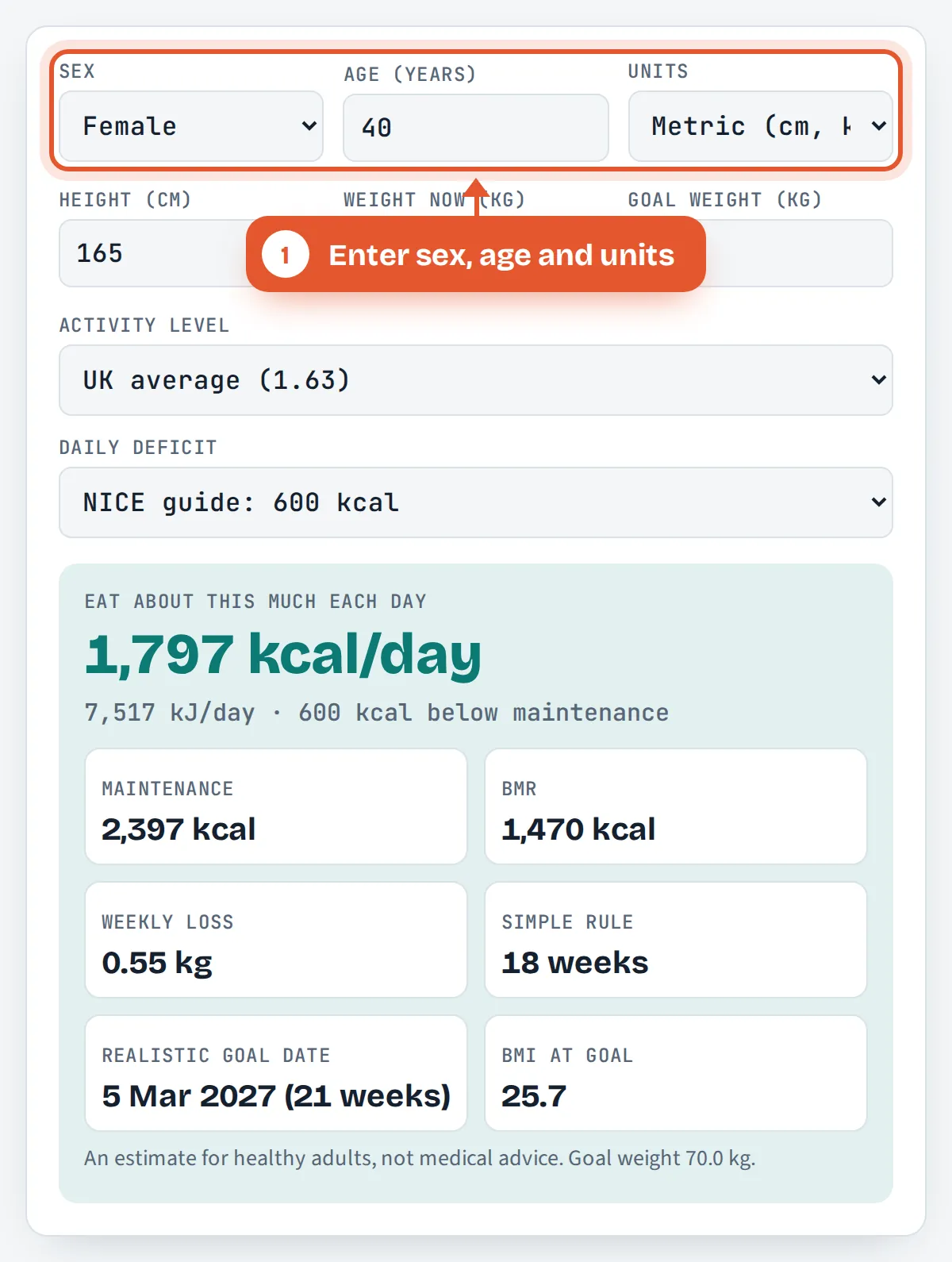
Enter sex, age and units
Pick your sex and age, then choose metric, UK (stone and pounds) or US units.

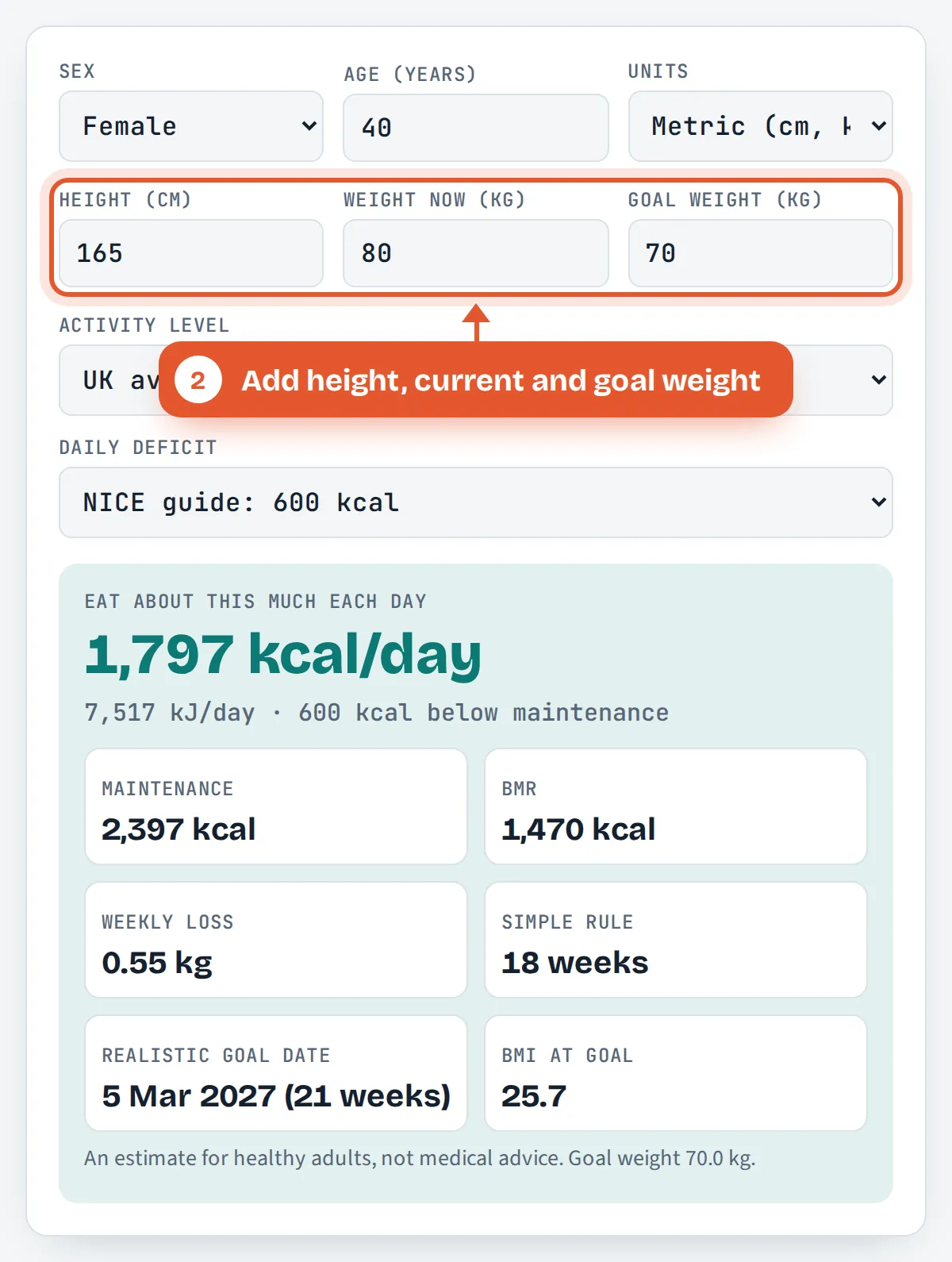
Add height, current and goal weight
Type your height, your weight today and the weight you want to reach.
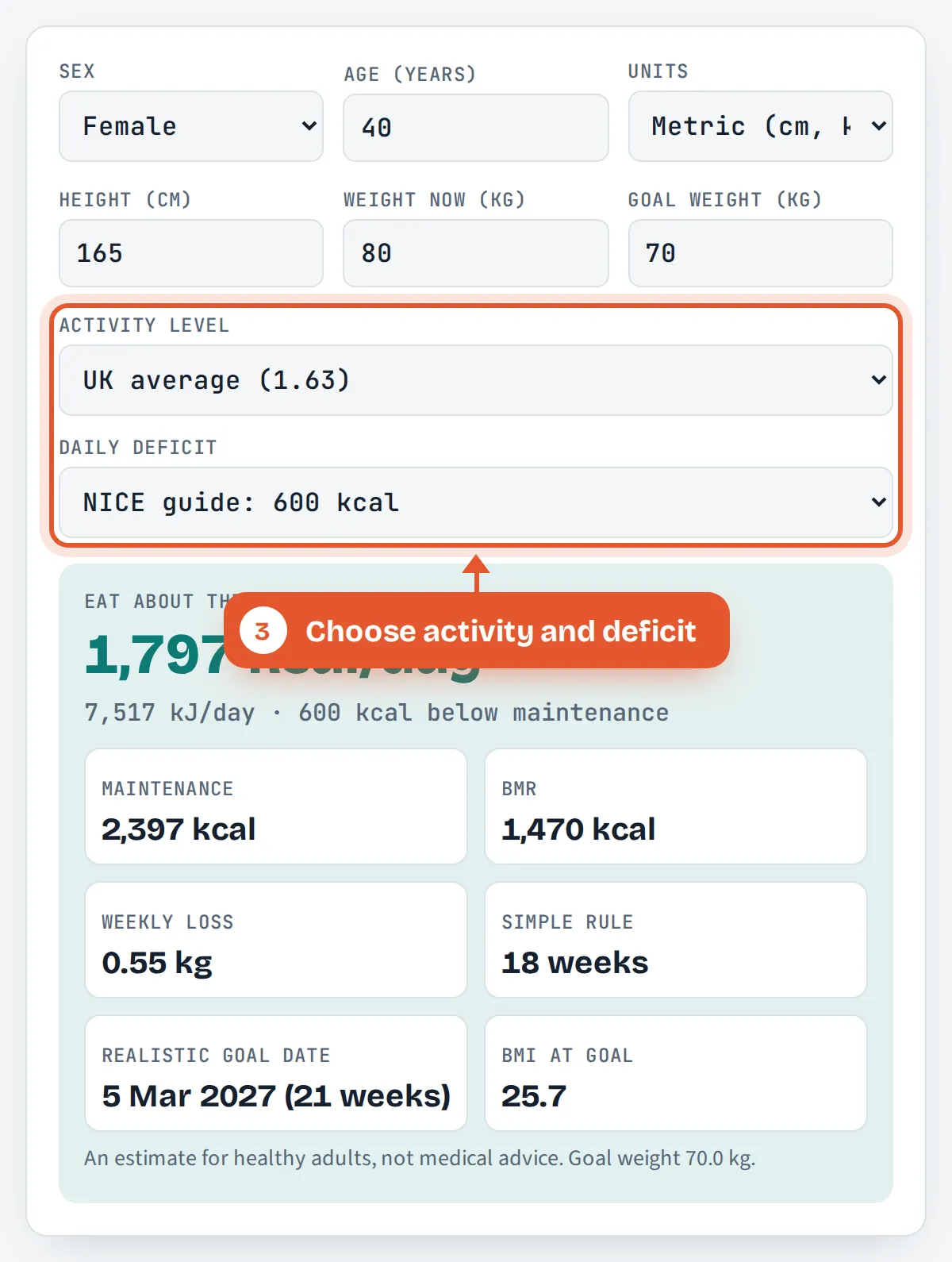
Choose activity and deficit
Pick the activity level closest to a normal week, then a daily deficit. 600 kcal is the NICE guide figure.
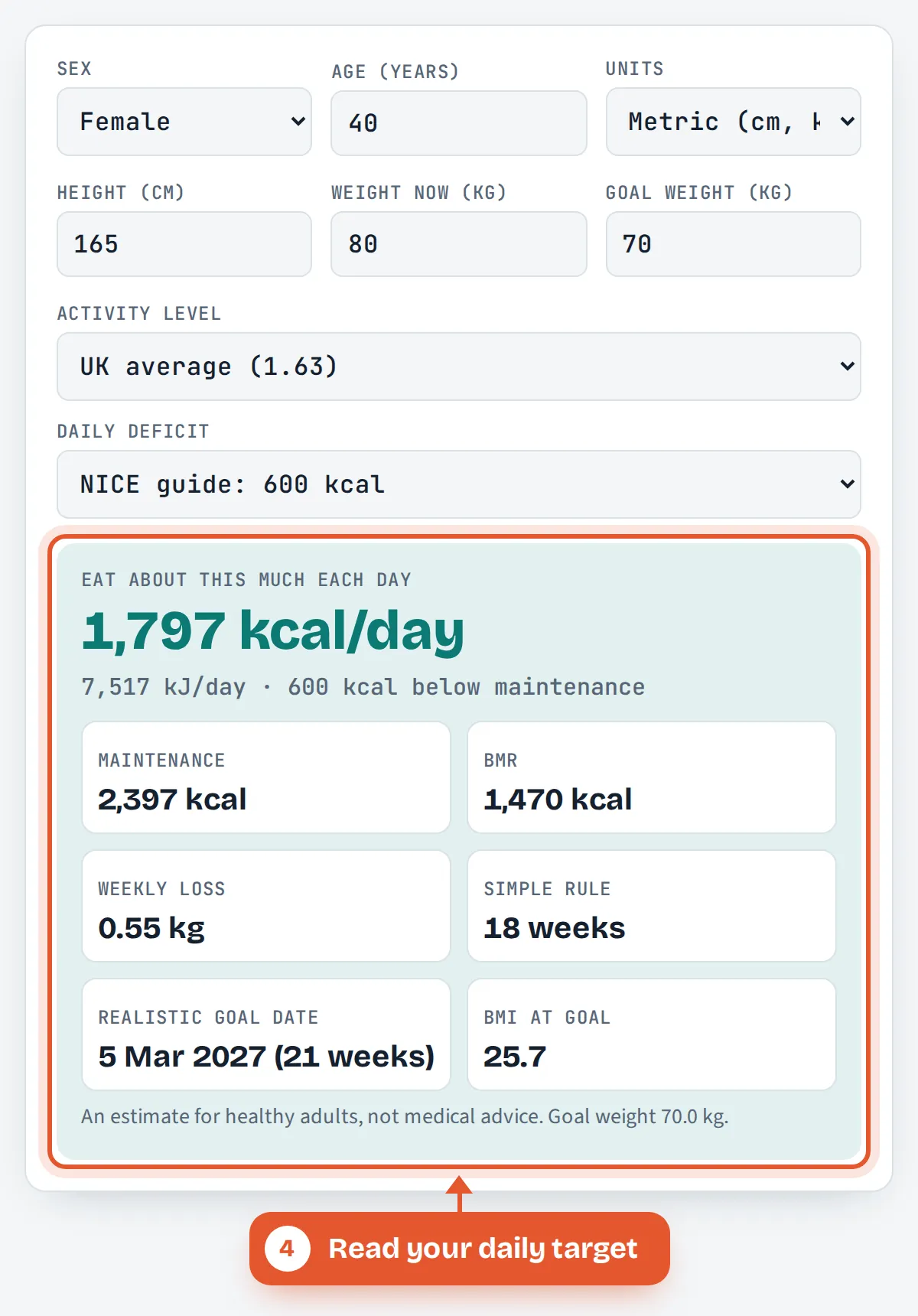
Read your daily target
Your daily calorie target shows in large text, with maintenance, weekly loss and both goal dates below.
Frequently Asked Questions
Is a 500 calorie deficit enough to lose weight?
Yes. A 500 kcal daily deficit leads to roughly 0.45 kg (1 lb) of loss a week at first by the simple 7,700 kcal per kg rule. Loss slows gradually as you get lighter, so recalculate every few kilos to keep the deficit working.
Is a 1,000 calorie deficit safe?
It can be too aggressive for many people. A 1,000 kcal deficit means about 0.9 kg a week at first, at the top of the 0.5 to 1 kg a week NICE describes as usual. It is hard to sustain and can leave your intake below your BMR, so ask your GP first.
Why am I not losing weight in a calorie deficit?
Usually the real deficit is smaller than planned. Food logs tend to miss snacks, drinks and cooking oil, and your maintenance calories fall as you lose weight. Water retention can also hide fat loss for a week or two, so look at the trend over a month.
Should I eat back the calories I burn exercising?
Not if you chose an activity level that already includes your exercise, because that would count it twice. If you picked a low activity level and add an unusually hard session, eating back part of it is reasonable.
How many calories are in 1 kg of body fat?
Pure body fat holds about 39.5 MJ, or roughly 9,400 kcal, per kg, according to Hall and colleagues. The weight you lose also includes water and some lean tissue, which hold far less. That is why the common planning figure is about 7,700 kcal per kg of body weight, or 3,500 kcal per pound.
Do I need to count calories to stay in a deficit?
No, but tracking for a few weeks helps you learn portion sizes. Under EU labelling rules, as the Food Safety Authority of Ireland explains, food labels must show energy per 100 g in both kJ and kcal, and the calculator shows your target in both, so you can compare directly.
Sources and Further Reading
- NICE Obesity: identification, assessment and management, very low calorie diets chapter (NCBI Bookshelf)
- Hall KD et al. Quantification of the effect of energy imbalance on bodyweight, The Lancet 2011 (PMC)
- Mifflin MD et al. A new predictive equation for resting energy expenditure, Am J Clin Nutr 1990 (PubMed)
Related Tools
Last reviewed: October 2026