Enter your sex, age, weight, height and activity level to see how many calories you burn each day. You also get ready made targets to cut, maintain or bulk.
Runs in your browser. Nothing you type is sent anywhere.
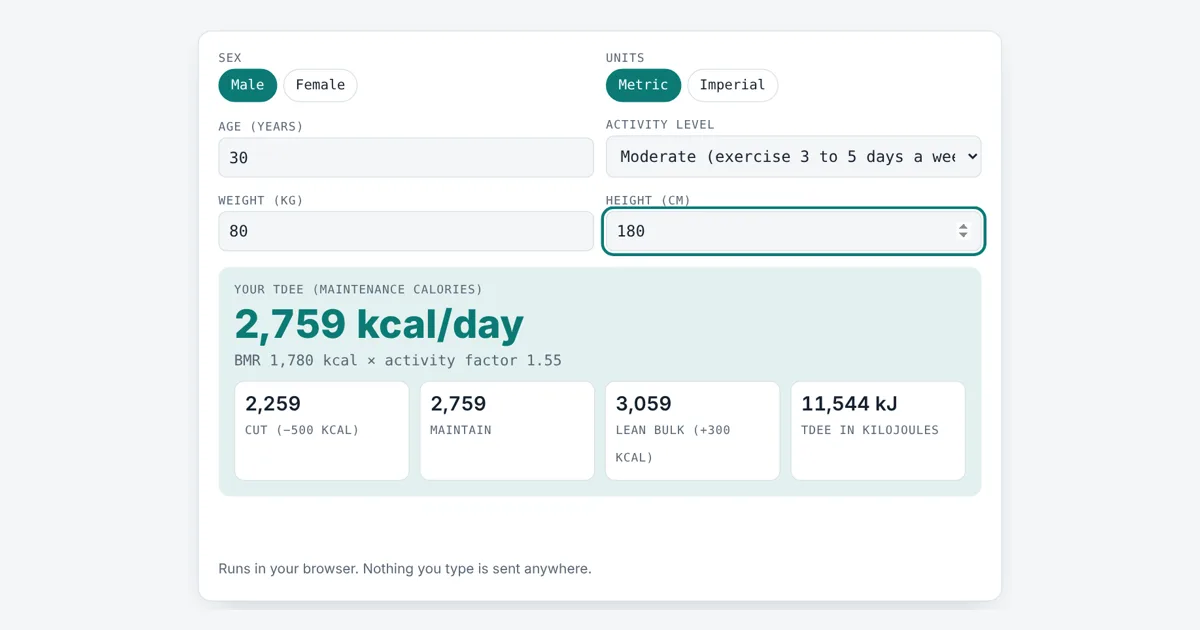
This tdee calculator is for anyone planning meals, a diet or a training block who wants a real calorie number to start from. It works out your resting burn with the Mifflin-St Jeor formula, multiplies it by your activity level, and gives cut, maintenance and lean bulk targets in kcal and kJ.
How Do You Work Out Your TDEE?
Your TDEE is your BMR multiplied by an activity factor from 1.2 (sedentary) to 1.9 (extra active). For example, a 30 year old man who weighs 80 kg and is 180 cm tall has a Mifflin-St Jeor BMR of 1,780 kcal. With moderate exercise (factor 1.55), his TDEE is about 2,759 kcal per day.
What Is TDEE and How Is It Different From BMR?
TDEE (total daily energy expenditure) is all the calories you burn in a day, while BMR is only the part your body uses at complete rest. Your BMR (basal metabolic rate) keeps your heart, lungs, brain and organs running. On top of that you burn energy digesting food, which is called the thermic effect of food and is roughly 10% of intake, plus everything you spend moving, from walking to the shops to a gym session. If you only want the resting number, our BMR calculator shows it on its own.
How Do You Calculate TDEE?
You calculate TDEE by working out your BMR with the Mifflin-St Jeor equation and multiplying it by an activity factor between 1.2 and 1.9.
Women: BMR = 10 × weight(kg) + 6.25 × height(cm) − 5 × age − 161
TDEE = BMR × activity factor
The Mifflin-St Jeor equation was published in 1990 in the American Journal of Clinical Nutrition and is the formula most dietitians use today for healthy adults. The activity factor, also called a physical activity level (PAL), scales the resting figure up to your real day. Imperial inputs are turned into kilograms and centimetres before the sum.
| Activity level | Factor | TDEE for BMR 1,780 |
|---|---|---|
| Sedentary | 1.2 | 2,136 kcal |
| Light | 1.375 | 2,448 kcal |
| Moderate | 1.55 | 2,759 kcal |
| Very active | 1.725 | 3,070 kcal |
| Extra active | 1.9 | 3,382 kcal |
How Many Calories Should I Eat to Lose or Gain Weight?
To lose weight, most people eat about 500 kcal below their TDEE, and to gain muscle with little fat they eat about 250 to 500 kcal above it. A daily gap of 500 kcal is a common starting point because it leads to slow, steady loss that is easier to keep up. This tool shows a cut at TDEE minus 500 and a lean bulk at TDEE plus 300. To plan the gap over weeks, use the calorie deficit calculator, and to split your target into protein, carbs and fat, try the macro calculator.
How Accurate Is a TDEE Calculator?
A TDEE calculator is a starting estimate that is often within about 10% for healthy adults, but your real burn can differ. Muscle mass, genetics, sleep and how honestly you rate your activity all shift the result. Track your weight for 2 to 3 weeks at the suggested intake and adjust by 100 to 200 kcal if the scale moves in the wrong direction. For a broader daily calorie plan with goals built in, see the calorie calculator.
This is an estimate, not medical advice. Talk to a doctor or registered dietitian before a big diet change, especially if you are pregnant, under 18 or have a health condition.
Worked Example
Ali is a 30 year old man, 80 kg and 180 cm, who trains 4 days a week. With Male, Metric and Moderate picked, the tool shows a BMR of 1,780 kcal and a TDEE of 2,759 kcal/day (11,544 kJ). His targets are 2,259 kcal to cut, 2,759 to maintain and 3,059 for a lean bulk. Switching to Female, Imperial, age 35, 150 lb, 5 ft 6 in and Light activity gives a BMR of 1,392 kcal and a TDEE of 1,914 kcal/day, with a cut target of 1,414 kcal.
How Do You Use the TDEE Calculator?
Pick sex and units
Tap Male or Female, then Metric or Imperial to match how you measure yourself.
Enter age and activity
Type your age and choose the activity level that fits a normal week, not your best week.
Add weight and height
Fill in your weight and height. Results update as you type.
Read your targets
The big number is your TDEE. The boxes show cut, maintain and lean bulk calories plus kJ.

Frequently Asked Questions
What does TDEE stand for?
TDEE stands for total daily energy expenditure. It is the total number of calories your body burns in 24 hours, adding your resting metabolism, the energy used to digest food and all of your movement and exercise.
Should I eat my TDEE or my BMR to lose weight?
Eat below your TDEE, not below your BMR. Your TDEE already counts your activity, so a target of about 500 kcal under TDEE gives a steady loss. Eating under your BMR for long periods is usually too aggressive without medical support.
What activity level should I choose?
Choose Sedentary if you sit most of the day and rarely exercise, Light for 1 to 3 workouts a week, and Moderate for 3 to 5. Most people overrate their activity, so if unsure, pick one level lower and adjust later.
Does TDEE change as I lose weight?
Yes. A lighter body burns fewer calories, so your TDEE drops as you lose weight. For example, the same 30 year old man at 75 kg instead of 80 kg has a moderate TDEE about 78 kcal lower. Recalculate after every 3 to 5 kg.
How many calories is a 500 calorie deficit per week?
A 500 kcal daily deficit adds up to 3,500 kcal per week. That is often linked to about 0.45 kg (1 lb) of fat loss a week, though real results slow over time as your body adapts.
Is the Mifflin-St Jeor equation better than Harris-Benedict?
For most healthy adults, studies have found Mifflin-St Jeor predicts resting energy use more closely than the older Harris-Benedict equation from 1919. Both are estimates, and neither knows your body fat level.
Sources and Further Reading
- Mifflin MD, St Jeor ST et al. A new predictive equation for resting energy expenditure in healthy individuals, Am J Clin Nutr 1990 (PubMed)
- National Cancer Institute: REE Mifflin-St Jeor equation, total energy expenditure and physical activity level
- NHS: Calorie counting and managing your weight
Related Tools
Last reviewed: October 2026