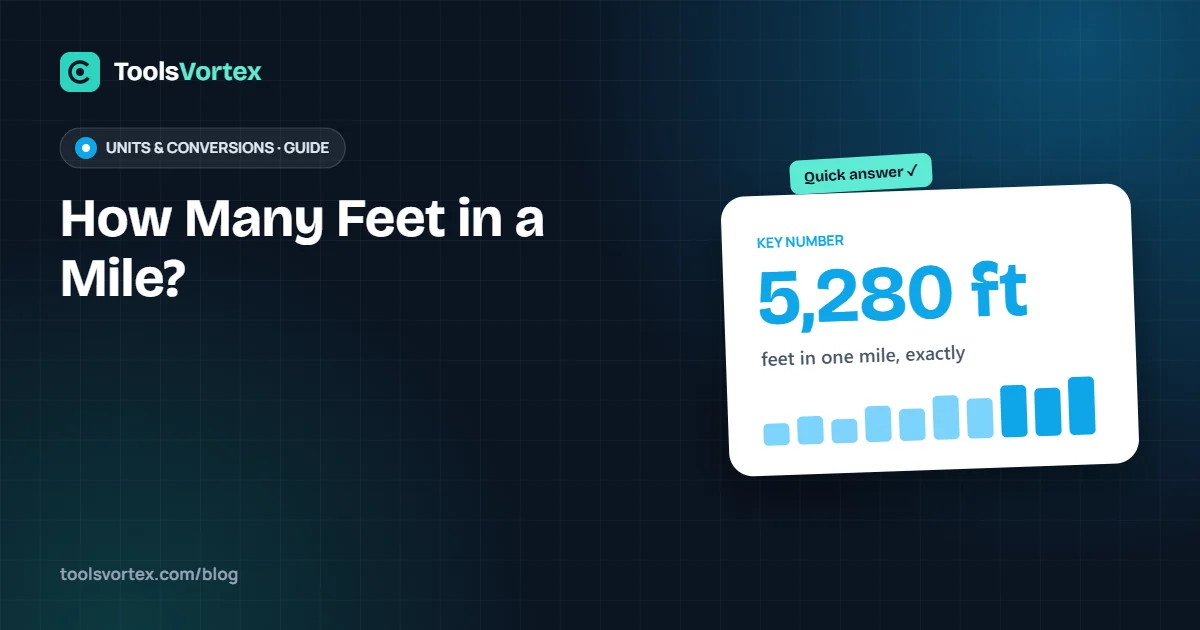
There are exactly 5,280 feet in a mile. That equals 1,760 yards, 63,360 inches, or 1,609.344 meters. The number comes from 8 furlongs of 660 feet each, set by an English law in 1593. A nautical mile is longer, at 1,852 meters, or about 6,076 feet.

If you want to know how many feet in a mile, the answer is 5,280. It is an exact number, not a rounded one, and it has been the same for over 400 years.
The odd number has a reason behind it, and it ties into furlongs, Roman soldiers, and a 1959 deal between six countries. Below you will find the history, charts for every common fraction of a mile, race distances in feet, and the track lap math that trips up a lot of runners. For quick swaps between metric and US distances, keep the km to miles converter open in another tab.
How Many Feet Are in a Mile?
A mile has exactly 5,280 feet. NIST Handbook 44 lists the mile as 5,280 feet (exactly) and 1.609344 kilometers (exactly).
The foot itself is fixed at exactly 0.3048 meters. That is why the mile converts to metric with no rounding at all.
Miles = feet / 5,280
Meters = miles x 1,609.344
So 3 miles is 3 x 5,280 = 15,840 feet. And 10,000 feet is 10,000 / 5,280 = 1.89 miles. If you need meters to feet for a single distance, the feet to meters converter handles it in one step.
A mile in everyday terms
Big numbers are hard to picture, so compare a mile to things you know. An American football field is 300 feet from goal line to goal line, or 360 feet with both end zones. That means a mile is 17.6 fields without end zones, or about 14.7 fields with them. A basketball court for the NBA is 94 feet long, so a mile is about 56 courts end to end.
Why Is a Mile 5,280 Feet?
A mile is 5,280 feet because English law set it at 8 furlongs, and a furlong was already 660 feet long. Eight times 660 is 5,280.
The furlong came from farming. Its name means “furrow long,” the length of one plowed furrow in an open field. By the 1500s it was fixed at 40 rods (also called poles), and each rod was 16.5 feet. That makes 40 x 16.5 = 660 feet.
The older Roman mile was shorter. The Romans called it mille passus, or a thousand paces. A Roman pace counted two steps, so it was about 5 Roman feet. Modern estimates put the Roman mile at roughly 1,480 meters, or about 4,850 of our feet.
England used several miles of different lengths for centuries. In 1593, during the reign of Elizabeth I, an Act of Parliament settled it: a mile would hold 8 furlongs of 40 poles each. Land was already measured in furlongs, so building the mile from them kept old field records usable. The result was the statute mile of 5,280 feet, or 1,760 yards. UK law still defines the mile as 1,760 yards in the Weights and Measures Act 1985.
Units hidden inside a mile
- 8 furlongs of 660 feet
- 80 chains of 66 feet
- 320 rods of 16.5 feet
- 1,760 yards of 3 feet
How Many Yards, Inches and Meters Are in a Mile?
One mile equals 1,760 yards, 63,360 inches, and 1,609.344 meters. All of these are exact.
| Unit | In one mile | Exact? |
|---|---|---|
| Feet | 5,280 | Yes |
| Yards | 1,760 | Yes |
| Inches | 63,360 | Yes |
| Furlongs | 8 | Yes |
| Meters | 1,609.344 | Yes |
| Kilometers | 1.609344 | Yes |
| Centimeters | 160,934.4 | Yes |
| Nautical miles | about 0.869 | No, rounded |
The metric values are exact because the yard is defined as exactly 0.9144 meter.
Why exact? Before 1959, the US and UK yards differed by a tiny amount. In the 1959 international yard and pound agreement, the US, the UK, and four other Commonwealth countries agreed on one yard of exactly 0.9144 meter. That fixed the foot at 0.3048 meter and the mile at 1,609.344 meters.
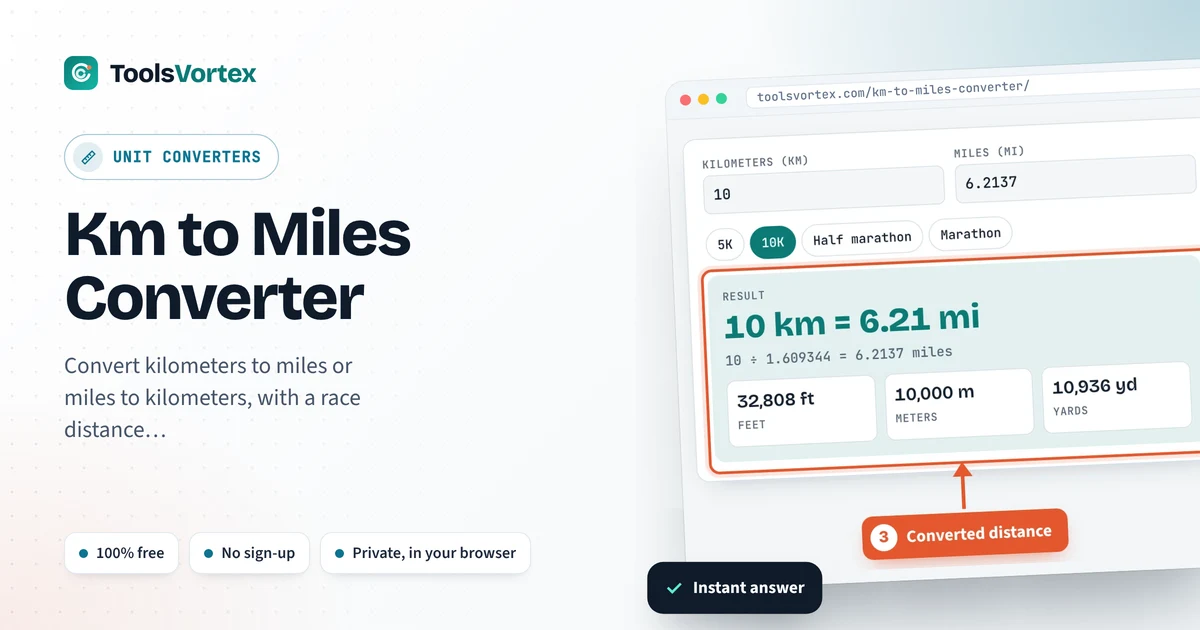
Going the other way, one kilometer is about 0.6214 miles, or 3,280.84 feet. That is why a 5K is a little over 3 miles. The km to miles converter does this for any distance.
Common mix-ups
- Using 5,000 feet: a quick guess of 5,000 is off by 280 feet, about 5%.
- Using 1.6 km: fine for a rough guess, but over a marathon it drifts by about 245 meters.
- Mixing yards and feet: 1,760 is yards, not feet. Multiply by 3 to get 5,280.
How Many Feet Are in Half a Mile or a Quarter Mile?
Half a mile is 2,640 feet, and a quarter mile is 1,320 feet. Multiply the fraction by 5,280 to get any other part of a mile.
| Fraction of a mile | Feet | Meters |
|---|---|---|
| 1/10 mile | 528 | 160.93 |
| 1/8 mile | 660 | 201.17 |
| 1/4 mile | 1,320 | 402.34 |
| 1/3 mile | 1,760 | 536.45 |
| 1/2 mile | 2,640 | 804.67 |
| 3/4 mile | 3,960 | 1,207.01 |
| 1 mile | 5,280 | 1,609.34 |
Meters are rounded to two decimals. Feet are exact.
Race distances are set in meters, so their feet values come out long. Here is the math for the most common runs.
| Race | Meters | Miles | Feet |
|---|---|---|---|
| 1,500 m | 1,500 | 0.932 | 4,921 |
| 5K | 5,000 | 3.107 | 16,404 |
| 10K | 10,000 | 6.214 | 32,808 |
| Half marathon | 21,097.5 | 13.109 | 69,218 |
| Marathon | 42,195 | 26.219 | 138,435 |
Feet are rounded to the nearest foot. The marathon is about 26.2 miles.
Speed works the same way. At 60 mph you cover 60 x 5,280 = 316,800 feet per hour, which is exactly 88 feet per second. The mph to km/h converter shows the same speed as 96.56 km/h. And if you run an 8 minute mile, you cover 660 feet, one furlong, every minute. Check your own numbers with the pace calculator.
How Long Is a Nautical Mile in Feet?
A nautical mile is about 6,076.1 feet, because it is defined as exactly 1,852 meters. It is about 15% longer than a regular mile.
Ships and planes use the nautical mile because it links to the shape of the Earth. One nautical mile is close to one minute of latitude, so navigators can read distance straight off a chart. The international nautical mile was set at 1,852 meters, and NIST Handbook 44 gives it as about 6,076.11549 feet.
- 1 nautical mile = 1.1508 statute miles
- 1 statute mile = 0.869 nautical miles
- 1 knot = 1 nautical mile per hour, about 1.15 mph
So when a pilot says a plane is 10 nautical miles out, that is about 11.5 regular miles. Do not mix the two when you plan a boat trip or read a flight tracker. On land, “mile” always means the statute mile of 5,280 feet unless a sign or map says otherwise.
How Many Laps Around a Track Is a Mile?
A mile is about 4.02 laps of a standard 400 meter track. Four laps is 1,600 meters, which falls about 30.7 feet short of a true mile.
That gap surprises a lot of runners. The 1,600 m race, often called the metric mile, is not quite a mile. To run a true mile on a 400 m track, start about 9.34 meters (30.7 feet) behind the finish line and run four laps. Some tracks mark a separate start line for the mile for this reason.
You want to run exactly 2 miles on a 400 m track. How many laps is that, and how far short are 8 laps?
- Convert to meters: 2 x 1,609.344 = 3,218.688 meters.
- Divide by lap length: 3,218.688 / 400 = 8.05 laps.
- Eight laps is 8 x 400 = 3,200 meters, or 1.988 miles.
- The gap: 3,218.688 minus 3,200 = 18.69 meters.
- In feet: 18.69 / 0.3048 = about 61.3 feet.
So 8 laps leaves you about 61 feet short of 2 miles. Run 8 laps, then about 19 more meters past the line.
Lane matters too. The 400 m figure is measured in lane 1. Outer lanes are longer, so a lap in lane 4 or 5 adds several meters each time around.
How Many Steps Are in a Mile?
Most adults take about 2,000 to 2,500 steps to walk a mile, but the real count depends on your height and stride. Divide 5,280 by your stride length in feet to get your own number.
A 2.5 foot stride gives 5,280 / 2.5 = 2,112 steps per mile. Our full guide on how many steps in a mile covers walking and running strides by height. To turn a step count from your phone into distance, use the steps to miles calculator.
Quick Recap
- A mile has exactly 5,280 feet, 1,760 yards, and 63,360 inches.
- The number comes from 8 furlongs of 660 feet, fixed by English law in 1593.
- Since the 1959 international yard and pound agreement, a mile is exactly 1,609.344 meters.
- A nautical mile is 1,852 meters, or about 6,076.1 feet.
- A mile is about 4.02 laps of a 400 m track, so four laps is about 30.7 feet short.
Frequently Asked Questions
How many feet are in half a mile?
Half a mile is exactly 2,640 feet. Multiply 0.5 by 5,280 to get it. In metric, that is about 804.67 meters, or just over two laps of a standard 400 meter running track.
How many feet are in a quarter mile?
A quarter mile is exactly 1,320 feet, or 440 yards. That is about 402.34 meters, which is why a quarter mile drag strip is slightly longer than one lap of a 400 meter track.
How many feet are in a kilometer?
One kilometer is about 3,280.84 feet. Divide 1,000 meters by 0.3048, the exact length of a foot in meters. A kilometer is about 0.62 miles, so it takes about 1.61 km to make one mile.
How many feet are in a 5K?
A 5K is about 16,404 feet. Five kilometers is 5,000 meters, and 5,000 divided by 0.3048 gives 16,404.2 feet. That is about 3.11 miles, or a bit over 12 laps of a track.
Is a nautical mile longer than a regular mile?
Yes. A nautical mile is 1,852 meters, about 6,076.1 feet, while a regular mile is 5,280 feet. One nautical mile equals about 1.15 regular miles. Ships and aircraft use nautical miles.
Why is a mile not 5,000 feet?
The Roman mile was about 5,000 Roman feet, but the English mile was later fixed at 8 furlongs. Each furlong was 660 feet, so the 1593 law made the mile 5,280 feet instead of a round number.
How many yards are in a mile?
There are exactly 1,760 yards in a mile. Each yard is 3 feet, and 1,760 x 3 = 5,280 feet. UK law still defines the mile as 1,760 yards.
Sources
- NIST: Handbook 44 Appendix C, General Tables of Units of Measurement, Mile of 5,280 ft and 1.609344 km, furlong of 660 ft, nautical mile of 1,852 m
- NIST: Guide to the SI, Appendix B, Conversion Factors, Exact foot of 0.3048 m and the international mile of 5,280 ft
- legislation.gov.uk: Weights and Measures Act 1985, Schedule 1, UK definitions of the mile as 1,760 yards and the yard as 0.9144 metre