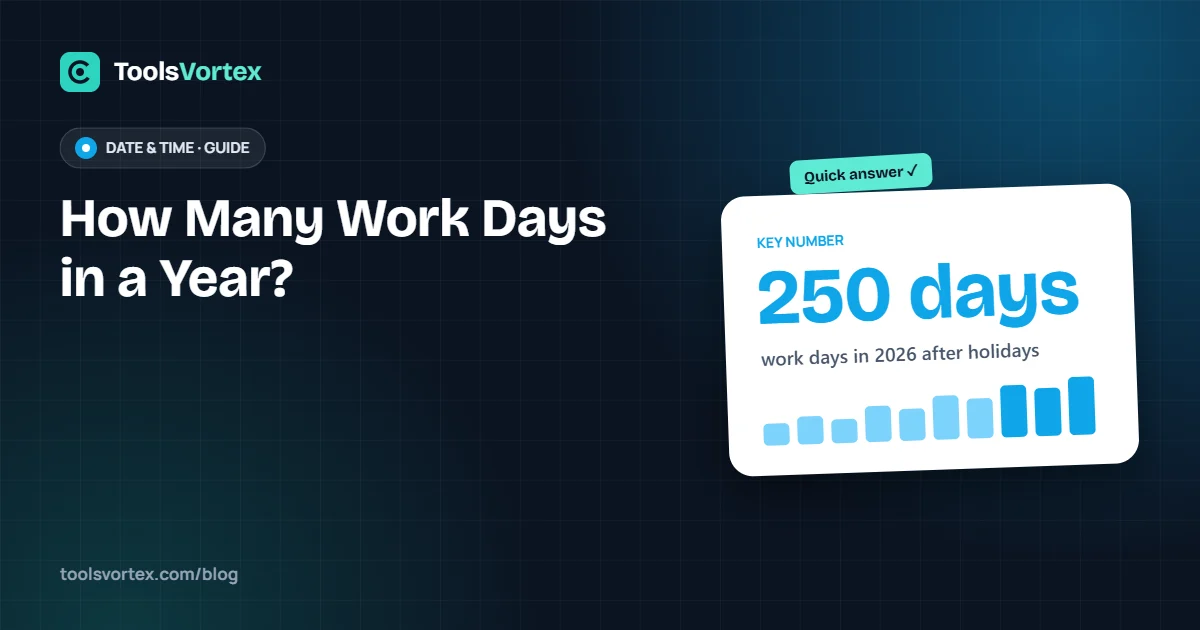
Most years have 261 weekdays (Monday to Friday). Some have 260 and a few leap years have 262. Subtract the 11 US federal holidays and a full-time worker gets about 250 work days, which is 2,000 hours at 8 hours a day. In 2026 the count is exactly 250.

If you want to know how many work days in a year you really have, the short answer is about 250. The long answer depends on which weekday January 1 falls on, whether it is a leap year, and how holidays land on the calendar.
We counted every weekday from 2025 to 2028 with code, then removed the US federal holidays using the official observed dates. You will also see a month by month count for 2026, the hours behind the 2,080 and 2,087 figures, and how to subtract your own vacation days. To count any custom range, use our date calculator.
How Many Work Days Are in a Year?
A normal year has 261 weekdays, and after the 11 US federal holidays you are left with about 250 work days.
Here is the count for the next few years. “Weekdays” means every Monday to Friday. “Holidays” means federal holidays whose observed date lands on a weekday inside that calendar year.
| Year | Jan 1 falls on | Total days | Weekdays | Federal holidays | Net work days | Hours at 8 a day |
|---|---|---|---|---|---|---|
| 2025 | Wednesday | 365 | 261 | 11 | 250 | 2,000 |
| 2026 | Thursday | 365 | 261 | 11 | 250 | 2,000 |
| 2027 | Friday | 365 | 261 | 12 | 249 | 1,992 |
| 2028 | Saturday | 366 | 260 | 10 | 250 | 2,000 |
2027 has 12 holidays because New Year’s Day 2028 falls on a Saturday, so it is observed on Friday, December 31, 2027. That also leaves 2028 with only 10. In 2025, an executive order also closed federal offices on December 24 and 26, so federal staff actually worked 248 days that year.
Private employers do not have to follow the federal list. They pick their own paid holidays. If your company gives 8 paid holidays that all land on weekdays, 2026 has 261 minus 8 = 253 work days for you. Check your employee handbook for the exact list, then subtract only the ones that fall Monday to Friday. A holiday that lands on a Saturday may or may not move to Friday at a private company, so ask HR how they handle it.
Why Do Some Years Have 260, 261 or 262 Weekdays?
The number of weekdays changes because 365 days is 52 weeks plus 1 extra day, and a leap year is 52 weeks plus 2 extra days.
Those 52 full weeks always hold 260 weekdays (52 x 5). The leftover day or days decide the rest. The extra day is always the same weekday as January 1. In a leap year, the day after it gets an extra turn too.
Common year = 52 weeks + 1 day
Leap year = 52 weeks + 2 days
| Year | Leap year? | Weekday(s) that occur 53 times | Weekdays |
|---|---|---|---|
| 2024 | Yes | Monday, Tuesday | 262 |
| 2025 | No | Wednesday | 261 |
| 2026 | No | Thursday | 261 |
| 2027 | No | Friday | 261 |
| 2028 | Yes | Saturday, Sunday | 260 |
In 2028 both extra days are weekend days, so the weekday count drops back to the minimum of 260.
We checked a full 28 year span (2001 to 2028). It had 17 years with 261 weekdays, 7 with 260 and 4 with 262. You can see which weekday a year starts on with the day of the week calculator.
Which Federal Holidays Reduce Work Days?
Eleven legal public holidays in federal law reduce the work year, and each one counts only when its observed date falls on a weekday.
The list in 5 U.S.C. 6103 is New Year’s Day, Birthday of Martin Luther King, Jr., Washington’s Birthday, Memorial Day, Juneteenth National Independence Day, Independence Day, Labor Day, Columbus Day, Veterans Day, Thanksgiving Day and Christmas Day. Juneteenth was the newest, added in 2021.
The weekend rule
Six holidays are tied to a weekday, such as “third Monday in January,” so they never land on a weekend. The five fixed date holidays (January 1, June 19, July 4, November 11 and December 25) can. When one falls on a Saturday, federal workers get the Friday before. When it falls on a Sunday, they get the Monday after. That is why the holiday never “disappears” from a Monday to Friday schedule.
- 2026: July 4 is a Saturday, so the holiday is Friday, July 3.
- 2027: June 19 and December 25 are Saturdays, so the days off are June 18 and December 24. July 4 is a Sunday, so July 5 is off.
- 2028: November 11 is a Saturday, so Veterans Day is observed Friday, November 10.
To find a date’s ISO week before you book time off around a holiday, try the week number calculator.
How Many Work Days Are in Each Month of 2026?
Months in 2026 range from 19 to 22 work days once federal holidays come out.
| Month | Days | Weekdays | Federal holidays | Work days |
|---|---|---|---|---|
| January | 31 | 22 | 2 (Jan 1, Jan 19) | 20 |
| February | 28 | 20 | 1 (Feb 16) | 19 |
| March | 31 | 22 | 0 | 22 |
| April | 30 | 22 | 0 | 22 |
| May | 31 | 21 | 1 (May 25) | 20 |
| June | 30 | 22 | 1 (Jun 19) | 21 |
| July | 31 | 23 | 1 (Jul 3) | 22 |
| August | 31 | 21 | 0 | 21 |
| September | 30 | 22 | 1 (Sep 7) | 21 |
| October | 31 | 22 | 1 (Oct 12) | 21 |
| November | 30 | 21 | 2 (Nov 11, Nov 26) | 19 |
| December | 31 | 23 | 1 (Dec 25) | 22 |
| Total | 365 | 261 | 11 | 250 |
March and April have no federal holidays, so they tie with July and December for the most work days. February and November have the fewest.
This matters for monthly targets. If you bill by the day, February 2026 gives you 3 fewer days than March. For any two dates, the days between dates calculator gives you the gap in calendar days.
How Many Work Hours Are in a Year?
The standard answer is 2,080 hours a year, which is 52 weeks times 40 hours.
That number is a shortcut. The real count of weekday hours is 261 x 8 = 2,088 hours in 2025, 2026 and 2027, but only 260 x 8 = 2,080 in 2028. Leap years with 262 weekdays reach 2,096.
Why the federal government uses 2,087
The Office of Personnel Management tells agencies to divide annual pay by 2,087 hours to get the hourly rate for almost all civilian federal employees. The figure comes from a 1981 GAO study of a 28 year cycle. It is the average number of paid hours per year over that cycle. We ran the same check on 2001 to 2028 and got 7,305 weekdays, or 2,087.1 hours a year on average.
Hours actually worked = (weekdays minus holidays minus PTO days) x 8
Hourly rate (federal) = annual salary / 2,087
Most private payroll systems still use 2,080. If you are converting a wage, our hourly to salary calculator handles the math, and the hourly to salary guide explains when 2,080 is the right divisor. This is general information, not financial advice.
How Do You Subtract Vacation and Sick Days?
Start with the net work days for your year, then subtract every paid day off you plan to take.
Maria works full time, Monday to Friday, in 2026. Her employer follows the federal holiday list and gives her 15 days of paid time off.
- Weekdays in 2026: 261.
- Minus 11 federal holidays: 261 minus 11 = 250 work days.
- Minus 15 PTO days: 250 minus 15 = 235 days at work.
- Hours at work: 235 x 8 = 1,880 hours.
- Paid hours, since holidays and PTO are paid: 261 x 8 = 2,088. At $25 an hour that is 2,088 x $25 = $52,200.
Maria is paid for 2,088 hours but only works 1,880 of them. If a salary offer quotes $52,000 using 2,080 hours, the extra $200 she sees here comes from the 261st weekday.
A few edge cases change the count:
- Part time: a 4 day week has about 4/5 of the weekdays. Count only your scheduled days.
- Shift workers: if your week is not Monday to Friday, federal law moves a holiday that hits your day off to another day, so count your own schedule.
- Unpaid days: unpaid leave lowers paid hours, not just hours worked.
- Floating holidays: treat them like PTO days.
You can add or subtract business days from any start date with the date calculator.
Quick Recap
- Most years have 261 weekdays; leap years can have 260 or 262.
- Take out 11 federal holidays and you get about 250 work days.
- 2027 has 249 work days because New Year’s Day 2028 is observed on Dec 31, 2027.
- Standard full-time hours are 2,080; OPM uses 2,087 for federal hourly rates.
- Subtract your PTO days to find the days you actually work.
Frequently Asked Questions
How many work days are in 2026?
2026 has 261 weekdays. After the 11 US federal holidays, all of which fall on weekdays in 2026, you have 250 work days. At 8 hours a day that is 2,000 hours of work time.
How many work days are in a month on average?
Divide 250 work days by 12 months and you get about 20.8 work days per month. In 2026 the real range runs from 19 days in February and November to 22 days in March, April, July and December.
Why is 2,080 the standard number of work hours?
It is 52 weeks times 40 hours. It ignores the extra one or two days that make a year longer than 52 weeks, so the true count of weekday hours is often 2,088.
Do federal holidays count as work days for private companies?
Not by law. Private employers choose their own paid holidays. A company with 8 paid weekday holidays would have 253 work days in 2026, while one that follows all 11 federal holidays would have 250.
What happens when a holiday falls on a weekend?
For federal workers on a Monday to Friday schedule, a Saturday holiday is observed on the Friday before and a Sunday holiday on the Monday after. In 2026, July 4 is a Saturday, so Friday, July 3 is the day off.
How many weekdays are in a leap year?
A leap year has 366 days, which is 52 weeks plus 2 days. It has 262 weekdays if both extra days are weekdays, 261 if one is, and 260 if both are Saturday and Sunday, as in 2028.
How many hours does a federal employee work in a year?
OPM sets the divisor at 2,087 hours for computing hourly pay. That is the average number of paid weekday hours over a 28 year cycle, not a count for any single year.
Sources
- Cornell Law School LII: 5 U.S. Code 6103, Holidays, the 11 legal public holidays and the Saturday holiday rule
- US Bankruptcy Court, Western District of Wisconsin: Federal Holidays 2023 to 2028, observed holiday dates for 2025 to 2028
- OPM: Computing Hourly Rates of Pay Using the 2,087 Hour Divisor, the 2,087 hour divisor and the 28 year GAO study
- GovInfo: Executive Order 14371, Providing for the Closing of Executive Departments and Agencies, federal closures on December 24 and 26, 2025