ToolsVortex
Explore tools

Category: Units & Conversions

Unit conversion guides on length, area, volume and weight, with simple formulas, worked examples and free converters on ToolsVortex.

  • How Many Pounds in a Kilogram? Exact Factor, Charts and Tricks

    How Many Pounds in a Kilogram? Exact Factor, Charts and Tricks

    Units & ConversionsUpdated November 4, 20268 min readBy ToolsVortex Editorial Team

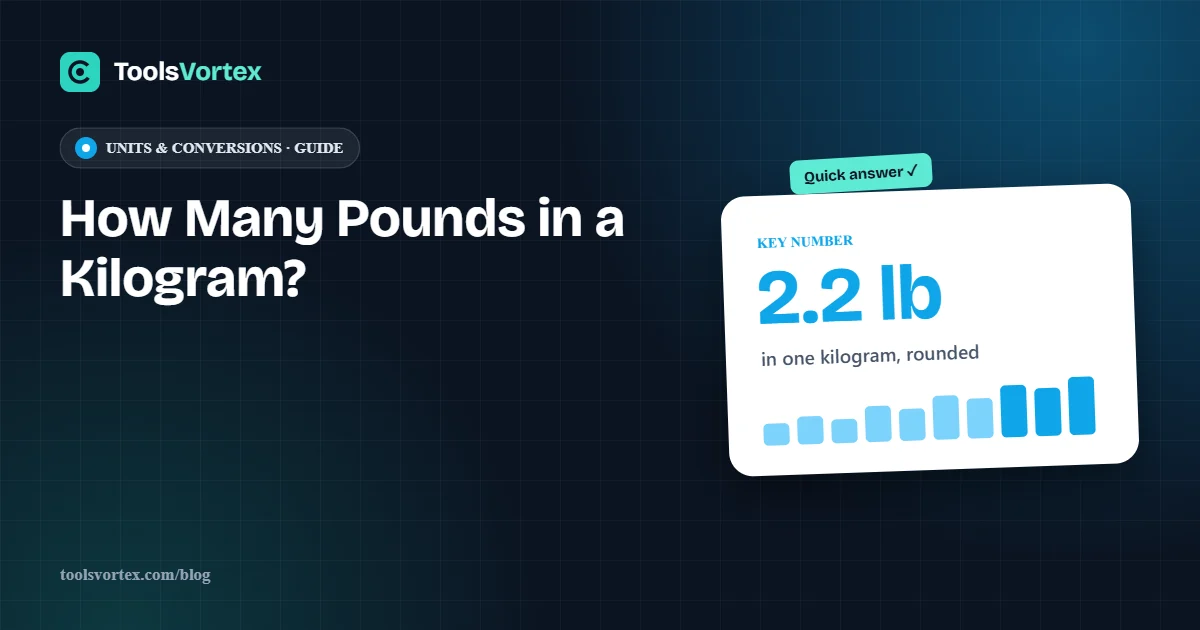
    One kilogram equals 2.20462 pounds, or about 2.2 lb for quick math. The exact link runs the other way: one pound is defined as 0.45359237 kilograms. So to turn kilograms into pounds, multiply by 2.20462. To turn pounds into kilograms, multiply by 0.45359237. For example, 70 kg is 154.3 lb.

    2.20462 lbin one kilogram
    0.45359237 kgin one pound, exactly
    35.27 ozin one kilogram
    How Many Pounds in a Kilogram? Exact Factor, Charts and Tricks

    If you are asking how many pounds in a kilogram, the answer is 2.20462 pounds. For everyday use, 2.2 is close enough. That small rounding only matters when the numbers get big or the stakes get high.

    This guide gives you the exact factor, where it comes from, and charts you can scan in seconds. You will also get a mental math trick, the pounds and ounces split for baby weights, and the stone used in the UK. To skip the math entirely, use the kg to lbs converter.

    How Many Pounds Are in One Kilogram?

    There are 2.20462 pounds in one kilogram. More precisely, 1 kg equals 2.2046226 lb, and NIST Handbook 44 rounds it to 2.205 lb in its quick table.

    The factor looks messy because the pound is defined in kilograms, not the other way around. Since July 1, 1959, the US avoirdupois pound has been exactly 0.45359237 kilogram, as recorded in NBS Miscellaneous Publication 233. Divide 1 by that number and you get the kilogram in pounds.

    Pounds = kilograms x 2.20462
    Kilograms = pounds x 0.45359237
    1 kg = 1 / 0.45359237 = 2.2046226 lb

    Notice that only one of those factors is exact. The pound to kilogram factor, 0.45359237, has no rounding at all. The kilogram to pound factor goes on forever, so any version you see has been cut short. When you need full precision, divide by 0.45359237 instead of multiplying by 2.2046.

    Kg to Lbs ConverterTurn kilograms into pounds, or pounds into kilograms, with the exact factor and instant results.
    Open tool →

    What Is a Kilogram to Pound Conversion Chart?

    A kg to lb chart lists common kilogram values next to their weight in pounds. The values below use the exact factor and are rounded to two decimals.

    KilogramsPounds (exact factor)Pounds (quick x 2.2)
    0.5 kg1.10 lb1.10 lb
    1 kg2.20 lb2.20 lb
    2 kg4.41 lb4.40 lb
    5 kg11.02 lb11.00 lb
    10 kg22.05 lb22.00 lb
    23 kg50.71 lb50.60 lb
    50 kg110.23 lb110.00 lb
    70 kg154.32 lb154.00 lb
    80 kg176.37 lb176.00 lb
    100 kg220.46 lb220.00 lb

    Using 2.2 instead of 2.20462 makes every answer about 0.21% low. At 100 kg that is less than half a pound.

    Going the other way is just as common in the US, where most scales read in pounds. Here are the reverse values.

    PoundsKilograms
    1 lb0.45 kg
    5 lb2.27 kg
    10 lb4.54 kg
    50 lb22.68 kg
    100 lb45.36 kg
    150 lb68.04 kg
    200 lb90.72 kg
    250 lb113.40 kg

    For any value not on the chart, type it into the kilograms to pounds converter. It runs both directions.

    How Do You Convert Kg to Pounds in Your Head?

    Double the kilograms, then add 10% of that result. The answer lands within about 0.2% of the exact value, which is fine for almost anything you weigh at home.

    1. Start with 80 kg.
    2. Double it: 80 x 2 = 160.
    3. Take 10% of 160: that is 16.
    4. Add them: 160 + 16 = 176 lb.

    The exact answer is 176.37 lb, so you are off by about a third of a pound. This works because doubling and adding 10% is the same as multiplying by 2.2.

    For pounds to kilograms, reverse it: halve the pounds, then take away 10% of that. For 200 lb, half is 100, minus 10 gives 90 kg. The exact answer is 90.72 kg. This shortcut runs about 0.8% low, so it is a little rougher than the other direction. If you need a closer answer, add back 1 kg for every 120 lb or so.

    How Do You Show Kilograms as Pounds and Ounces or Stone?

    Take the whole pounds first, then turn the decimal part into ounces by multiplying by 16. For stone, divide the pounds by 14 and keep the remainder in pounds.

    This matters most for babies. Hospitals often weigh newborns in grams or kilograms, but many parents in the US want pounds and ounces. A pound has 16 ounces, so 0.5 lb is 8 oz, not 5 oz. It is an easy mistake to make with decimal pounds.

    KilogramsDecimal poundsPounds and ounces
    2.5 kg5.51 lb5 lb 8.2 oz
    3.2 kg7.05 lb7 lb 0.9 oz
    3.5 kg7.72 lb7 lb 11.5 oz
    4 kg8.82 lb8 lb 13.1 oz

    Ounces here are avoirdupois ounces, the kind used for food and body weight. One kilogram holds about 35.27 of them.

    In the UK and Ireland, people often give body weight in stone. NIST Handbook 44 lists 1 stone as 14 pounds. So 70 kg is 154.3 lb, which is 11 stone and 0.3 lb. And 90 kg is 198.4 lb, or 14 stone 2.4 lb. The stone to lbs converter handles that split for you. For smaller kitchen weights, the grams to ounces converter is the faster route.

    How Do You Check a Kilogram Weight Limit in Pounds?

    Convert the limit into pounds once, then compare every reading on your scale to that number. It is easier than converting each weigh-in back to kilograms.

    Worked example

    Your checked bag limit is 23 kg. Your home scale reads in pounds and shows 49.5 lb. Are you under?

    1. Convert the limit: 23 / 0.45359237 = 50.71 lb.
    2. Compare: 49.5 lb is less than 50.71 lb.
    3. Find your margin: 50.71 minus 49.5 = 1.21 lb.
    4. Check it in kilograms: 49.5 x 0.45359237 = 22.45 kg.

    You are under by about 1.2 lb, or roughly 0.55 kg. That is about the weight of a pair of sneakers, so leave room for souvenirs.

    Notice the trap here. Many people round 23 kg down to 50 lb. That is the safe direction, since you leave 0.71 lb unused. The risky mistake is the opposite one: treating a 50 lb limit as 23 kg. The real figure is 22.68 kg, so a bag at 22.9 kg would be over. Home bathroom scales can also drift, so leave a buffer either way.

    The same habit helps with any limit set in one unit and checked in the other. Convert the limit once, write it down, and compare your readings to it.

    Is a Kilogram a Unit of Mass or Weight?

    A kilogram is a unit of mass, and so is the avoirdupois pound. In daily life, both are used for weight, and the conversion between them is the same everywhere on Earth.

    Physics draws a line between mass, which is how much matter something has, and weight, which is the pull of gravity on it. Scientists measure force in newtons or in pounds force. Your bathroom scale measures force but displays mass, because it assumes Earth gravity. On the Moon, the same scale would read about one sixth as much, while your mass would not change at all.

    The kilogram itself got a new definition recently. Since May 20, 2019, it has been defined through a fixed value of the Planck constant, a number from quantum physics, according to NIST. Before that, it was tied to a physical reference object. The change did not alter the size of a kilogram in any way you could notice, so 2.20462 lb per kg still holds.

    One more edge case: gold and silver use the troy pound, which is a different unit. A troy pound is 12 troy ounces, about 0.373 kg, so it is about 82% of a regular pound. If you see “pound” on a grocery label or a scale, it means the avoirdupois pound.

    Where Do You Still Need to Convert Kg and Lbs?

    You will run into kilograms and pounds side by side in gyms, travel, shipping, cooking, and health care. The US uses pounds for most daily weights, while most of the world uses kilograms.

    • Gym plates: many gyms mix plates. A 20 kg plate is 44.09 lb, a little lighter than a 45 lb plate. A 25 kg plate is 55.12 lb.
    • Shipping: carriers that serve other countries often quote rates per kilogram. Always round up to the next billing step after you convert.
    • Recipes: 1 kg of flour is 2.2 lb, so a 5 lb bag holds about 2.27 kg.
    • Body weight: health tools often ask for kilograms. A reading of 154 lb is 69.85 kg.

    Doctors and vets often figure doses per kilogram of body weight. If a pound value gets typed in as kilograms by mistake, the dose would be about 2.2 times too large. Always confirm which unit a form wants. To see a healthy weight range for your height in either unit, try the ideal weight calculator. This is general information, not medical advice.

    Quick Recap

    • One kilogram equals 2.20462 pounds; use 2.2 for quick math.
    • One pound is exactly 0.45359237 kg, the legal US definition since 1959.
    • Mental trick: double the kilograms, then add 10%.
    • For pounds and ounces, multiply the decimal part of the pounds by 16.
    • One stone is 14 pounds, so 70 kg is about 11 stone.
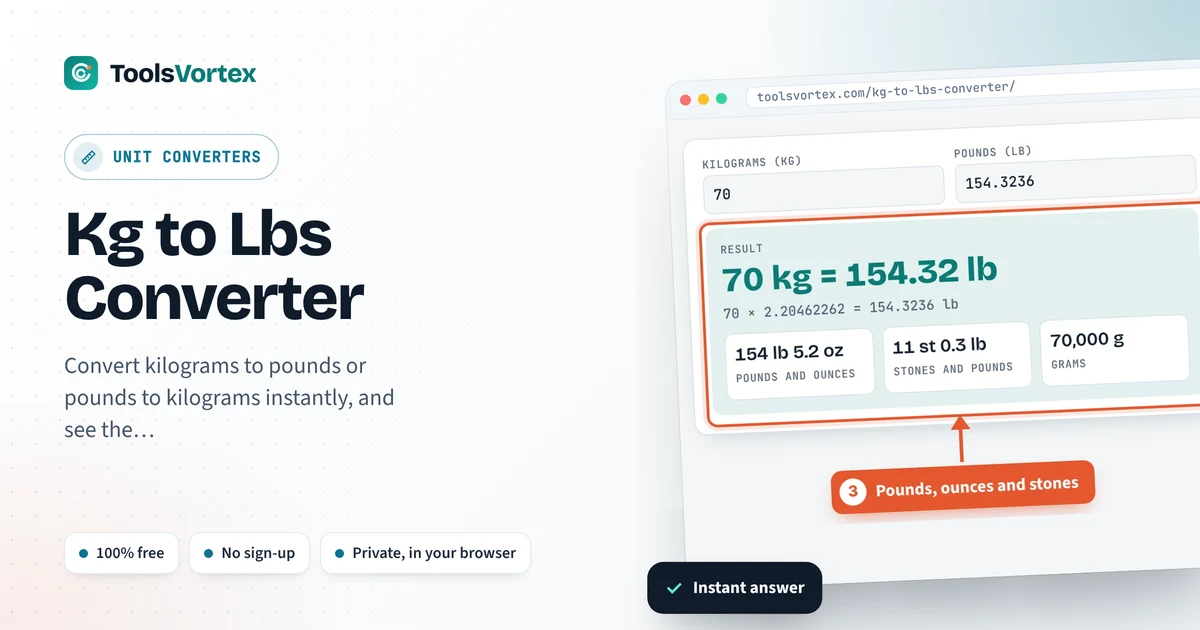
    How Many Pounds in a Kilogram: use the free kg to lbs converter on ToolsVortex

    Frequently Asked Questions

    Is a kilogram 2.2 pounds exactly?

    No. A kilogram is 2.2046226 pounds, so 2.2 is a rounded value. The rounding makes answers about 0.21% low, which is under half a pound at 100 kg. For exact results, divide the kilograms by 0.45359237.

    How many pounds is 1 kg of weight?

    One kilogram weighs about 2.2 pounds on Earth, or 2.20462 pounds to five decimals. Both units are used for weight in daily life, so the same factor works for groceries, luggage and body weight.

    Which is heavier, a kilogram or a pound?

    A kilogram is heavier. It is a little more than twice a pound, at 2.20462 pounds. Put the other way, one pound is about 45% of a kilogram, or 453.59 grams.

    How many ounces are in a kilogram?

    There are about 35.27 avoirdupois ounces in one kilogram. A pound has 16 ounces, and 2.20462 x 16 = 35.27. For gold or silver in troy ounces, a kilogram is about 32.15 troy ounces.

    How many kilograms is 150 pounds?

    150 pounds is 68.04 kilograms. Multiply 150 by 0.45359237 to get 68.0389, then round. A quick check: half of 150 is 75, minus 10% is 67.5, which is close.

    How do I convert kg to lbs and ounces?

    Multiply the kilograms by 2.20462 to get decimal pounds. Keep the whole pounds, then multiply the decimal part by 16 for ounces. For 3.5 kg, that gives 7.72 lb, which is 7 lb 11.5 oz.

    Why is the pound defined in kilograms?

    US customary units are defined from metric ones. Under the refinement that took effect on July 1, 1959, the avoirdupois pound is exactly 0.45359237 kg, so every scale and lab uses one shared value.

    Sources

    1. NBS: Miscellaneous Publication 233, Units of Weight and Measure, Avoirdupois pound of exactly 0.45359237 kg, effective July 1, 1959
    2. NIST: Handbook 44 Appendix C, General Tables of Units of Measurement, 1 kg = 2.205 lb, 16 ounces per pound, 14 pounds per stone, troy pound of 12 troy ounces
    3. NIST: Guide to the SI, Appendix B.8, Factors for Units Listed Alphabetically, Conversion factors for the avoirdupois and troy pound and ounce
    4. NIST: The Kilogram’s Future, Kilogram defined through the Planck constant since May 20, 2019
    TV
    Written by the ToolsVortex Editorial Team

    We check every number in our guides against the original source and test each example in our calculators before publishing. This guide is general information, not professional advice. Spotted an error? Tell us and we will fix it.

    Keep reading

  • How Many Feet in a Mile? 5,280 Feet Explained With Charts

    How Many Feet in a Mile? 5,280 Feet Explained With Charts

    Units & ConversionsUpdated October 29, 20268 min readBy ToolsVortex Editorial Team

    There are exactly 5,280 feet in a mile. That equals 1,760 yards, 63,360 inches, or 1,609.344 meters. The number comes from 8 furlongs of 660 feet each, set by an English law in 1593. A nautical mile is longer, at 1,852 meters, or about 6,076 feet.

    5,280 ftin one statute mile, exactly
    1,609.344 min one mile since 1959
    4.02 lapsof a 400 m track per mile
    How Many Feet in a Mile? 5,280 Feet Explained With Charts

    If you want to know how many feet in a mile, the answer is 5,280. It is an exact number, not a rounded one, and it has been the same for over 400 years.

    The odd number has a reason behind it, and it ties into furlongs, Roman soldiers, and a 1959 deal between six countries. Below you will find the history, charts for every common fraction of a mile, race distances in feet, and the track lap math that trips up a lot of runners. For quick swaps between metric and US distances, keep the km to miles converter open in another tab.

    How Many Feet Are in a Mile?

    A mile has exactly 5,280 feet. NIST Handbook 44 lists the mile as 5,280 feet (exactly) and 1.609344 kilometers (exactly).

    The foot itself is fixed at exactly 0.3048 meters. That is why the mile converts to metric with no rounding at all.

    Feet = miles x 5,280
    Miles = feet / 5,280
    Meters = miles x 1,609.344

    So 3 miles is 3 x 5,280 = 15,840 feet. And 10,000 feet is 10,000 / 5,280 = 1.89 miles. If you need meters to feet for a single distance, the feet to meters converter handles it in one step.

    A mile in everyday terms

    Big numbers are hard to picture, so compare a mile to things you know. An American football field is 300 feet from goal line to goal line, or 360 feet with both end zones. That means a mile is 17.6 fields without end zones, or about 14.7 fields with them. A basketball court for the NBA is 94 feet long, so a mile is about 56 courts end to end.

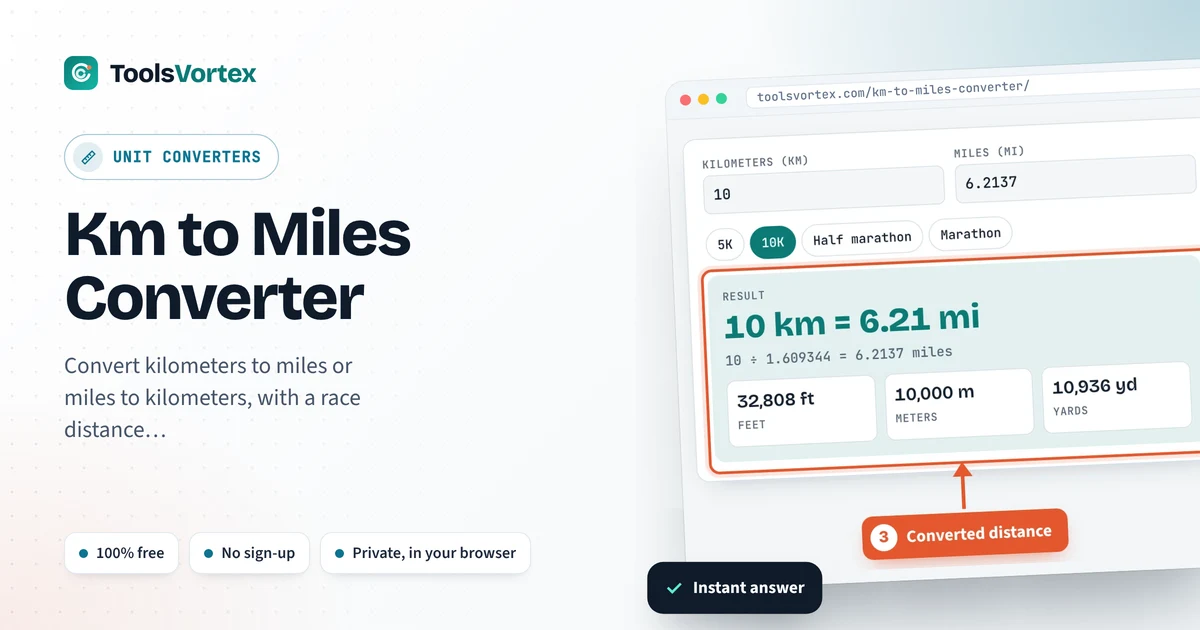
    KM to Miles ConverterConvert kilometers to miles and miles to kilometers using the exact 1.609344 factor.
    Open tool →

    Why Is a Mile 5,280 Feet?

    A mile is 5,280 feet because English law set it at 8 furlongs, and a furlong was already 660 feet long. Eight times 660 is 5,280.

    The furlong came from farming. Its name means “furrow long,” the length of one plowed furrow in an open field. By the 1500s it was fixed at 40 rods (also called poles), and each rod was 16.5 feet. That makes 40 x 16.5 = 660 feet.

    The older Roman mile was shorter. The Romans called it mille passus, or a thousand paces. A Roman pace counted two steps, so it was about 5 Roman feet. Modern estimates put the Roman mile at roughly 1,480 meters, or about 4,850 of our feet.

    England used several miles of different lengths for centuries. In 1593, during the reign of Elizabeth I, an Act of Parliament settled it: a mile would hold 8 furlongs of 40 poles each. Land was already measured in furlongs, so building the mile from them kept old field records usable. The result was the statute mile of 5,280 feet, or 1,760 yards. UK law still defines the mile as 1,760 yards in the Weights and Measures Act 1985.

    Units hidden inside a mile

    • 8 furlongs of 660 feet
    • 80 chains of 66 feet
    • 320 rods of 16.5 feet
    • 1,760 yards of 3 feet

    How Many Yards, Inches and Meters Are in a Mile?

    One mile equals 1,760 yards, 63,360 inches, and 1,609.344 meters. All of these are exact.

    UnitIn one mileExact?
    Feet5,280Yes
    Yards1,760Yes
    Inches63,360Yes
    Furlongs8Yes
    Meters1,609.344Yes
    Kilometers1.609344Yes
    Centimeters160,934.4Yes
    Nautical milesabout 0.869No, rounded

    The metric values are exact because the yard is defined as exactly 0.9144 meter.

    Why exact? Before 1959, the US and UK yards differed by a tiny amount. In the 1959 international yard and pound agreement, the US, the UK, and four other Commonwealth countries agreed on one yard of exactly 0.9144 meter. That fixed the foot at 0.3048 meter and the mile at 1,609.344 meters.

    Going the other way, one kilometer is about 0.6214 miles, or 3,280.84 feet. That is why a 5K is a little over 3 miles. The km to miles converter does this for any distance.

    Common mix-ups

    • Using 5,000 feet: a quick guess of 5,000 is off by 280 feet, about 5%.
    • Using 1.6 km: fine for a rough guess, but over a marathon it drifts by about 245 meters.
    • Mixing yards and feet: 1,760 is yards, not feet. Multiply by 3 to get 5,280.

    How Many Feet Are in Half a Mile or a Quarter Mile?

    Half a mile is 2,640 feet, and a quarter mile is 1,320 feet. Multiply the fraction by 5,280 to get any other part of a mile.

    Fraction of a mileFeetMeters
    1/10 mile528160.93
    1/8 mile660201.17
    1/4 mile1,320402.34
    1/3 mile1,760536.45
    1/2 mile2,640804.67
    3/4 mile3,9601,207.01
    1 mile5,2801,609.34

    Meters are rounded to two decimals. Feet are exact.

    Race distances are set in meters, so their feet values come out long. Here is the math for the most common runs.

    RaceMetersMilesFeet
    1,500 m1,5000.9324,921
    5K5,0003.10716,404
    10K10,0006.21432,808
    Half marathon21,097.513.10969,218
    Marathon42,19526.219138,435

    Feet are rounded to the nearest foot. The marathon is about 26.2 miles.

    Speed works the same way. At 60 mph you cover 60 x 5,280 = 316,800 feet per hour, which is exactly 88 feet per second. The mph to km/h converter shows the same speed as 96.56 km/h. And if you run an 8 minute mile, you cover 660 feet, one furlong, every minute. Check your own numbers with the pace calculator.

    How Long Is a Nautical Mile in Feet?

    A nautical mile is about 6,076.1 feet, because it is defined as exactly 1,852 meters. It is about 15% longer than a regular mile.

    Ships and planes use the nautical mile because it links to the shape of the Earth. One nautical mile is close to one minute of latitude, so navigators can read distance straight off a chart. The international nautical mile was set at 1,852 meters, and NIST Handbook 44 gives it as about 6,076.11549 feet.

    • 1 nautical mile = 1.1508 statute miles
    • 1 statute mile = 0.869 nautical miles
    • 1 knot = 1 nautical mile per hour, about 1.15 mph

    So when a pilot says a plane is 10 nautical miles out, that is about 11.5 regular miles. Do not mix the two when you plan a boat trip or read a flight tracker. On land, “mile” always means the statute mile of 5,280 feet unless a sign or map says otherwise.

    How Many Laps Around a Track Is a Mile?

    A mile is about 4.02 laps of a standard 400 meter track. Four laps is 1,600 meters, which falls about 30.7 feet short of a true mile.

    That gap surprises a lot of runners. The 1,600 m race, often called the metric mile, is not quite a mile. To run a true mile on a 400 m track, start about 9.34 meters (30.7 feet) behind the finish line and run four laps. Some tracks mark a separate start line for the mile for this reason.

    Worked example

    You want to run exactly 2 miles on a 400 m track. How many laps is that, and how far short are 8 laps?

    1. Convert to meters: 2 x 1,609.344 = 3,218.688 meters.
    2. Divide by lap length: 3,218.688 / 400 = 8.05 laps.
    3. Eight laps is 8 x 400 = 3,200 meters, or 1.988 miles.
    4. The gap: 3,218.688 minus 3,200 = 18.69 meters.
    5. In feet: 18.69 / 0.3048 = about 61.3 feet.

    So 8 laps leaves you about 61 feet short of 2 miles. Run 8 laps, then about 19 more meters past the line.

    Lane matters too. The 400 m figure is measured in lane 1. Outer lanes are longer, so a lap in lane 4 or 5 adds several meters each time around.

    How Many Steps Are in a Mile?

    Most adults take about 2,000 to 2,500 steps to walk a mile, but the real count depends on your height and stride. Divide 5,280 by your stride length in feet to get your own number.

    A 2.5 foot stride gives 5,280 / 2.5 = 2,112 steps per mile. Our full guide on how many steps in a mile covers walking and running strides by height. To turn a step count from your phone into distance, use the steps to miles calculator.

    Quick Recap

    • A mile has exactly 5,280 feet, 1,760 yards, and 63,360 inches.
    • The number comes from 8 furlongs of 660 feet, fixed by English law in 1593.
    • Since the 1959 international yard and pound agreement, a mile is exactly 1,609.344 meters.
    • A nautical mile is 1,852 meters, or about 6,076.1 feet.
    • A mile is about 4.02 laps of a 400 m track, so four laps is about 30.7 feet short.
    How Many Feet in a Mile: use the free km to miles converter on ToolsVortex

    Frequently Asked Questions

    How many feet are in half a mile?

    Half a mile is exactly 2,640 feet. Multiply 0.5 by 5,280 to get it. In metric, that is about 804.67 meters, or just over two laps of a standard 400 meter running track.

    How many feet are in a quarter mile?

    A quarter mile is exactly 1,320 feet, or 440 yards. That is about 402.34 meters, which is why a quarter mile drag strip is slightly longer than one lap of a 400 meter track.

    How many feet are in a kilometer?

    One kilometer is about 3,280.84 feet. Divide 1,000 meters by 0.3048, the exact length of a foot in meters. A kilometer is about 0.62 miles, so it takes about 1.61 km to make one mile.

    How many feet are in a 5K?

    A 5K is about 16,404 feet. Five kilometers is 5,000 meters, and 5,000 divided by 0.3048 gives 16,404.2 feet. That is about 3.11 miles, or a bit over 12 laps of a track.

    Is a nautical mile longer than a regular mile?

    Yes. A nautical mile is 1,852 meters, about 6,076.1 feet, while a regular mile is 5,280 feet. One nautical mile equals about 1.15 regular miles. Ships and aircraft use nautical miles.

    Why is a mile not 5,000 feet?

    The Roman mile was about 5,000 Roman feet, but the English mile was later fixed at 8 furlongs. Each furlong was 660 feet, so the 1593 law made the mile 5,280 feet instead of a round number.

    How many yards are in a mile?

    There are exactly 1,760 yards in a mile. Each yard is 3 feet, and 1,760 x 3 = 5,280 feet. UK law still defines the mile as 1,760 yards.

    Sources

    1. NIST: Handbook 44 Appendix C, General Tables of Units of Measurement, Mile of 5,280 ft and 1.609344 km, furlong of 660 ft, nautical mile of 1,852 m
    2. NIST: Guide to the SI, Appendix B, Conversion Factors, Exact foot of 0.3048 m and the international mile of 5,280 ft
    3. legislation.gov.uk: Weights and Measures Act 1985, Schedule 1, UK definitions of the mile as 1,760 yards and the yard as 0.9144 metre
    TV
    Written by the ToolsVortex Editorial Team

    We check every number in our guides against the original source and test each example in our calculators before publishing. This guide is general information, not professional advice. Spotted an error? Tell us and we will fix it.

    Keep reading

  • How Many Ounces in a Gallon? US, UK and Bottle Charts

    How Many Ounces in a Gallon? US, UK and Bottle Charts

    Units & ConversionsUpdated October 23, 20268 min readBy ToolsVortex Editorial Team

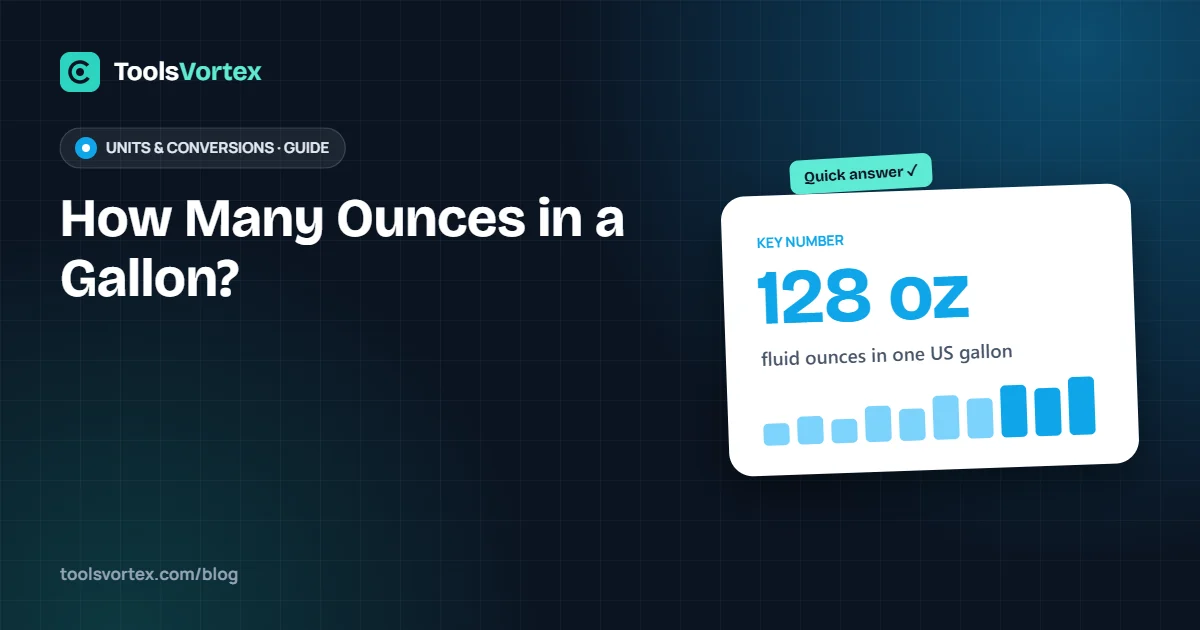
    A US gallon holds 128 fluid ounces, which is 16 cups or 3.785 liters. A UK imperial gallon is bigger: it holds 160 imperial fluid ounces, or 4.546 liters. That equals about 153.7 US fluid ounces. For water bottles, it takes about 7.6 standard 16.9 oz bottles to fill one US gallon.

    128 fl ozin one US liquid gallon
    160 fl ozin one UK imperial gallon
    7.6 bottlesof 16.9 oz water per US gallon
    How Many Ounces in a Gallon? US, UK and Bottle Charts

    If you are asking how many ounces in a gallon, the short answer in the United States is 128 fluid ounces. That number comes straight from how the gallon is built: 4 quarts, each with 32 ounces.

    The full answer has a few traps. The UK gallon is a different size, the UK ounce is a different size too, and a fluid ounce is not the same as an ounce on a scale. This guide gives you the exact numbers, a chart for every common size, and the math for water bottles and recipes. To flip between metric and US units fast, open the liters to gallons converter.

    How Many Ounces Are in a Gallon?

    There are exactly 128 US fluid ounces in one US liquid gallon. The US gallon is defined as 231 cubic inches, which is exactly 3.785411784 liters, according to NIST Handbook 44.

    The 128 comes from a simple chain of halves and quarters. One gallon is 4 quarts. One quart is 2 pints. One pint is 2 cups. One cup is 8 fluid ounces. Multiply it out and you get 4 x 2 x 2 x 8 = 128.

    Fluid ounces = gallons x 128
    Gallons = fluid ounces / 128
    1 US fl oz = 3,785.411784 mL / 128 = 29.5735295625 mL

    So one US fluid ounce is about 29.57 mL. Most labels round it to 29.6 or even 30 mL. If you need the exact figure for a lab, a label, or a big batch, use 29.5735 mL. For small swaps, the mL to oz converter does the rounding for you.

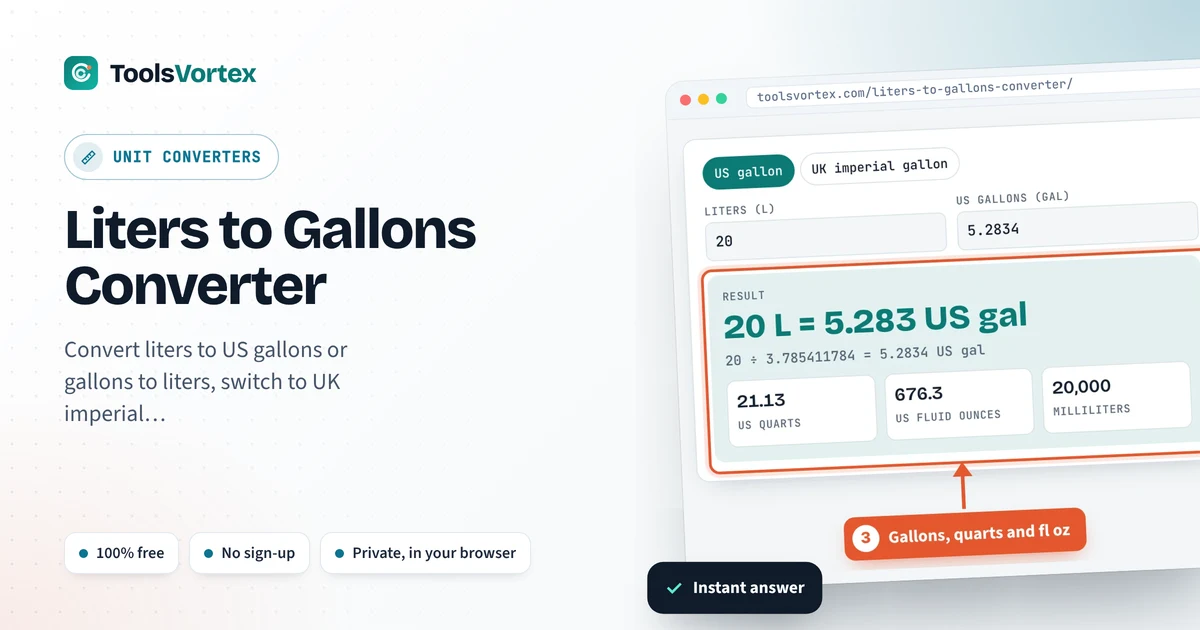
    Liters to Gallons ConverterConvert liters to US or UK gallons and back, with exact factors and instant results.
    Open tool →

    Is a UK Gallon Different From a US Gallon?

    Yes. A UK imperial gallon is about 20% bigger than a US gallon, and it is split into 160 imperial fluid ounces instead of 128.

    UK law sets the gallon at 4.54609 cubic decimetres, which is 4.54609 liters, in Schedule 1 of the Weights and Measures Act 1985. The same schedule sets the pint at 0.56826125 liters and the fluid ounce at 1/20 of a pint.

    Here is the part most charts skip: the imperial fluid ounce is smaller than the US one. The gallon is bigger, but the ounce is smaller. That is why the counts do not line up neatly.

    UnitUS customaryUK imperial
    Fluid ounces per gallon128160
    1 gallon in liters3.7854117844.54609
    1 fluid ounce in mL29.573529562528.4130625
    1 pint in fluid ounces1620
    1 gallon in US fl oz128about 153.72

    One imperial gallon equals about 1.201 US gallons. One imperial fluid ounce is about 96% of a US fluid ounce.

    If a recipe, a car manual, or a fuel figure comes from the UK, check which gallon it means. A UK figure of “40 miles per gallon” uses the bigger gallon, so the same car would show about 33.3 miles per US gallon.

    How Many Ounces Are in a Half Gallon, Quart, Pint and Cup?

    A half gallon holds 64 fluid ounces, a quart holds 32, a pint holds 16, and a cup holds 8. The chart below uses US customary units and the exact NIST value for the gallon.

    US measureFluid ouncesCupsMilliliters
    1 gallon128163,785.41
    1/2 gallon6481,892.71
    1 quart (1/4 gallon)324946.35
    1 pint (1/8 gallon)162473.18
    1 cup (1/16 gallon)81236.59

    Milliliters are rounded to two decimals. A US legal nutrition label cup is 240 mL, which is slightly larger than the 236.59 mL customary cup.

    You can also go smaller. One fluid ounce is 2 tablespoons, so a gallon holds 256 tablespoons and a cup holds 16. The tablespoons to cups converter handles those small kitchen jumps. To turn ounces into cups for any odd amount, like 42 oz, use the ounces to cups converter. It gives 5.25 cups.

    How Many Water Bottles Make a Gallon?

    It takes about 7.6 standard 16.9 oz water bottles to make one US gallon. Divide 128 by the bottle size in fluid ounces and you have the answer for any bottle.

    Bottle sizeBottles per US gallonPractical count
    8 oz1616 bottles
    12 oz10.6711 bottles (a little over)
    16.9 oz (500 mL)7.578 bottles (a little over)
    20 oz6.46.5 bottles
    24 oz5.335.5 bottles
    32 oz44 bottles exactly

    The 16.9 oz bottle is a 500 mL bottle sold with a rounded US label. Using 500 mL exactly gives 7.57 bottles per gallon.

    People ask this most when they track water. A gallon a day is a common challenge, and it equals six and a half refills of a 20 oz bottle. The right amount for you depends on your body, the weather, and how active you are. The water intake calculator gives a general daily estimate in ounces and liters. This is general information, not medical advice.

    Is a Fluid Ounce the Same as an Ounce of Weight?

    No. A fluid ounce measures volume, while an ounce on a scale measures weight. They only match closely for water and drinks that are mostly water.

    A US gallon of water weighs about 8.34 pounds. Here is the math: 3.785411784 liters of water at its densest weighs about 3.785 kg, and one pound is exactly 0.45359237 kg. So 3.785411784 / 0.45359237 = 8.345 pounds. At room temperature water is a touch less dense, so a gallon weighs closer to 8.33 pounds.

    • Water: 1 fl oz weighs about 1.04 oz. Close enough for most drinks.
    • Milk: slightly heavier than water, so a gallon weighs about 8.6 pounds.
    • Cooking oil: lighter than water. A cup of oil weighs less than 8 oz.
    • Honey: much heavier. A cup weighs about 12 oz.

    A UK gallon of water weighs about 10 pounds. That is no accident. The imperial gallon was first defined as the volume of 10 pounds of water under set conditions, as NIST notes in Handbook 44.

    So if a recipe lists “8 oz of flour,” it means weight, not a cup. Weigh it, or use a grams to cups chart for that ingredient.

    What Is a US Dry Gallon?

    A US dry gallon is an older unit for grains and produce, equal to 1/8 of a US bushel, or 268.8025 cubic inches. That works out to about 4.405 liters.

    NIST Handbook 44 defines the US bushel as 2,150.42 cubic inches. Divide by 8 and you get the dry gallon. It is about 16% larger than the liquid gallon. You will almost never see it on a store label today. Berries and produce are usually sold by the dry pint or dry quart, or by weight.

    The key point: fluid ounces only apply to the liquid gallon. There is no “dry ounce” that splits a dry gallon into 128 parts. If you see ounces on a bag of rice, that is weight.

    How Do You Use Gallon Conversions in the Kitchen?

    Convert everything to fluid ounces first, then divide by 128 to get gallons, or by 32 to get quarts. It keeps the math in whole numbers.

    Worked example

    You are making lemonade for 20 guests, with one 8 oz cup each. How much do you need?

    1. Total ounces: 20 x 8 = 160 fl oz.
    2. Gallons: 160 / 128 = 1.25 gallons.
    3. Split it: 1 gallon is 128 oz, and the extra 32 oz is exactly 1 quart.
    4. In liters: 1.25 x 3.785411784 = 4.73 liters.
    5. In 64 oz jugs: 160 / 64 = 2.5 jugs, so buy 3.

    So you need 1 gallon plus 1 quart, about 4.73 liters. Plan a little extra for ice melt and refills.

    A few more edge cases come up often:

    • Scaling a soup: a recipe that makes 2 quarts makes half a gallon, or 64 oz. Doubling it fills a gallon pot to the brim, so use a bigger pot.
    • Metric recipes: 1 liter is about 33.8 US fl oz, so 4 liters is about 135 oz, a bit more than a gallon. The cups to mL converter helps when a recipe mixes both systems.
    • Old British cookbooks: a UK pint is 20 imperial fl oz, not 16. Treat it as about 19.2 US fl oz.

    For fuel, aquariums, or any job measured in liters, the liters to gallons converter does the 3.785 math both ways.

    Quick Recap

    • A US liquid gallon holds exactly 128 fluid ounces, or 3.785411784 liters.
    • A UK imperial gallon holds 160 imperial fluid ounces, about 153.7 US fluid ounces.
    • Half gallon = 64 oz, quart = 32 oz, pint = 16 oz, cup = 8 oz.
    • About 7.6 bottles of 16.9 oz water make one US gallon.
    • A US gallon of water weighs about 8.34 pounds; fluid ounces are volume, not weight.
    How Many Ounces in a Gallon: use the free liters to gallons converter on ToolsVortex

    Frequently Asked Questions

    How many 16.9 oz water bottles are in a gallon?

    About 7.57 bottles. Divide 128 by 16.9 and you get 7.57, so 8 bottles gives you a little more than one US gallon. The 16.9 oz bottle is really a 500 mL bottle, and 500 mL goes into a gallon 7.57 times too.

    Is 64 oz half a gallon?

    Yes. Half of a US gallon is exactly 64 fluid ounces, which is 2 quarts, 8 cups, or about 1.89 liters. Many juice and milk cartons sold as a half gallon hold this amount.

    How many ounces are in a gallon of milk?

    A US gallon of milk holds 128 fluid ounces, the same as any US gallon of liquid. By weight it comes to about 8.6 pounds, a bit more than water, because milk is denser than water.

    How many ounces are in a UK gallon?

    A UK imperial gallon holds 160 imperial fluid ounces. In US fluid ounces that is about 153.7, because the imperial fluid ounce is smaller at 28.41 mL compared with 29.57 mL for the US fluid ounce.

    How many cups are in a gallon?

    There are 16 US cups in one US gallon. Each cup holds 8 fluid ounces, and 16 x 8 = 128 fluid ounces. A quart holds 4 cups and a pint holds 2 cups.

    How much does a gallon of water weigh?

    A US gallon of water weighs about 8.34 pounds, or about 3.79 kg. At room temperature it is closer to 8.33 pounds. A UK imperial gallon of water weighs about 10 pounds.

    How many 20 oz bottles make a gallon?

    It takes 6.4 bottles of 20 oz to make one US gallon. Divide 128 by 20 to get 6.4. In real life, that means six full bottles plus a little less than half of a seventh.

    Sources

    1. NIST: Handbook 44 Appendix C, General Tables of Units of Measurement, US gallon of 231 cubic inches and 3.785411784 L, 128 fl oz, bushel size, imperial gallon notes
    2. legislation.gov.uk: Weights and Measures Act 1985, Schedule 1, UK gallon of 4.54609 cubic decimetres, pint, and fluid ounce of 1/20 pint
    3. NIST: Guide to the SI, Appendix B, Conversion Factors, Official guidance on exact and rounded conversion factors
    TV
    Written by the ToolsVortex Editorial Team

    We check every number in our guides against the original source and test each example in our calculators before publishing. This guide is general information, not professional advice. Spotted an error? Tell us and we will fix it.

    Keep reading