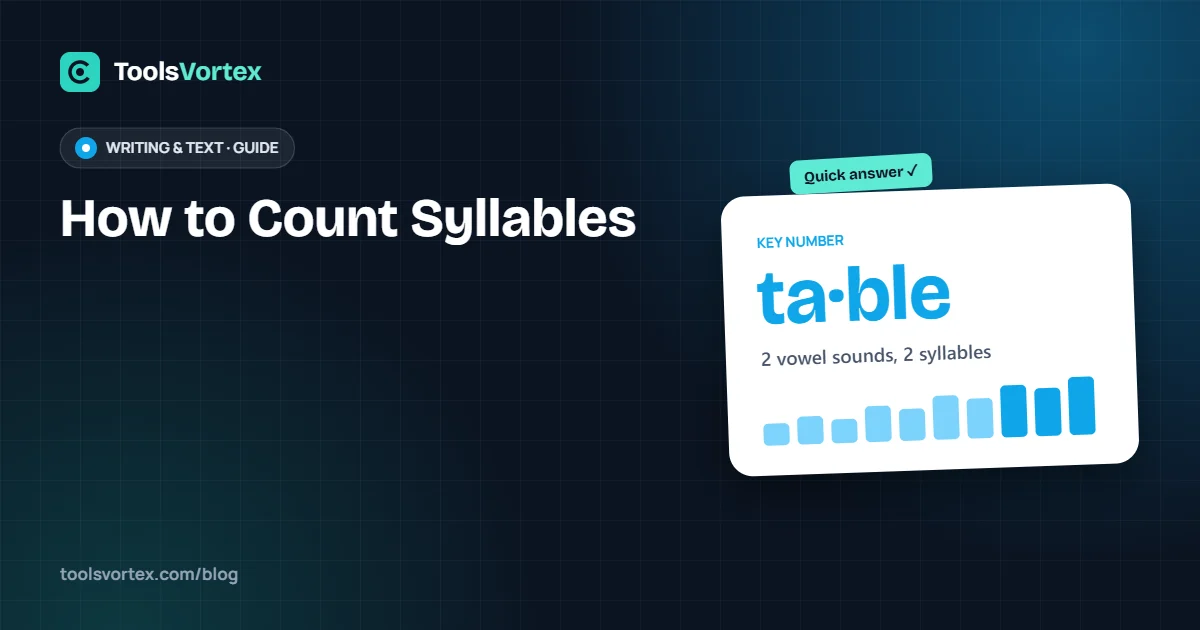
To count syllables, say the word out loud and count the vowel sounds you hear, not the vowel letters. Each beat is one syllable. “Cake” has 1, “table” has 2 and “information” has 4. Clap once per beat or feel your chin drop. Silent e and most -ed endings add no syllable.

Learning how to count syllables takes about five minutes. The trick is to trust your ears more than your eyes, because English spelling hides a lot of silent letters.
This guide gives you three quick methods, the spelling rules that cause most mistakes, and a table of words that even teachers argue about. Then we use syllable counts to score a real sentence for readability. If you just need a number fast, paste your text into our syllable counter.
What Is a Syllable and How Do You Count One?
A syllable is a single beat of sound built around one vowel sound, so you count syllables by counting the vowel sounds you hear.
A vowel sound can come from one letter (the a in “cat”), two letters (the oa in “boat”) or even a y (the y in “gym”). Consonants hang on either side of that sound, but they never make a beat by themselves in normal English words.
Not = number of vowel letters you see
Look at “cake.” It has two vowel letters, a and e, but you only hear one vowel sound. So it has 1 syllable. “Banana” has three a’s and three sounds: ba, na, na. That is 3 syllables.
What Are the Easiest Ways to Count Syllables?
The three easiest methods are clapping the beats, feeling your chin drop, and counting the vowel sounds you hear.
1. Clap or tap
Say the word at a normal speed and clap once for each beat. “Hap py” gets two claps. “Cel e brate” gets three. Tapping a finger on the desk works the same way and is quieter.
2. Hand under your chin
Rest the back of your hand under your chin and say the word. Your jaw drops each time you make a vowel sound. Count the drops. This method is good for kids because it uses touch, not just hearing.
3. Count vowel sounds
Write the word and mark each vowel sound, not each vowel letter. “Boat” has two vowel letters but one sound. “Create” has two vowel letters next to each other but two sounds: cre, ate. This method is the most accurate for long words.
Speak at your normal pace. If you stretch a word out slowly, you may add a beat that is not really there, like “fi yer” for “fire.”
What Are the Rules for Counting Syllables?
The rules mostly tell you which letters stay silent and which letter groups make one sound or two.
| Rule | What happens | Examples (syllables) |
|---|---|---|
| Silent final e | An e at the end is usually silent | cake (1), hope (1), complete (2) |
| Consonant + le | The ending makes its own beat | table (2), little (2), purple (2) |
| -ed ending | Adds a beat only after t or d | wanted (2), needed (2), walked (1), played (1) |
| Vowel teams | Two letters, one sound | rain (1), boat (1), team (1) |
| Split vowels | Two letters, two sounds | create (2), lion (2), poem (2) |
| Y as a vowel | Y makes a vowel sound inside or at the end | gym (1), happy (2), my (1) |
| -tion and -sion | The ending is one beat | nation (2), vision (2), information (4) |
| Prefixes and suffixes | Each one usually adds its own beat | redo (2), unhappy (3), carefully (3) |
Watch for exceptions. “Recipe” has 3 syllables because its final e is spoken, and “-le” after a vowel, as in “mile,” is just a silent e.
The -ed rule in detail
The -ed ending is the most common mistake. After a t or d sound, you need an extra beat to say it: “want ed,” “land ed.” After any other sound, the -ed blends in as a t or d sound: “jumped” sounds like “jumpt,” and “played” sounds like “playd.” Both are 1 syllable.
Diphthongs
A diphthong is one vowel sound that glides, like the oi in “coin” or the ou in “house.” It still counts as one syllable, even though your mouth moves during it.
Which Words Have Tricky Syllable Counts?
Words with dropped middle vowels or silent letters cause the most disagreement, and the right count often depends on your accent.
We checked each word below in the Merriam-Webster dictionary. The dots show where the dictionary breaks the written word. The spoken count comes from the pronunciations it lists.
| Word | Merriam-Webster breaks | Spoken count | Why it trips people |
|---|---|---|---|
| fire | fire | 1 (some say 2) | Many people add a small “uh” sound: fy er |
| every | ev·ery | 2 | The dictionary lists only “ev ree”; some speakers say 3 |
| chocolate | choc·o·late | 2 or 3 | The middle o is often dropped: choc late |
| family | fam·i·ly | 2 or 3 | Both “fam lee” and “fam uh lee” are listed |
| business | busi·ness | 2 | The i after s is silent: biz ness |
| poem | po·em | 2 (some say 1) | “Po um” is standard; “pome” is also listed |
| orange | or·ange | 2 (some say 1) | Some speakers squeeze it to one beat |
| Wednesday | Wednes·day | 2 | The first d and second e are silent: wenz day |
Dictionary dots mark places to split a word at the end of a line. They do not always match the spoken beats. “Every” has one written break but can be spoken with 2 or 3 beats.
If you are writing for a contest or a class, pick the most common pronunciation and stay consistent across the whole piece.
How Do You Divide a Word Into Syllables?
You divide a word by finding its vowel sounds, then splitting the consonants between them using three common patterns.
- VC/CV: two consonants between vowels usually split down the middle: rab bit, nap kin, win ter.
- V/CV: one consonant often goes with the second vowel, which leaves the first vowel long: ti ger, ba con, mu sic.
- VC/V: if the first vowel sounds short, the consonant stays with it: cam el, lem on, rob in.
Never split a consonant team that makes one sound, like ch, sh, th or ph. “Teacher” splits as teach er, not teac her. These patterns help you sound out new words, but the count of beats is what matters for syllable counting.
Why Does Counting Syllables Matter?
Syllable counts shape poetry forms, song lyrics and the readability scores that many writers and editors use.
Haiku
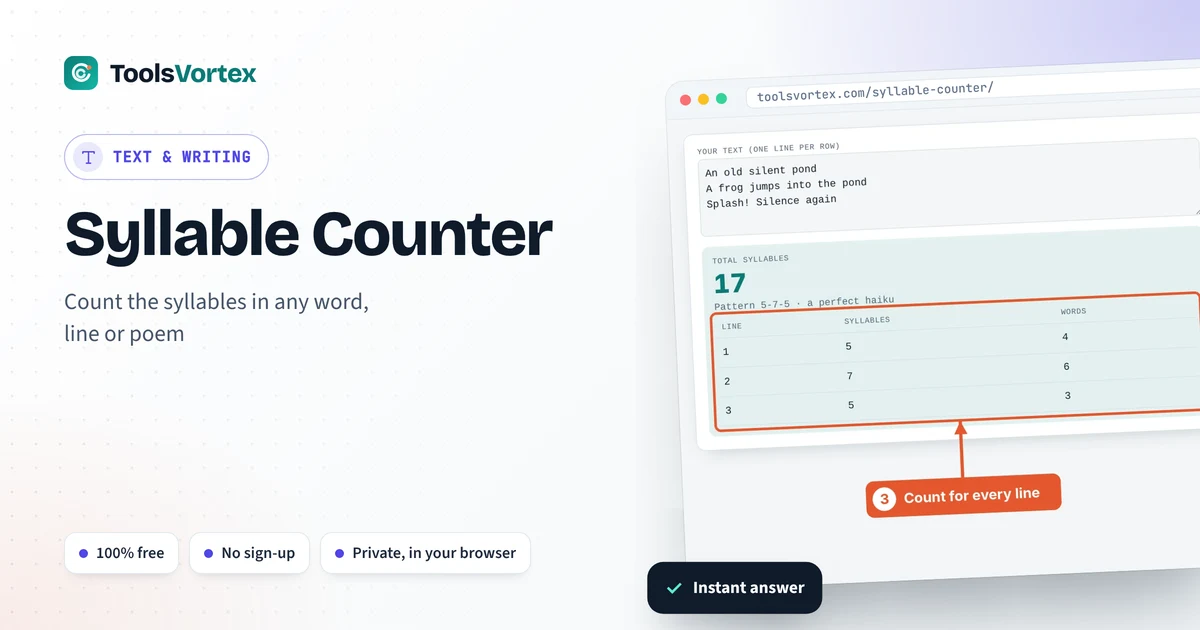
A Japanese haiku typically has 17 sound units arranged 5, 7 and 5. In English, the Haiku Society of America notes that most haiku have three lines of 17 or fewer syllables, and many poets now write shorter ones. In school, 5, 7, 5 is still the usual rule, so check what your teacher or contest wants.
Meter and lyrics
A line of iambic pentameter has 10 syllables in five pairs of unstressed and stressed beats. Shakespeare’s “Shall I compare thee to a summer’s day?” counts out to exactly 10. Songwriters count syllables too, so each line fits the same number of notes. A quick word counter helps you keep verses the same length, and a character counter helps if a platform limits line length.
Readability
The Flesch Reading Ease formula uses syllables per word as its biggest input. Long words with many syllables lower the score, which means the text is harder to read.
Higher score = easier text
Score this text: “We baked a chocolate cake for the family party. Everyone wanted a second slice.”
- Words: 9 in the first sentence plus 5 in the second = 14 words.
- Sentences: 2. Words per sentence = 14 / 2 = 7.
- Syllables, sentence one: we (1), baked (1), a (1), chocolate (3), cake (1), for (1), the (1), family (3), party (2) = 14.
- Syllables, sentence two: everyone (3), wanted (2), a (1), second (2), slice (1) = 9.
- Total syllables = 23. Syllables per word = 23 / 14 = 1.643.
- Score = 206.835 minus (1.015 x 7) minus (84.6 x 1.643) = 206.835 minus 7.105 minus 138.986 = 60.7.
Now count “chocolate” and “family” as 2 syllables each, the way many people say them. The total drops to 21, and the score rises to 72.8. Two accent choices moved the score by 12 points.
That is why automated tools and humans sometimes disagree. Our syllable counter uses common dictionary pronunciations, so use it for a consistent baseline. If your draft is in all caps, run it through the case converter first so it is easier to read and check.
Quick Recap
- Count vowel sounds you hear, not vowel letters you see.
- Silent final e adds no beat; consonant + le adds one.
- The -ed ending is its own syllable only after t or d.
- Words like chocolate and family vary by accent, so stay consistent.
- Syllable counts drive haiku, meter and the Flesch Reading Ease score.
Frequently Asked Questions
How many syllables are in chocolate?
Merriam-Webster breaks it as choc·o·late, which is 3 written parts. In speech many Americans drop the middle o and say “choc late,” which is 2 syllables. Both counts are accepted; pick one and stay consistent.
Does every vowel make a syllable?
No. Only vowel sounds make syllables. “Boat” has two vowel letters and one sound, so it has 1 syllable. A silent e at the end of “hope” or “cake” adds no syllable either.
Is the -ed ending a separate syllable?
Only after a t or d sound. “Wanted” and “needed” have 2 syllables. “Walked,” “jumped” and “played” have 1, because the -ed blends into a t or d sound.
Does y count as a vowel when counting syllables?
Yes, when it makes a vowel sound. In “gym” and “my” it is the only vowel sound, so each word has 1 syllable. In “happy” the final y makes the second beat, giving 2 syllables.
Does a haiku have to be 5, 7, 5 syllables?
Not always in English. The Haiku Society of America says most English haiku have 17 or fewer syllables in three lines. Many schools and contests still ask for 5, 7, 5, so follow their rules.
How many syllables are in Wednesday?
Most speakers say 2: “wenz day.” The first d and the second e are silent. Merriam-Webster also lists a British variant with an extra middle beat, which would give 3.
Why do syllable counters give different answers?
Some tools guess from spelling rules, and others look words up in a pronunciation dictionary. Words with dropped vowels, like family or every, can get different counts depending on which method and accent the tool uses.
Sources
- Merriam-Webster: chocolate, example of dictionary syllable breaks and pronunciations
- Kincaid et al., Derivation of New Readability Formulas for Navy Enlisted Personnel (DTIC, 1975), the Flesch Reading Ease formula and constants
- Haiku Society of America: Definitions (2004), English haiku are usually 17 or fewer syllables
- Academy of American Poets: Iambic Pentameter, five pairs of unstressed and stressed syllables