Find out what day of the week any date falls on, from year 1 to 9999. See the full working with Zeller’s congruence or Conway’s Doomsday rule, and get correct weekdays for old British and European dates.
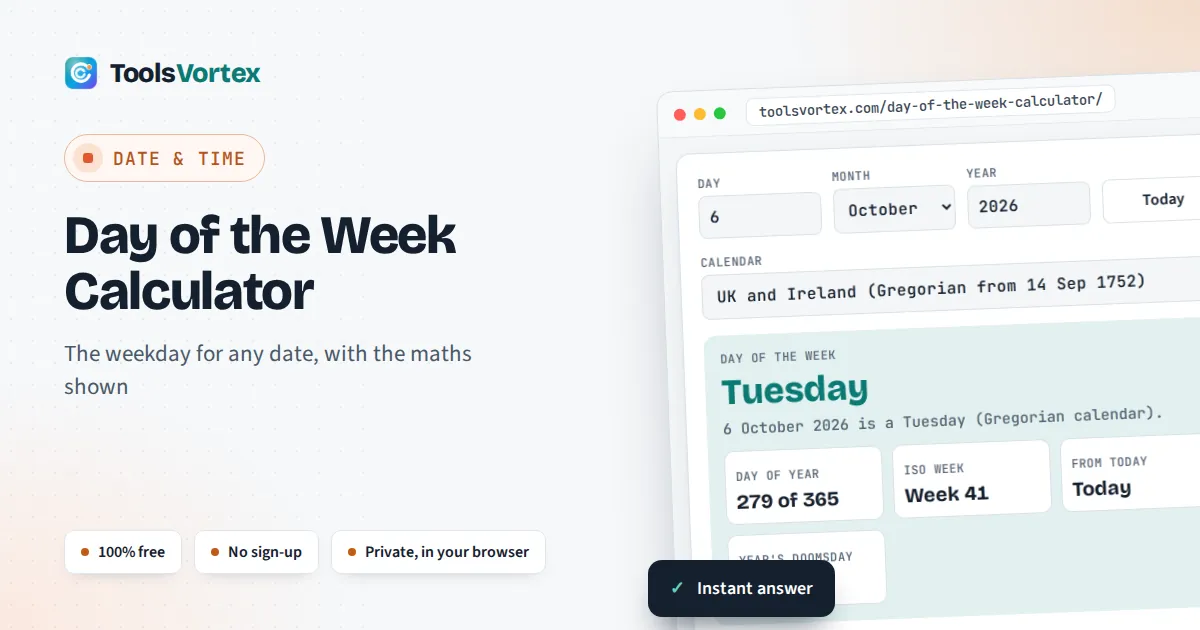
This day of the week calculator tells you which weekday any date falls on, past or future, for birthdays, historical events, contracts and planning. It also shows how the answer is worked out, using the two methods taught in maths classes and puzzle books, and it handles the calendar change that removed 11 days from September 1752 in Britain and Ireland.
How do you find what day of the week a date falls on?
Enter the day, month and year above and the calculator shows the weekday at once. By hand, use Zeller’s congruence: add the day, ⌊13(m+1)/5⌋, the year of the century, a quarter of it and two century terms, then take the remainder after dividing by 7. For 14 March 1990 the remainder is 4, which means Wednesday.
How does Zeller’s congruence work?
Zeller’s congruence, devised by Christian Zeller in the 19th century, turns any date into a number from 0 to 6. January and February count as months 13 and 14 of the previous year, so that the leap day falls at the end of the counting year.
Julian: h = ( q + ⌊13(m+1)/5⌋ + K + ⌊K/4⌋ + 5 + 6J ) mod 7
q = day, m = month (3 = March … 14 = February), K = year mod 100, J = ⌊year ÷ 100⌋
h: 0 = Saturday, 1 = Sunday, 2 = Monday, 3 = Tuesday, 4 = Wednesday, 5 = Thursday, 6 = Friday
Worked example: Niamh’s birthday. Niamh was born on 14 March 1990. Here q = 14, m = 3, K = 90 and J = 19. That gives 14 + ⌊52/5⌋ + 90 + ⌊90/4⌋ + ⌊19/4⌋ + 5 × 19 = 14 + 10 + 90 + 22 + 4 + 95 = 235. 235 divided by 7 leaves 4, so she was born on a Wednesday. Type the date into the tool and press “Zeller working” to see the same lines. To find her exact age in years, months and days, use the age calculator.
How does the Doomsday rule work?
The Doomsday rule, devised by mathematician John Conway in 1973, relies on the fact that certain easy dates share the same weekday every year. That weekday is the year’s “Doomsday”. Find it once, then count from the nearest memorable date.
| Month | Doomsday date | Memory hook |
|---|---|---|
| January | 3 (4 in leap years) | 3rd in 3 years, 4th in the 4th |
| February | Last day (28 or 29) | End of the month |
| March | 14 | Two weeks after the last day of February |
| April, June, August, October, December | 4/4, 6/6, 8/8, 10/10, 12/12 | Even months: same day and month |
| May, September | 9/5 and 5/9 | “I work 9 to 5 at the 7 to 11” |
| July, November | 11/7 and 7/11 | Same rhyme |
Century anchor days are Friday for the 1800s, Wednesday for the 1900s, Tuesday for the 2000s and Sunday for the 2100s. For the year itself, use the “odd + 11” steps: take the last two digits, add 11 if odd, halve, add 11 if odd, then subtract the remainder after dividing by 7 from 7 and count that many days on from the anchor. For 2026: 26, 13, 24, so 7 − 3 = 4 days after Tuesday, which makes Doomsday 2026 a Saturday. Christmas Day, 25 December 2026, is 13 days after 12/12, so it falls on a Friday.
Why do old British dates use a different calendar?
Because Britain and its dominions, including Ireland, stayed on the Julian calendar until 1752. The Calendar Act 1750 ruled that the day after 2 September 1752 would be 14 September, dropping 11 days. Spain, Portugal, Italy and Poland had already switched in 1582, when Thursday 4 October was followed by Friday 15 October. The weekday sequence never broke: only the dates jumped.
| Region | Last Julian date | First Gregorian date |
|---|---|---|
| Spain, Portugal, Italy, Poland | Thursday 4 October 1582 | Friday 15 October 1582 |
| Great Britain, Ireland and colonies | Wednesday 2 September 1752 | Thursday 14 September 1752 |
So the calendar setting matters for older dates. A British date before 14 September 1752 should be read with the “UK and Ireland” option, which uses the Julian calendar for those years and flags dates such as 5 September 1752 that never existed. Many online weekday tools apply the modern Gregorian rules backwards to every date, which gives the wrong weekday for many historical British records.
What else does the calculator show?
Beside the weekday you get the day of the year, the ISO 8601 week number, how many days away the date is, and the year’s Doomsday. For week numbers on their own, use the week number calculator, and to count the days between two dates use the days between dates calculator.
How Do You Use the Day of the Week Calculator?
Enter the date
Type the day, pick the month and type the year. Press Today to jump back to the current date.

Choose the calendar
Leave it on UK and Ireland for British dates, or pick the 1582 option for Spain, Italy, Portugal and Poland. Modern dates give the same answer either way.
Read the weekday
The weekday appears in large text, with the day of the year, ISO week, days from today and the year’s Doomsday below.
Check the working
Switch between Zeller and Doomsday to see every number used, so you can follow it or check your homework.


Frequently Asked Questions
What day of the week was 1 January 2000?
Saturday. Using Zeller’s congruence, January counts as month 13 of 1999, so q = 1, m = 13, K = 99 and J = 19. The total is 1 + 36 + 99 + 24 + 4 + 95 = 259, which divides exactly by 7, and a remainder of 0 means Saturday.
What day is Christmas 2026?
Friday 25 December 2026. Doomsday for 2026 is Saturday, so 12 December is a Saturday. Christmas is 13 days later, which is one week and six days, so it lands on a Friday.
What does mod 7 mean in these formulas?
It means the remainder after dividing by 7. A week has seven days, so any running total of days can be reduced to a number from 0 to 6, and each remainder stands for one weekday.
Why does Zeller treat January and February as months 13 and 14?
Moving them to the end of the previous year puts 29 February at the very end of the counting year. The month term ⌊13(m+1)/5⌋ then works for every month without a separate leap year correction.
Why does the calculator say a date in September 1752 does not exist?
Under the Calendar Act 1750, Britain and its dominions skipped from Wednesday 2 September to Thursday 14 September 1752. Dates from 3 to 13 September 1752 never happened there. Choose “Gregorian for every date” if you need them anyway.
How far back and forward does the calculator work?
From year 1 to year 9999. For dates before a country adopted the Gregorian calendar, pick the matching calendar option, because the weekday for a given date number differs between the Julian and Gregorian calendars.
Sources and Further Reading
- Zeller’s congruence, Wikipedia
- Doomsday rule, Wikipedia
- 1582 and the first Gregorian calendar change, Wikipedia
Related Tools
Last reviewed: October 2026