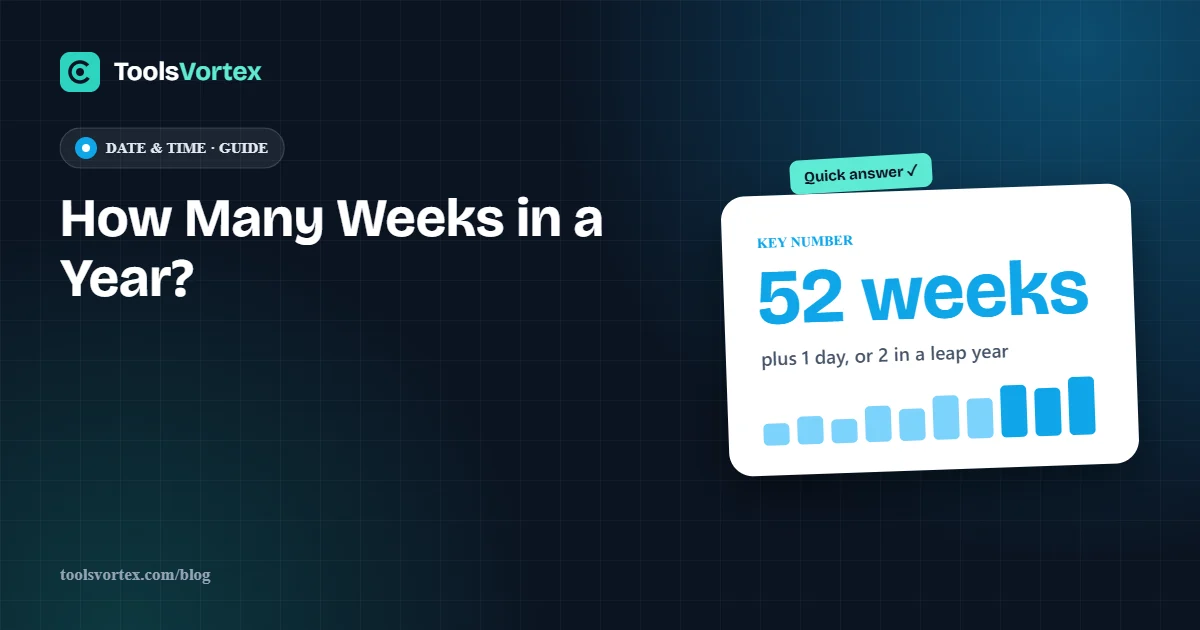
A year has 52 weeks and 1 day (365 days), or 52 weeks and 2 days in a leap year (366 days). In decimals that is 52.14 and 52.29 weeks. Under the ISO week system, most years have 52 numbered weeks, but some have 53. 2026 is one of them.

Ask how many weeks in a year and most people say 52. That is close, but a year is never exactly 52 weeks. There is always a day or two left over, and those spare days decide whether your calendar shows 52 or 53 week numbers and whether you get an extra paycheck.
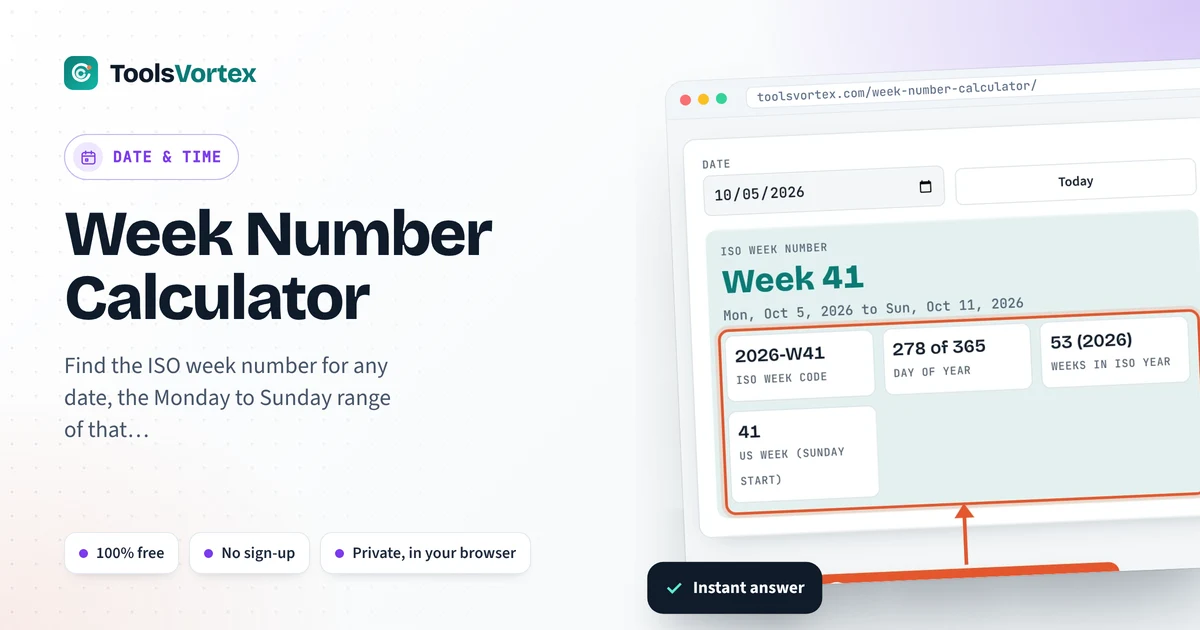
This guide gives the exact counts, a list of upcoming 53 week years, the weeks in each month, and how weekly and biweekly pay schedules handle the leftover days. To look up the week number of any date, use our week number calculator.
How Many Weeks Are in a Year?
A year has 52 full weeks plus 1 extra day, or 52 full weeks plus 2 extra days in a leap year.
The math is simple. 52 weeks x 7 days = 364 days. A common year has 365 days, so one day is left over. A leap year has 366, so two are left over.
| Year type | Days | Weeks (exact) | Full weeks + extra days |
|---|---|---|---|
| Common year | 365 | 52.1429 | 52 weeks + 1 day |
| Leap year | 366 | 52.2857 | 52 weeks + 2 days |
| Gregorian average | 365.2425 | 52.1775 | 52 weeks + 1.2425 days |
The Gregorian average comes from the US Naval Observatory, which gives the calendar year an average length of 365.2425 days.
So if a form asks for “weeks per year,” 52 is the standard answer. If you need precision, for example to spread a yearly cost over weeks, use 52.14 for a normal year.
How Many Weeks Are in a Year Exactly?
A common year is exactly 52.1429 weeks, a leap year is 52.2857 weeks, and the long run average is 52.1775 weeks.
Common year = 365 / 7 = 52.1429
Leap year = 366 / 7 = 52.2857
Leap years follow a rule that many people only half know. The US Naval Observatory states it this way: years evenly divisible by 4 are leap years, except century years that are not evenly divisible by 400. So 2000 was a leap year, but 2100 will not be. That rule is why the average Gregorian calendar year is 365.2425 days and not 365.25.
A full 400 year Gregorian cycle has 146,097 days. Divide by 7 and you get exactly 20,871 weeks. That is why the calendar repeats its weekday pattern every 400 years.
Does a Year Have 52 or 53 Weeks?
Most years have 52 numbered weeks, but about 1 year in every 5 or 6 has 53 under the ISO 8601 week system.
ISO 8601 is the international standard for writing dates. Its week rules, as Google’s ISOWEEKNUM help page puts them, are: weeks begin on Monday and end on Sunday, and week 1 is the week containing the first Thursday of the year. Because of that Thursday rule, a year gets a week 53 when it starts on a Thursday, or when it is a leap year that starts on a Wednesday.
| Year | Jan 1 falls on | Leap year? | Day(s) that occur 53 times | ISO weeks |
|---|---|---|---|---|
| 2025 | Wednesday | No | Wednesday | 52 |
| 2026 | Thursday | No | Thursday | 53 |
| 2027 | Friday | No | Friday | 52 |
| 2028 | Saturday | Yes | Saturday, Sunday | 52 |
| 2029 | Monday | No | Monday | 52 |
| 2030 | Tuesday | No | Tuesday | 52 |
| 2031 | Wednesday | No | Wednesday | 52 |
| 2032 | Thursday | Yes | Thursday, Friday | 53 |
| 2033 | Saturday | No | Saturday | 52 |
We counted every year with code. In one full 400 year cycle, 71 years have 53 ISO weeks and 329 have 52.
The “53 times” column is a separate idea. In 2026, there are 53 Thursdays but only 52 of every other weekday. In leap years, two weekdays get the bonus. That column is what decides how many weekly paydays or weekly meetings land in the year.
When Is Week 53 in 2026?
ISO week 53 of 2026 runs from Monday, December 28, 2026 to Sunday, January 3, 2027.
That means January 1, 2 and 3 of 2027 are still part of week 53 of 2026. The first week of 2027 starts on Monday, January 4. The same thing happens at the start of 2026 in reverse: Monday, December 29, 2025 was already the first day of week 1 of 2026.
This trips people up in planning software, shipping schedules and payroll reports. If a report groups data by ISO week, those first January days get counted in the old year. Always check which week system a tool uses before you compare week numbers across countries or apps. The week number lookup shows the ISO week for any date.
A different system: Sunday weeks
Some calendars and spreadsheet settings start weeks on Sunday and call the week that holds January 1 week 1, no matter which day it is. With that method, a year almost always touches 53 week numbers, because the first and last weeks are partial. A leap year that starts on a Saturday, like 2028, even reaches 54. Neither system is wrong. They answer different questions.
How Many Weeks Are in a Month?
An average month has about 4.35 weeks, which is 52.14 weeks divided by 12.
No month is exactly 4.35 weeks. A 31 day month is 4 weeks and 3 days. A 30 day month is 4 weeks and 2 days. Only February in a common year is exactly 4 weeks.
| Month (2026) | Days | Weeks (decimal) | Full weeks + days |
|---|---|---|---|
| January | 31 | 4.43 | 4 weeks + 3 days |
| February | 28 | 4.00 | 4 weeks exactly |
| March | 31 | 4.43 | 4 weeks + 3 days |
| April | 30 | 4.29 | 4 weeks + 2 days |
| May | 31 | 4.43 | 4 weeks + 3 days |
| June | 30 | 4.29 | 4 weeks + 2 days |
| July | 31 | 4.43 | 4 weeks + 3 days |
| August | 31 | 4.43 | 4 weeks + 3 days |
| September | 30 | 4.29 | 4 weeks + 2 days |
| October | 31 | 4.43 | 4 weeks + 3 days |
| November | 30 | 4.29 | 4 weeks + 2 days |
| December | 31 | 4.43 | 4 weeks + 3 days |
February 2026 has 28 days, so it is the only month this year with exactly 4 weeks. In leap years like 2028 it has 4 weeks and 1 day.
A quarter is often called 13 weeks, which is 91 days. In 2026 the real quarters run 90, 91, 92 and 92 days, so Q1 is one day short and Q3 and Q4 are one day long. To count the exact days in any span, use the days between dates calculator.
How Many Paychecks Are in a Year?
Weekly pay gives you 52 paychecks in most years and 53 in some, and biweekly pay gives you 26 in most years and 27 in some.
The extra paycheck comes from the leftover day or two. If you are paid every Friday, you get 53 paychecks in any year with 53 Fridays. From 2025 to 2033, that happens in 2027 and 2032. For biweekly pay, the 27th payday appears about once every 11 years, and the exact year depends on your employer’s start date. For example, a Friday biweekly schedule with a payday on January 2, 2026 lands paydays on both January 1 and December 31, 2027, so 2027 gets 27.
Jordan is paid weekly and wants to set aside money each week for a $1,200 monthly rent payment.
- Yearly rent: $1,200 x 12 = $14,400.
- Weekly amount using 52 weeks: $14,400 / 52 = $276.92 per week.
- If Jordan used the “4 weeks a month” habit instead: $1,200 / 4 = $300 per week.
- Over 52 weeks that is $300 x 52 = $15,600, which is $1,200 more than the rent needs.
- In a 53 paycheck year, setting aside $276.92 every week adds one more deposit, for 53 x $276.92 = $14,676.76 saved.
Saving $300 a week is not harmful, but it ties up an extra month of rent. Using 52 weeks gives the true weekly cost.
To turn a salary into an hourly rate, the hourly to salary guide explains why 52 weeks x 40 hours gives 2,080 hours. For how holidays shrink that number, see how many work days are in a year. This is general information, not financial advice. Check your own pay calendar with HR or payroll.
Quick Recap
- A year is 52 weeks plus 1 day, or 52 weeks plus 2 days in a leap year.
- In decimals that is 52.14 weeks, or 52.29 in a leap year.
- ISO 8601 gives some years 53 weeks; 2026, 2032 and 2037 are the next ones.
- Week 53 of 2026 runs December 28, 2026 to January 3, 2027.
- Weekly pay brings 53 paychecks in some years; biweekly pay brings 27 about once every 11 years.
Frequently Asked Questions
Is a year 52 or 53 weeks?
A year is 52 full weeks plus 1 or 2 days. When you count numbered weeks with the ISO 8601 system, most years have 52 weeks, but years that start on a Thursday, and leap years that start on a Wednesday, have 53.
How many weeks are in 2026?
2026 has 365 days, which is 52 weeks and 1 day. It also has 53 ISO weeks, because it starts on a Thursday. Week 53 runs from December 28, 2026 to January 3, 2027.
How many weeks are in a leap year?
A leap year has 366 days, which is 52 weeks and 2 days, or 52.29 weeks. Whether it has 52 or 53 ISO weeks depends on the weekday it starts on. 2028 has 52, while 2032 has 53.
How many weeks are in a month on average?
About 4.35 weeks. Divide 52.14 weeks by 12 months to get it. Real months run from exactly 4 weeks in a 28 day February to 4 weeks and 3 days in a 31 day month.
How many work weeks are in a year?
There are 52 weeks in a year, so a full-time schedule is usually counted as 52 work weeks. Paid holidays and vacation days reduce the time you actually spend working, so the real number of weeks on the job is lower.
What is the next year with 53 weeks?
Under ISO 8601, 2026 has 53 weeks. After that, the next 53 week years are 2032 and 2037. We checked each year from 2025 to 2040 with code using the ISO Thursday rule.
Why do some years have 27 biweekly paychecks?
Each year has one or two days beyond 52 weeks. Those days slowly shift the payday schedule until a year starts and ends with a payday. Then the year holds 27 biweekly paydays instead of 26.
Sources
- US Naval Observatory: Leap Years, the Gregorian leap year rule and the 365.2425 day average year
- Google Docs Editors Help: ISOWEEKNUM, ISO 8601 weeks start Monday and week 1 holds the first Thursday
- ISO: ISO 8601, International Standard for Date and Time Format, ISO 8601 as the international standard covering years, weeks and days