Find the healthy weight range for your height in kilograms, stone or pounds. The calculator also shows three classic ideal body weight formulas, how far you are from the range, and your waist-to-height ratio.
An estimate for adults, not medical advice.
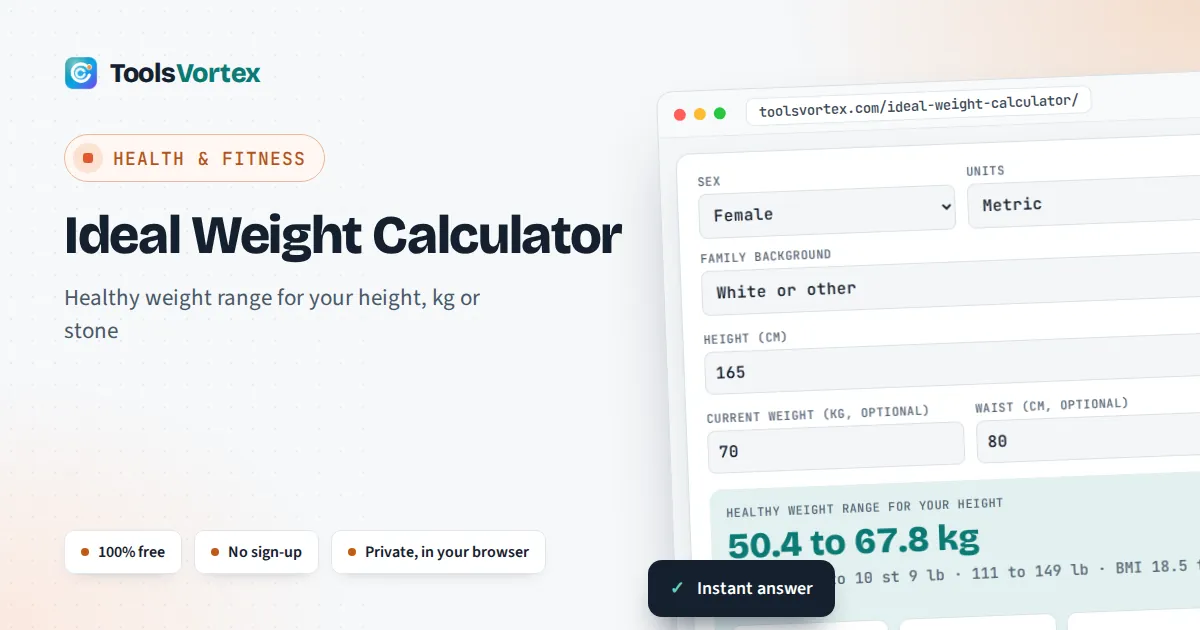
This ideal weight calculator shows adults the range of weights that counts as healthy for their height, so you have a realistic target rather than a single magic number. It uses the BMI range the NHS uses, adjusts it for family backgrounds with a higher risk of type 2 diabetes at lower weights, and compares it with three ideal body weight formulas that doctors and pharmacists still use. If you only want your current BMI score, the BMI calculator is quicker.
What is my ideal weight for my height?
For most adults, an ideal weight is any weight that gives a BMI of 18.5 to 24.9, which is weight in kg divided by height in meters squared. At 170 cm that is about 53.5 to 72.0 kg (8 st 6 lb to 11 st 5 lb). An ideal weight calculator also shows the Devine formula, which gives one point inside it.
How Is Ideal Weight Calculated?
The main result is a range taken from body mass index. The three formulas below each give a single figure based on height above 5 feet (152.4 cm).
Higher risk backgrounds: 18.5 × height(m)² to 22.9 × height(m)²
Inches over 5 ft = height(cm) ÷ 2.54 − 60
Devine (1974): men 50 kg, women 45.5 kg, + 2.3 kg per inch
Robinson (1983): men 52 kg + 1.9 kg per inch, women 49 kg + 1.7 kg per inch
Miller (1983): men 56.2 kg + 1.41 kg per inch, women 53.1 kg + 1.36 kg per inch
The Devine formula was published for working out drug doses, not as a health target. A 2000 review in the Annals of Pharmacotherapy traced it back to estimates by Devine’s mentor, Dr Margaret McCarron, which matched old insurance height and weight tables. Robinson and Miller later fitted similar equations to population data. That history is why the range is the main answer here and the formulas are shown for comparison. The formulas are not valid under 152 cm, so the calculator hides them for shorter adults.
What Should I Weigh for My Height? Chart in cm
Healthy BMI range and the Devine figure for common heights. Values are in kilograms.
| Height | Healthy range (BMI 18.5 to 24.9) | Range if BMI limit is 23 | Devine, women | Devine, men |
|---|---|---|---|---|
| 155 cm (5 ft 1) | 44.4 to 59.8 | 44.4 to 55.0 | 47.9 | 52.4 |
| 160 cm (5 ft 3) | 47.4 to 63.7 | 47.4 to 58.6 | 52.4 | 56.9 |
| 165 cm (5 ft 5) | 50.4 to 67.8 | 50.4 to 62.3 | 56.9 | 61.4 |
| 170 cm (5 ft 7) | 53.5 to 72.0 | 53.5 to 66.2 | 61.4 | 65.9 |
| 175 cm (5 ft 9) | 56.7 to 76.3 | 56.7 to 70.1 | 66.0 | 70.5 |
| 180 cm (5 ft 11) | 59.9 to 80.7 | 59.9 to 74.2 | 70.5 | 75.0 |
| 185 cm (6 ft 1) | 63.3 to 85.2 | 63.3 to 78.4 | 75.0 | 79.5 |
| 190 cm (6 ft 3) | 66.8 to 89.9 | 66.8 to 82.7 | 79.5 | 84.0 |
Why Is the Healthy Range Lower for Some Ethnic Groups?
People from some family backgrounds develop type 2 diabetes and heart disease at lower body weights, so UK guidance uses lower BMI cut offs for them. The NHS says that for adults with a South Asian, Chinese, other Asian, Middle Eastern, Black African or African-Caribbean background, a BMI of 23 to 27.4 counts as overweight and 27.5 or more as obese, compared with 25 and 30 for everyone else. Choose that option in the calculator and the top of your healthy range moves down to a BMI of 22.9.
Worked Example: What Is James’s Ideal Weight?
James is a 180 cm (about 5 ft 11) man from Manchester who weighs 92 kg (14 st 7 lb) and has a 90 cm waist.
- Healthy range: 1.80² = 3.24, so 18.5 × 3.24 = 59.9 kg to 24.9 × 3.24 = 80.7 kg (9 st 6 lb to 12 st 10 lb)
- Formulas: 180 cm is 10.87 inches over 5 ft, so Devine gives 75.0 kg, Robinson 72.6 kg and Miller 71.5 kg
- Current BMI: 92 ÷ 3.24 = 28.4, in the overweight band
- To reach the range: 92 − 80.7 = about 11.3 kg to lose
- Waist to height: 90 ÷ 180 = 0.50, right on the line NICE uses for increased health risk
A realistic first goal for James is to lose 5% of his weight, about 4.6 kg, which the UK government’s Better Health campaign says can seriously reduce the chance of heart disease. Our calorie calculator turns a target like this into a daily intake, and the guide on how many calories to eat to lose weight explains a safe pace.
Is Waist Size Better Than an Ideal Weight?
Waist size adds information that weight alone misses, because fat stored around the middle carries the highest health risk. NICE guidance from 2022 tells adults with a BMI under 35 to keep their waist to less than half their height. A waist-to-height ratio of 0.4 to 0.49 is healthy, 0.5 to 0.59 means increased risk, and 0.6 or more means high risk.
Diabetes UK advises measuring halfway between the bottom of your ribs and the top of your hip bone, after breathing out and relaxing, with the tape straight but not tight. The ratio works for men and women of all ethnic groups and for muscular people, which is where BMI and ideal weight formulas fall down.
When Is an Ideal Weight Calculator Not Accurate?
An ideal weight calculator is a rough guide, and it is least accurate for people with a lot of muscle, who can sit above the range while being lean. It also does not suit children and teenagers, who need age based growth charts, pregnant women, older adults who may benefit from a little extra weight, or anyone under 152 cm for the formulas. A body fat calculator gives a better picture for athletes. This is an estimate, not medical advice. See your GP if your BMI is under 18.5, if you are losing weight without trying, or if your waist is more than half your height, so they can check your blood pressure and blood sugar.
How Do You Use the Ideal Weight Calculator?
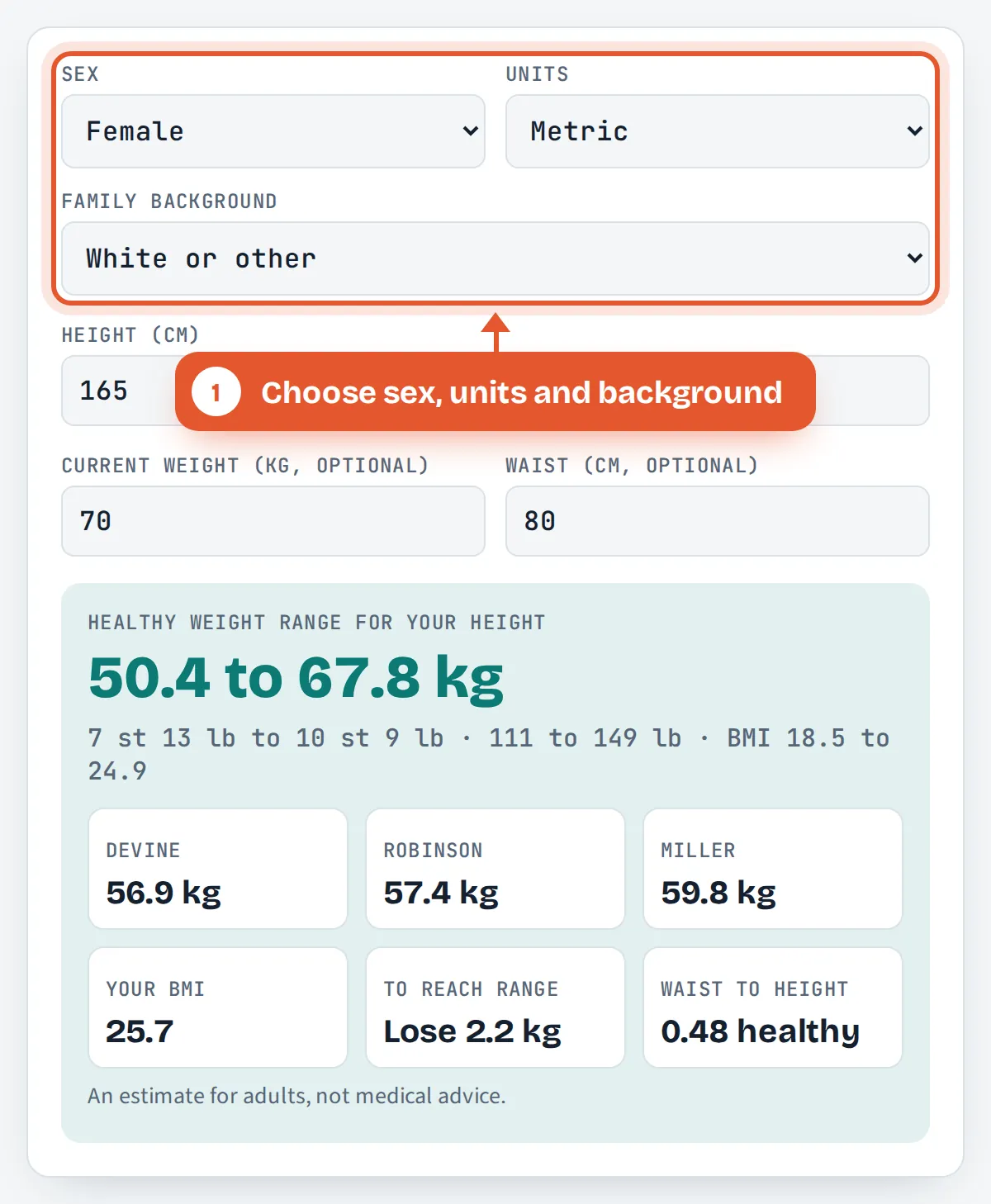
Choose sex, units and background
Pick your sex, metric, UK or US units, and the family background that fits you best.

Enter your height
Type your height in centimeters, or in feet and inches if you chose UK or US units.
Add weight and waist
Add your current weight and waist if you want your BMI, distance to the range and waist ratio.
Read your healthy range
Your healthy weight range shows in large text, with the three formulas, your BMI and waist-to-height ratio below.


Frequently Asked Questions
What is the ideal weight for a 5 ft 4 woman?
A 5 ft 4 (163 cm) woman has a healthy BMI range of about 48.9 to 65.8 kg, or 7 st 10 lb to 10 st 5 lb. The Devine formula puts her at 54.7 kg and Robinson at 55.8 kg, both inside that range.
What is the ideal weight for a 5 ft 10 man?
A 5 ft 10 (178 cm) man has a healthy BMI range of about 58.5 to 78.7 kg, or 9 st 3 lb to 12 st 6 lb. The Devine formula gives 73.0 kg and Miller 70.3 kg, both near the middle of the range.
Is ideal weight the same as a healthy BMI?
Not exactly. A healthy BMI is a range from 18.5 to 24.9, while ideal weight formulas such as Devine give a single figure. Any weight in the healthy BMI range is considered healthy for most adults, so use the range as your target.
Does ideal weight change with age?
No. The healthy BMI range and the formulas are the same for every adult aged 18 or over. Children and teenagers are assessed with age based growth charts instead. If you are over 65 or have a long term condition, agree a target weight with your GP.
Why does the calculator ask about my ethnic background?
NHS guidance uses lower BMI cut offs for people with South Asian, Chinese, other Asian, Middle Eastern, Black African or African-Caribbean family backgrounds, because their risk of type 2 diabetes rises at lower weights. Choosing that option lowers the top of your healthy range.
How much weight should I lose to see health benefits?
Losing just 5% of your body weight can seriously reduce your chance of heart disease, according to the UK government’s Better Health campaign. For someone at 90 kg that is 4.5 kg, a far more realistic first goal than reaching a formula weight straight away.
Sources and Further Reading
- Obesity diagnosis: BMI and waist size, NHS
- Pai MP, Paloucek FP. The origin of the “ideal” body weight equations, Ann Pharmacother 2000 (PubMed)
- Waist-to-height ratio and the 2022 NICE boundaries, Wikipedia
Related Tools
Last reviewed: October 2026