ToolsVortex
Explore tools

Category: Math & Education

Math and school guides on percentages and GPA, with clear formulas, worked examples and free calculators for homework and grades.

  • How to Calculate GPA: Semester, Cumulative and Weighted Steps

    How to Calculate GPA: Semester, Cumulative and Weighted Steps

    Math & EducationUpdated November 3, 20269 min readBy ToolsVortex Editorial Team

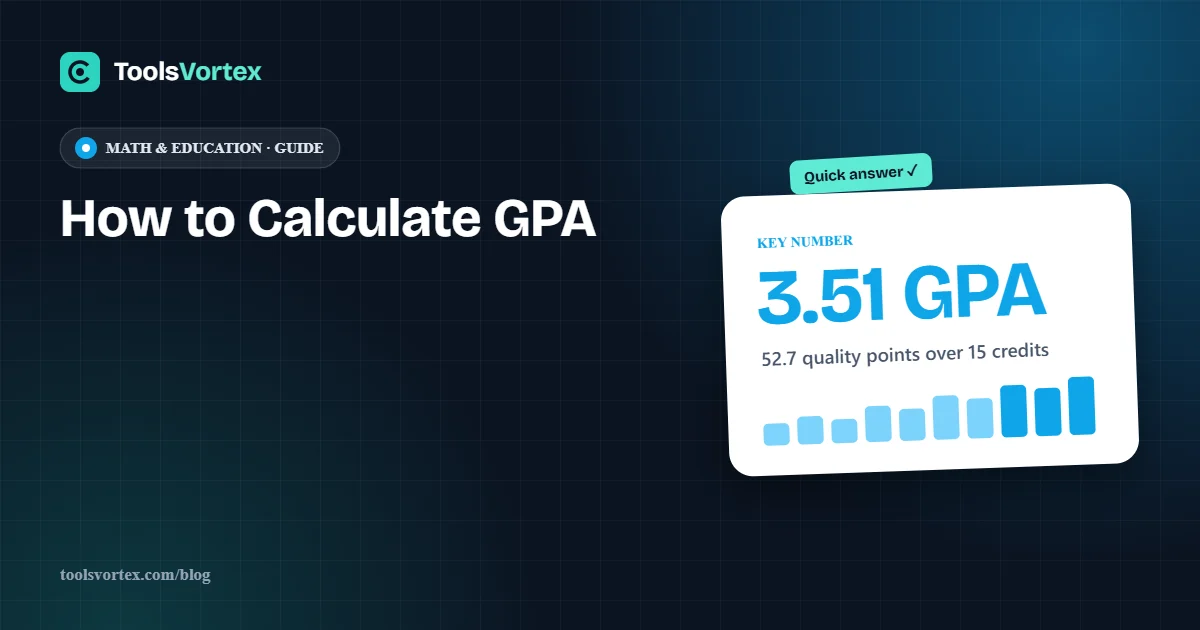
    To calculate GPA, turn each letter grade into grade points (A = 4.0, B = 3.0, C = 2.0), multiply by the course credit hours to get quality points, add them up, and divide by total credits attempted. For example, 52.7 quality points over 15 credits gives a 3.51 GPA.

    4.0grade points for an A on the standard scale
    Points / creditsthe core GPA formula
    3.51GPA from 52.7 points over 15 credits
    How to Calculate GPA: Semester, Cumulative and Weighted Steps

    Knowing how to calculate GPA yourself lets you check your transcript, plan next semester and catch mistakes before they cost you a scholarship. The math is simple: grade points times credits, added up, divided by credits.

    This guide walks through a full semester example, then shows the parts most explainers skip: combining terms, weighted high school GPAs, grades that do not count, and the exact GPA you need next term to reach a goal. To skip the arithmetic, enter your classes in our GPA calculator.

    How Do You Calculate GPA Step by Step?

    You calculate GPA by multiplying each course’s grade points by its credit hours, adding those quality points, and dividing by the total credit hours you attempted.

    Quality points = grade points × credit hours
    GPA = total quality points ÷ total credit hours attempted

    Here are the four steps:

    1. Convert each letter grade to grade points using your school’s scale (see the table below).
    2. Multiply each grade point value by that course’s credit hours.
    3. Add all the quality points together, and add all the credit hours together.
    4. Divide total quality points by total credit hours. Round to two decimals, the way most transcripts show it.

    Credit hours matter because a 4 credit lab science should count more than a 1 credit gym class. That is why GPA is a weighted average, not a plain average of your grades.

    Notice the word attempted. James Madison University counts the credit hours of every graded class in the divisor whether you pass or fail it. So a failed class adds credits to the bottom of the fraction but no points to the top. Your term GPA uses one semester of classes, and your cumulative GPA uses every graded class you have taken at that school. Keep a simple list of each course, its credits and its grade, and you can rebuild either number in a few minutes.

    GPA CalculatorEnter your grades and credit hours to get your GPA in seconds, with no manual math.
    Open tool →

    What Is the Grade Point Value of Each Letter Grade?

    On the common 4.0 scale, an A is worth 4.0, a B is 3.0, a C is 2.0, a D is 1.0 and an F is 0, with plus and minus grades in between.

    The catch is that schools do not agree on the plus and minus values. James Madison University uses 3.70 for an A minus, while the University of Toledo uses 3.67. Both are official registrar scales.

    Letter gradeScale A (tenths)Scale B (thirds)
    A4.004.00
    A minus3.703.67
    B plus3.303.33
    B3.003.00
    B minus2.702.67
    C plus2.302.33
    C2.002.00
    C minus1.701.67
    D plus1.301.33
    D1.001.00
    D minus0.700.67
    F0.000.00

    Scale A matches James Madison University. Scale B matches the University of Toledo. Some high schools skip plus and minus grades entirely, so check your student handbook.

    The difference is small. In the example below, the tenths scale gives 3.513 and the thirds scale gives 3.511. Both round to 3.51. It only matters when you sit right on a cutoff, like a 3.50 honors line.

    How Do You Calculate Your GPA for One Semester?

    For one semester, list every graded class with its credits, find the quality points for each, and divide the total points by the total credits.

    Worked example

    Maya takes five classes this fall. Her school uses the tenths scale.

    1. English, 3 credits, B plus: 3 × 3.3 = 9.9 quality points.
    2. Calculus, 4 credits, A minus: 4 × 3.7 = 14.8 quality points.
    3. Biology, 4 credits, B: 4 × 3.0 = 12.0 quality points.
    4. History, 3 credits, A: 3 × 4.0 = 12.0 quality points.
    5. PE, 1 credit, A: 1 × 4.0 = 4.0 quality points.
    6. Totals: 52.7 quality points and 15 credits. 52.7 ÷ 15 = 3.513.

    Maya’s semester GPA is 3.51. If she had just averaged her five grade values, she would get 3.60. The plain average overstates her GPA because her two A grades include a 1 credit class.

    That gap is the most common GPA mistake. Always weight by credits. If you want to see how weighting works outside of grades, our weighted average calculator uses the same math.

    How Do You Calculate Cumulative GPA?

    To calculate cumulative GPA, add the quality points from every term and divide by the total credits from every term. Do not average the term GPAs.

    Cumulative GPA = (points term 1 + points term 2 + …) ÷ (credits term 1 + credits term 2 + …)
    Term points = term GPA × term credits

    Say you earned a 3.20 over 15 credits in fall and a 3.80 over 12 credits in spring. Averaging the two GPAs gives 3.50, but that is wrong because fall had more credits.

    TermCreditsTerm GPAQuality points
    Fall153.2048.0
    Spring123.8045.6
    Cumulative273.4793.6

    93.6 ÷ 27 = 3.467, which rounds to 3.47, not 3.50.

    If your transcript only shows term GPAs, multiply each one by its credits to rebuild the quality points first. Applying abroad or to a school that uses percentages? Our CGPA to percentage calculator handles that conversion.

    How Do You Calculate a Weighted GPA in High School?

    A weighted GPA adds bonus points to harder classes such as honors, AP or IB before you average, so an A in an AP class can count as more than 4.0.

    There is no national rule for the bonus. A school might add 0.5 for honors and 1.0 for AP, while another school adds nothing and reports only an unweighted GPA. Use the numbers printed in your school profile or handbook. The example below assumes that 0.5 and 1.0 setup and full year classes worth 1 credit each.

    ClassLevelGradeUnweightedWeighted
    AP BiologyAP (+1.0)A4.05.0
    Honors EnglishHonors (+0.5)B plus3.33.8
    Algebra IIRegularB3.03.0
    Spanish IIRegularA4.04.0
    AP US HistoryAP (+1.0)B3.04.0
    GPA3.463.96

    Unweighted: 17.3 ÷ 5 = 3.46. Weighted: 19.8 ÷ 5 = 3.96. If classes have different credits, multiply each value by its credits first.

    Colleges often recalculate GPA their own way, so keep both numbers handy. For what counts as strong on each scale, see our guide on what a good GPA is.

    Which Grades Do Not Count Toward Your GPA?

    Pass/fail grades, incompletes, audits and most withdrawals usually do not count toward GPA, and a replaced repeat grade may drop out too, but every school sets its own rules.

    • Pass/fail: At the University of Toledo, a pass or no credit grade does not affect GPA at all. You earn credits, but no quality points.
    • Incomplete: Toledo leaves an incomplete out of GPA until it turns into a real grade, which happens if you miss the deadline.
    • Failed classes: An F still counts. You attempted the credits and earned 0 points, so it pulls the average down hard.
    • Repeated classes: At CU Boulder, a retake grade that is the same or better replaces the old one in GPA. The old grade stays on the transcript. If the retake grade is lower, both count.

    Here is why repeat rules matter. A student with 45 quality points over 15 credits (a 3.00) fails a 3 credit class. The GPA drops to 45 ÷ 18 = 2.50. After a retake with a B, the GPA is 54 ÷ 21 = 2.57 if both attempts count, or 54 ÷ 18 = 3.00 if the B replaces the F.

    What GPA Do I Need Next Semester to Raise My GPA?

    The GPA you need next term equals your target GPA times your total future credits, minus the points you already have, divided by the new credits you will take.

    GPA needed = (target × (current credits + new credits) − current GPA × current credits) ÷ new credits

    The more credits you already have, the harder your GPA is to move. This table shows that clearly.

    Current GPA and creditsTargetNeed over 15 creditsNeed over 30 creditsNeed over 60 credits
    2.80 over 603.003.803.403.20
    2.80 over 603.204.80 (not possible)4.003.60
    3.30 over 903.504.70 (not possible)4.10 (not possible)3.80

    Any result above 4.00 cannot be reached on an unweighted 4.0 scale in that many credits. Plan over more terms.

    So a junior with a 2.80 can reach 3.00 in one 15 credit term only with a 3.80. Spread over two terms, a 3.40 does it. If your next grade depends on one big exam, the final grade calculator shows the score you need. Run your real numbers through the GPA calculator to test different plans.

    Quick Recap

    • GPA = total quality points ÷ total credit hours attempted.
    • Quality points = grade points × credits, so bigger classes count more.
    • Combine terms by adding points and credits, never by averaging term GPAs.
    • Plus and minus values and weighted bonuses differ by school, so use your own scale.
    • The GPA needed next term = (target × all credits − current points) ÷ new credits.
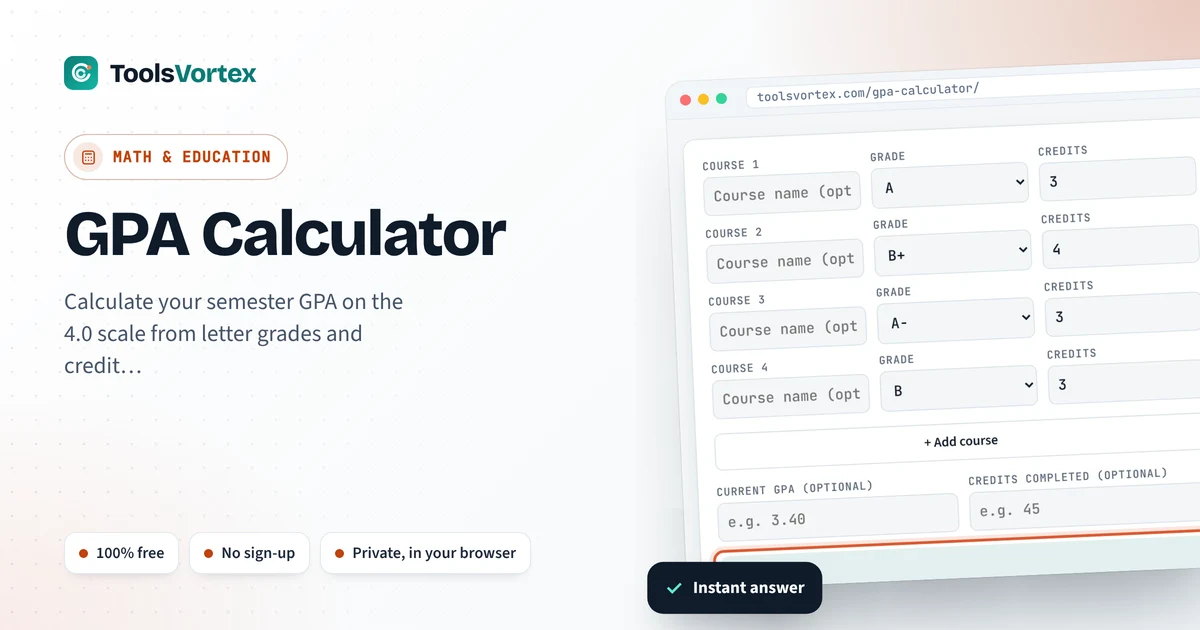
    How to Calculate GPA: use the free gpa calculator on ToolsVortex

    Frequently Asked Questions

    How do you calculate GPA on a 4.0 scale?

    Convert each grade to points (A = 4.0, B = 3.0, C = 2.0, D = 1.0, F = 0), multiply each by its credit hours, add the products, then divide by total credit hours. Round the result to two decimal places.

    How do you calculate GPA without credit hours?

    If every class has the same credits, or your school does not use credits, add the grade points and divide by the number of classes. For example, grades of 4.0, 3.0, 3.3 and 3.7 average to 3.5.

    Does an F count in your GPA?

    Yes. An F earns 0 grade points but the credits still count as attempted. A 3 credit F adds 3 credits and 0 points, which can drop a 3.00 GPA over 15 credits to 2.50.

    Do pass/fail classes affect GPA?

    Usually not. A pass earns credits but no quality points, so it is left out of the GPA math. Some schools count a failing grade in a pass/fail class as an F, so check your registrar’s policy.

    Is GPA rounded or truncated?

    It depends on the school. Most transcripts round to two decimals, so 3.467 shows as 3.47. A few schools truncate, showing 3.46. Check the transcript key if a cutoff such as 3.50 matters to you.

    How do you convert a percentage grade to GPA?

    There is no single national conversion. Many schools map 90 to 100 percent to an A, 80 to 89 to a B and so on, then use the 4.0 scale. Use the table in your syllabus or handbook.

    Can you raise a GPA from 2.5 to 3.0 in one semester?

    Only if you have few credits so far. With 15 credits at 2.5, you need a 3.5 over 15 new credits. With 60 credits at 2.5, even a 4.0 over 15 credits only reaches 2.8.

    Sources

    1. James Madison University Registrar: Calculating GPA, grade point values, quality points, term and cumulative GPA formulas
    2. University of Toledo Office of the Registrar: Grades, thirds based plus and minus scale, pass/no credit and incomplete rules
    3. University of Colorado Boulder Registrar: Grade Replacement, how a repeated course grade replaces the original in GPA
    TV
    Written by the ToolsVortex Editorial Team

    We check every number in our guides against the original source and test each example in our calculators before publishing. This guide is general information, not professional advice. Spotted an error? Tell us and we will fix it.

    Keep reading

  • Roman Numerals 1 to 100: Full Chart, Rules and Common Mistakes

    Roman Numerals 1 to 100: Full Chart, Rules and Common Mistakes

    Math & EducationUpdated October 27, 20268 min readBy ToolsVortex Editorial Team

    Roman numerals 1 to 100 use five symbols: I = 1, V = 5, X = 10, L = 50 and C = 100. Add symbols from left to right, but a smaller one before a larger one subtracts, so 4 = IV, 9 = IX, 40 = XL and 90 = XC.

    7 symbolsI, V, X, L, C, D and M
    3 repeatsthe most any symbol can appear in a row
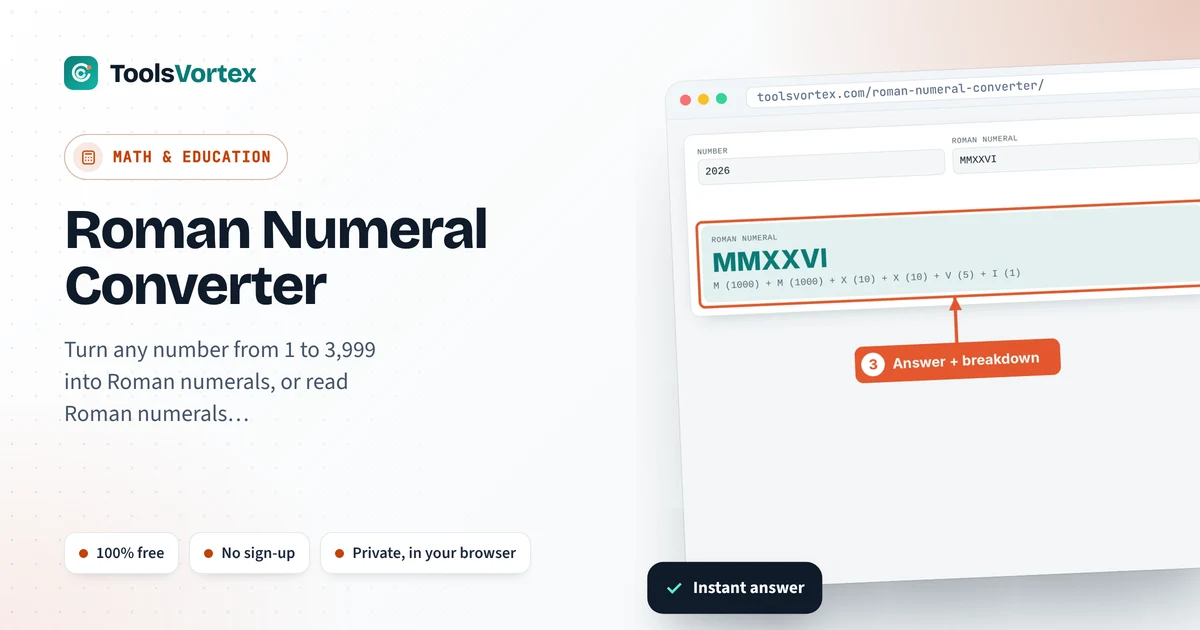
    MMXXVIhow to write the year 2026
    Roman Numerals 1 to 100: Full Chart, Rules and Common Mistakes

    You need roman numerals 1 to 100 for an outline, a tattoo, a clock face or a homework sheet, and you want them right the first time. Below is the full chart, split into two compact tables so you can scan it fast.

    After the chart you get the few rules that make every number work, the mistakes people make most (like IC for 99), how to write years, and why so many clocks break the rules with IIII. If you just want an answer for one number, the Roman numeral converter does it in one step.

    What Are the Roman Numerals 1 to 100?

    The Roman numerals from 1 to 100 run from I to C, built from I, V, X, L and C. Read each table across: every pair of columns shows a number and its numeral.

    Roman numerals 1 to 50

    No.RomanNo.RomanNo.RomanNo.RomanNo.Roman
    1I11XI21XXI31XXXI41XLI
    2II12XII22XXII32XXXII42XLII
    3III13XIII23XXIII33XXXIII43XLIII
    4IV14XIV24XXIV34XXXIV44XLIV
    5V15XV25XXV35XXXV45XLV
    6VI16XVI26XXVI36XXXVI46XLVI
    7VII17XVII27XXVII37XXXVII47XLVII
    8VIII18XVIII28XXVIII38XXXVIII48XLVIII
    9IX19XIX29XXIX39XXXIX49XLIX
    10X20XX30XXX40XL50L

    Roman numerals 51 to 100

    No.RomanNo.RomanNo.RomanNo.RomanNo.Roman
    51LI61LXI71LXXI81LXXXI91XCI
    52LII62LXII72LXXII82LXXXII92XCII
    53LIII63LXIII73LXXIII83LXXXIII93XCIII
    54LIV64LXIV74LXXIV84LXXXIV94XCIV
    55LV65LXV75LXXV85LXXXV95XCV
    56LVI66LXVI76LXXVI86LXXXVI96XCVI
    57LVII67LXVII77LXXVII87LXXXVII97XCVII
    58LVIII68LXVIII78LXXVIII88LXXXVIII98XCVIII
    59LIX69LXIX79LXXIX89LXXXIX99XCIX
    60LX70LXX80LXXX90XC100C

    Every value in these tables was generated by the same rules our converter uses, then checked by reading each numeral back to a number.

    A few patterns make the chart easy to memorize. Every number ending in 4 ends in IV, and every number ending in 9 ends in IX. The 40s all start with XL and the 90s all start with XC. Once you know the tens and the ones, you just glue them together: 73 is LXX (70) plus III (3), so LXXIII.

    Roman Numeral ConverterTurn any number into Roman numerals, or read a Roman numeral back as a regular number.
    Open tool →

    What Do the 7 Roman Numeral Symbols Mean?

    There are seven Roman numeral symbols: I is 1, V is 5, X is 10, L is 50, C is 100, D is 500 and M is 1,000. Every Roman numeral you will ever read is made of these seven letters.

    SymbolValueCan it subtract?Can it repeat?
    I1Yes, before V and XYes, up to 3 times
    V5NoNo, never doubled
    X10Yes, before L and CYes, up to 3 times
    L50NoNo, never doubled
    C100Yes, before D and MYes, up to 3 times
    D500NoNo, never doubled
    M1,000No (nothing higher)Yes, up to 3 times

    Only I, X, C and M (the powers of ten) can repeat. V, L and D never appear twice in a row, because VV would just be X, LL would be C and DD would be M.

    There is no symbol for zero. The Roman system was built for counting and recording, not for place value math. That is the big difference from the Arabic numerals we use today, where the 2 in 20 and the 2 in 200 mean different things because of where they sit. If you like comparing number systems, the same idea of place value powers the binary to decimal converter, just with base 2 instead of base 10.

    What Are the Rules for Writing Roman Numerals?

    Write Roman numerals from largest to smallest and add them up, except for six subtractive pairs where a smaller symbol before a larger one is subtracted. That covers every number from 1 to 3,999.

    Adding = larger symbol first, then smaller: VI = 5 + 1 = 6
    Subtracting = smaller symbol first: IV = 5 minus 1 = 4
    The six allowed pairs = IV (4), IX (9), XL (40), XC (90), CD (400), CM (900)

    Three rules keep the system tidy:

    1. Only I, X and C can subtract. V, L and D never go in front of a larger symbol, so VX for 5 is wrong. It is just V.
    2. A symbol can only subtract from the next two larger symbols. I goes before V and X. X goes before L and C. C goes before D and M. Nothing else.
    3. No symbol repeats more than three times in a row. 3 is III, but 4 is IV, not IIII. 30 is XXX, but 40 is XL.

    Common mistakes to avoid

    • IC for 99. I can only subtract from V and X. The right answer is XC (90) plus IX (9), so XCIX.
    • XM for 990. X can only subtract from L and C. Write CM (900) plus XC (90): CMXC.
    • VV for 10. Two fives is just X. V, L and D are never doubled.
    • IL for 49. Same problem as IC. Write XL (40) plus IX (9): XLIX.
    • IIX for 8. Only one symbol can subtract at a time. 8 is VIII.

    A quick check: break the number into thousands, hundreds, tens and ones, and write each part on its own. If you get a pair that is not on the list of six, something went wrong.

    How Do You Write Years in Roman Numerals?

    To write a year in Roman numerals, split it into thousands, hundreds, tens and ones, convert each part with the table below, and join them. The year 2026 is MM (2,000) plus XX (20) plus VI (6), so MMXXVI.

    DigitOnesTensHundredsThousands
    1IXCM
    2IIXXCCMM
    3IIIXXXCCCMMM
    4IVXLCDnot standard
    5VLDnot standard
    6VILXDCnot standard
    7VIILXXDCCnot standard
    8VIIILXXXDCCCnot standard
    9IXXCCMnot standard

    Standard Roman numerals stop at 3,999 (MMMCMXCIX), so there is no standard way to write 4,000 or more with M alone.

    Worked example

    Convert the year 1987 to Roman numerals.

    1. Split it by place: 1,000 + 900 + 80 + 7.
    2. Thousands: 1,000 is M.
    3. Hundreds: 900 is CM (100 before 1,000, an allowed pair).
    4. Tens: 80 is LXXX (50 plus three 10s).
    5. Ones: 7 is VII (5 plus two 1s).
    6. Join them in order: M + CM + LXXX + VII.

    Answer: 1987 = MCMLXXXVII. To check it, read it back: 1,000 + 900 + 80 + 7 = 1,987.

    Here are some years people look up often:

    YearRoman numeralsWhy you might need it
    1776MDCCLXXVIUS Declaration of Independence
    1969MCMLXIXMoon landing year
    1999MCMXCIXSeen on many late 1990s film credits
    2000MMThe year 2000
    2025MMXXVLast year
    2026MMXXVIThis year
    2027MMXXVIINext year
    2050MMLMid century

    Want to know what weekday a Roman numeral date fell on, like a wedding date engraved on a ring? Convert it to a regular date first, then use the day of the week calculator. For a birth year on a cornerstone or a certificate, the age calculator tells you exactly how long ago it was.

    Why Do Clocks Show IIII Instead of IV?

    Many clocks show IIII for 4 because of long clockmaking tradition, not because IV is wrong. IV is the standard form, and IIII on a dial is a style choice so common it is called the watchmaker’s four.

    Nobody has a single proven reason for it. The explanations you will hear most are about looks: IIII sits opposite VIII and balances its visual weight, and it means the dial uses I alone for the first four hours, V for the next four and X for the last four. The Romans themselves often wrote 4 as IIII, so it is not a modern invention.

    The takeaway for you: if you are reading a clock, IIII and IV both mean 4. If you are writing a number for school, a document or a design, use IV. IV is the form teachers and converters expect.

    How Do You Write Numbers Above 3,999 in Roman Numerals?

    Numbers above 3,999 use a bar over a numeral, called a vinculum, which multiplies its value by 1,000. A V with a bar over it means 5,000, and an X with a bar means 10,000.

    • 4,000 is IV with a bar over both letters (4 times 1,000).
    • 5,000 is V with a bar.
    • 10,000 is X with a bar.
    • 1,000,000 is M with a bar (1,000 times 1,000).

    So 5,026 would be V with a bar followed by XXVI. The catch is that most keyboards and fonts do not have a clean overline, so you rarely see this outside textbooks. In real life, very large numbers are written with Arabic numerals or in powers of ten. If you work with big values often, the scientific notation converter is a far more practical tool than a row of barred letters.

    Where Are Roman Numerals Used Today?

    You still see Roman numerals in sports, royal and papal names, book chapters, outlines, clock faces and film copyright years. They signal something formal, traditional or ongoing.

    • The Super Bowl. The NFL started using Roman numerals with Super Bowl V in 1971. It made one exception: Super Bowl 50 used Arabic numerals because the league felt a lone L did not work on the logo, then went back to Roman numerals with Super Bowl LI.
    • Monarchs and popes. King Charles III of the United Kingdom and Pope Leo XIV both carry numerals that show their place in a line of rulers with the same name.
    • Books and outlines. Front matter pages are often numbered i, ii, iii in lowercase, and many outlines use I, II, III for main points.
    • Movie and TV credits. Copyright years at the end of credits are often in Roman numerals, such as MCMXCIX for 1999 or MMXXVI for 2026.
    • Sequels and events. Film sequels, wrestling events and anniversaries often use them too.
    Season ends inSuper Bowl numberWritten as
    19715V
    20165050 (the NFL skipped L)
    201751LI
    202660LX
    202761LXI

    For games played in 2026 and later, subtract 1966 from the year to get the Super Bowl number. Super Bowl LX was played in February 2026.

    Need to check a numeral from a credit roll or a cornerstone? Paste it into the Roman numeral converter and get the number back in a second.

    Quick Recap

    • Roman numerals 1 to 100 use I, V, X, L and C, from I (1) to C (100).
    • Only I, X and C subtract, and only from the next two larger symbols.
    • No symbol repeats more than three times, so 4 is IV and 40 is XL.
    • Write years one place at a time: 2026 is MM + XX + VI = MMXXVI.
    • A bar over a numeral multiplies it by 1,000 for numbers above 3,999.
    Roman Numerals 1 to 100: use the free roman numeral converter on ToolsVortex

    Frequently Asked Questions

    What is 100 in Roman numerals?

    100 in Roman numerals is C, from the Latin word centum. It is one of the seven basic symbols, so it needs no adding or subtracting. 200 is CC, 300 is CCC, and 400 switches to the subtractive form CD.

    What is 99 in Roman numerals?

    99 is XCIX. Break it into 90 and 9: 90 is XC and 9 is IX. A common mistake is IC, but I can only subtract from V and X, so IC is not a valid Roman numeral.

    What is 4 in Roman numerals, IV or IIII?

    The standard form of 4 is IV, which means 5 minus 1. IIII appears on many clock faces as a design tradition, but in writing, schoolwork and documents you should use IV.

    How do you write 2026 in Roman numerals?

    2026 in Roman numerals is MMXXVI. That is MM for 2,000, XX for 20 and VI for 6. There are no hundreds, so nothing is written for that place. 2027 will be MMXXVII.

    Is there a zero in Roman numerals?

    No. The Roman system has no symbol for zero because it was built for counting and recording amounts, not for place value math. When a place is empty, like the hundreds in 2026, you simply skip it.

    What is the largest number in standard Roman numerals?

    The largest number you can write with the standard rules is 3,999, which is MMMCMXCIX. Beyond that you need a bar over a numeral, called a vinculum, which multiplies its value by 1,000.

    What is the longest Roman numeral from 1 to 100?

    88 is the longest, at eight letters: LXXXVIII. It uses the most repeats allowed for both X and I. 38, 78, 83 and 87 are next, at seven letters each.

    Sources

    1. Britannica Kids: Roman numeral, subtractive pairs, three repeat limit, bar multiplies by 1,000
    2. Encyclopaedia Britannica: Roman numerals, the seven symbols and their values
    3. NPR: NFL says when it comes to Super Bowl 50, L is for losers, Super Bowl V first used Roman numerals; Super Bowl 50 exception; return with LI
    TV
    Written by the ToolsVortex Editorial Team

    We check every number in our guides against the original source and test each example in our calculators before publishing. This guide is general information, not professional advice. Spotted an error? Tell us and we will fix it.

    Keep reading

  • What Is a Good GPA? High School, College and Grad School

    What Is a Good GPA? High School, College and Grad School

    Math & EducationUpdated October 6, 20269 min readBy ToolsVortex Editorial Team

    What is a good GPA? For most students, a 3.0 is good and a 3.5 or higher is very good on the standard 4.0 unweighted scale. The average US high school graduate finished with a 3.11 (2019 federal data). For selective colleges, competitive grad programs or medical school, aim for 3.7 and up.

    3.11average GPA of US high school graduates (2019)
    3.0common cutoff for scholarships and resumes
    3.81average GPA of 2025 medical school entrants
    What is a good gpa: quick answer and key number

    “Good” depends on what you want the GPA to do for you. A 3.2 is plenty for a state university and a lot of jobs. It’s tough for Stanford or med school. So let’s look at real benchmarks instead of vague labels.

    What is a good GPA? The short version

    • 3.7 to 4.0: excellent. Mostly A’s. Competitive almost anywhere.
    • 3.3 to 3.6: very good. A mix of A’s and B’s.
    • 3.0 to 3.2: good. A B average. Opens most doors.
    • 2.5 to 2.9: fair. Fine for many schools, limiting for scholarships.
    • Below 2.0: trouble. Can put financial aid and academic standing at risk in college.
    GPA CalculatorAdd your classes, credit hours and grades to get your semester and cumulative GPA, weighted or unweighted.
    Open tool →

    How the 4.0 GPA scale works

    Each letter grade becomes a number of grade points. Your GPA is the average of those points, weighted by credit hours. Here’s a typical scale. Some schools don’t use plus or minus grades, and the percentage cutoffs vary a bit, so check your handbook.

    LetterPercent (typical)UnweightedWeighted (AP/IB)
    A / A+93 to 1004.05.0
    A−90 to 923.74.7
    B+87 to 893.34.3
    B83 to 863.04.0
    B−80 to 822.73.7
    C+77 to 792.33.3
    C73 to 762.03.0
    D65 to 721.02.0
    FBelow 650.00.0
    GPA = sum of (grade points × credits) ÷ total credits
    Worked example

    Jalen, a college sophomore in Michigan, takes four classes: Biology (4 credits, B+ = 3.3), Calculus (4 credits, B = 3.0), English (3 credits, A = 4.0) and Psychology (3 credits, A− = 3.7).

    Points: 13.2 + 12.0 + 12.0 + 11.1 = 48.3. Credits: 14. GPA: 48.3 ÷ 14 = 3.45. Notice the 4-credit B in calc drags harder than a 3-credit grade would. Big classes move the needle more.

    Weighted vs unweighted GPA

    Unweighted GPA treats every class the same, so the top is 4.0. Weighted GPA gives extra points for harder classes, typically +0.5 for honors and +1.0 for AP, IB or dual-enrollment, which is how people end up with a 4.4.

    So is a 3.9 weighted better than a 3.7 unweighted? You can’t tell without knowing the schedule. That’s exactly why many colleges throw out the high school’s math and recompute GPA their own way, often using only core academic classes. And they look at the transcript to see how hard your courses were. A 3.6 with six APs often impresses more than a 4.0 with none.

    What is a good GPA in high school?

    Grade inflation is real. Federal transcript data shows the average graduate’s GPA climbing for decades:

    4.003.002.001.000.002.6819902.9420003.0020093.112019
    Average GPA of US high school graduates (NCES High School Transcript Study)

    Because averages have crept up, a 3.0 doesn’t stand out the way it did in 1990. Roughly speaking:

    • For most state universities: a 3.0 to 3.5 unweighted is a comfortable range.
    • For selective colleges: admitted students commonly sit at 3.7 to 4.0 unweighted, with the hardest courses available.
    • For community college: GPA rarely matters for admission. Most are open enrollment.

    The best number to check is the middle 50% GPA range on each college’s Common Data Set or admissions page. That beats any general rule.

    What is a good GPA in college?

    College grading is usually tougher than high school, especially in STEM. A 3.0 is the line many employers and grad programs care about. Below 2.0 is where things get serious: most schools put you on academic probation, and federal aid rules generally require a C average, or your school’s equivalent, by the end of your second academic year to keep receiving aid.

    What counts as good also depends on your major. A 3.3 in chemical engineering and a 3.3 in a major with gentler grading aren’t quite the same achievement, and recruiters in tough fields know it.

    GPA targets by goal

    GoalGPA to aim for
    Stay eligible for federal student aid2.0 (a C average) or your school’s standard
    Many merit scholarships3.0 to 3.5
    Put GPA on a resume3.0 or higher
    Graduate school minimum3.0 for many programs
    Competitive grad / law programs3.5 and up
    Medical school (2025 entering class average)3.81
    Latin honors in collegeOften around 3.5 to 3.9, varies by school

    For law school, the number that matters is the median GPA at each school you’re targeting, alongside your LSAT. Top schools often sit above 3.9. For med school, AAMC reports a 3.81 average for the 2025 entering class, so a 3.5 is around the realistic floor for most MD programs.

    How fast can you raise your GPA?

    This is the question nobody answers with actual numbers. The math is simple, but the results are humbling. The more credits you’ve already taken, the slower your GPA moves. Here’s how many credits of straight A’s (4.0) you’d need:

    Current GPATargetA-credits neededTime at 15 credits/term
    2.5 after 30 credits3.015 credits≈ 1 semesters
    2.8 after 30 credits3.07 credits≈ 1 semesters
    3.0 after 60 credits3.326 credits≈ 2 semesters
    3.0 after 30 credits3.530 credits≈ 2 semesters
    3.2 after 60 credits3.536 credits≈ 3 semesters
    3.4 after 90 credits3.646 credits≈ 4 semesters
    Credits needed = credits done × (target − current) ÷ (4.0 − target)

    See the 3.4 to 3.6 row? Ninety credits in, you’d need nearly a year of perfect grades for a 0.2 bump. That’s why freshman year matters so much. It’s also why retaking a failed class can be the smartest move, if your school replaces the old grade rather than averaging both. Plug your own numbers into the GPA calculator, and use the grade calculator to see what you need on a final.

    What matters besides the number

    Admissions officers and hiring managers look at more than one figure. An upward trend (a 2.7 freshman year rising to 3.6 by junior year) tells a good story. A tough schedule helps. So do test scores, essays, work experience and real projects.

    Studying abroad or applying overseas? Some systems use a 10-point CGPA, and the CGPA to percentage calculator converts it. Just know there’s no single official conversion to the US 4.0 scale.

    What is a good gpa: quick recap

    • What is a good GPA in high school? A 3.0 is solid, a 3.5 or higher is competitive for selective colleges.
    • What is a good GPA in college? Most employers and grad programs treat 3.0 as the floor and 3.5 as strong.
    • What is a good GPA for med school or law school? Accepted students usually sit around 3.7 to 3.9.
    • What is a good GPA on a weighted 5.0 scale? Anything above 4.0 means you took harder classes and did well in them.
    • What is a good GPA for scholarships? Many merit awards start at 3.0 to 3.5, so check each award’s rules.
    • If you’re asking what is a good GPA for your own plans, run your grades through the GPA calculator and compare with the targets above.
    What is a good gpa: use the free gpa calculator on ToolsVortex

    Frequently asked questions

    Is a 3.0 GPA good?

    It’s solid. A 3.0 is a B average, it clears the bar for most scholarships and many graduate programs, and it’s the usual cutoff for listing GPA on a resume. It’s slightly below the national high school average of 3.11, though.

    Is a 3.5 GPA good?

    Yes. A 3.5 means mostly A’s and B+’s. It’s competitive for many graduate programs and scholarships, and it puts you in range for Latin honors at a lot of colleges.

    What is the average high school GPA?

    3.11 for 2019 graduates, the latest year in the federal High School Transcript Study. It was 3.00 in 2009 and 2.68 in 1990.

    What's the difference between weighted and unweighted GPA?

    Unweighted GPA uses a 4.0 scale for every class. Weighted GPA adds a bonus, usually 0.5 for honors and 1.0 for AP or IB, so an A in AP Chemistry counts as a 5.0. Colleges often recalculate both their own way.

    What GPA do you need for medical school?

    There’s no single cutoff, but the 2025 entering class at US MD schools averaged a 3.81 GPA, according to AAMC data. Science GPA gets close attention.

    Can I raise my GPA from 2.5 to 3.0?

    Yes, but it takes time. With 30 credits done at a 2.5, you’d need about 30 more credits of straight A’s to reach 3.0. Retaking failed classes, if your school replaces the old grade, is often faster.

    Does GPA matter after college?

    For your first job or grad school, sometimes. Some employers screen for a 3.0 or higher. After a couple of years of work experience, almost nobody asks.

    Sources

    1. High School Transcript Study (HSTS), National Center for Education Statistics
    2. FACTS: Applicants and Matriculants Data, Association of American Medical Colleges
    3. Staying Eligible for Financial Aid, Federal Student Aid, U.S. Department of Education
    4. 34 CFR 668.34: Satisfactory academic progress, Electronic Code of Federal Regulations
    TV
    Written by the ToolsVortex Editorial Team

    We check every number in our guides against the original source and test each example in our calculators before publishing. This guide is general information, not professional advice. Spotted an error? Tell us and we will fix it.

    Keep reading

  • How to Calculate Percentage: Easy Formulas With Examples

    How to Calculate Percentage: Easy Formulas With Examples

    Math & EducationUpdated October 6, 20269 min readBy ToolsVortex Editorial Team

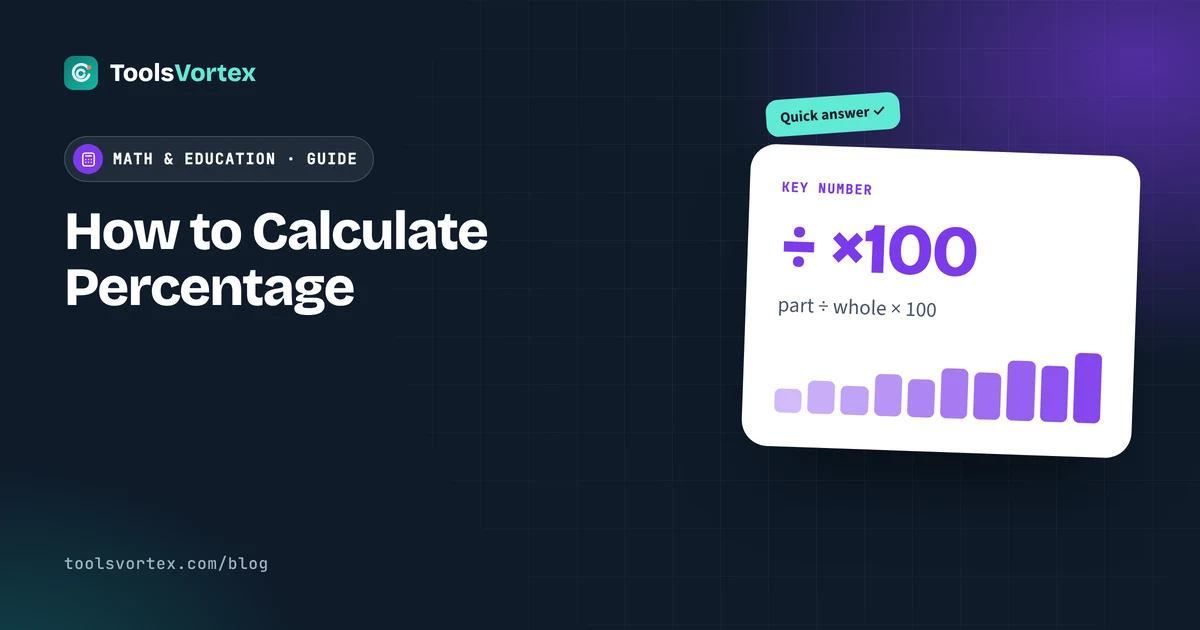
    Here’s how to calculate percentage: divide the part by the whole, then multiply by 100. So 30 out of 120 is 30 ÷ 120 = 0.25, which is 25%. To find a percentage of a number, flip it around: turn the percent into a decimal and multiply (20% of 85 = 0.20 × 85 = 17).

    ÷ then ×100part ÷ whole × 100 gives the percentage
    % → decimalmove the decimal two places left (15% = 0.15)
    8% of 50equals 50% of 8. Swap when it’s easier
    How to calculate percentage: quick answer and key number

    Percentages show up everywhere. Sale tags, test scores, tips, your raise, the “battery at 14%” warning. And yet most of us learned this once in sixth grade and then quietly started guessing. Let’s fix that. Ten minutes and you’ll have it for good.

    How Do You Calculate a Percentage?

    Percent means per hundred, so you can solve any percentage problem with one relationship: Part equals Percent times Whole, with the percent written as a decimal. “Percent” literally means “per hundred.” So 25% is 25 out of every 100. Every percentage problem is some version of this one relationship:

    Part = Percent × Whole  (with the percent as a decimal)
    Percent = Part ÷ Whole × 100
    Whole = Part ÷ Percent

    That’s it. Three pieces, and if you know any two, you can get the third. The only real skill is spotting which two you’ve been given.

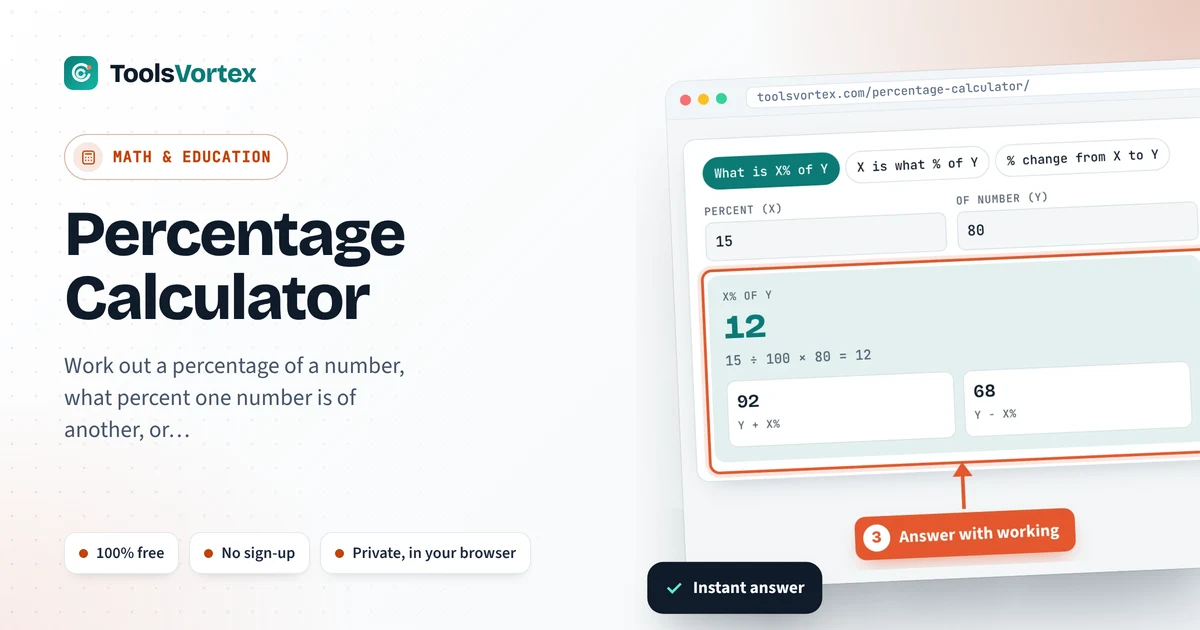
    Percentage CalculatorFind X% of Y, what percent one number is of another, or the percent change between two values. Instant answers with the steps shown.
    Open tool →

    The three percentage questions (and how to solve each)

    1. What is X% of Y?

    Convert the percent to a decimal by moving the point two places left, then multiply. What’s 18% of 250? 0.18 × 250 = 45.

    2. X is what percent of Y?

    Divide, then multiply by 100. You answered 37 out of 45 quiz questions right. 37 ÷ 45 = 0.8222, times 100 = 82.2%. (Want to know what that does to your class grade? The grade calculator handles the weighting.)

    3. X is Y% of what?

    Divide the part by the decimal. Your $1,800 rent is 30% of your take-home pay. What’s your take-home? $1,800 ÷ 0.30 = $6,000.

    People mix up #2 and #3 all the time. A quick sanity check: if the percent is under 100, the whole has to be bigger than the part. If your answer says otherwise, you divided the wrong way round.

    How to calculate percentage increase and decrease

    Percent change compares a new number to an old one. The old number always goes on the bottom.

    Percent change = (new − old) ÷ old × 100
    Worked example

    Maya’s hourly pay goes from $21.50 to $23.25. The difference is $1.75. Divide by the old rate: $1.75 ÷ $21.50 = 0.0814. Times 100 is an 8.1% raise.

    Now say her electric bill drops from $142 to $118. That’s (118 − 142) ÷ 142 × 100 = −16.9%. The minus sign just means it’s a decrease.

    For raises and price jumps you’ll run often, our percentage increase calculator saves a step.

    The trap: up and down aren’t equal

    If something rises 50% and then falls 50%, you’re not back where you started. You’re 25% down. Why? The drop is taken from a bigger number. Here’s what happens to 100:

    MoveAfter the riseAfter the fallWhere you end up
    +10% then −10%110991% below start
    +20% then −20%120964% below start
    +25% then −25%12593.756.25% below start
    +50% then −50%1507525% below start
    200150100500100Start150+50%75then −50%50−50%75then +50%
    Starting at 100: a 50% gain and a 50% loss, in either order, leave you at 75

    This is why a stock that loses half its value needs to gain 100% to recover. It’s also why “50% off, then another 20% off” is 60% off, not 70%. You take 20% of the already-reduced price: 0.5 × 0.8 = 0.40 of the original, so you pay 40%.

    How Do You Find the Original Number After a Percentage Change?

    Divide the final price by one minus the discount, so a jacket that costs $60 after 25% off originally cost $60 divided by 0.75, which is $80. This one trips up almost everyone. A jacket is $60 after 25% off. What was the original price? Most people add 25% of $60 back ($75). Wrong. The 25% came off the original, not the sale price.

    Original = final price ÷ (1 − discount)
    Original = final price ÷ (1 + increase)

    So $60 ÷ 0.75 = $80. Same idea for tax. A receipt total of $53.50 with 7% sales tax means the pre-tax price was $53.50 ÷ 1.07 = $50. The sales tax calculator and discount calculator both run this in reverse if you’d rather not.

    What Is the Difference Between Percent and Percentage Points?

    A percentage point is the direct gap between two percentages, while percent shows relative growth, so a mortgage rate moving from 6% to 7% rose 1 percentage point but 16.7%. News reports blur this constantly. When a mortgage rate goes from 6% to 7%, it rose 1 percentage point. But relative to where it started, it rose 1 ÷ 6 = 16.7%. Both statements are true. They just answer different questions.

    Rule of thumb: when you’re comparing two percentages directly, say “points.” When you’re describing how much something grew relative to itself, say “percent.”

    Mental math tricks that actually work

    • 10% is a decimal shift. 10% of 340 is 34. From there, 5% is half (17), 20% is double (68), 15% is 34 + 17 = 51.
    • 1% is two shifts. 1% of 340 is 3.4, so 3% is 10.2.
    • Swap the numbers. 4% of 75 looks annoying. 75% of 4 is just 3. Same answer, every time.
    • Fractions you already know. 25% is a quarter, 50% is half, 75% is three quarters, 33⅓% is a third. If you’re rusty on fractions, the fraction calculator helps.

    Try one now. What’s 35% of 60? (30% is 18, 5% is 3, so 21.) Not bad, right?

    Quick percentage reference chart

    Percentof 20of 50of 80of 150of 250of 1,200
    5%12.547.512.560
    10%2581525120
    15%37.51222.537.5180
    20%410163050240
    25%512.52037.562.5300
    30%615244575360
    50%10254075125600
    75%1537.560112.5187.5900

    How to calculate percentage in Excel and Google Sheets

    Spreadsheets store percentages as decimals, so 15% is really 0.15 underneath. Some handy formulas:

    • What percent is A2 of B2: =A2/B2, then click the % format button.
    • Percent change from A2 to B2: =(B2-A2)/A2
    • 15% of A2: =A2*15% or =A2*0.15
    • Add 8% to A2: =A2*1.08

    One gotcha: if you type 15 into a cell and then format it as a percent, Sheets shows 1500%. Type 15% or 0.15 instead.

    How to calculate percentage: quick recap

    • How to calculate percentage of a number: multiply the number by the percent and divide by 100, so 15% of 80 is 12.
    • How to calculate percentage from two numbers: divide the part by the whole and multiply by 100, so 18 out of 24 is 75%.
    • How to calculate percentage change: subtract old from new, divide by old, times 100.
    • How to calculate percentage in Excel: =A2/B2, then format the cell as a percent.
    • How to calculate percentage of marks: total marks earned divided by total possible, times 100.
    • If you just want the answer, the percentage calculator shows how to calculate percentage step by step for all three question types.
    How to calculate percentage: use the free percentage calculator on ToolsVortex

    Frequently asked questions

    How do I calculate a percentage of a number?

    Turn the percent into a decimal and multiply. For 15% of 80, do 0.15 × 80 = 12.

    What is the formula for percentage?

    Percentage = (part ÷ whole) × 100. If you got 42 out of 50 questions right, 42 ÷ 50 = 0.84, and 0.84 × 100 = 84%.

    How do I calculate percent change?

    Subtract the old value from the new one, divide by the old value, then multiply by 100. Going from $40 to $50 is (50 − 40) ÷ 40 × 100 = 25%.

    How do I find the original price before a discount?

    Divide the sale price by (1 minus the discount as a decimal). A $60 jacket after 25% off was $60 ÷ 0.75 = $80. Don’t just add 25% back on.

    What's the difference between percent and percentage points?

    Percentage points are the plain gap between two percentages. A rate moving from 4% to 5% is up 1 percentage point, but that is a 25% increase relative to where it started.

    How do I calculate a percentage in Excel or Google Sheets?

    Use =A2/B2 and format the cell as a percent. For percent change, use =(B2-A2)/A2. For X% of a number, use =A2*15% or =A2*0.15.

    Is X% of Y the same as Y% of X?

    Yes, always. 8% of 50 equals 50% of 8, which is 4. Swap them whenever one version is easier to do in your head.

    Sources

    1. Percentages, Khan Academy, ratios, rates and percentages
    2. Percentage Change, Math Is Fun
    3. Consumer Price Index: How percent changes are calculated, U.S. Bureau of Labor Statistics
    TV
    Written by the ToolsVortex Editorial Team

    We check every number in our guides against the original source and test each example in our calculators before publishing. This guide is general information, not professional advice. Spotted an error? Tell us and we will fix it.

    Keep reading