
What is a good GPA? For most students, a 3.0 is good and a 3.5 or higher is very good on the standard 4.0 unweighted scale. The average US high school graduate finished with a 3.11 (2019 federal data). For selective colleges, competitive grad programs or medical school, aim for 3.7 and up.

“Good” depends on what you want the GPA to do for you. A 3.2 is plenty for a state university and a lot of jobs. It’s tough for Stanford or med school. So let’s look at real benchmarks instead of vague labels.
What is a good GPA? The short version
- 3.7 to 4.0: excellent. Mostly A’s. Competitive almost anywhere.
- 3.3 to 3.6: very good. A mix of A’s and B’s.
- 3.0 to 3.2: good. A B average. Opens most doors.
- 2.5 to 2.9: fair. Fine for many schools, limiting for scholarships.
- Below 2.0: trouble. Can put financial aid and academic standing at risk in college.
How the 4.0 GPA scale works
Each letter grade becomes a number of grade points. Your GPA is the average of those points, weighted by credit hours. Here’s a typical scale. Some schools don’t use plus or minus grades, and the percentage cutoffs vary a bit, so check your handbook.
| Letter | Percent (typical) | Unweighted | Weighted (AP/IB) |
|---|---|---|---|
| A / A+ | 93 to 100 | 4.0 | 5.0 |
| A− | 90 to 92 | 3.7 | 4.7 |
| B+ | 87 to 89 | 3.3 | 4.3 |
| B | 83 to 86 | 3.0 | 4.0 |
| B− | 80 to 82 | 2.7 | 3.7 |
| C+ | 77 to 79 | 2.3 | 3.3 |
| C | 73 to 76 | 2.0 | 3.0 |
| D | 65 to 72 | 1.0 | 2.0 |
| F | Below 65 | 0.0 | 0.0 |
Jalen, a college sophomore in Michigan, takes four classes: Biology (4 credits, B+ = 3.3), Calculus (4 credits, B = 3.0), English (3 credits, A = 4.0) and Psychology (3 credits, A− = 3.7).
Points: 13.2 + 12.0 + 12.0 + 11.1 = 48.3. Credits: 14. GPA: 48.3 ÷ 14 = 3.45. Notice the 4-credit B in calc drags harder than a 3-credit grade would. Big classes move the needle more.
Weighted vs unweighted GPA
Unweighted GPA treats every class the same, so the top is 4.0. Weighted GPA gives extra points for harder classes, typically +0.5 for honors and +1.0 for AP, IB or dual-enrollment, which is how people end up with a 4.4.
So is a 3.9 weighted better than a 3.7 unweighted? You can’t tell without knowing the schedule. That’s exactly why many colleges throw out the high school’s math and recompute GPA their own way, often using only core academic classes. And they look at the transcript to see how hard your courses were. A 3.6 with six APs often impresses more than a 4.0 with none.
What is a good GPA in high school?
Grade inflation is real. Federal transcript data shows the average graduate’s GPA climbing for decades:
Because averages have crept up, a 3.0 doesn’t stand out the way it did in 1990. Roughly speaking:
- For most state universities: a 3.0 to 3.5 unweighted is a comfortable range.
- For selective colleges: admitted students commonly sit at 3.7 to 4.0 unweighted, with the hardest courses available.
- For community college: GPA rarely matters for admission. Most are open enrollment.
The best number to check is the middle 50% GPA range on each college’s Common Data Set or admissions page. That beats any general rule.
What is a good GPA in college?
College grading is usually tougher than high school, especially in STEM. A 3.0 is the line many employers and grad programs care about. Below 2.0 is where things get serious: most schools put you on academic probation, and federal aid rules generally require a C average, or your school’s equivalent, by the end of your second academic year to keep receiving aid.
What counts as good also depends on your major. A 3.3 in chemical engineering and a 3.3 in a major with gentler grading aren’t quite the same achievement, and recruiters in tough fields know it.
GPA targets by goal
| Goal | GPA to aim for |
|---|---|
| Stay eligible for federal student aid | 2.0 (a C average) or your school’s standard |
| Many merit scholarships | 3.0 to 3.5 |
| Put GPA on a resume | 3.0 or higher |
| Graduate school minimum | 3.0 for many programs |
| Competitive grad / law programs | 3.5 and up |
| Medical school (2025 entering class average) | 3.81 |
| Latin honors in college | Often around 3.5 to 3.9, varies by school |
For law school, the number that matters is the median GPA at each school you’re targeting, alongside your LSAT. Top schools often sit above 3.9. For med school, AAMC reports a 3.81 average for the 2025 entering class, so a 3.5 is around the realistic floor for most MD programs.
How fast can you raise your GPA?
This is the question nobody answers with actual numbers. The math is simple, but the results are humbling. The more credits you’ve already taken, the slower your GPA moves. Here’s how many credits of straight A’s (4.0) you’d need:
| Current GPA | Target | A-credits needed | Time at 15 credits/term |
|---|---|---|---|
| 2.5 after 30 credits | 3.0 | 15 credits | ≈ 1 semesters |
| 2.8 after 30 credits | 3.0 | 7 credits | ≈ 1 semesters |
| 3.0 after 60 credits | 3.3 | 26 credits | ≈ 2 semesters |
| 3.0 after 30 credits | 3.5 | 30 credits | ≈ 2 semesters |
| 3.2 after 60 credits | 3.5 | 36 credits | ≈ 3 semesters |
| 3.4 after 90 credits | 3.6 | 46 credits | ≈ 4 semesters |
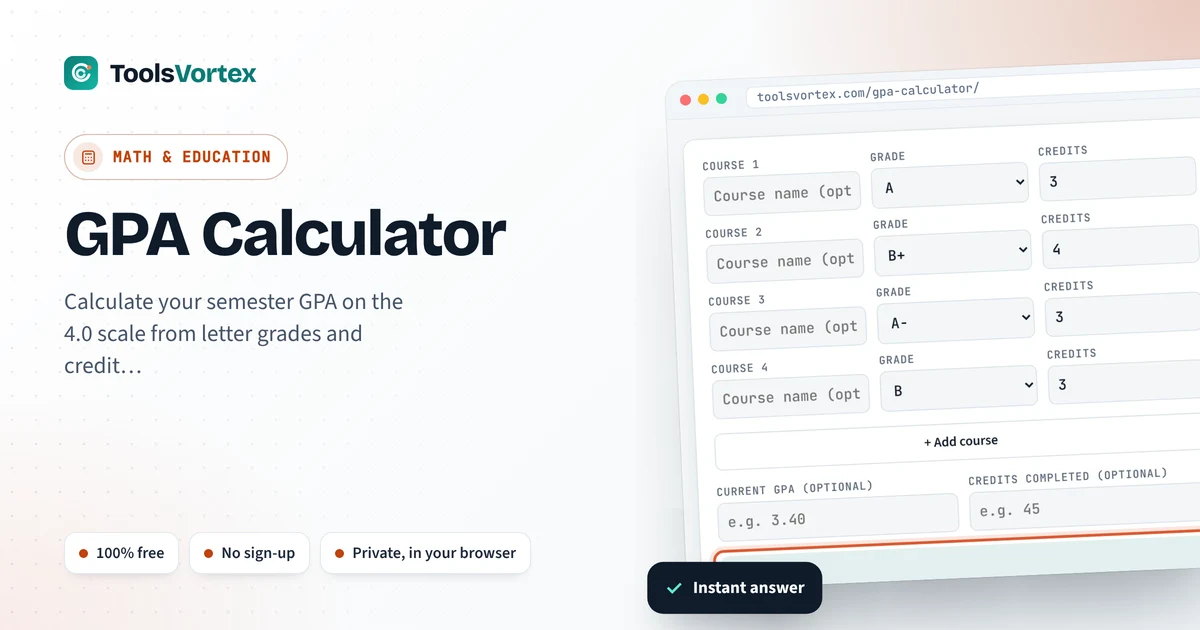
See the 3.4 to 3.6 row? Ninety credits in, you’d need nearly a year of perfect grades for a 0.2 bump. That’s why freshman year matters so much. It’s also why retaking a failed class can be the smartest move, if your school replaces the old grade rather than averaging both. Plug your own numbers into the GPA calculator, and use the grade calculator to see what you need on a final.
What matters besides the number
Admissions officers and hiring managers look at more than one figure. An upward trend (a 2.7 freshman year rising to 3.6 by junior year) tells a good story. A tough schedule helps. So do test scores, essays, work experience and real projects.
Studying abroad or applying overseas? Some systems use a 10-point CGPA, and the CGPA to percentage calculator converts it. Just know there’s no single official conversion to the US 4.0 scale.
What is a good gpa: quick recap
- What is a good GPA in high school? A 3.0 is solid, a 3.5 or higher is competitive for selective colleges.
- What is a good GPA in college? Most employers and grad programs treat 3.0 as the floor and 3.5 as strong.
- What is a good GPA for med school or law school? Accepted students usually sit around 3.7 to 3.9.
- What is a good GPA on a weighted 5.0 scale? Anything above 4.0 means you took harder classes and did well in them.
- What is a good GPA for scholarships? Many merit awards start at 3.0 to 3.5, so check each award’s rules.
- If you’re asking what is a good GPA for your own plans, run your grades through the GPA calculator and compare with the targets above.
Frequently asked questions
Is a 3.0 GPA good?
It’s solid. A 3.0 is a B average, it clears the bar for most scholarships and many graduate programs, and it’s the usual cutoff for listing GPA on a resume. It’s slightly below the national high school average of 3.11, though.
Is a 3.5 GPA good?
Yes. A 3.5 means mostly A’s and B+’s. It’s competitive for many graduate programs and scholarships, and it puts you in range for Latin honors at a lot of colleges.
What is the average high school GPA?
3.11 for 2019 graduates, the latest year in the federal High School Transcript Study. It was 3.00 in 2009 and 2.68 in 1990.
What's the difference between weighted and unweighted GPA?
Unweighted GPA uses a 4.0 scale for every class. Weighted GPA adds a bonus, usually 0.5 for honors and 1.0 for AP or IB, so an A in AP Chemistry counts as a 5.0. Colleges often recalculate both their own way.
What GPA do you need for medical school?
There’s no single cutoff, but the 2025 entering class at US MD schools averaged a 3.81 GPA, according to AAMC data. Science GPA gets close attention.
Can I raise my GPA from 2.5 to 3.0?
Yes, but it takes time. With 30 credits done at a 2.5, you’d need about 30 more credits of straight A’s to reach 3.0. Retaking failed classes, if your school replaces the old grade, is often faster.
Does GPA matter after college?
For your first job or grad school, sometimes. Some employers screen for a 3.0 or higher. After a couple of years of work experience, almost nobody asks.
Sources
- High School Transcript Study (HSTS), National Center for Education Statistics
- FACTS: Applicants and Matriculants Data, Association of American Medical Colleges
- Staying Eligible for Financial Aid, Federal Student Aid, U.S. Department of Education
- 34 CFR 668.34: Satisfactory academic progress, Electronic Code of Federal Regulations