Convert any number to scientific notation (standard form in the UK) and back again, with E notation, engineering notation with the SI prefix, the full decimal and a significant figures option.
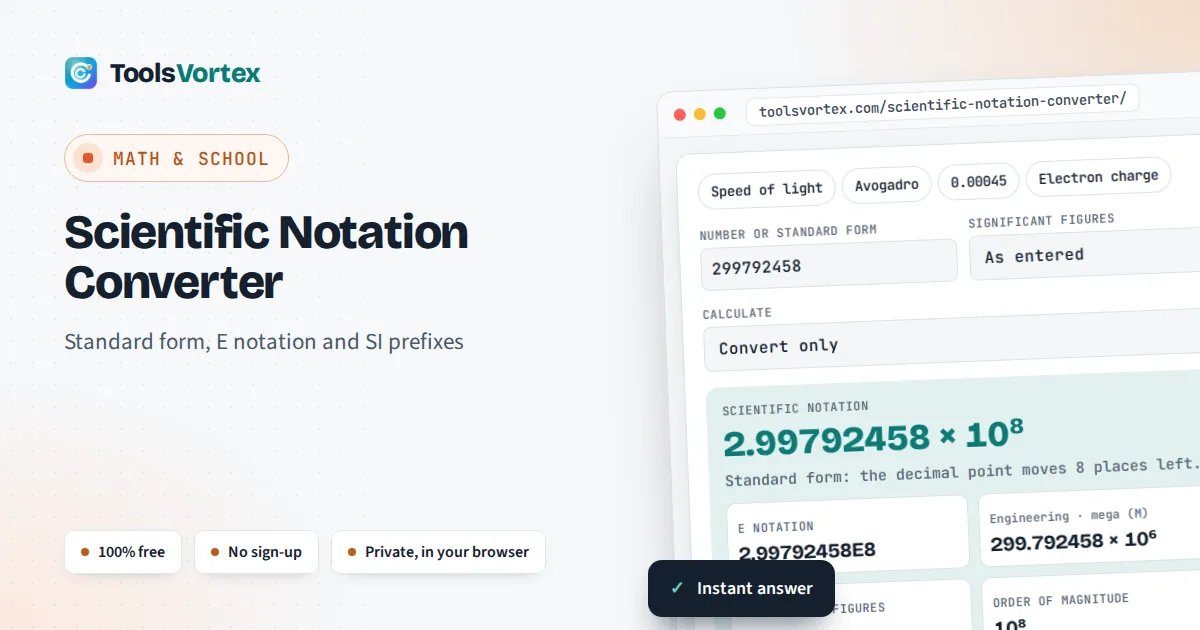
This scientific notation converter turns ordinary numbers into scientific notation, called standard form or standard index form in UK schools, and turns standard form back into a decimal. It is built for GCSE, Leaving Certificate and university students, and for anyone reading very large or very small numbers in science, engineering or data. Type a number, an E value from a calculator, or a form such as 3.2 × 10⁵, and every format updates as you type.
How do you write a number in scientific notation?
Move the decimal point until exactly one non zero digit sits in front of it, then multiply by 10 to the power of the number of places you moved. Moving left gives a positive power, moving right a negative one. In scientific notation, 299,792,458 becomes 2.99792458 × 10⁸ and 0.00045 becomes 4.5 × 10⁻⁴.
What is the difference between scientific notation and standard form?
In the UK and Ireland they are the same thing: standard form is the school name for scientific notation, a number written as a × 10ⁿ. The catch is that in the United States “standard form” usually means the opposite, the ordinary written out number such as 45,000. If a worksheet from a US source asks for standard form, it wants the decimal, not the power of ten.
n = number of places the decimal point moves (left: n > 0, right: n < 0)
E notation: a × 10ⁿ is written aEn, so 4.5 × 10⁻⁴ = 4.5E−4
The number a is called the coefficient or mantissa, and n is the exponent or order of magnitude. Every non zero number has exactly one standard form. Zero is the exception, since no power of ten makes 0 a number between 1 and 10, so it is simply written as 0.
How do you convert scientific notation back to a decimal?
Move the decimal point n places to the right if the power is positive, or n places to the left if it is negative, filling empty places with zeros. So 3.07 × 10⁵ is 307,000, because the point moves 5 places right, and 3.07 × 10⁻³ is 0.00307, because it moves 3 places left. The converter does this exactly, digit by digit, so even 6.02214076 × 10²³ expands without the rounding a phone calculator adds.
How do powers of ten match SI prefixes?
Engineering notation keeps the exponent a multiple of 3, so every result lines up with a metric prefix. This is the notation used on European datasheets, energy bills in kWh and MWh, and lab equipment. The converter shows it next to the standard form:
| Power of ten | Prefix | Metric example |
|---|---|---|
| 10¹² | tera (T) | 1 TWh = 1,000,000,000 kWh |
| 10⁹ | giga (G) | 1 GB = 1,000,000,000 bytes |
| 10⁶ | mega (M) | 1 MW = 1,000,000 W |
| 10³ | kilo (k) | 1 km = 1,000 m |
| 10⁻³ | milli (m) | 1 mm = 0.001 m |
| 10⁻⁶ | micro (µ) | 1 µm = 0.000001 m |
| 10⁻⁹ | nano (n) | 1 nm = 0.000000001 m |
| 10⁻¹² | pico (p) | 1 pF = 0.000000000001 F |
The SI now runs from quecto (10⁻³⁰) to quetta (10³⁰), after ronna, quetta, ronto and quecto were added in 2022. For converting everyday lengths, weights and volumes rather than powers of ten, see the unit converters.
How do you multiply and divide numbers in standard form?
Multiply or divide the front numbers, then add the powers when multiplying or subtract them when dividing, and finally adjust so the front number is between 1 and 10. Adding and subtracting work differently: rewrite both numbers with the same power of ten first, or convert to decimals.
Worked example: Aisling’s GCSE question
Aisling has to work out (3 × 10⁴) × (5 × 10⁻⁷). She multiplies 3 × 5 = 15 and adds the powers, 4 + (−7) = −3, giving 15 × 10⁻³. Fifteen is not between 1 and 10, so she moves the point one place left and adds one to the power: 1.5 × 10⁻², or 0.015. For the addition 4.2 × 10⁵ + 3 × 10⁴ she rewrites 3 × 10⁴ as 0.3 × 10⁵, so the answer is 4.5 × 10⁵. Pick Multiply by or Add in the converter to check both.
What does E mean on a calculator?
The E stands for “times ten to the power of”, so 6.02E23 on a calculator, spreadsheet or in code means 6.02 × 10²³. Calculators switch to it when a result is too long for the screen. It is not Euler’s number e, and it is not an error. You can paste E values straight into the converter, including lower case e and negative powers such as 1.6e-19.
Very large and very small numbers often turn up as percentages or ratios too. Once a value is in a sensible range, the percentage calculator and the decimal to fraction calculator take it from there.
How Do You Use the Scientific Notation Converter?
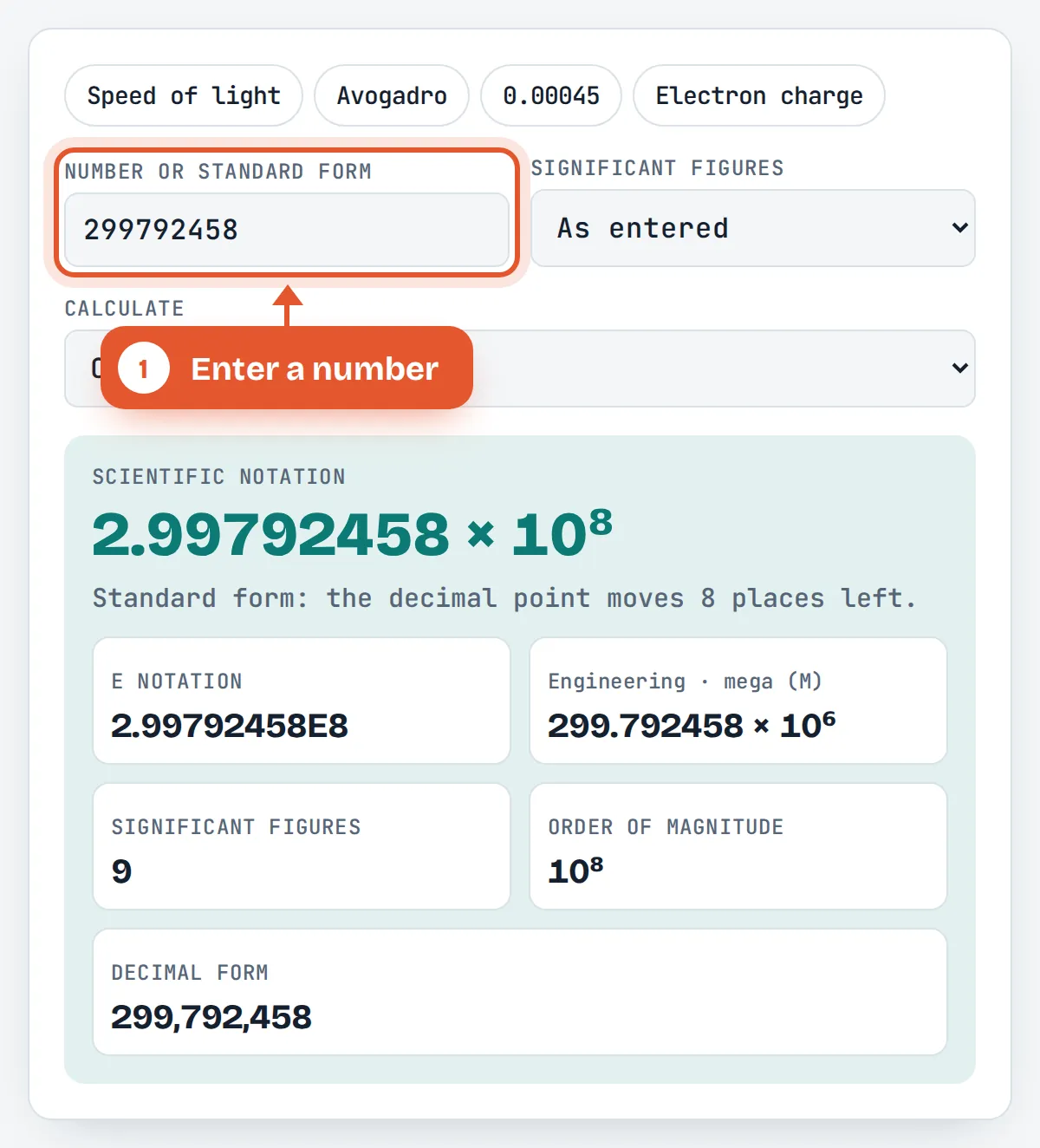
Enter a number
Type a decimal such as 0.00045, an E value such as 6.02e23, or standard form such as 3.2 x 10^5. A decimal comma works too.

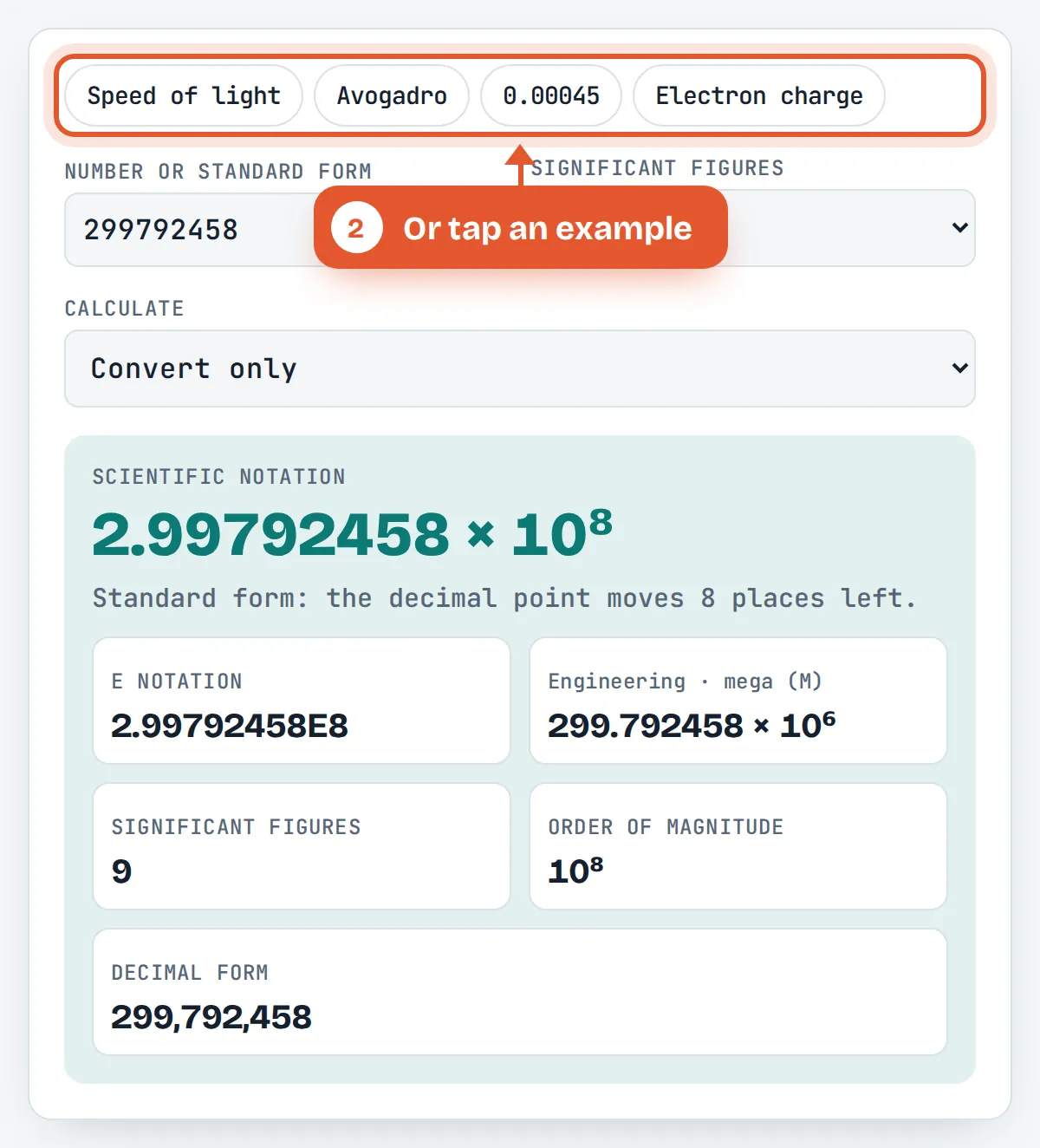
Or tap an example
Try the speed of light, the Avogadro constant, a tiny decimal or the electron charge to see how each one converts.
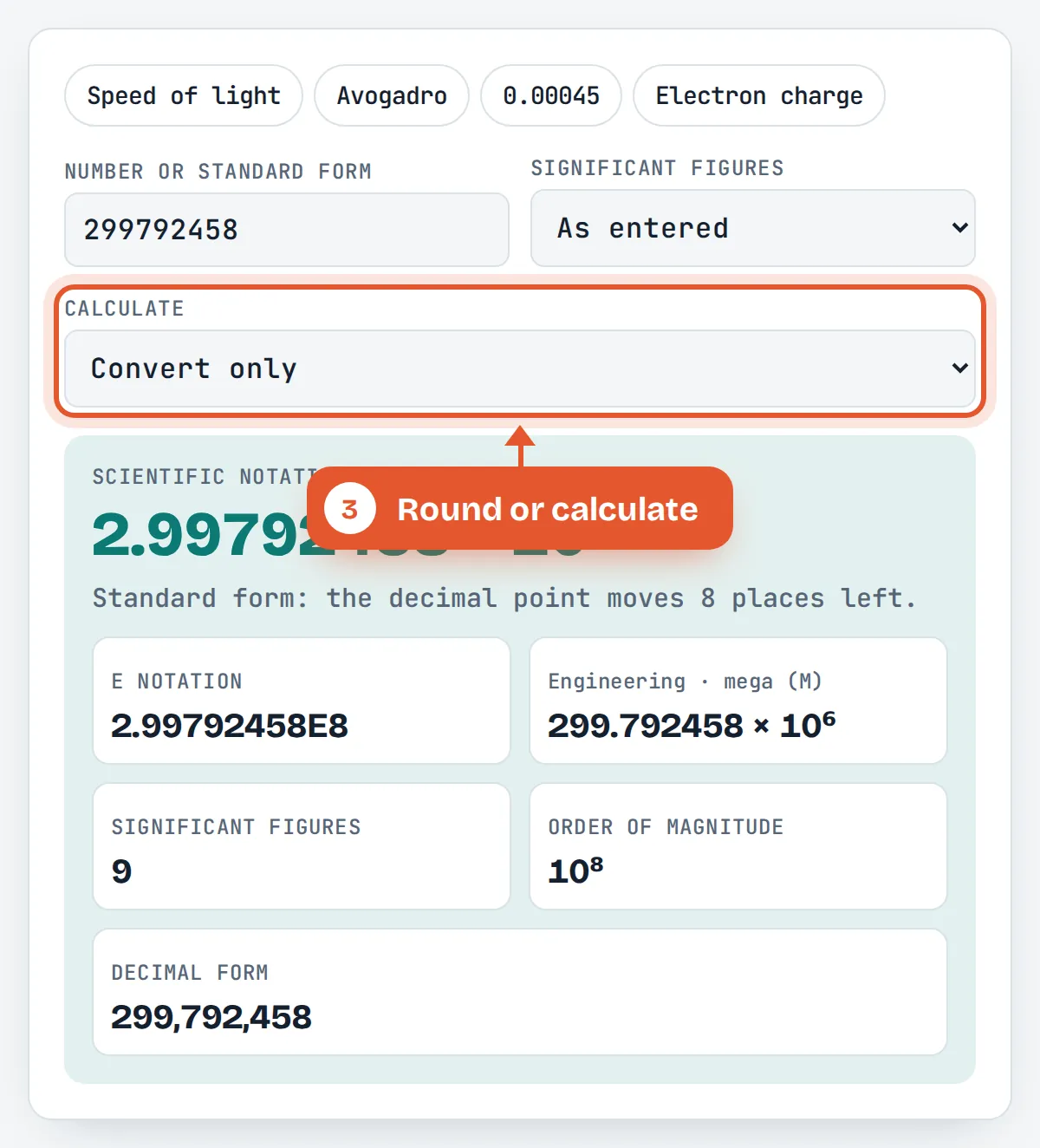
Round or calculate
Choose a number of significant figures, or pick multiply, divide, add or subtract and enter a second number.
Read every format
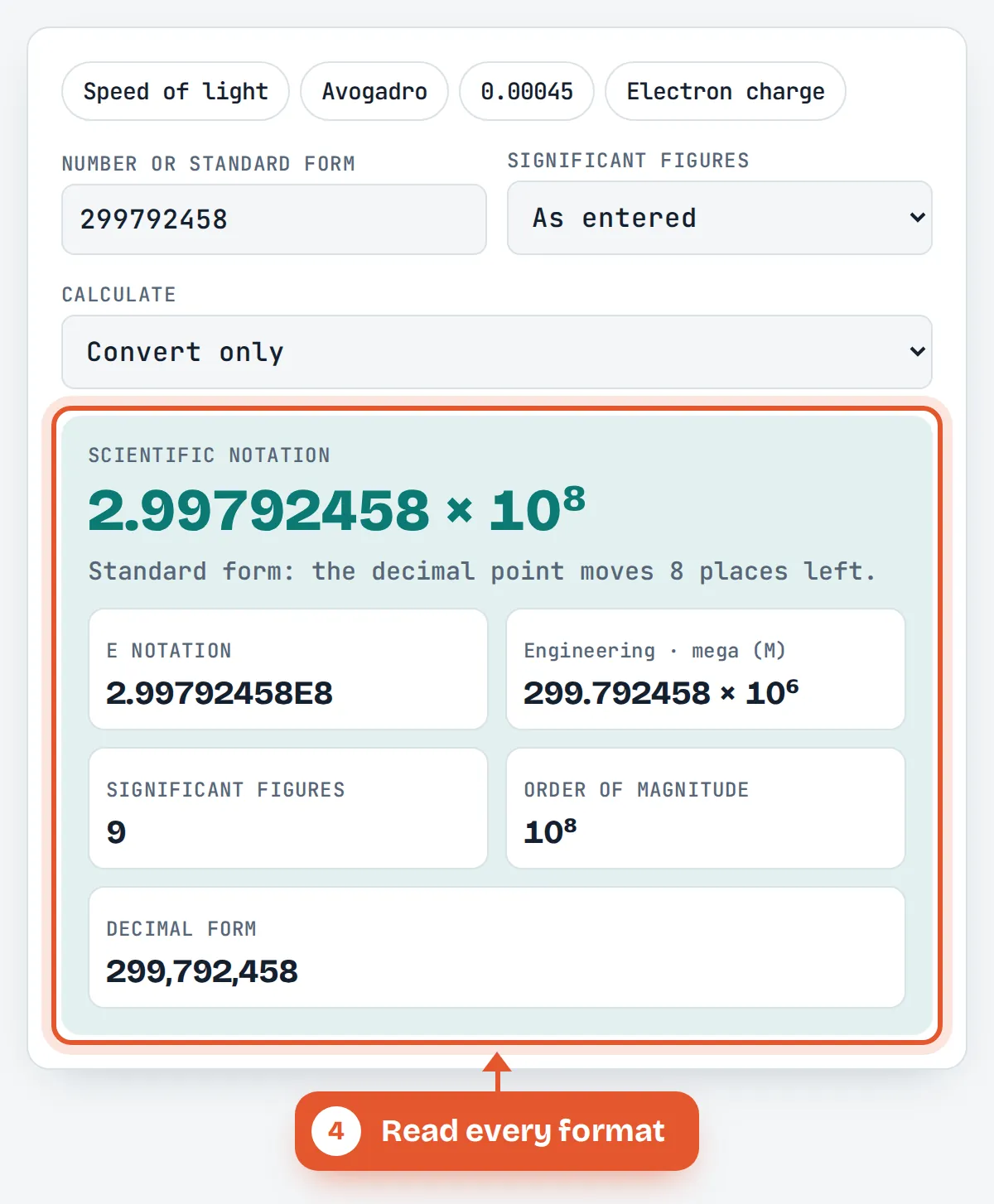
Standard form appears in large text, with E notation, engineering notation and its SI prefix, the significant figures and the full decimal.
Frequently Asked Questions
Is standard form the same as scientific notation?
Yes, in the UK and Ireland standard form, or standard index form, means scientific notation: a number from 1 to under 10 multiplied by a power of 10. In the United States, standard form usually means the ordinary written out number, so check which meaning a worksheet uses.
How do you write 0.00045 in scientific notation?
Move the decimal point 4 places to the right to get 4.5, a number between 1 and 10. Because you moved right, the power is negative, so 0.00045 = 4.5 × 10⁻⁴. In calculator E notation that is 4.5E-4.
Can the number in front be 10 or more?
No. In proper scientific notation the front number must be at least 1 and less than 10. An answer such as 15 × 10⁻³ is correct in value but not in standard form, so rewrite it as 1.5 × 10⁻² by moving the point and adding one to the power.
How do you write negative numbers in standard form?
Keep the minus sign in front and convert the rest as normal. For example, −0.0072 becomes −7.2 × 10⁻³. The sign of the number and the sign of the power are separate: the power only tells you how far the decimal point moved.
What is the difference between scientific and engineering notation?
Scientific notation keeps one digit before the point, so 45,000 is 4.5 × 10⁴. Engineering notation uses powers that are multiples of 3, so the same number is 45 × 10³, which reads directly as 45 kilo, matching the SI metric prefixes.
How many significant figures does a number in standard form have?
Count every digit in the front number. 2.99792458 × 10⁸ has 9 significant figures, and 1.20 × 10³ has 3, because the trailing zero after the decimal point is significant. The power of ten never adds significant figures.
Sources and Further Reading
- Scientific notation, Wikipedia
- SI prefixes, BIPM (International Bureau of Weights and Measures)
- Fundamental physical constants, NIST
Related Tools
Last reviewed: October 2026