How to calculate overtime pay: multiply your regular hourly rate by 1.5, then by the hours you worked over 40 that week, and add it to your normal pay. At $20 an hour, a 45-hour week is 40 × $20 + 5 × $30 = $950. Bonuses you were promised raise the rate, and some states, like California, add daily overtime.

You worked the extra shifts. Now you want to know if the paycheck is right. Good instinct, because overtime math goes wrong more often than you’d think, usually around bonuses and odd schedules. Let’s walk through it.
How Do You Calculate Overtime Pay?
Multiply your regular hourly rate by 1.5 to get your overtime rate, then multiply that rate by every hour you work over 40 in a workweek. The federal Fair Labor Standards Act (FLSA) says non-exempt employees get at least one and a half times their regular rate for every hour over 40 in a workweek. A workweek is any fixed run of seven days, 168 hours, that your employer sets. It doesn’t have to start on Monday.
Overtime pay = overtime rate × hours over 40
Total pay = (regular rate × 40) + overtime pay
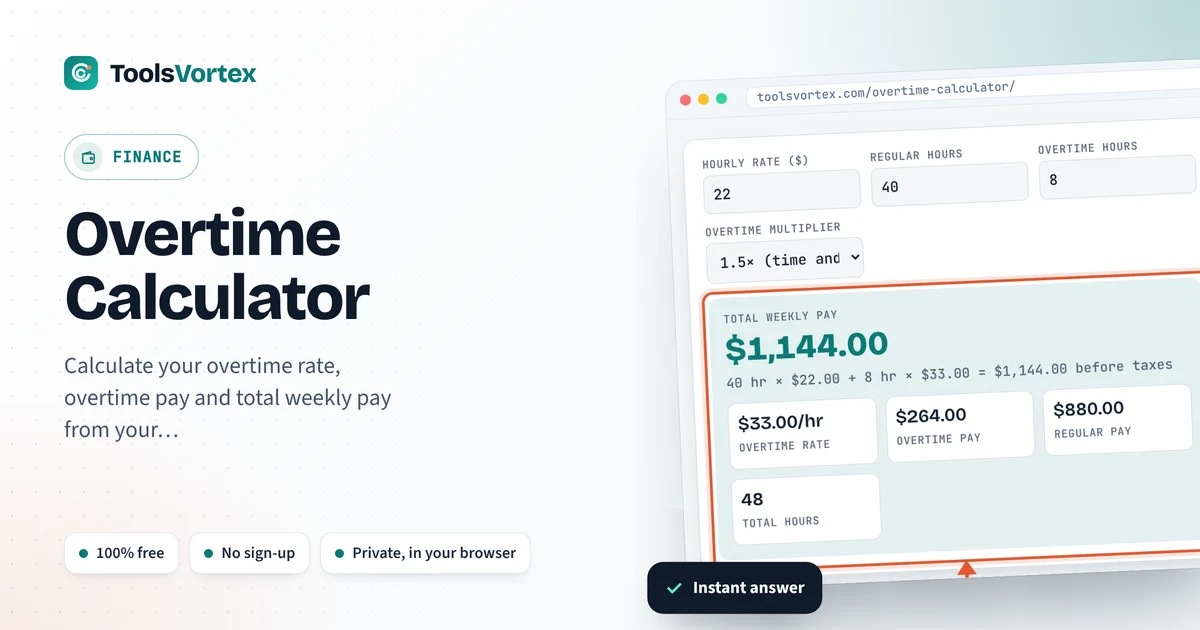
Keisha is a warehouse lead in Memphis earning $22 an hour. Last week she clocked 50 hours.
- Regular pay: 40 × $22 = $880
- Overtime rate: $22 × 1.5 = $33
- Overtime pay: 10 × $33 = $330
- Total: $1,210 before taxes
If your hours come in odd minutes, total them with the time card calculator first. Then plug everything into the calculator below.
Overtime pay chart by hourly rate
Gross weekly pay at time and a half for hours over 40:
| Hourly rate | Overtime rate | 45 hrs | 50 hrs | 60 hrs |
|---|---|---|---|---|
| $12.00 | $18.00 | $570 | $660 | $840 |
| $15.00 | $22.50 | $712 | $825 | $1,050 |
| $18.00 | $27.00 | $855 | $990 | $1,260 |
| $20.00 | $30.00 | $950 | $1,100 | $1,400 |
| $22.00 | $33.00 | $1,045 | $1,210 | $1,540 |
| $25.00 | $37.50 | $1,188 | $1,375 | $1,750 |
| $30.00 | $45.00 | $1,425 | $1,650 | $2,100 |
| $35.00 | $52.50 | $1,662 | $1,925 | $2,450 |
| $40.00 | $60.00 | $1,900 | $2,200 | $2,800 |
Notice that 60 hours pays $1,400, not $1,200. Those last 20 hours each pay $30. That’s 75% more money for 50% more time.
What Is the Regular Rate for Overtime Pay?
The regular rate is your hourly pay for all hours plus shift differentials, commissions and nondiscretionary bonuses, divided by total hours worked, and overtime is figured from it instead of your base wage. Here’s the part most online calculators skip. Time and a half is 1.5 times your regular rate, and that’s not always your hourly wage. The regular rate includes most pay for work: shift differentials, commissions and nondiscretionary bonuses (the ones promised in advance for production, attendance, safety and so on).
What’s left out? Things like discretionary gifts, paid vacation and holiday pay for time not worked, expense reimbursements, and premium pay that already counts as overtime.
Overtime owed = 0.5 × regular rate × overtime hours (the straight time is already paid)
Tom earns $18 an hour and works 46 hours. He also earns a $92 production bonus that week.
- Straight-time pay: 46 × $18 = $828
- Regular rate: ($828 + $92) ÷ 46 = $20.00
- Overtime premium: 0.5 × $20.00 × 6 hours = $60.00
- Total: $828 + $92 + $60.00 = $980.00
Had payroll ignored the bonus, Tom’s overtime would have been figured at $27 an hour instead of $30.00. Six dollars short on one check sounds small. Over a year of regular overtime, it isn’t.
How Does California Daily Overtime and Double Time Work?
In California, non-exempt workers generally get 1.5 times pay for hours over 8 in a workday or over 40 in a week, and double time for hours over 12 in a workday. Federal law only counts weekly hours. A few states go further, and California is the big one. Non-exempt workers there generally get:
- 1.5× for hours over 8 in a workday, and over 40 in a week
- 2× (double time) for hours over 12 in a workday
- On the seventh consecutive day worked in a workweek: 1.5× for the first 8 hours, 2× after that
Hours already paid as daily overtime aren’t counted again toward the weekly 40. Here’s an uneven week at $24 an hour:
| Day | Hours | Regular | 1.5× | 2× |
|---|---|---|---|---|
| Mon | 10 | 8 | 2 | 0 |
| Tue | 8 | 8 | 0 | 0 |
| Wed | 13 | 8 | 4 | 1 |
| Thu | 8 | 8 | 0 | 0 |
| Fri | 6 | 6 | 0 | 0 |
| Total | 45 | 38 | 6 | 1 |
California pay: 38 × $24 + 6 × $36 + 1 × $48 = $1,176. Under federal rules alone, the same 45-hour week pays 40 × $24 + 5 × $36 = $1,140. Daily overtime adds $36.
Alaska, Colorado and Nevada have daily overtime rules too, with their own triggers and exceptions. If you work there, check your state labor department’s page.
Who gets overtime, and who doesn’t
Most hourly workers are non-exempt and get overtime. Being on salary doesn’t automatically change that. To be exempt as an executive, administrative or professional employee, you generally need to pass a duties test and earn at least $684 a week ($35,568 a year) on a salary basis. That’s the federal threshold in effect after a court struck down the 2024 increase. Some states, including California, New York and Washington, set higher thresholds.
Certain jobs have their own rules, like some farm workers, live-in domestic workers and commissioned retail staff. When in doubt, the Department of Labor’s Wage and Hour Division can tell you where you stand.
Common overtime payroll mistakes
Averaging two weeks. Biweekly pay doesn’t mean a 80-hour threshold. Each workweek stands alone. Work 52 hours, then 28? You’re owed 12 hours of overtime for week one.
Comp time instead of cash. Private employers can’t swap overtime pay for future time off under the FLSA. (Public agencies have special rules.)
Off-the-clock work. Answering emails at home, mandatory pre-shift meetings, required security screenings at some workplaces. If it’s work the employer requires or allows, it usually counts.
“We don’t approve overtime.” An employer can discipline you for unapproved overtime, but it still has to pay for hours worked.
The federal overtime tax deduction (2025 to 2028)
The 2025 tax law, often called the One Big Beautiful Bill Act, created a new federal income tax deduction for overtime. The short version, based on IRS guidance and the statute:
- It covers only the premium part of FLSA overtime, the extra half in time and a half, not the whole overtime check.
- Maximum deduction: $12,500 a year, or $25,000 on a joint return.
- It phases out above $150,000 of modified adjusted gross income ($300,000 joint). For single filers it shrinks by $100 for every $1,000 over.
- It applies to tax years 2025 through 2028. You can take it whether or not you itemize, but you need a valid Social Security number, and married couples must file jointly.
- Overtime required only by state law, such as California daily overtime, or by a union contract doesn’t qualify. Neither does overtime above what the FLSA requires.
- Social Security, Medicare and state income taxes still apply. Starting with 2026 wages, employers report qualified overtime on the W-2 in box 12 with code TT.
Keisha from earlier works 10 overtime hours a week for 50 weeks. Her premium is the extra half of $33, which is $11 an hour. That’s 10 × 50 × $11 = $5,500 of deductible overtime for the year, well under the $12,500 cap.
Overtime pay isn’t taxed at a special rate on your paycheck, by the way. It just looks that way because a bigger check gets withheld as if you earned that much every week. You’ll square up at tax time. Curious what all those extra hours mean per year? Run them through the hourly to salary calculator or read our hourly to salary guide.
How to calculate overtime pay: quick recap
- How to calculate overtime pay in one line: regular rate × 1.5 × hours over 40 in the workweek.
- How to calculate overtime pay with a bonus: add nondiscretionary bonuses to the week’s pay before finding the regular rate.
- How to calculate overtime pay in California: also count hours over 8 in a day, and double time after 12.
- How to calculate overtime pay for two jobs at one employer: use the weighted average of both rates.
- How to calculate overtime pay for salaried non-exempt workers: divide the weekly salary by the hours it covers to get the rate.
- Not sure how to calculate overtime pay for your own week? The overtime calculator does the math and shows each step.
- Knowing how to calculate overtime pay yourself is the quickest way to catch a payroll mistake.
- Save your time cards, because they are the proof you need if the way your employer chose how to calculate overtime pay looks wrong.
Frequently asked questions
How do you calculate overtime pay?
Multiply your regular hourly rate by 1.5 to get the overtime rate, then multiply by the hours you worked past 40 in the workweek. Add that to your regular pay for the first 40 hours.
What is time and a half for $20 an hour?
$30 an hour. Five overtime hours would add $150, so a 45-hour week pays $800 + $150 = $950 before taxes.
Do bonuses count toward overtime pay?
Nondiscretionary bonuses do, like production, attendance or safety bonuses promised in advance. They raise your regular rate, which raises the overtime rate. Purely discretionary gifts, like a surprise holiday bonus, generally don’t.
Is overtime based on hours per day or per week?
Federal law uses hours per workweek, over 40. A few states add daily overtime. California pays 1.5 times after 8 hours in a day and double time after 12.
Can my employer average hours over two weeks?
No. Under the FLSA each workweek stands alone. Working 50 hours one week and 30 the next still means 10 hours of overtime for the first week.
Are salaried employees eligible for overtime?
Some are. Being paid a salary doesn’t make you exempt by itself. You also have to meet a duties test and earn at least the federal salary threshold, currently $684 a week.
Is overtime pay tax-free now?
Not exactly. For tax years 2025 through 2028, eligible workers can deduct the premium part of FLSA overtime (the extra half) on their federal income tax return, up to $12,500, or $25,000 on a joint return. Social Security, Medicare and state taxes still apply.
Sources
- Overtime Pay, U.S. Department of Labor, Wage and Hour Division
- Fact Sheet #56A: Overview of the Regular Rate of Pay Under the FLSA, U.S. Department of Labor
- Overtime FAQs, California Department of Industrial Relations
- What to know about the No Tax on Overtime deduction, Internal Revenue Service
- 26 U.S. Code § 225: Qualified overtime compensation, Cornell Law School, Legal Information Institute