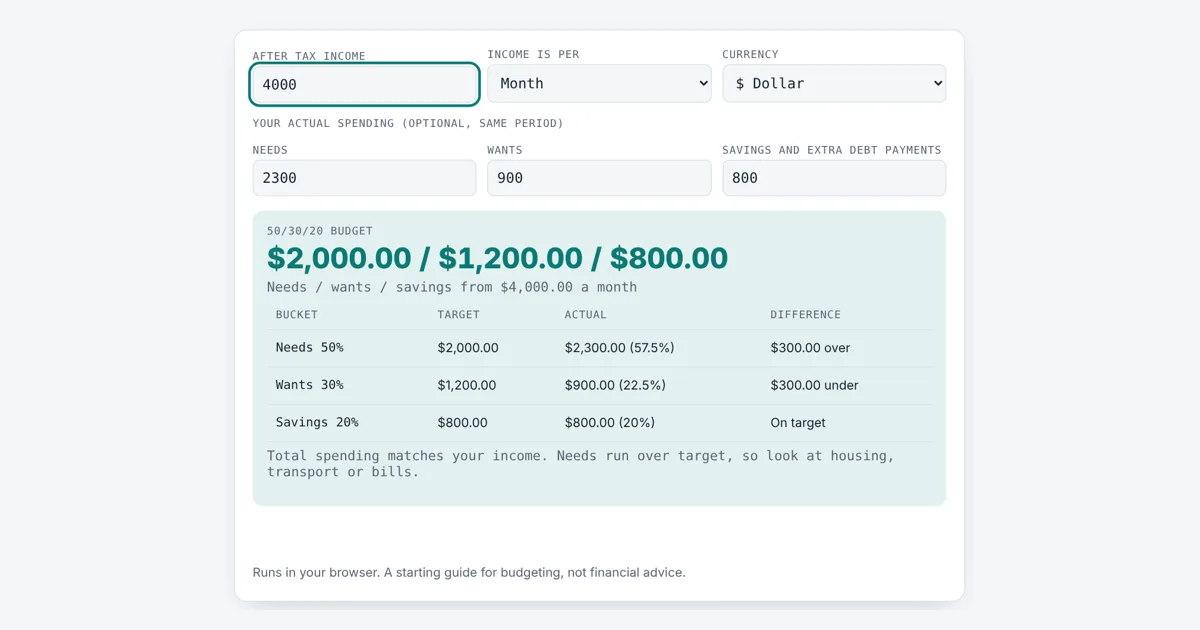
Enter your take home pay and get the 50/30/20 split for needs, wants and savings. Add what you really spend to see which bucket is over or under.
| Bucket | Target | Actual | Difference |
|---|---|---|---|
| Needs 50% | $2,000.00 | $2,300.00 (57.5%) | $300.00 over |
| Wants 30% | $1,200.00 | $900.00 (22.5%) | $300.00 under |
| Savings 20% | $800.00 | $800.00 (20%) | On target |
Total spending matches your income. Needs run over target, so look at housing, transport or bills.
Runs in your browser. A starting guide for budgeting, not financial advice.
This 50 30 20 budget calculator is for anyone who wants a simple budget without tracking every coffee: students, new graduates, couples and families. Enter your after tax income, the pay that lands in your account, and it splits it into 50% for needs, 30% for wants and 20% for savings, then compares those targets with your real spending.
How Does the 50 30 20 Budget Rule Work?
The 50/30/20 rule splits after tax income into three parts: 50% for needs, 30% for wants and 20% for savings and extra debt payments. On a take home pay of $4,000 a month, that is $2,000 for needs, $1,200 for wants and $800 for savings. It is a guide you can adjust, not a fixed law.
Where Does the 50/30/20 Rule Come From?
The 50/30/20 rule was made popular by US Senator Elizabeth Warren and her daughter Amelia Warren Tyagi in their 2005 book All Your Worth.
In the book they call the three parts must-haves, wants and savings. The idea is that keeping fixed must-have costs near half of take home pay leaves room to handle a job loss or emergency. The exact labels and rules here are a common modern reading of their plan.
wants = after tax income × 0.30
savings and extra debt payments = after tax income × 0.20
What Counts as Needs, Wants and Savings in a 50 30 20 Budget?
Needs are bills you must pay to live and work, wants are spending you could cut without real harm, and savings covers money set aside plus debt paid above the minimum.
Needs include rent or mortgage, utilities, groceries, insurance, transport to work and minimum loan payments. Wants include eating out, streaming, hobbies, holidays and upgrades. Savings includes an emergency fund, retirement contributions and extra payments that clear debt faster. If you have card debt, the credit card payoff calculator shows what extra payments save, and the savings goal calculator turns the 20% into a target date.
How Much Is 50/30/20 on Common Incomes?
Multiply your monthly take home pay by 0.5, 0.3 and 0.2, as shown in this table.
| Monthly take home | Needs 50% | Wants 30% | Savings 20% |
|---|---|---|---|
| $2,000 | $1,000 | $600 | $400 |
| $3,000 | $1,500 | $900 | $600 |
| $4,000 | $2,000 | $1,200 | $800 |
| $5,000 | $2,500 | $1,500 | $1,000 |
| $6,000 | $3,000 | $1,800 | $1,200 |
| $8,000 | $4,000 | $2,400 | $1,600 |
What If My Needs Are More Than 50%?
If needs take more than half your pay, which is common in high rent cities, take the extra from wants first and keep savings as close to 20% as you can.
A 60/20/20 or 70/20/10 split is a reasonable starting point while you work on lowering fixed costs. Use net income, not gross salary: if you only know your salary, the salary to hourly calculator helps you understand your pay, but take home pay after tax is what this budget splits. This is a guide for planning, not financial advice.
Worked Example
Lee takes home $4,000 a month. The tool sets targets of $2,000.00 for needs, $1,200.00 for wants and $800.00 for savings. Lee’s real spending is $2,300 on needs, $900 on wants and $800 on savings. The table shows needs at 57.5%, which is $300.00 over target, wants at 22.5%, which is $300.00 under, and savings exactly on target at 20%. Over a year, the 20% savings bucket adds up to $9,600.
How Do You Use the 50/30/20 Budget Calculator?
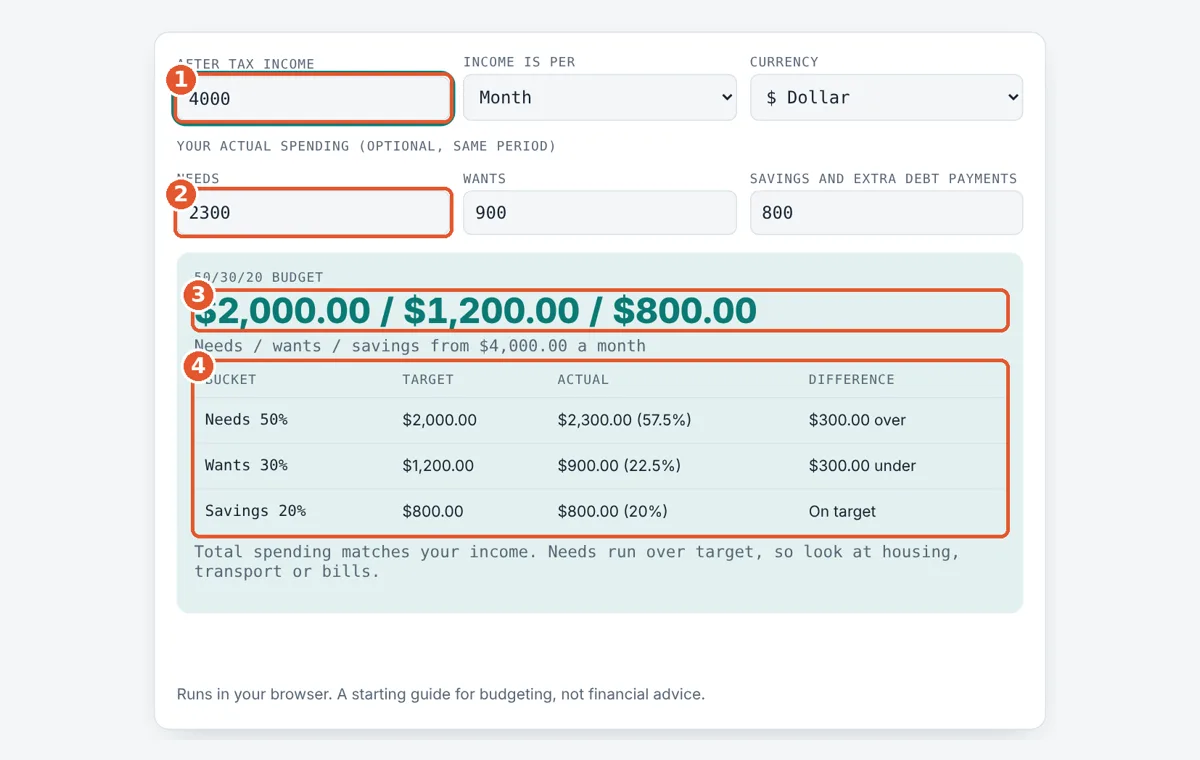
Enter your take home pay
Type your after tax income and pick month, year or week, plus your currency.
Add your real spending
Optionally enter what you spend on needs, wants and savings in the same period.
Read the 50/30/20 split
The big line shows your targets for needs, wants and savings, in that order.
Compare target and actual
The table shows each target, your actual amount and share, and how far over or under you are.
Frequently Asked Questions
Is the 50/30/20 rule based on gross or net income?
It uses net income, also called take home pay, which is what you receive after income tax and payroll deductions. If retirement contributions come out of your paycheck, many people add them back and count them as savings.
Do debt payments count as needs or savings?
Minimum payments on loans and cards are needs, because you must pay them. Anything you pay above the minimum counts toward the 20% savings bucket, since it lowers your debt faster.
Is 20% savings enough?
For many people 20% is a strong target, but it depends on your goals and age. Someone starting late on retirement may need more. If 20% is not possible yet, start smaller and raise it with each pay rise.
How much is 50/30/20 on a $60,000 salary?
It depends on take home pay, not salary. If $60,000 a year leaves about $4,000 a month after tax, the split is $2,000 for needs, $1,200 for wants and $800 for savings each month.
Is groceries a need or a want?
Basic groceries are a need. Takeaway meals, restaurant dinners and luxury food items are wants. Splitting your grocery receipt this way can show that part of what feels like a need is really a want.
Can I change the 50/30/20 percentages?
Yes. The rule is a starting point. People in high cost areas often use 60/20/20, and people paying off debt quickly may choose 50/20/30 with 30% going to savings and debt.
Sources and Further Reading
- Elizabeth Warren and Amelia Warren Tyagi, All Your Worth (Free Press, 2005)
- CFPB: Your Money, Your Goals toolkit
- MyMoney.gov: Spend
Related Tools
Last reviewed: October 2026