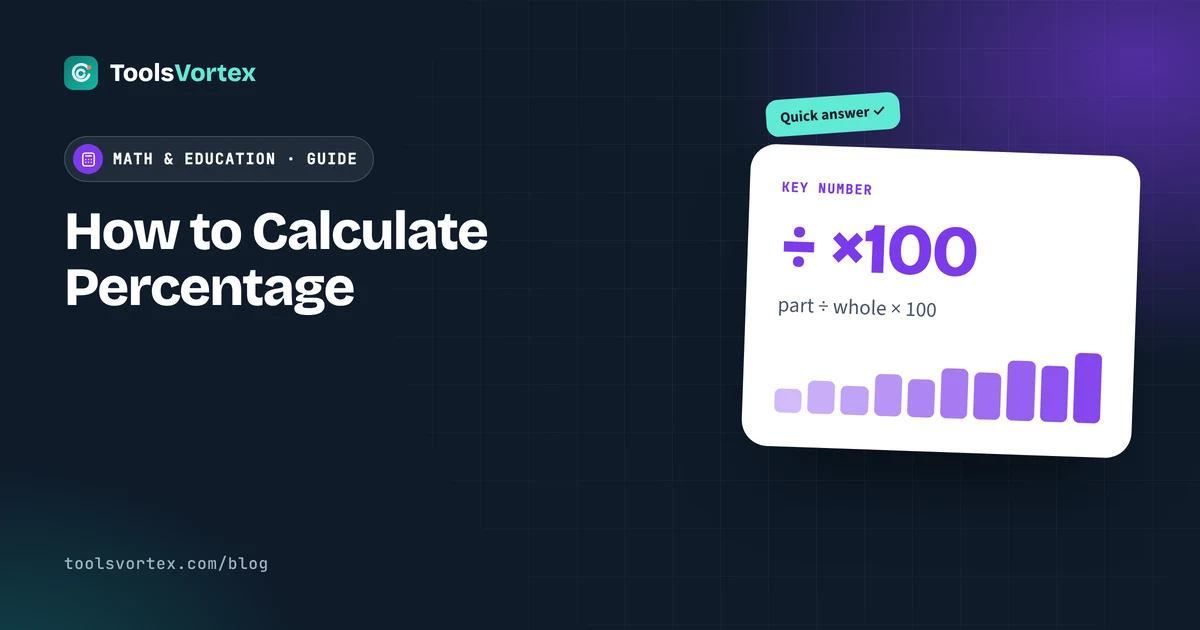
Here’s how to calculate percentage: divide the part by the whole, then multiply by 100. So 30 out of 120 is 30 ÷ 120 = 0.25, which is 25%. To find a percentage of a number, flip it around: turn the percent into a decimal and multiply (20% of 85 = 0.20 × 85 = 17).

Percentages show up everywhere. Sale tags, test scores, tips, your raise, the “battery at 14%” warning. And yet most of us learned this once in sixth grade and then quietly started guessing. Let’s fix that. Ten minutes and you’ll have it for good.
How Do You Calculate a Percentage?
Percent means per hundred, so you can solve any percentage problem with one relationship: Part equals Percent times Whole, with the percent written as a decimal. “Percent” literally means “per hundred.” So 25% is 25 out of every 100. Every percentage problem is some version of this one relationship:
Percent = Part ÷ Whole × 100
Whole = Part ÷ Percent
That’s it. Three pieces, and if you know any two, you can get the third. The only real skill is spotting which two you’ve been given.
The three percentage questions (and how to solve each)
1. What is X% of Y?
Convert the percent to a decimal by moving the point two places left, then multiply. What’s 18% of 250? 0.18 × 250 = 45.
2. X is what percent of Y?
Divide, then multiply by 100. You answered 37 out of 45 quiz questions right. 37 ÷ 45 = 0.8222, times 100 = 82.2%. (Want to know what that does to your class grade? The grade calculator handles the weighting.)
3. X is Y% of what?
Divide the part by the decimal. Your $1,800 rent is 30% of your take-home pay. What’s your take-home? $1,800 ÷ 0.30 = $6,000.
People mix up #2 and #3 all the time. A quick sanity check: if the percent is under 100, the whole has to be bigger than the part. If your answer says otherwise, you divided the wrong way round.
How to calculate percentage increase and decrease
Percent change compares a new number to an old one. The old number always goes on the bottom.
Maya’s hourly pay goes from $21.50 to $23.25. The difference is $1.75. Divide by the old rate: $1.75 ÷ $21.50 = 0.0814. Times 100 is an 8.1% raise.
Now say her electric bill drops from $142 to $118. That’s (118 − 142) ÷ 142 × 100 = −16.9%. The minus sign just means it’s a decrease.
For raises and price jumps you’ll run often, our percentage increase calculator saves a step.
The trap: up and down aren’t equal
If something rises 50% and then falls 50%, you’re not back where you started. You’re 25% down. Why? The drop is taken from a bigger number. Here’s what happens to 100:
| Move | After the rise | After the fall | Where you end up |
|---|---|---|---|
| +10% then −10% | 110 | 99 | 1% below start |
| +20% then −20% | 120 | 96 | 4% below start |
| +25% then −25% | 125 | 93.75 | 6.25% below start |
| +50% then −50% | 150 | 75 | 25% below start |
This is why a stock that loses half its value needs to gain 100% to recover. It’s also why “50% off, then another 20% off” is 60% off, not 70%. You take 20% of the already-reduced price: 0.5 × 0.8 = 0.40 of the original, so you pay 40%.
How Do You Find the Original Number After a Percentage Change?
Divide the final price by one minus the discount, so a jacket that costs $60 after 25% off originally cost $60 divided by 0.75, which is $80. This one trips up almost everyone. A jacket is $60 after 25% off. What was the original price? Most people add 25% of $60 back ($75). Wrong. The 25% came off the original, not the sale price.
Original = final price ÷ (1 + increase)
So $60 ÷ 0.75 = $80. Same idea for tax. A receipt total of $53.50 with 7% sales tax means the pre-tax price was $53.50 ÷ 1.07 = $50. The sales tax calculator and discount calculator both run this in reverse if you’d rather not.
What Is the Difference Between Percent and Percentage Points?
A percentage point is the direct gap between two percentages, while percent shows relative growth, so a mortgage rate moving from 6% to 7% rose 1 percentage point but 16.7%. News reports blur this constantly. When a mortgage rate goes from 6% to 7%, it rose 1 percentage point. But relative to where it started, it rose 1 ÷ 6 = 16.7%. Both statements are true. They just answer different questions.
Rule of thumb: when you’re comparing two percentages directly, say “points.” When you’re describing how much something grew relative to itself, say “percent.”
Mental math tricks that actually work
- 10% is a decimal shift. 10% of 340 is 34. From there, 5% is half (17), 20% is double (68), 15% is 34 + 17 = 51.
- 1% is two shifts. 1% of 340 is 3.4, so 3% is 10.2.
- Swap the numbers. 4% of 75 looks annoying. 75% of 4 is just 3. Same answer, every time.
- Fractions you already know. 25% is a quarter, 50% is half, 75% is three quarters, 33⅓% is a third. If you’re rusty on fractions, the fraction calculator helps.
Try one now. What’s 35% of 60? (30% is 18, 5% is 3, so 21.) Not bad, right?
Quick percentage reference chart
| Percent | of 20 | of 50 | of 80 | of 150 | of 250 | of 1,200 |
|---|---|---|---|---|---|---|
| 5% | 1 | 2.5 | 4 | 7.5 | 12.5 | 60 |
| 10% | 2 | 5 | 8 | 15 | 25 | 120 |
| 15% | 3 | 7.5 | 12 | 22.5 | 37.5 | 180 |
| 20% | 4 | 10 | 16 | 30 | 50 | 240 |
| 25% | 5 | 12.5 | 20 | 37.5 | 62.5 | 300 |
| 30% | 6 | 15 | 24 | 45 | 75 | 360 |
| 50% | 10 | 25 | 40 | 75 | 125 | 600 |
| 75% | 15 | 37.5 | 60 | 112.5 | 187.5 | 900 |
How to calculate percentage in Excel and Google Sheets
Spreadsheets store percentages as decimals, so 15% is really 0.15 underneath. Some handy formulas:
- What percent is A2 of B2:
=A2/B2, then click the % format button. - Percent change from A2 to B2:
=(B2-A2)/A2 - 15% of A2:
=A2*15%or=A2*0.15 - Add 8% to A2:
=A2*1.08
One gotcha: if you type 15 into a cell and then format it as a percent, Sheets shows 1500%. Type 15% or 0.15 instead.
How to calculate percentage: quick recap
- How to calculate percentage of a number: multiply the number by the percent and divide by 100, so 15% of 80 is 12.
- How to calculate percentage from two numbers: divide the part by the whole and multiply by 100, so 18 out of 24 is 75%.
- How to calculate percentage change: subtract old from new, divide by old, times 100.
- How to calculate percentage in Excel: =A2/B2, then format the cell as a percent.
- How to calculate percentage of marks: total marks earned divided by total possible, times 100.
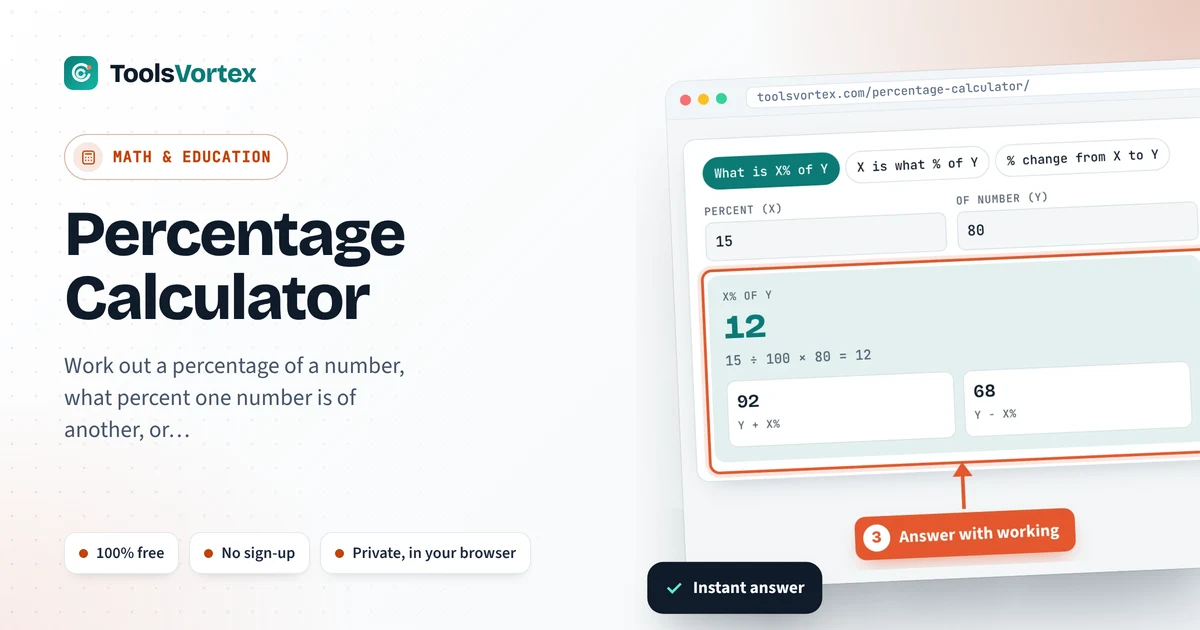
- If you just want the answer, the percentage calculator shows how to calculate percentage step by step for all three question types.
Frequently asked questions
How do I calculate a percentage of a number?
Turn the percent into a decimal and multiply. For 15% of 80, do 0.15 × 80 = 12.
What is the formula for percentage?
Percentage = (part ÷ whole) × 100. If you got 42 out of 50 questions right, 42 ÷ 50 = 0.84, and 0.84 × 100 = 84%.
How do I calculate percent change?
Subtract the old value from the new one, divide by the old value, then multiply by 100. Going from $40 to $50 is (50 − 40) ÷ 40 × 100 = 25%.
How do I find the original price before a discount?
Divide the sale price by (1 minus the discount as a decimal). A $60 jacket after 25% off was $60 ÷ 0.75 = $80. Don’t just add 25% back on.
What's the difference between percent and percentage points?
Percentage points are the plain gap between two percentages. A rate moving from 4% to 5% is up 1 percentage point, but that is a 25% increase relative to where it started.
How do I calculate a percentage in Excel or Google Sheets?
Use =A2/B2 and format the cell as a percent. For percent change, use =(B2-A2)/A2. For X% of a number, use =A2*15% or =A2*0.15.
Is X% of Y the same as Y% of X?
Yes, always. 8% of 50 equals 50% of 8, which is 4. Swap them whenever one version is easier to do in your head.
Sources
- Percentages, Khan Academy, ratios, rates and percentages
- Percentage Change, Math Is Fun
- Consumer Price Index: How percent changes are calculated, U.S. Bureau of Labor Statistics