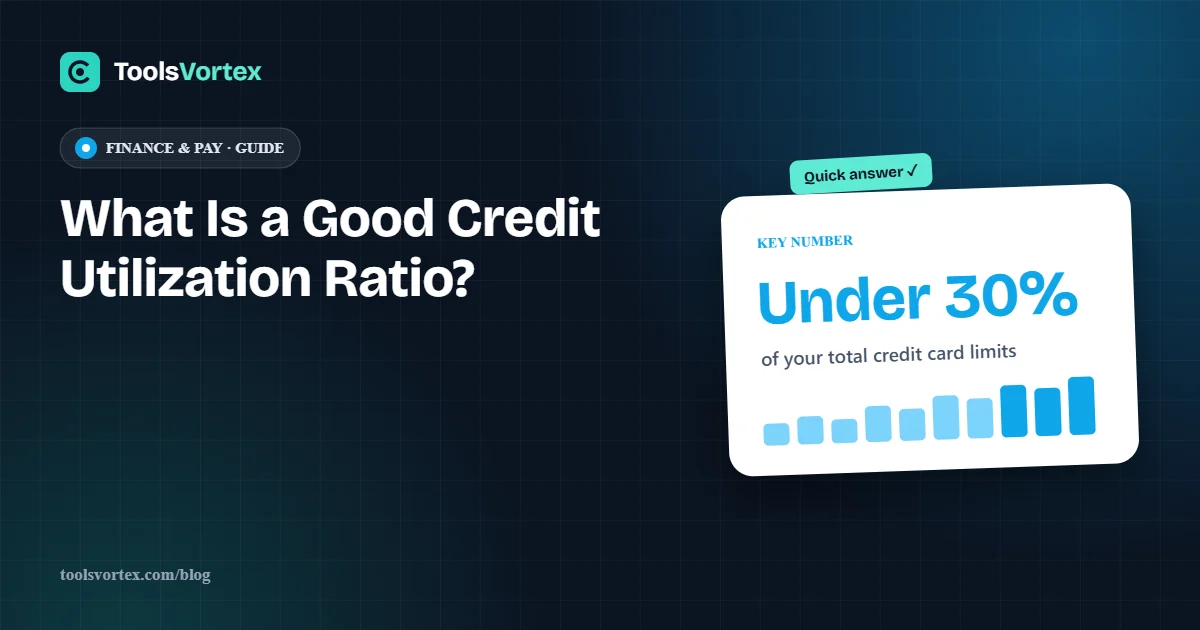
A good credit utilization ratio is below 30% of your total credit card limits, the guideline the CFPB says experts advise. Lower is better: FICO has reported that people with its highest scores use about 7% on average. Divide your card balances by your limits and multiply by 100. On a $5,000 limit, 30% is $1,500.

If you are asking what is a good credit utilization ratio, the common answer is “under 30%.” That is a sound guideline, but it leaves out two things: lower is better than just under 30%, and one maxed out card can look bad even when your total is fine.
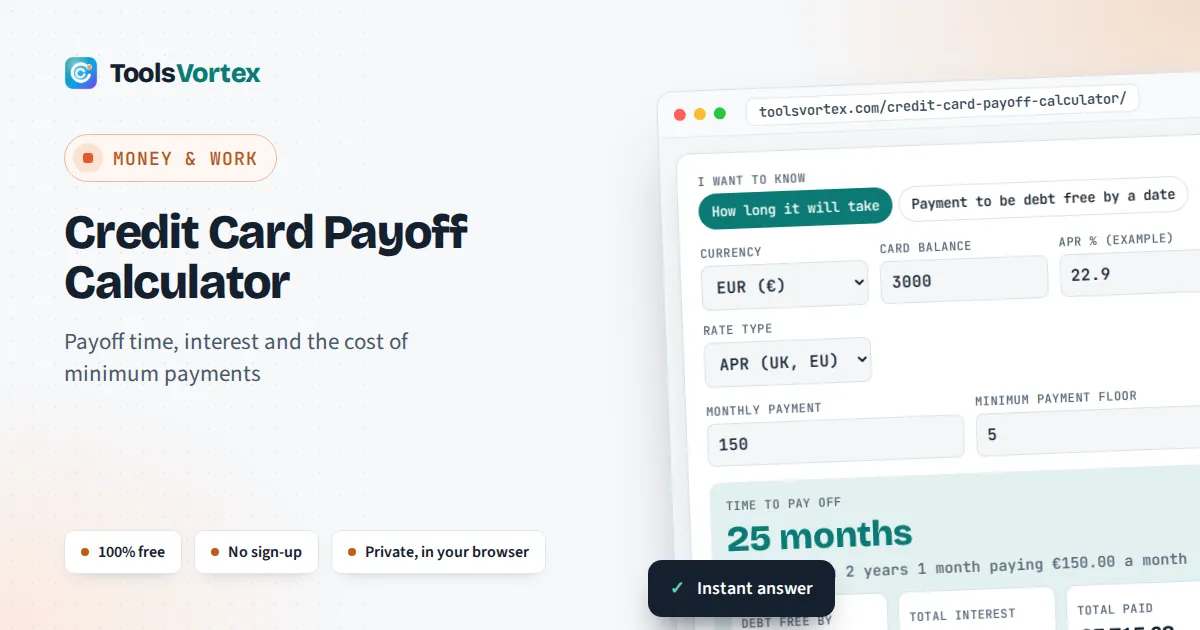
This guide shows the formula, a dollar table for common limits, a three card example, and the moves that lower your ratio fastest. If you carry a balance you want gone, our credit card payoff calculator shows how long it takes at your rate and payment. This is general information, not financial advice.
What Is a Good Credit Utilization Ratio?
A good credit utilization ratio is under 30% of your total credit limit, and under 10% is even better.
The Consumer Financial Protection Bureau (CFPB) says experts advise keeping your use of credit at no more than 30 percent of your total credit limit. FICO, the company behind the FICO Score, went further in a 2012 release: people with its highest scores used an average of only 7 percent of their available revolving credit.
| Utilization | What the primary sources say |
|---|---|
| Under 10% | FICO said in 2012 that people with its highest scores used an average of 7% of their revolving credit |
| Under 30% | The CFPB says experts advise using no more than 30% of your total credit limit |
| 30% to 50% | Above the 30% guideline; FICO says higher utilization goes with higher default risk |
| Over 50% | Close to maxed out, which scoring models look at, per the CFPB |
These are guidelines, not cutoffs. No source we checked says a score jumps or drops at an exact percentage. Lower utilization is simply read as lower risk.
Utilization matters because it sits inside the biggest scoring factors. myFICO says the amounts owed category makes up about 30% of a FICO Score, and that credit card balances carry more weight there than mortgage or auto loans.
How Do You Calculate Your Credit Utilization Ratio?
Divide your credit card balance by your credit limit, then multiply by 100.
Overall utilization = total of all card balances / total of all card limits x 100
Most you can owe for a target = total limit x target %
myFICO gives a simple example: owing $1,000 on a $10,000 limit means you are using 10% of your credit. If percentages feel rusty, our guide on how to calculate a percentage walks through the same step.
Here is what each target means in dollars, so you can see the line before you swipe.
| Total credit limit | 10% utilization | 30% utilization | 50% utilization |
|---|---|---|---|
| $1,000 | $100 | $300 | $500 |
| $2,500 | $250 | $750 | $1,250 |
| $5,000 | $500 | $1,500 | $2,500 |
| $10,000 | $1,000 | $3,000 | $5,000 |
| $20,000 | $2,000 | $6,000 | $10,000 |
Each figure is the total limit times 10%, 30% or 50%. Add up the limits on all your cards to find your row.
Only revolving credit, like credit cards and lines of credit, counts here. A car loan or mortgage has a balance, but it is not part of this ratio.
Where to find your numbers
Your monthly statement or card app shows two figures you need: the current balance and the credit limit. Write both down for every card you have, including store cards you rarely use. Add the balances into one total and the limits into another. Then run the overall formula, and run the card formula once for each card. A simple list of five cards takes about two minutes. Do it again right after your next statements close, since the number changes every month as you spend and pay. If a card shows a pending payment, use the balance after the payment posts.
Does Utilization on Each Card Matter or Just the Total?
Both can matter, because scoring models can look at each card’s ratio as well as your overall ratio.
myFICO defines the rate for each account as that account’s balance divided by its limit. The CFPB says models check how close you are to being maxed out. So a single card near its limit can stand out even when your total looks healthy.
Sam has three credit cards with a combined limit of $10,000.
- Card A: $600 / $2,000 = 30%.
- Card B: $2,400 / $3,000 = 80%.
- Card C: $0 / $5,000 = 0%.
- Overall: $3,000 / $10,000 = 30%.
- To bring Card B to 30%, Sam must owe no more than $3,000 x 0.30 = $900, so he needs to pay $2,400 minus $900 = $1,500 on that card.
- To bring the overall ratio to 10%, Sam’s total balance must be $1,000 or less, so he needs to pay down $2,000 in total.
Sam’s overall number is right at the 30% line, but Card B is at 80%. Paying Card B first fixes the worst ratio and, if it has the highest rate, saves the most interest too.
| Card | Balance | Limit | Card utilization |
|---|---|---|---|
| Card A | $600 | $2,000 | 30% |
| Card B | $2,400 | $3,000 | 80% |
| Card C | $0 | $5,000 | 0% |
| All cards | $3,000 | $10,000 | 30% overall |
Card C has a zero balance, yet it does real work. Its $5,000 limit keeps Sam’s overall ratio at 30% instead of 60%.
Does Closing a Credit Card Hurt Your Utilization?
It can, because closing a card removes its limit from your total, which pushes your ratio up if you still carry balances.
The CFPB warns that closing some card accounts and moving most or all of your balances onto one card may hurt your credit score. In Sam’s case, closing Card C drops his total limit from $10,000 to $5,000. The same $3,000 in debt then becomes $3,000 / $5,000 = 60% utilization.
That does not mean you must keep every card forever. A card with a high annual fee may cost more than it helps. But if a card is free to keep, leaving it open and unused protects your ratio. A quick test: if the yearly fee is more than the rewards or perks you get from the card, closing may still make sense. Weigh it before you call the issuer, and pay down balances first so the lost limit hurts less. The same goes for a balance transfer: moving debt onto one new card can max out that card even if your total stays the same.
How Can You Lower Your Credit Utilization Fast?
The fastest way is to pay down your card balances, and the second fastest is to raise your available credit without adding new debt.
- Pay before the balance is reported. The balance that counts is the one your card issuer reports to the credit bureaus. If you pay a big purchase off early, a lower balance may be reported. Ask your issuer when it reports.
- Make two payments a month. Paying half mid-cycle and half at the due date keeps the running balance lower.
- Target the highest ratio card first. As Sam’s example shows, it fixes the card that stands out.
- Ask for a higher limit. myFICO shows that $2,000 of spending on a $5,000 limit is 40%, but on an $8,000 limit it is 25%. Only do this if you will not spend more.
- Pay in full each month. The CFPB says this helps get the best scores and keeps interest low. You do not need to carry a balance to build a good score.
Spending to a monthly plan helps too. The 50/30/20 budget calculator splits your take-home pay so card spending has a firm cap.
How Long Does It Take to Pay Down a High Utilization Card?
It depends on your rate and payment, but a bigger monthly payment cuts both the time and the interest sharply.
We ran Sam’s Card B, a $2,400 balance, at a 24% APR with no new charges. Interest was charged monthly at 2% of the balance.
| Monthly payment | Months to pay off $2,400 | Interest paid (about) |
|---|---|---|
| $100 | 34 | $902 |
| $200 | 14 | $372 |
| $300 | 9 | $242 |
Our own month by month math, rounded. Your card’s rate, fees and minimum payment rules will change the result.
Moving from $100 to $200 a month saves about $530 in interest and 20 months of payments. Plug your own numbers into the payoff calculator to see your timeline. Once your cards are under control, our guide on how much house you can afford covers the next big credit question. We cannot promise any score change, since each scoring model weighs many factors.
Quick Recap
- Keep total card balances under 30% of your total limits; under 10% is better.
- Utilization = balance / limit x 100, for each card and for all cards.
- One maxed out card can stand out even when your total is fine.
- Closing an unused card lowers your total limit and can raise your ratio.
- Paying in full each month is the simplest way to keep utilization low.
Frequently Asked Questions
Is 30% credit utilization good?
It is acceptable, and it is the upper limit the CFPB says experts advise. Lower is better. FICO reported in 2012 that people with its highest scores used about 7% of their available revolving credit on average.
Is 0% credit utilization bad?
Not in any way that should make you carry debt. The CFPB says you do not need to carry a balance on credit cards to get a good score, and paying in full each month helps get the best scores.
Does a car loan count toward credit utilization?
No. Credit utilization is about revolving credit, such as credit cards. Installment loans like car loans and mortgages have balances, but myFICO says card balances weigh more heavily in the amounts owed category.
How much should I spend on a $1,000 limit card?
To stay under 30%, keep the reported balance at $300 or less. To stay under 10%, keep it at $100 or less. Paying the balance in full by the due date also avoids interest.
Will paying off my credit card raise my score right away?
Not instantly. Your new balance has to be reported by the card issuer first, and no one can promise a set change. A lower reported balance does lower your utilization ratio once it appears.
Does asking for a credit limit increase help utilization?
Yes, if your spending stays the same. myFICO shows $2,000 of spending is 40% of a $5,000 limit but 25% of an $8,000 limit. It only helps if the new room does not turn into new debt.
How do I find my credit utilization?
Add up the balances on all your credit cards, then add up all their limits. Divide total balances by total limits and multiply by 100. Then do the same for each card on its own.
Sources
- CFPB: How Do I Get and Keep a Good Credit Score?, the 30 percent guideline, paying in full, and the risk of closing cards
- myFICO: How FICO Scores Look at Credit Card Limits, per account utilization and amounts owed at about 30% of a score
- myFICO: FICO Score Factor, Amounts Owed, utilization examples and card balances weighing more than installment loans
- FICO: myFICO Reveals Techniques of People With the Highest Credit Scores (2012), high achievers use about 7% of available revolving credit