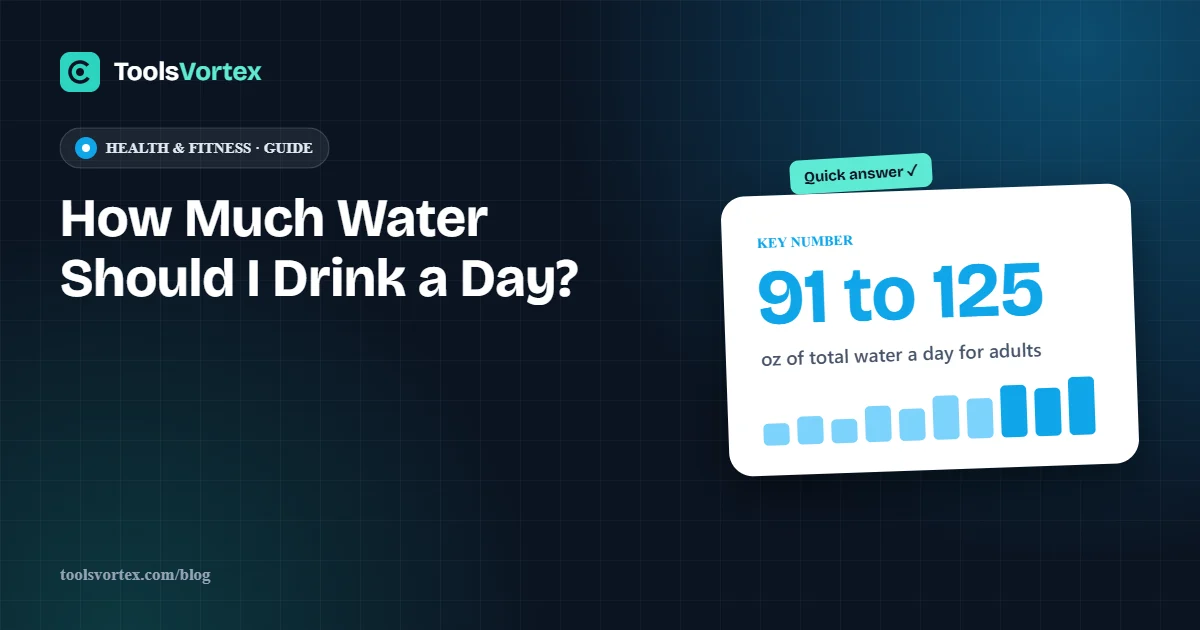
The National Academies set adequate total water intake at about 3.7 liters (125 oz) a day for men and 2.7 liters (91 oz) for women. About 20% comes from food, so drinks supply roughly 12.5 cups for men and 9 cups for women. Heat, exercise, pregnancy and breastfeeding raise the amount.

If you have ever asked how much water should I drink a day, you have probably heard eight glasses. The real answer is a little more and a little less, depending on your body, your day and what you eat.
This guide gives the official reference amounts in liters, ounces and cups, for kids through adults, and shows how much of that you already get from food. You will also see where the 8 glasses rule fell short, how to measure your sweat loss after a workout, and when more water is not better. For a number based on your own weight and activity, try the water intake calculator. This is general information, not medical advice.
How Much Water Should You Drink a Day?
Most healthy adults do well with about 9 cups of drinks a day for women and about 12.5 cups for men, on top of the water in their food. Those figures come from the National Academies’ adequate intake for total water.
In 2004, a National Academies panel looked at how much water healthy, well hydrated Americans take in. Women averaged about 2.7 liters (91 ounces) of total water a day. Men averaged about 3.7 liters (125 ounces). The panel set those as the adequate intake, or AI.
Drinks = total water x 0.8 (about)
Cups = fluid ounces / 8
Total water means all of it: plain water, coffee, milk, juice and the water inside food. About 20% comes from food, so roughly 80% comes from what you drink. For women that is about 2.16 liters, or 73 ounces. For men it is about 2.96 liters, or 100 ounces.
The AI is not a hard minimum. The panel said most healthy people meet their needs by letting thirst guide them. Treat these numbers as a reference point, then adjust for heat, sweat and how you feel. To switch between ounces and milliliters, use the ml to oz converter.
How Much Water Do Kids, Teens and Pregnant Women Need?
Needs rise with age and body size, from about 1.3 liters of total water for toddlers to 3.8 liters for women who are breastfeeding.
| Group | Total water (L) | Total (fl oz) | From drinks, about 80% (cups) |
|---|---|---|---|
| Children 1 to 3 | 1.3 | 44 | 4.4 |
| Children 4 to 8 | 1.7 | 57 | 5.7 |
| Boys 9 to 13 | 2.4 | 81 | 8.1 |
| Girls 9 to 13 | 2.1 | 71 | 7.1 |
| Boys 14 to 18 | 3.3 | 112 | 11.2 |
| Girls 14 to 18 | 2.3 | 78 | 7.8 |
| Men 19 and older | 3.7 | 125 | 12.5 |
| Women 19 and older | 2.7 | 91 | 9.1 |
| Pregnancy | 3.0 | 101 | 10.1 |
| Breastfeeding | 3.8 | 128 | 12.8 |
Total water values are the Dietary Reference Intake AIs. The drinks column is our estimate using the 80% share, with 1 cup = 8 fl oz = 236.6 mL.
Notice that the adult amounts stay the same past age 70. Older adults often feel less thirsty, so a fixed habit, like a glass with each meal, helps more than waiting for thirst. Pregnancy adds about 0.3 liters, and breastfeeding adds about 1.1 liters over the usual adult female amount.
Is the 8 Glasses of Water a Day Rule True?
Not as a strict rule. Eight 8 ounce glasses is 64 ounces, or about 1.89 liters, and no study set that as a requirement for healthy adults.
In 2002, Dartmouth physiologist Heinz Valtin reviewed the evidence in the American Journal of Physiology. He found no scientific support for the 8 x 8 rule in healthy adults. He suggested it may have come from a misread National Research Council recommendation.
Here is the odd part. For many adults, 64 ounces of drinks is actually a bit low compared with the AI. The average woman gets about 73 ounces from drinks, and the average man about 100. So the rule is not a myth because it asks for too much. It is a myth because one number cannot fit a 110 pound teen and a 220 pound roofer in July.
Valtin did list cases where more water helps, such as preventing kidney stones, hard exercise, long flights and hot weather.
Do Coffee, Tea and Food Count Toward Your Water Intake?
Yes. Coffee, tea, milk, juice and water rich foods all count, because the AI covers total water from every source.
The caffeine worry comes from its mild effect on urine output. Valtin’s review concluded that caffeinated drinks should count toward daily fluid intake for the vast majority of people. If you drink coffee every day, your body adjusts.
- Food: about 20% of daily water. Fruits, vegetables, soups and yogurt carry the most.
- Plain water: the best default, with no calories or sugar.
- Sugary drinks: they hydrate, but soda and sweet tea add calories fast. Swapping them for water is one of the easiest cuts in our guide to how many calories to lose weight.
- Alcohol: beer and wine are mostly water, but count them as treats, not hydration.
If you track bottles, a 16.9 ounce bottle is 500 mL. Four of them is 2 liters, a little under the drinks share for an adult woman. Our guide on how many ounces in a gallon covers the jug math: a 128 ounce gallon is more than a day of drinks for most women.
How Much More Water Do You Need When You Exercise?
Weigh yourself before and after exercise. Each pound you lose is about 15.3 fluid ounces of sweat that you did not replace.
The American College of Sports Medicine says the goal of drinking during exercise is to prevent losing more than 2% of body weight from water loss. Sweat rates vary a lot from person to person, so the scale works better than any fixed number. The National Academies noted that very active people in hot weather may need 6 liters or more of total water a day.
| Body weight | 2% of body weight | Fluid equal to that loss |
|---|---|---|
| 120 lb | 2.4 lb | 36.8 fl oz |
| 140 lb | 2.8 lb | 42.9 fl oz |
| 160 lb | 3.2 lb | 49.1 fl oz |
| 180 lb | 3.6 lb | 55.2 fl oz |
| 200 lb | 4.0 lb | 61.4 fl oz |
| 220 lb | 4.4 lb | 67.5 fl oz |
Uses 1 lb of water = 453.6 mL = 15.3 fl oz. Weigh without sweaty clothes for the best number.
You weigh 140.0 lb before a one hour run and 138.6 lb after. You drank 12 oz of water during the run. What is your sweat rate?
- Weight lost: 140.0 minus 138.6 = 1.4 lb.
- Convert to ounces: 1.4 x 15.3 = 21.5 fl oz.
- Add what you drank: 21.5 + 12 = 33.5 fl oz in one hour.
- Percent lost: 1.4 / 140 = 1.0% of body weight, under the 2% mark.
So on a similar day you sweat about 33 oz an hour. Drinking a bit more during the run, and the rest after, keeps you well under 2%. If your scale reads in kilograms, the kg to lbs converter handles the switch.
Can You Drink Too Much Water?
Yes. Drinking far more than you sweat out, in a short time, can dilute the sodium in your blood. This is rare in daily life but shows up in long endurance events.
The classic case is a slower marathon runner who drinks at every aid station for hours and finishes heavier than at the start. A steady weight before and after is the sign you matched your losses. Gaining weight during exercise means you drank more than you needed.
Some people should not follow general targets at all. If a doctor has told you to limit fluids, for example because of a heart or kidney condition, follow that advice over any chart or calculator.
How Can You Tell if You Are Drinking Enough Water?
For most healthy people, rarely feeling thirsty and having pale yellow urine are simple signs that intake is on track.
- Thirst: the National Academies panel called it a reliable guide for most healthy people.
- Urine color: pale straw is a good sign. Dark yellow often means you need more. Some vitamins can tint urine bright yellow on their own.
- Daily habits: a glass with each of three meals, plus one mid morning and one mid afternoon, adds up to 5 cups before you count coffee or food.
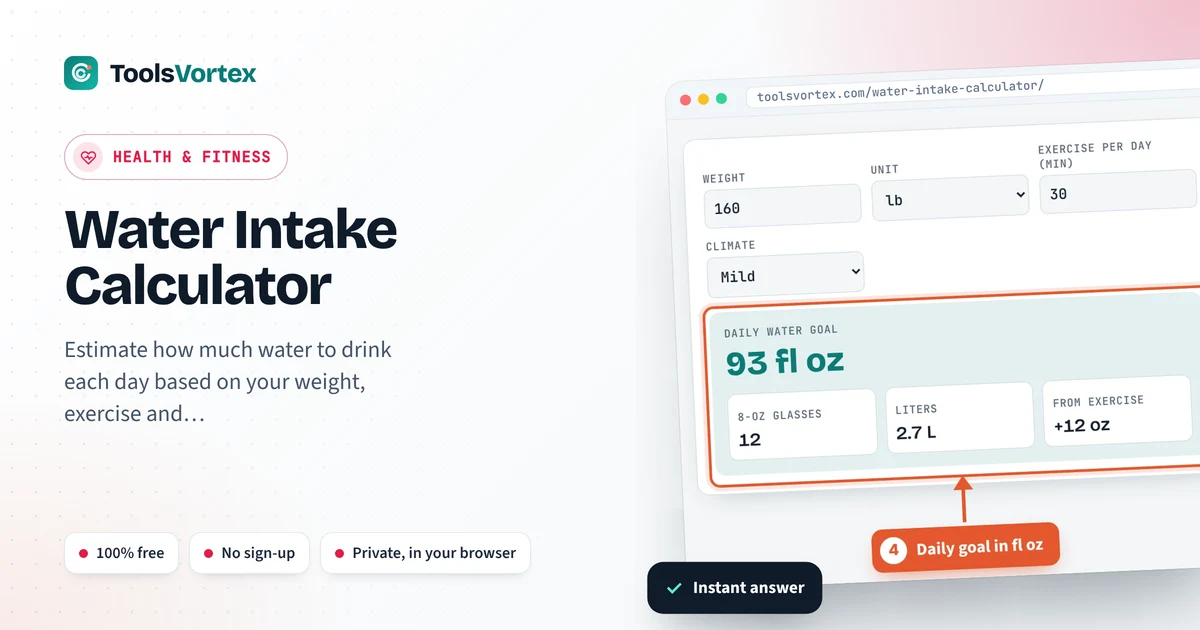
Want a personal number instead of an average? The water intake calculator uses your weight, activity and climate to give a daily target in ounces and liters.
Quick Recap
- Adult women take in about 2.7 liters and men about 3.7 liters of total water a day.
- About 80% comes from drinks: roughly 9 cups for women and 12.5 cups for men.
- Coffee, tea, milk and food all count toward total water.
- Weigh before and after exercise and aim to lose less than 2% of body weight.
- Thirst and pale urine are good everyday guides. Follow your doctor if you have fluid limits.
Frequently Asked Questions
How many ounces of water should I drink a day?
Adult women average about 91 ounces of total water a day and men about 125 ounces. Since about 20% comes from food, that works out to roughly 73 ounces of drinks for women and 100 ounces for men.
Is a gallon of water a day too much?
A gallon is 128 ounces, which is more than most adults need from drinks alone. It can be fine for large, very active people in heat, but most people do not need it. Spread intake through the day.
Does coffee dehydrate you?
For most regular coffee drinkers, no. A review in the American Journal of Physiology concluded that caffeinated drinks count toward daily fluid intake for the vast majority of people. Plain water is still the best default.
How much water should a pregnant woman drink?
The adequate intake in pregnancy is about 3.0 liters of total water a day, or about 101 ounces. Roughly 80% of that, about 10 cups, would come from drinks. Ask your prenatal care provider about your own needs.
Should I drink half my body weight in ounces?
It is a popular shortcut, not an official guideline. For a 160 pound person it gives 80 ounces, close to the drinks share for adults. It overshoots for heavy people and ignores heat and exercise.
How much water should I drink when working out?
Weigh yourself before and after. Each pound lost is about 15.3 ounces of fluid. The American College of Sports Medicine advises keeping losses under 2% of body weight during exercise.
Does food really count as water intake?
Yes. About 20% of the average person’s daily water comes from food. Fruits, vegetables, soups and dairy carry the most, so a diet rich in produce lowers how much you need to drink.
Sources
- National Academies: Report sets dietary intake levels for water, salt, and potassium, 2.7 L and 3.7 L adequate intakes, 20% from food, thirst as a guide, 6 L or more in heat
- NIH NCBI Bookshelf: DRI table for total water and macronutrients, Total water AIs for children, teens, adults, pregnancy and breastfeeding
- American College of Sports Medicine: Exercise and Fluid Replacement position stand, Weighing before and after exercise, keeping losses under 2% of body weight
- Dartmouth Medical School: Valtin review of the 8 x 8 advice, No evidence for 8 x 8 in healthy adults, and caffeinated drinks count