Enter any one measurement of a circle (radius, diameter, circumference or area) and get the other three instantly, with the exact answer in terms of π, a scale diagram and the working.
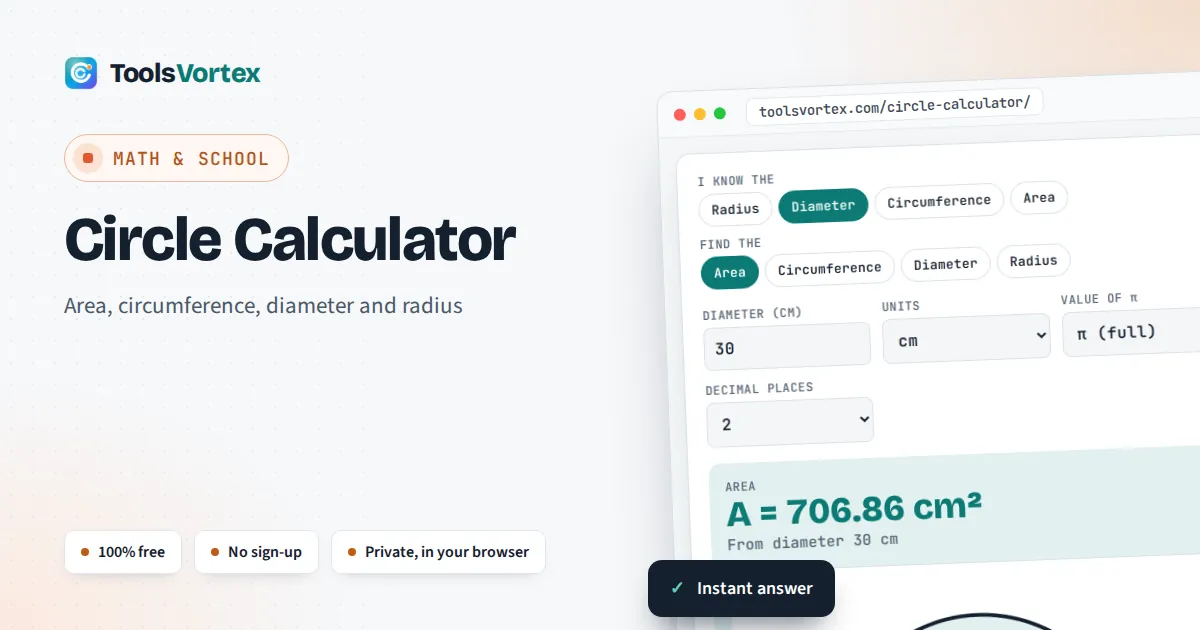
This circle calculator works out the radius, diameter, circumference and area of a circle from any one of them, for students checking homework and for anyone measuring a round table, pond, pizza, pipe or tree trunk. It works in millimeters, centimeters, meters or kilometers, with inches, feet and yards as options, shows the exact answer in terms of π, and lets you choose 3.14, 3.142 or 22/7 when a question tells you which value of π to use.
How do you calculate the area of a circle?
Multiply π by the radius squared: A = πr². A circle with a 5 cm radius has an area of π × 25 = 78.54 cm². If you only know the diameter, halve it first. A circle calculator also gives the circumference, 2πr, so the same circle measures 31.42 cm around its edge.
What Are the Formulas for a Circle?
Every circle measurement comes from the radius r, the distance from the center to the edge. The diameter is twice the radius, the circumference is π times the diameter, and the area is π times the radius squared. π (pi) is the same for every circle: the circumference divided by the diameter, 3.14159265 to eight decimal places.
Circumference: C = 2πr = πd
Area: A = πr² = πd² ÷ 4
From the circumference: r = C ÷ 2π
From the area: r = √(A ÷ π)
In England, the AQA GCSE formula appendix lists C = 2πr = πd and A = πr² among the formulae students must know, because they are not printed on the exam paper. Ireland’s Junior Cycle maths specification includes the perimeter and area of shapes made from discs, with operations involving π, under learning outcome GT.2.
Circumference and Area of Common Circle Sizes
| Diameter | Radius | Circumference | Area |
|---|---|---|---|
| 10 cm | 5 cm | 31.42 cm | 78.54 cm² |
| 20 cm | 10 cm | 62.83 cm | 314.16 cm² |
| 25 cm | 12.5 cm | 78.54 cm | 490.87 cm² |
| 30 cm | 15 cm | 94.25 cm | 706.86 cm² |
| 40 cm | 20 cm | 125.66 cm | 1,256.64 cm² |
| 1 m | 0.5 m | 3.14 m | 0.79 m² |
| 2 m | 1 m | 6.28 m | 3.14 m² |
Why Does Doubling the Diameter Quadruple the Area?
Area grows with the square of the radius, so doubling the diameter multiplies the area by 2² = 4. A 20 cm circle covers 314.16 cm², while a 40 cm circle covers 1,256.64 cm², four times as much. The circumference only doubles, from 62.83 cm to 125.66 cm, because it grows in a straight line with the radius. The same rule explains why a circle fills about 78.5% of the square drawn around it: πr² ÷ (2r)² = π ÷ 4 for every size.
Worked example: one big pizza or two medium ones?
Lukas in Dublin can order one 40 cm pizza or two 28 cm pizzas for the same price. The 40 cm pizza has a radius of 20 cm, so its area is π × 20² = 1,256.64 cm². Each 28 cm pizza has a radius of 14 cm and an area of π × 14² = 615.75 cm², so two of them give 1,231.50 cm². The single large pizza is about 2% bigger, even though 28 + 28 = 56 cm sounds like more. To compare prices per square centimeter, divide each price by its area, or use the percentage calculator to see the difference.
How Do You Find the Radius From the Circumference or Area?
Divide the circumference by 2π to get the radius, or divide the area by π and take the square root. These are the two most useful reverse calculations, because the circumference is often the only thing you can measure.
A tree trunk with a girth (circumference) of 1.5 m has a diameter of 1.5 ÷ π = 0.477 m, about 47.7 cm, without cutting it. A round garden pond with a surface area of 3 m² has a radius of √(3 ÷ π) = 0.977 m, so it is about 1.95 m across. For a round patio, multiply the area by the slab depth to get the volume of concrete, or use the cubic yard calculator. For square and rectangular parts of a room, the square footage calculator adds up the floor area.
Which Value of π Should You Use?
Use the full value of π unless a question tells you otherwise, because every shortcut adds a small error. The table shows how far the common approximations are from the true value, and how much they change the area of a 1 m radius circle (3.14159 m²).
| Value used | Difference from π | Area of a 1 m radius circle |
|---|---|---|
| 3.14 | 0.051% too small | 3.14 m² |
| 3.142 | 0.013% too large | 3.142 m² |
| 22/7 (3.142857…) | 0.040% too large | 3.1429 m² |
| 355/113 | under 0.00001% | 3.14159 m² |
π cannot be written exactly as a fraction, so 22/7 is only an approximation. Exam answers “in terms of π” leave π as a symbol, such as 225π cm², and the calculator shows that exact form whenever you start from a radius or diameter. The decimal to fraction calculator shows why fractions such as 22/7 come close but never match.
How Do You Use the Circle Calculator?
Pick what you know and what you want
Choose radius, diameter, circumference or area as the value you know, then choose which result to show in large text.

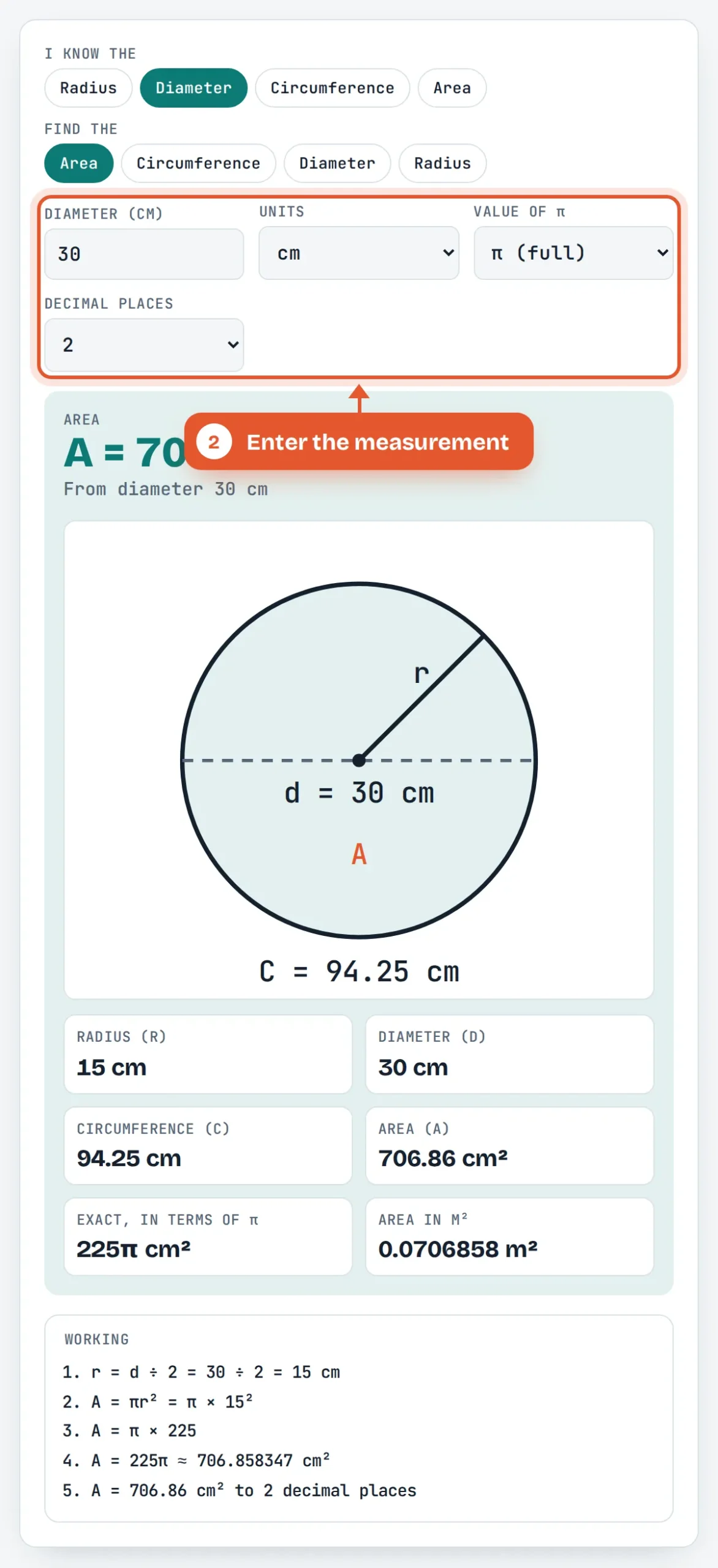
Enter the measurement
Type the value, choose the unit and, if your question says so, pick 3.14, 3.142 or 22/7 for π. Areas are entered in square units.
Read all four values
The answer appears in large text, with the radius, diameter, circumference, area, exact form in terms of π and the area in a second unit below.
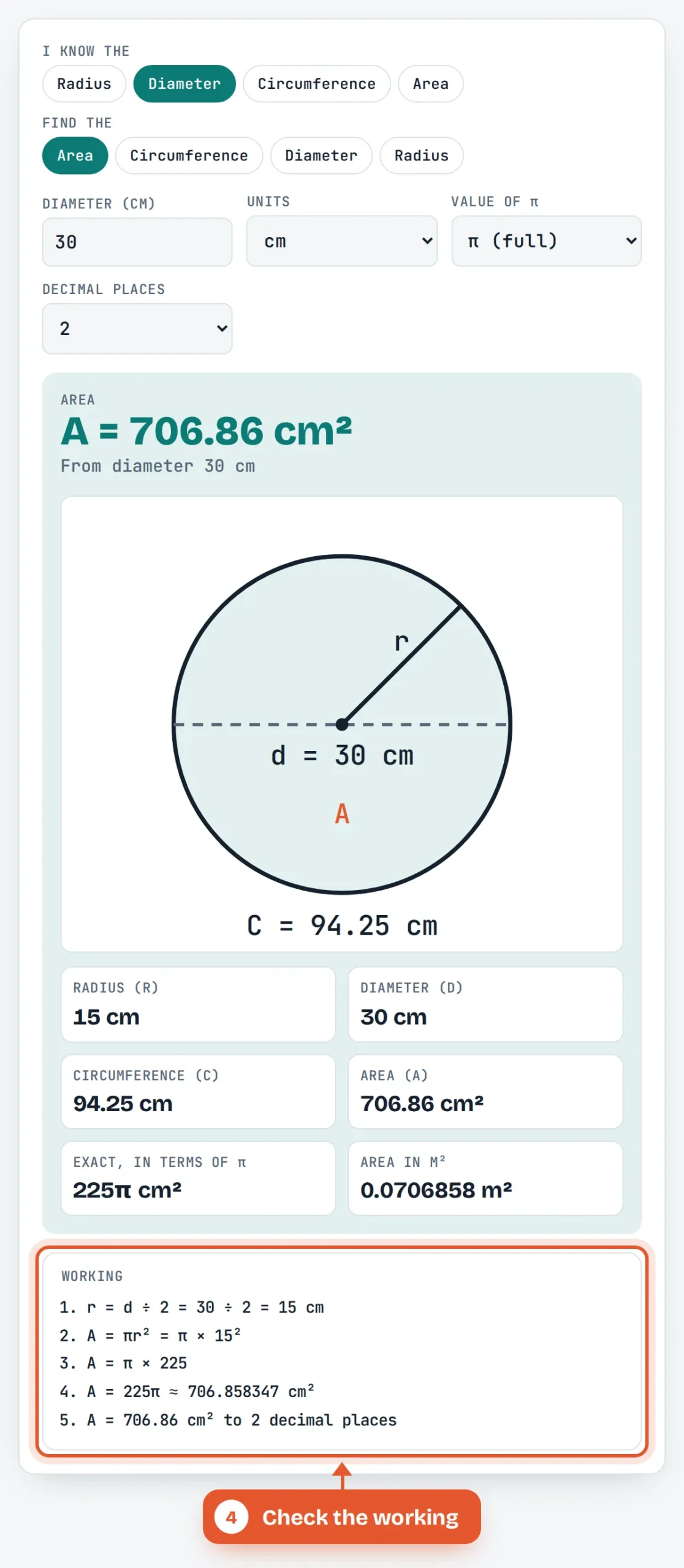
Check the working
The working shows each formula with your numbers substituted, so you can follow the method or copy it into homework.


Frequently Asked Questions
What is the area of a circle with a 10 cm diameter?
The radius is half the diameter, 5 cm, so the area is π × 5² = 25π, about 78.54 cm². The circumference of the same circle is π × 10 = 31.42 cm. In square meters the area is 0.00785 m².
What is the difference between radius and diameter?
The radius runs from the center of a circle to its edge. The diameter runs right across the circle through the center, so it is always exactly twice the radius. A circle with a 15 cm radius has a 30 cm diameter.
How do you measure the diameter of a round object?
Wrap a tape measure around the object to get the circumference, then divide by π. A pipe that measures 31.4 cm around has a diameter of about 10 cm. This is easier and more accurate than trying to find the exact center.
Is π exactly 22/7?
No. 22/7 is 3.142857…, while π is 3.14159265…, so 22/7 is about 0.04% too large. π is irrational: no fraction equals it exactly and its decimal digits never end or repeat. Use 22/7 only when a question asks for it.
How do you convert a circle area from cm² to m²?
Divide by 10,000, because 1 m² is 100 cm × 100 cm. A circle of 7,853.98 cm² is 0.785 m². Square units always convert by the square of the length factor, so the calculator shows the area in a second unit automatically.
What is the circumference of a circle with a 1 meter diameter?
Multiply the diameter by π: 1 × π = 3.14 m, or 314.16 cm. A wheel with a 1 m diameter moves forward about 3.14 m every time it turns once, which is why the circumference matters for wheels and measuring wheels.
Sources and Further Reading
Related Tools
Last reviewed: October 2026