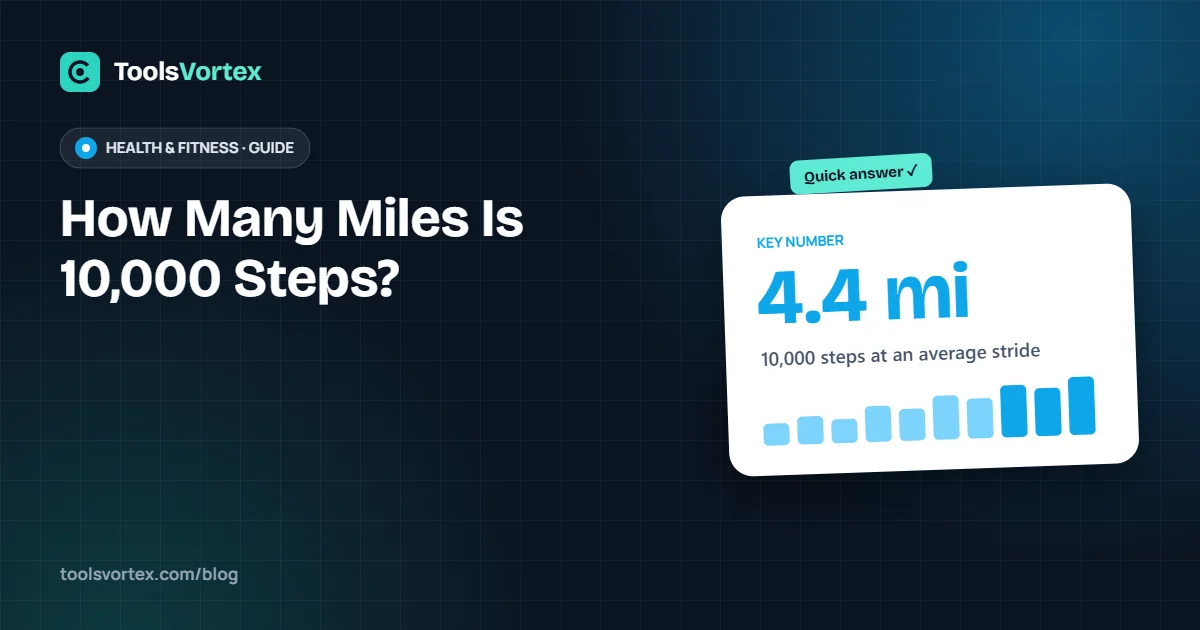
For most adults, 10,000 steps is about 4 to 5 miles (6.3 to 7.9 km) at a walking stride. An average person about 5 feet 7 inches tall covers roughly 4.4 miles (7 km). Walking it takes about 1.5 hours at 3 mph. Running steps are longer, so 10,000 running steps can reach 6 to 7 miles.

You hit 10,000 on your step counter and want to know what that means on a map. So, how many miles is 10,000 steps? The short answer is about 4 to 5 miles for most adults, but your height and whether you walk or run change it a lot.
This guide gives you the distance in miles and kilometers by height, how long 10,000 steps takes at common paces, where the 10,000 goal came from, and what research says about how many steps you really need. If you want your own number, plug your height into the steps to miles calculator.
How Many Miles Is 10,000 Steps by Height?
10,000 walking steps is about 3.9 miles if you are 5 feet tall and about 4.9 miles if you are 6 feet 3 inches tall. Taller people take longer steps, so they cover more ground with the same count.
The table uses a common estimate that a walking step is about 41.4% of your height. For running, we used a rough step length of 65% of height at an easy jog. Running step length changes a lot with speed, so treat that column as a ballpark.
| Height | Walking step | 10,000 steps walking | 10,000 steps running (est.) |
|---|---|---|---|
| 5 ft 0 in | 24.8 in | 3.92 mi (6.31 km) | 6.16 mi (9.91 km) |
| 5 ft 3 in | 26.1 in | 4.12 mi (6.62 km) | 6.46 mi (10.40 km) |
| 5 ft 6 in | 27.3 in | 4.31 mi (6.94 km) | 6.77 mi (10.90 km) |
| 5 ft 9 in | 28.6 in | 4.51 mi (7.26 km) | 7.08 mi (11.39 km) |
| 6 ft 0 in | 29.8 in | 4.70 mi (7.57 km) | 7.39 mi (11.89 km) |
| 6 ft 3 in | 31.0 in | 4.90 mi (7.89 km) | 7.69 mi (12.38 km) |
Walking step = height x 0.414. Running step = height x 0.65 (rough estimate for an easy jog). 1 mile = 63,360 inches; 1 km = 0.621 miles.
Want the full steps per mile breakdown and how to measure your own stride? That is covered in our guide on how many steps are in a mile. Here is the math for 10,000 steps:
Kilometers = miles x 1.609
Minutes = miles / speed (mph) x 60
How Long Does It Take to Walk 10,000 Steps?
Walking 10,000 steps takes about 1 hour and 28 minutes at a 3 mph pace for an average adult. A slow stroll stretches that past 2 hours, and a brisk 4 mph walk cuts it to just over an hour.
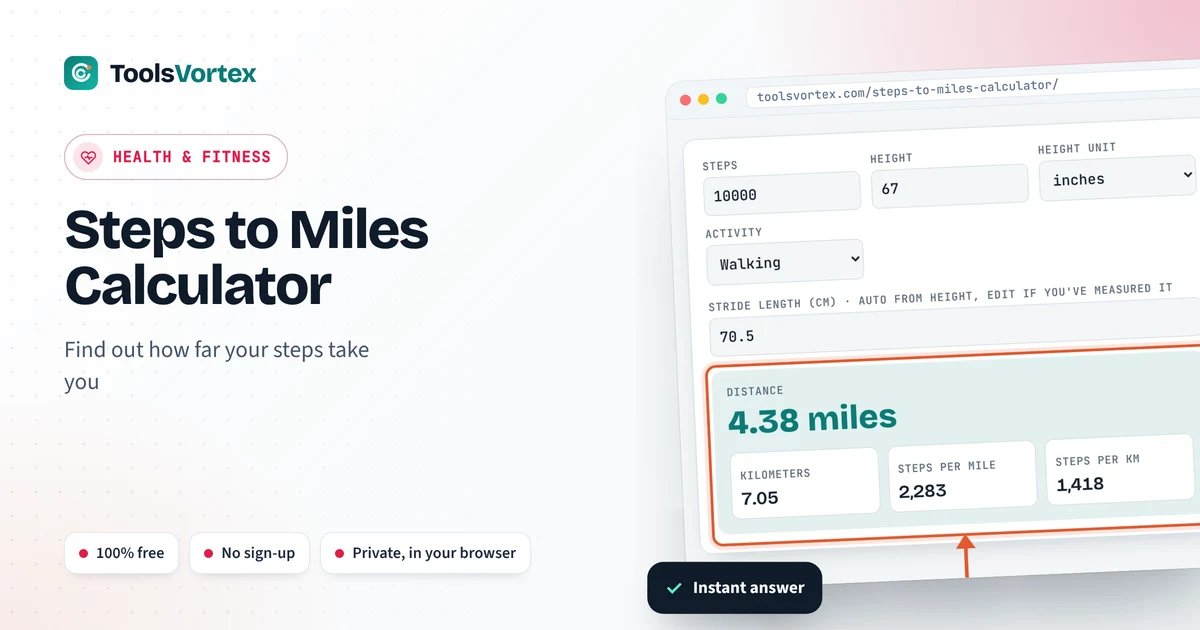
We used a 5 foot 7 inch walker with a 27.7 inch step, which puts 10,000 steps at 4.38 miles. The cadence column shows the steps per minute you would need to hold.
| Pace | Time for 10,000 steps | Steps per minute |
|---|---|---|
| 2.0 mph (slow stroll) | 2 h 11 min | 76 |
| 2.5 mph (easy) | 1 h 45 min | 95 |
| 3.0 mph (average) | 1 h 28 min | 114 |
| 3.5 mph (brisk) | 1 h 15 min | 133 |
| 4.0 mph (very brisk) | 1 h 6 min | 152 |
Real walkers speed up partly by taking longer steps, not only faster ones, so your cadence at 4 mph may be a bit lower than shown.
Most people never walk 10,000 steps in one go. Your daily total includes every trip to the kitchen and the car. For a single walk, see how long it takes to walk a mile, or use the pace calculator to turn your time into a pace.
Maria is 5 feet 4 inches (64 inches) tall, weighs 140 pounds, and walks at 3 mph. How far and how long is her 10,000 step goal?
- Step length: 64 x 0.414 = 26.5 inches.
- Distance: 10,000 x 26.5 / 63,360 = 4.18 miles, or 6.73 km.
- Time: 4.18 / 3 x 60 = about 84 minutes.
- Calories: 3 mph walking is about 3.8 METs. 3.8 x 3.5 x 63.5 kg / 200 = 4.2 calories per minute, x 84 minutes = about 353 calories gross.
- Net calories (minus what she burns at rest, about 1 MET): 2.8 x 3.5 x 63.5 / 200 x 84 = about 260 calories.
So Maria’s 10,000 steps is just over 4 miles, close to an hour and a half of walking, and roughly 260 to 350 calories.
Where Did the 10,000 Steps a Day Goal Come From?
The 10,000 steps goal started as a marketing slogan in Japan in the 1960s, not as a medical finding. A pedometer sold there was called the manpo-kei, which translates roughly to “10,000 steps meter.”
Researchers Catrine Tudor-Locke and David Bassett wrote in the journal Sports Medicine in 2004 that the figure can be traced to Japanese walking clubs and a business slogan. The round number was easy to remember, and it stuck. Fitness trackers later made it their default daily goal.
That does not make 10,000 a bad target. It means the number was picked first and tested later. As the next section shows, the research that came after points to benefits starting well below 10,000.
Do You Really Need 10,000 Steps a Day?
No, you do not need exactly 10,000 steps to get large health benefits. Large studies find that the risk of early death drops steeply as you move from a few thousand steps toward 7,000 to 8,000, then levels off.
The 2022 meta-analysis
A 2022 meta-analysis by Amanda Paluch and colleagues in The Lancet Public Health pooled 15 cohorts with 47,471 adults followed for a median of 7.1 years. Compared with the least active group (a median of 3,553 steps a day), people in the higher groups had a lower risk of death:
- About 5,800 steps: 40% lower risk (hazard ratio 0.60)
- About 7,800 steps: 45% lower risk (0.55)
- About 10,900 steps: 53% lower risk (0.47)
The benefit leveled off at about 6,000 to 8,000 steps a day for adults 60 and older, and about 8,000 to 10,000 steps for adults under 60.
The Women’s Health Study
A 2019 study of 18,289 older US women (mean age 72) in JAMA Internal Medicine found death rates fell as steps rose, then leveled off at about 7,500 steps a day.
The takeaway: more steps help, and the biggest gains come from getting off the bottom. If you are at 3,000 today, reaching 6,000 or 7,000 matters more than chasing a perfect 10,000. These studies show links in groups of people, not a guarantee for any one person.
How Can You Fit 10,000 Steps Into Your Day?
The easiest way to reach 10,000 steps is to split it into three or four chunks instead of one long walk. Errands, chores and moving around at work already add a few thousand steps for many people, so planned walks only need to cover the rest.
Here is one way to build it, using the 114 steps per minute pace from the table above:
- Morning walk, 20 minutes: about 2,300 steps
- Lunch walk, 15 minutes: about 1,700 steps
- Evening walk, 20 minutes: about 2,300 steps
- Daily life, for example: 3,000 to 4,000 steps from chores, errands and stairs
That adds up to about 9,300 to 10,300 steps. Small habits help fill the gap:
- Take phone calls standing or walking.
- Park at the far end of the lot.
- Get off the bus one stop early.
- Walk while you wait for food, laundry or a kettle.
Two edge cases most guides skip. First, a phone in your pocket misses steps when you leave it on the desk, so your real total may be higher than the app says. Second, treadmill walking while holding the rails can make a wrist tracker undercount, because your arm does not swing. Check your distance against a known route with the steps calculator to see if your device is close. If you track in kilometers, the km to miles converter helps you compare.
How Many Calories Do You Burn Walking 10,000 Steps?
Walking 10,000 steps burns roughly 375 to 440 calories for a 150 pound person and about 500 to 585 calories for a 200 pound person. Body weight matters more than pace, because a faster walk burns more per minute but finishes sooner.
These numbers use MET values from the 2024 Adult Compendium of Physical Activities and the same 4.38 mile walk as above. They are gross calories, which include what you would burn sitting still.
| Pace | MET | 150 lb person | 200 lb person |
|---|---|---|---|
| 2.0 mph | 2.8 | 438 cal | 584 cal |
| 2.5 mph | 3.0 | 375 cal | 500 cal |
| 3.0 mph | 3.8 | 396 cal | 528 cal |
| 3.5 mph | 4.8 | 429 cal | 572 cal |
| 4.0 mph | 5.5 | 430 cal | 573 cal |
Calories per minute = MET x 3.5 x weight in kg / 200. The 2.0 mph row is higher than 2.5 mph because the slow walk takes 26 minutes longer.
For your own weight and speed, use the walking calories burned calculator. This is general information, not medical advice. Talk to your doctor before starting a new exercise plan if you have a health condition.
Quick Recap
- 10,000 walking steps is about 4 to 5 miles (6.3 to 7.9 km) for most adults.
- At 3 mph, 10,000 steps takes about 1 hour and 28 minutes.
- The 10,000 goal began as a 1960s Japanese pedometer slogan, not a medical rule.
- Research shows benefits leveling off around 6,000 to 10,000 steps, depending on age.
- 10,000 steps burns roughly 375 to 585 calories, mostly depending on your weight.
Frequently Asked Questions
Is 10,000 steps 5 miles?
Only if you are tall. A 10,000 step walk reaches 5 miles when your step is about 31.7 inches, which fits someone around 6 feet 4 inches. For most adults it lands between 4 and 4.7 miles. Running steps are longer, so 10,000 running steps easily pass 5 miles.
How many kilometers is 10,000 steps?
10,000 walking steps is about 6.3 to 7.9 kilometers for most adults, with an average near 7 km. Shorter people land near the low end and taller people near the high end. Multiply your miles by 1.609 to get kilometers.
Is 10,000 steps a day good for weight loss?
It can help, because 10,000 steps burns roughly 375 to 585 calories for many adults. Weight loss still depends on your total calorie balance over weeks, including food. Steps alone do not guarantee you will lose weight, so pair them with a sensible eating plan.
How many steps a day is healthy for older adults?
In the 2022 Lancet Public Health meta-analysis, the drop in death risk leveled off at about 6,000 to 8,000 steps a day for adults 60 and older. A 2019 study of older women found a similar level near 7,500 steps. Any increase from a low baseline helps.
How long does it take to walk 10,000 steps?
At an average 3 mph pace, 10,000 steps takes about 1 hour and 28 minutes. At a brisk 4 mph it takes about 66 minutes, and at a slow 2 mph stroll it takes over 2 hours. Most people spread these minutes across the whole day.
Do steps from running count toward 10,000?
Yes. Your tracker counts every step, walking or running. Running steps cover more distance and burn more calories per minute, so 10,000 running steps can equal 6 to 7 miles. That is a much harder workout than 10,000 walking steps.
Why does my tracker show a different distance for 10,000 steps?
Most trackers estimate step length from the height you entered, then multiply by your steps. If your real stride is longer or shorter, the distance is off. Enter an accurate height, or measure your stride over a known distance, to make it closer.
Sources
- The Lancet Public Health: Daily steps and all-cause mortality, a meta-analysis of 15 international cohorts (Paluch et al., 2022), quartile hazard ratios and age-specific step thresholds
- Sports Medicine: How many steps/day are enough? (Tudor-Locke and Bassett, 2004), origin of the 10,000 steps figure in Japan
- JAMA Internal Medicine: Association of step volume and intensity with all-cause mortality in older women (Lee et al., 2019), mortality leveling at about 7,500 steps a day
- 2024 Adult Compendium of Physical Activities: Walking, MET values used for walking calories