
Paste any text and switch it to UPPERCASE, lowercase, Title Case, Sentence case, alternating case, camelCase, snake_case or kebab-case with one click.

Caps lock left on, a title pasted in all capitals, a column of names that came out of a spreadsheet in lowercase. Retyping all of that is a waste of time. This case converter changes the capitalization of any text instantly, and it also handles the formats programmers use for variable names and URLs. Paste your text, tap a style, and copy the result.
How do I change text from uppercase to lowercase?
Paste the text in the box and tap “lower”. Every letter becomes lowercase while spaces, numbers and punctuation stay put. Tap “Sentence case” instead and the first letter of each sentence is capitalized, so “MEETING MOVED TO FRIDAY. BRING SNACKS.” becomes “Meeting moved to Friday. Bring snacks.” after you fix the proper noun.
Case styles at a glance
| Style | Example | Typical use |
|---|---|---|
| UPPERCASE | FREE SHIPPING TODAY | Short labels, warnings, acronyms |
| lowercase | free shipping today | Tags, email addresses, cleanup |
| Title Case | Free Shipping on All Orders | Headlines, book and song titles |
| Sentence case | Free shipping on all orders | Body text, buttons, most UI copy |
| camelCase | freeShippingToday | JavaScript and Java variables |
| snake_case | free_shipping_today | Python, database columns |
| kebab-case | free-shipping-today | URL slugs, CSS class names |
How Title Case is handled
Major words get a capital letter. Short articles, conjunctions and prepositions (a, an, the, and, but, or, for, nor, of, on, in, at, to, by) stay lowercase unless they open the title or follow a colon, which matches the way most US style guides do it. Style guides don’t fully agree, so give important headlines a quick read afterward.
A note on Sentence case
Sentence case lowercases everything and then capitalizes the first letter of each sentence and the word “I”. It can’t know which words are names, so you’ll need to fix proper nouns like Chicago or Monday by hand.
How to use the Case Converter
Paste your text
Type or paste any text into the top box. It can be a single line or several paragraphs.

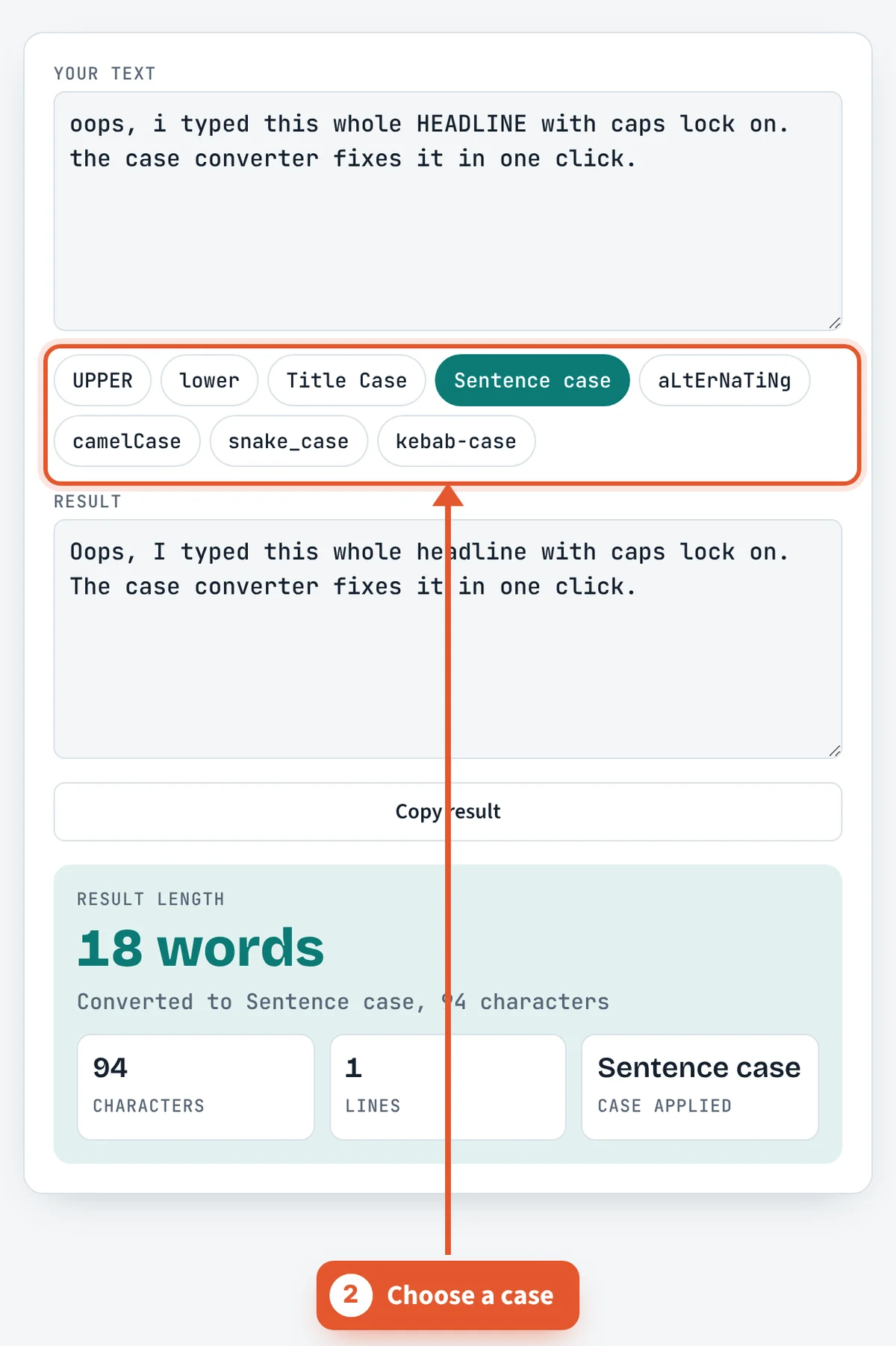
Choose a case
Tap UPPER, lower, Title Case, Sentence case, alternating, camelCase, snake_case or kebab-case. The result updates as you edit.
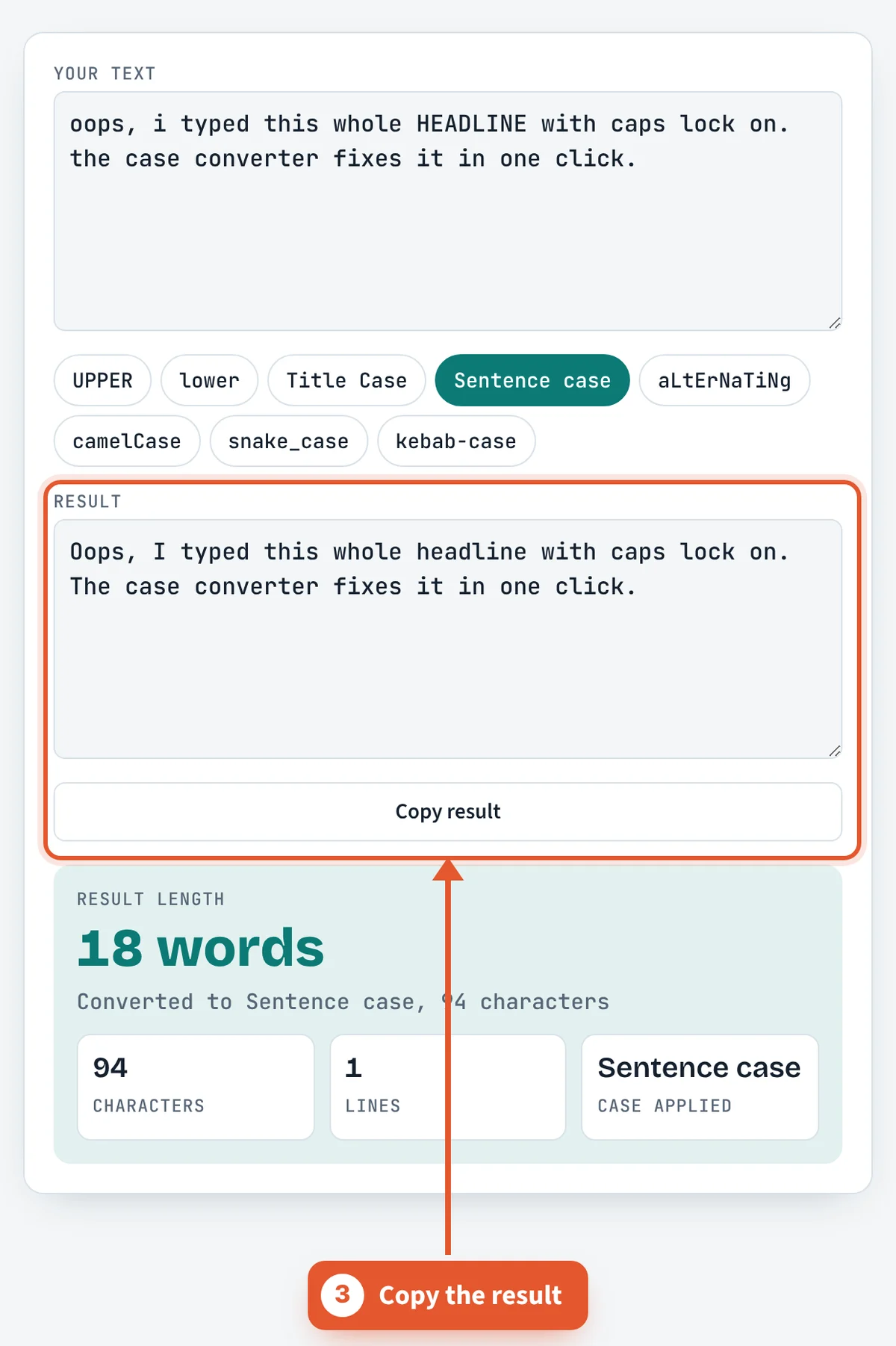
Copy the result
Press “Copy result” to put the converted text on your clipboard, then paste it wherever you need it.

Why do some letters change unexpectedly when you switch case?
Case rules for computers are set by Unicode, the standard that encodes almost every writing system. For English, upper and lower case map one to one, but several languages break that pattern.
- German ß (sharp s) has no single-letter uppercase in the default rules, so “straße” becomes “STRASSE”. Converting back gives “strasse”, not the original word. A capital ẞ was added in Unicode 5.1 in 2008, and the Council for German Orthography accepted it in 2017, but most software still outputs SS.
- Turkish has a dotted i with capital İ and a dotless ı with capital I. Standard English rules turn i into I, which is the wrong letter in Turkish, so correct results require Turkish-specific case mapping.
- Greek has two lowercase sigmas. Capital Σ becomes σ inside a word but the final sigma ς at the end of a word.
Because of these cases, a converted text can have a different length than the original. Check it with the character counter if you face a strict limit.
Where do the words uppercase and lowercase come from?
The terms come from printing with movable type. Compositors kept individual metal letters in shallow wooden trays called cases. The capitals were stored in the case placed higher on the stand, the upper case, and the small letters in the lower case within easy reach, since they were used far more often. The names stuck long after metal type disappeared.
The letters themselves are older. Ancient Roman inscriptions used only capitals, which scholars call majuscules. Small letters, or minuscules, developed in handwriting over centuries. The most influential form was Carolingian minuscule, a clear, rounded script promoted in the late 700s in the empire of Charlemagne to standardize books across Europe.
Renaissance scholars revived Carolingian minuscule, and early printers in Italy based their roman typefaces on it. The habit of mixing the two systems, a capital to start a sentence or name and small letters elsewhere, is the basis of the Sentence case and Title Case styles this tool produces.
To sort a list of names after fixing their case, use the alphabetical order tool.
Frequently asked questions
How do I fix text typed with caps lock on?
Paste it in and tap Sentence case. Then capitalize any names or places by hand.
What is the difference between Title Case and Sentence case?
Title Case capitalizes most words, like a headline. Sentence case only capitalizes the first word of each sentence and proper nouns.
What is camelCase used for?
It joins words with no spaces and capitalizes each word after the first, like totalPrice. JavaScript and Java use it for variable names.
Does the case converter change numbers or punctuation?
No for UPPER, lower, Title, Sentence and alternating. The code styles (camel, snake, kebab) drop punctuation and join words with _ or - instead.
Is my text uploaded anywhere?
No. The conversion runs in your browser, so the text never leaves your device.
Sources and further reading
Related tools
Last reviewed: October 2026