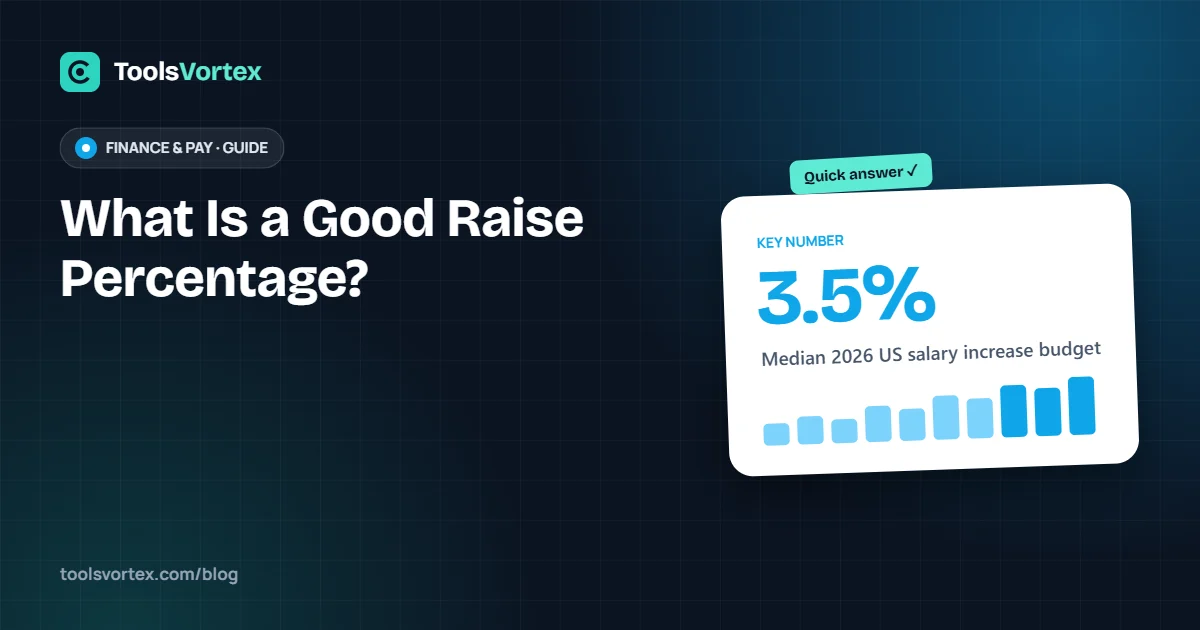
A good raise percentage in 2026 is 4% or more. US employers budget a median of 3.5% for total salary increases and about 3.1% for merit raises, per The Conference Board. With consumer prices up 3.7% over the 12 months ending September 2026, a raise below that loses buying power.

You just got your annual review, and the number says 3%. Is that good? To answer what is a good raise percentage, you need two things: what other employers are paying this year, and how fast prices are rising. A raise that looks fine on paper can still leave you with less buying power.
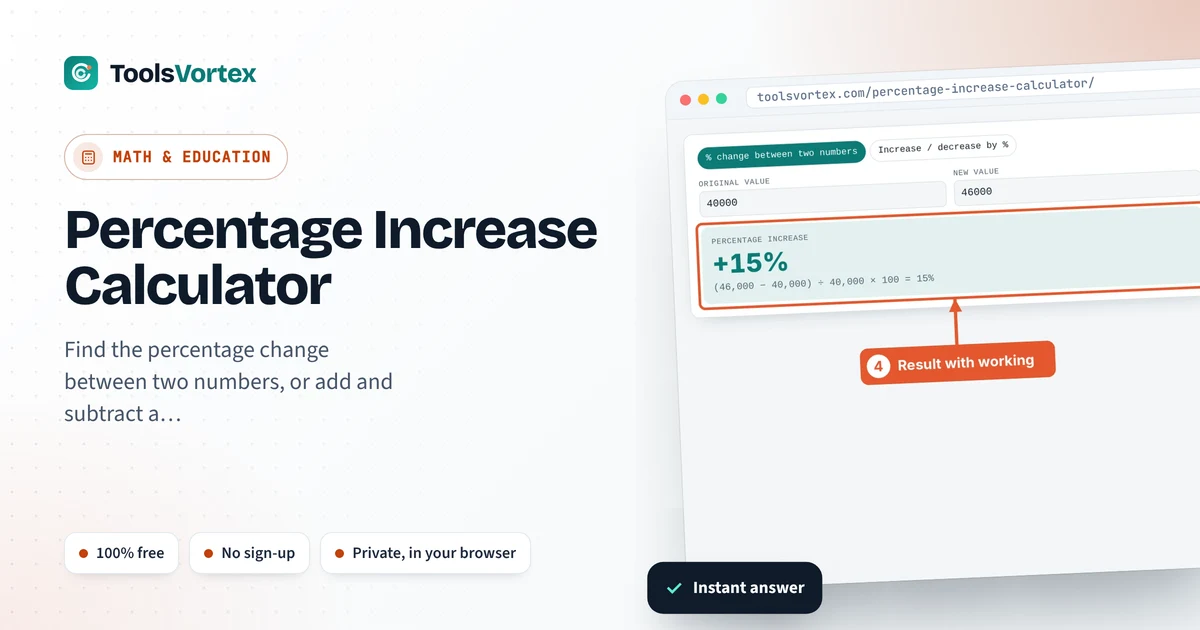
This guide gives you the current benchmarks from published salary surveys, the formula to work out your own raise, and a quick test to see if you beat inflation. You can plug your old and new pay into the percentage increase calculator to get your exact number in seconds.
What Is a Good Raise Percentage in 2026?
A good raise in 2026 is 4% or more, because that beats both the average budget and current inflation. An average raise sits around 3% to 3.5%. A raise of 5% or higher is strong for staying in the same job.
The Conference Board, a nonprofit research group, released its salary budget survey on September 3, 2026. It found a median US salary increase budget of 3.5% for 2026, with the same 3.5% planned for 2027. The median merit budget for 2027 is 3.1%. The gap between the two numbers is money set aside for promotions and other pay moves.
Here is a simple way to grade your raise:
- Below 3%: under the typical budget. Worth a polite question.
- 3% to 3.5%: average. You are being paid like most peers.
- 4% to 5%: above average. Your manager likely fought for it.
- Over 5%: strong. Often tied to top ratings, a market adjustment, or a new role.
Remember that a budget is an average across a whole company. Top performers often get more, and low ratings may get nothing. Some employers also hand out a flat bonus instead of a bigger base raise.
How Do You Calculate Your Raise Percentage?
To calculate your raise percentage, subtract your old pay from your new pay, divide by your old pay, and multiply by 100. It works for yearly salary, monthly pay, or an hourly rate, as long as both numbers use the same unit.
Raise % = (raise amount ÷ old pay) × 100
New pay = old pay × (1 + raise % ÷ 100)
Maria earns $62,000 a year. Her new offer letter says $64,480.
- Raise amount: $64,480 minus $62,000 = $2,480.
- Divide by old pay: $2,480 ÷ $62,000 = 0.04.
- Multiply by 100: 0.04 × 100 = 4%.
- Per paycheck: $2,480 ÷ 26 biweekly checks = about $95.38 more before tax.
- Real raise: 1.04 ÷ 1.037 = 1.0029, so about 0.29% after 3.7% inflation.
Maria got a 4% raise, which is above the 3.5% median budget. After inflation, her buying power rose only about 0.3%.
If you are paid by the hour, use your hourly rate. Going from $24.00 to $25.10 an hour is a $1.10 raise, and $1.10 ÷ $24.00 = 4.58%. To see what that means for a full year, try the hourly to salary calculator.
One edge case trips people up: a raise is always measured against your old pay, not your new pay. If you divide $2,480 by $64,480, you get 3.85%, which understates the raise. For more on percent change math, see our guide on how to calculate percentages.
Is Your Raise Beating Inflation?
Your raise beats inflation only if it is higher than the rise in prices over the same year. The Bureau of Labor Statistics reported on October 14, 2026 that the Consumer Price Index for All Urban Consumers (CPI-U) rose 3.7% over the 12 months ending September 2026. Core prices, which leave out food and energy, rose 2.6%.
Quick estimate = raise % minus inflation %
Here is how common raises stack up against 3.7% inflation:
| Your raise | Real raise after 3.7% inflation | What it means |
|---|---|---|
| 2% | -1.64% | Losing ground |
| 3% | -0.68% | Losing ground |
| 3.5% | -0.19% | Losing ground |
| 4% | +0.29% | Roughly even |
| 5% | +1.25% | Gaining ground |
| 10% | +6.08% | Gaining ground |
Real raise computed with the exact formula above. The quick estimate (raise minus inflation) is within about 0.2 points for raises under 10%.
The median 3.5% budget falls just short of 3.7% inflation. In plain terms, an average raise this year keeps you almost even but not quite. CPI is a national average, so your own costs may rise faster or slower depending on rent, commute, and family size.
How Does a Raise Compare to the Social Security COLA?
The Social Security cost-of-living adjustment (COLA) is a handy yardstick because it tracks inflation by law. The Social Security Administration set the COLA at 2.8% for 2026. On October 14, 2026, it announced a 3.6% COLA for 2027, starting with January 2027 benefits.
The COLA is not a raise for work. It only aims to keep benefits level with prices. So if your raise is close to the COLA, you are roughly treading water. A raise at least 1 point above it is a better sign that your pay is growing in real terms.
Use the same logic when you compare offers. A 3.6% raise in 2027 would match the COLA but would not move you ahead.
Is a Promotion or a New Job a Better Raise Than a Merit Increase?
A promotion or a job change usually pays more than a merit increase, because merit raises come from a small fixed budget. Promotion money comes from a separate pool, which is why total salary budgets (3.5%) run higher than merit budgets (3.1%) in The Conference Board data.
Job switching shows the gap clearly. The Federal Reserve Bank of Atlanta Wage Growth Tracker shows median hourly wage growth of 4.4% for job switchers versus 3.5% for job stayers, on a 12-month average through September 2026. That is a 0.9 point edge for people who changed jobs.
Three kinds of raises
- Merit raise: yearly raise based on your rating. Usually close to the merit budget.
- Promotion raise: paid when your title and duties grow. Size varies a lot by employer and level.
- Market adjustment: a fix when your pay falls behind what the job pays elsewhere.
Switching jobs has costs too. You may lose unvested retirement money, paid leave, or a bonus. Compare total pay, not just base salary. The percentage calculator helps you size each piece.
What Does a 3%, 4%, 5%, or 10% Raise Mean in Dollars?
A 4% raise on a $60,000 salary adds $2,400 a year, or about $92 per biweekly paycheck before tax. The table shows yearly dollars for common salaries, with the per paycheck amount in parentheses.
| Current salary | 3% raise | 4% raise | 5% raise | 10% raise |
|---|---|---|---|---|
| $40,000 | +$1,200 ($46.15) | +$1,600 ($61.54) | +$2,000 ($76.92) | +$4,000 ($153.85) |
| $50,000 | +$1,500 ($57.69) | +$2,000 ($76.92) | +$2,500 ($96.15) | +$5,000 ($192.31) |
| $60,000 | +$1,800 ($69.23) | +$2,400 ($92.31) | +$3,000 ($115.38) | +$6,000 ($230.77) |
| $75,000 | +$2,250 ($86.54) | +$3,000 ($115.38) | +$3,750 ($144.23) | +$7,500 ($288.46) |
| $100,000 | +$3,000 ($115.38) | +$4,000 ($153.85) | +$5,000 ($192.31) | +$10,000 ($384.62) |
Gross pay, 26 biweekly paychecks per year. Taxes, retirement, and benefit deductions will lower the take-home change.
Notice that the jump from 3% to 4% matters more as pay grows. On $100,000 it is $1,000 a year. If you think in hourly terms, the salary to hourly calculator turns any new salary into an hourly rate. Our hourly to salary guide explains the 2,080 hour year behind that math.
How Do You Ask for a Raise?
Ask for a raise with numbers: your results, the market rate for your job, and a specific percentage. A clear, short case works better than a long list of reasons.
- Pick your timing. Ask a month or two before budgets are set, not after.
- Bring proof. List two or three results with numbers, like sales, savings, or projects shipped.
- Know the market. Check pay data for your job and city.
- Name a number. Say a percentage, such as 5%, and show the dollar figure from the percentage increase calculator.
- Have a fallback. If the budget is fixed, ask about a bonus, title change, or a review date in six months.
Stay calm and specific. This is general information, not financial advice. Pay decisions depend on your employer, role, and location.
Quick Recap
- The median 2026 US salary increase budget is 3.5%; merit budgets run near 3.1%.
- Raise % = (new pay minus old pay) ÷ old pay × 100.
- With CPI-U up 3.7% through September 2026, you need about 4% to gain buying power.
- Job switchers saw 4.4% wage growth versus 3.5% for job stayers in the Atlanta Fed tracker.
- Ask for a raise with results, market data, and a specific number.
Frequently Asked Questions
Is a 3% raise good in 2026?
A 3% raise is close to average but slightly below the 3.5% median salary budget The Conference Board reported for 2026. With inflation at 3.7% for the 12 months ending September 2026, a 3% raise cuts your buying power by about 0.7%.
Is a 5% raise good?
Yes. A 5% raise is well above the typical 3% to 3.5% budget and beats 3.7% inflation by about 1.25 points in real terms. On a $60,000 salary it adds $3,000 a year, or about $115 per biweekly paycheck before tax.
Is a 10% raise a lot?
A 10% raise is large for staying in the same role. It usually comes with a promotion, a market adjustment, or a new job. On $75,000 it adds $7,500 a year and about $288 per biweekly paycheck before tax.
How do I calculate my raise percentage from my hourly rate?
Subtract your old hourly rate from your new one, divide by the old rate, and multiply by 100. Going from $20.00 to $20.80 is a $0.80 raise, and $0.80 ÷ $20.00 × 100 gives a 4% raise.
What is a cost of living raise?
A cost of living raise is a pay increase meant to keep up with rising prices, not to reward performance. Social Security uses one, called a COLA, which is 2.8% for 2026 and 3.6% for 2027.
Should I ask for a raise if I got the average?
You can, especially if your results beat expectations or your pay trails the market. Bring numbers, name a target percentage, and if the budget is fixed, ask for a review date or a bonus instead.
What raise do I need to beat inflation?
You need a raise higher than the inflation rate for the same period. With CPI-U at 3.7% for the 12 months ending September 2026, a 4% raise gives about a 0.29% real gain, and 5% gives about 1.25%.
Sources
- The Conference Board: US Salary Increase Budgets 2026-2027, median 3.5% salary budget and 3.1% merit budget
- U.S. Bureau of Labor Statistics: Consumer Price Index, September 2026, CPI-U up 3.7% over 12 months; core up 2.6%
- Social Security Administration: 3.6 Percent Benefit Increase for 2027, 2027 COLA of 3.6%
- Federal Reserve Bank of Atlanta Wage Growth Tracker via FRED: job switchers, 4.4% switcher wage growth, Sept 2026