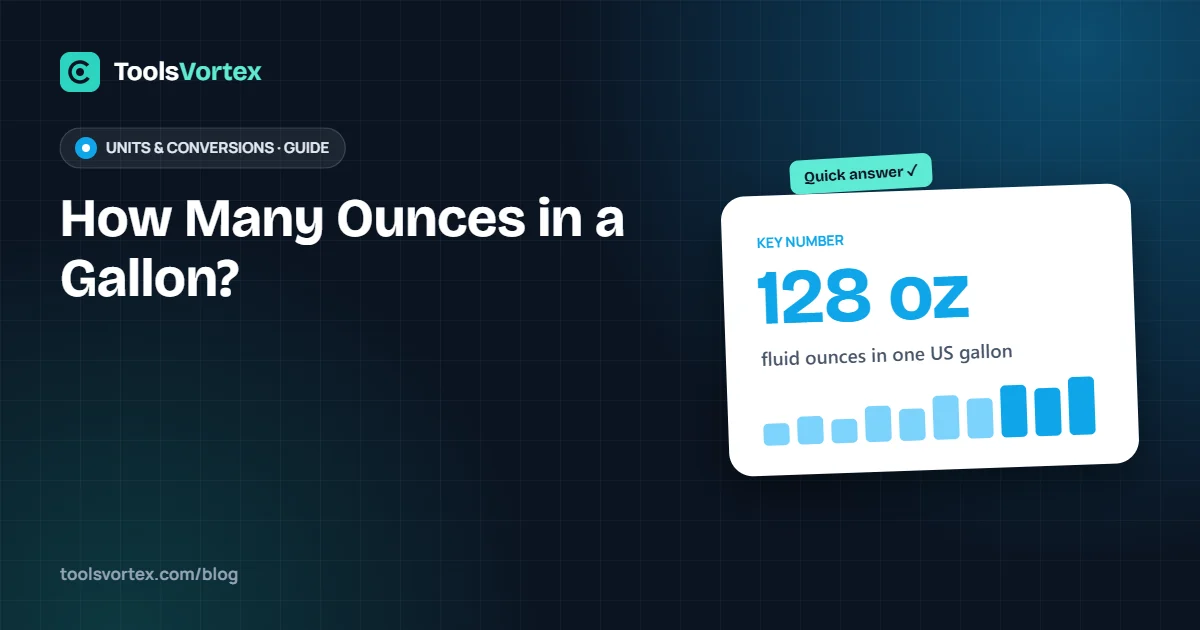
A US gallon holds 128 fluid ounces, which is 16 cups or 3.785 liters. A UK imperial gallon is bigger: it holds 160 imperial fluid ounces, or 4.546 liters. That equals about 153.7 US fluid ounces. For water bottles, it takes about 7.6 standard 16.9 oz bottles to fill one US gallon.

If you are asking how many ounces in a gallon, the short answer in the United States is 128 fluid ounces. That number comes straight from how the gallon is built: 4 quarts, each with 32 ounces.
The full answer has a few traps. The UK gallon is a different size, the UK ounce is a different size too, and a fluid ounce is not the same as an ounce on a scale. This guide gives you the exact numbers, a chart for every common size, and the math for water bottles and recipes. To flip between metric and US units fast, open the liters to gallons converter.
How Many Ounces Are in a Gallon?
There are exactly 128 US fluid ounces in one US liquid gallon. The US gallon is defined as 231 cubic inches, which is exactly 3.785411784 liters, according to NIST Handbook 44.
The 128 comes from a simple chain of halves and quarters. One gallon is 4 quarts. One quart is 2 pints. One pint is 2 cups. One cup is 8 fluid ounces. Multiply it out and you get 4 x 2 x 2 x 8 = 128.
Gallons = fluid ounces / 128
1 US fl oz = 3,785.411784 mL / 128 = 29.5735295625 mL
So one US fluid ounce is about 29.57 mL. Most labels round it to 29.6 or even 30 mL. If you need the exact figure for a lab, a label, or a big batch, use 29.5735 mL. For small swaps, the mL to oz converter does the rounding for you.
Is a UK Gallon Different From a US Gallon?
Yes. A UK imperial gallon is about 20% bigger than a US gallon, and it is split into 160 imperial fluid ounces instead of 128.
UK law sets the gallon at 4.54609 cubic decimetres, which is 4.54609 liters, in Schedule 1 of the Weights and Measures Act 1985. The same schedule sets the pint at 0.56826125 liters and the fluid ounce at 1/20 of a pint.
Here is the part most charts skip: the imperial fluid ounce is smaller than the US one. The gallon is bigger, but the ounce is smaller. That is why the counts do not line up neatly.
| Unit | US customary | UK imperial |
|---|---|---|
| Fluid ounces per gallon | 128 | 160 |
| 1 gallon in liters | 3.785411784 | 4.54609 |
| 1 fluid ounce in mL | 29.5735295625 | 28.4130625 |
| 1 pint in fluid ounces | 16 | 20 |
| 1 gallon in US fl oz | 128 | about 153.72 |
One imperial gallon equals about 1.201 US gallons. One imperial fluid ounce is about 96% of a US fluid ounce.
If a recipe, a car manual, or a fuel figure comes from the UK, check which gallon it means. A UK figure of “40 miles per gallon” uses the bigger gallon, so the same car would show about 33.3 miles per US gallon.
How Many Ounces Are in a Half Gallon, Quart, Pint and Cup?
A half gallon holds 64 fluid ounces, a quart holds 32, a pint holds 16, and a cup holds 8. The chart below uses US customary units and the exact NIST value for the gallon.
| US measure | Fluid ounces | Cups | Milliliters |
|---|---|---|---|
| 1 gallon | 128 | 16 | 3,785.41 |
| 1/2 gallon | 64 | 8 | 1,892.71 |
| 1 quart (1/4 gallon) | 32 | 4 | 946.35 |
| 1 pint (1/8 gallon) | 16 | 2 | 473.18 |
| 1 cup (1/16 gallon) | 8 | 1 | 236.59 |
Milliliters are rounded to two decimals. A US legal nutrition label cup is 240 mL, which is slightly larger than the 236.59 mL customary cup.
You can also go smaller. One fluid ounce is 2 tablespoons, so a gallon holds 256 tablespoons and a cup holds 16. The tablespoons to cups converter handles those small kitchen jumps. To turn ounces into cups for any odd amount, like 42 oz, use the ounces to cups converter. It gives 5.25 cups.
How Many Water Bottles Make a Gallon?
It takes about 7.6 standard 16.9 oz water bottles to make one US gallon. Divide 128 by the bottle size in fluid ounces and you have the answer for any bottle.
| Bottle size | Bottles per US gallon | Practical count |
|---|---|---|
| 8 oz | 16 | 16 bottles |
| 12 oz | 10.67 | 11 bottles (a little over) |
| 16.9 oz (500 mL) | 7.57 | 8 bottles (a little over) |
| 20 oz | 6.4 | 6.5 bottles |
| 24 oz | 5.33 | 5.5 bottles |
| 32 oz | 4 | 4 bottles exactly |
The 16.9 oz bottle is a 500 mL bottle sold with a rounded US label. Using 500 mL exactly gives 7.57 bottles per gallon.
People ask this most when they track water. A gallon a day is a common challenge, and it equals six and a half refills of a 20 oz bottle. The right amount for you depends on your body, the weather, and how active you are. The water intake calculator gives a general daily estimate in ounces and liters. This is general information, not medical advice.
Is a Fluid Ounce the Same as an Ounce of Weight?
No. A fluid ounce measures volume, while an ounce on a scale measures weight. They only match closely for water and drinks that are mostly water.
A US gallon of water weighs about 8.34 pounds. Here is the math: 3.785411784 liters of water at its densest weighs about 3.785 kg, and one pound is exactly 0.45359237 kg. So 3.785411784 / 0.45359237 = 8.345 pounds. At room temperature water is a touch less dense, so a gallon weighs closer to 8.33 pounds.
- Water: 1 fl oz weighs about 1.04 oz. Close enough for most drinks.
- Milk: slightly heavier than water, so a gallon weighs about 8.6 pounds.
- Cooking oil: lighter than water. A cup of oil weighs less than 8 oz.
- Honey: much heavier. A cup weighs about 12 oz.
A UK gallon of water weighs about 10 pounds. That is no accident. The imperial gallon was first defined as the volume of 10 pounds of water under set conditions, as NIST notes in Handbook 44.
So if a recipe lists “8 oz of flour,” it means weight, not a cup. Weigh it, or use a grams to cups chart for that ingredient.
What Is a US Dry Gallon?
A US dry gallon is an older unit for grains and produce, equal to 1/8 of a US bushel, or 268.8025 cubic inches. That works out to about 4.405 liters.
NIST Handbook 44 defines the US bushel as 2,150.42 cubic inches. Divide by 8 and you get the dry gallon. It is about 16% larger than the liquid gallon. You will almost never see it on a store label today. Berries and produce are usually sold by the dry pint or dry quart, or by weight.
The key point: fluid ounces only apply to the liquid gallon. There is no “dry ounce” that splits a dry gallon into 128 parts. If you see ounces on a bag of rice, that is weight.
How Do You Use Gallon Conversions in the Kitchen?
Convert everything to fluid ounces first, then divide by 128 to get gallons, or by 32 to get quarts. It keeps the math in whole numbers.
You are making lemonade for 20 guests, with one 8 oz cup each. How much do you need?
- Total ounces: 20 x 8 = 160 fl oz.
- Gallons: 160 / 128 = 1.25 gallons.
- Split it: 1 gallon is 128 oz, and the extra 32 oz is exactly 1 quart.
- In liters: 1.25 x 3.785411784 = 4.73 liters.
- In 64 oz jugs: 160 / 64 = 2.5 jugs, so buy 3.
So you need 1 gallon plus 1 quart, about 4.73 liters. Plan a little extra for ice melt and refills.
A few more edge cases come up often:
- Scaling a soup: a recipe that makes 2 quarts makes half a gallon, or 64 oz. Doubling it fills a gallon pot to the brim, so use a bigger pot.
- Metric recipes: 1 liter is about 33.8 US fl oz, so 4 liters is about 135 oz, a bit more than a gallon. The cups to mL converter helps when a recipe mixes both systems.
- Old British cookbooks: a UK pint is 20 imperial fl oz, not 16. Treat it as about 19.2 US fl oz.
For fuel, aquariums, or any job measured in liters, the liters to gallons converter does the 3.785 math both ways.
Quick Recap
- A US liquid gallon holds exactly 128 fluid ounces, or 3.785411784 liters.
- A UK imperial gallon holds 160 imperial fluid ounces, about 153.7 US fluid ounces.
- Half gallon = 64 oz, quart = 32 oz, pint = 16 oz, cup = 8 oz.
- About 7.6 bottles of 16.9 oz water make one US gallon.
- A US gallon of water weighs about 8.34 pounds; fluid ounces are volume, not weight.
Frequently Asked Questions
How many 16.9 oz water bottles are in a gallon?
About 7.57 bottles. Divide 128 by 16.9 and you get 7.57, so 8 bottles gives you a little more than one US gallon. The 16.9 oz bottle is really a 500 mL bottle, and 500 mL goes into a gallon 7.57 times too.
Is 64 oz half a gallon?
Yes. Half of a US gallon is exactly 64 fluid ounces, which is 2 quarts, 8 cups, or about 1.89 liters. Many juice and milk cartons sold as a half gallon hold this amount.
How many ounces are in a gallon of milk?
A US gallon of milk holds 128 fluid ounces, the same as any US gallon of liquid. By weight it comes to about 8.6 pounds, a bit more than water, because milk is denser than water.
How many ounces are in a UK gallon?
A UK imperial gallon holds 160 imperial fluid ounces. In US fluid ounces that is about 153.7, because the imperial fluid ounce is smaller at 28.41 mL compared with 29.57 mL for the US fluid ounce.
How many cups are in a gallon?
There are 16 US cups in one US gallon. Each cup holds 8 fluid ounces, and 16 x 8 = 128 fluid ounces. A quart holds 4 cups and a pint holds 2 cups.
How much does a gallon of water weigh?
A US gallon of water weighs about 8.34 pounds, or about 3.79 kg. At room temperature it is closer to 8.33 pounds. A UK imperial gallon of water weighs about 10 pounds.
How many 20 oz bottles make a gallon?
It takes 6.4 bottles of 20 oz to make one US gallon. Divide 128 by 20 to get 6.4. In real life, that means six full bottles plus a little less than half of a seventh.
Sources
- NIST: Handbook 44 Appendix C, General Tables of Units of Measurement, US gallon of 231 cubic inches and 3.785411784 L, 128 fl oz, bushel size, imperial gallon notes
- legislation.gov.uk: Weights and Measures Act 1985, Schedule 1, UK gallon of 4.54609 cubic decimetres, pint, and fluid ounce of 1/20 pint
- NIST: Guide to the SI, Appendix B, Conversion Factors, Official guidance on exact and rounded conversion factors