Find the square root of any number, fraction or decimal. You get the decimal to as many places as you need, the simplest surd form, both roots and the full working, updated as you type.
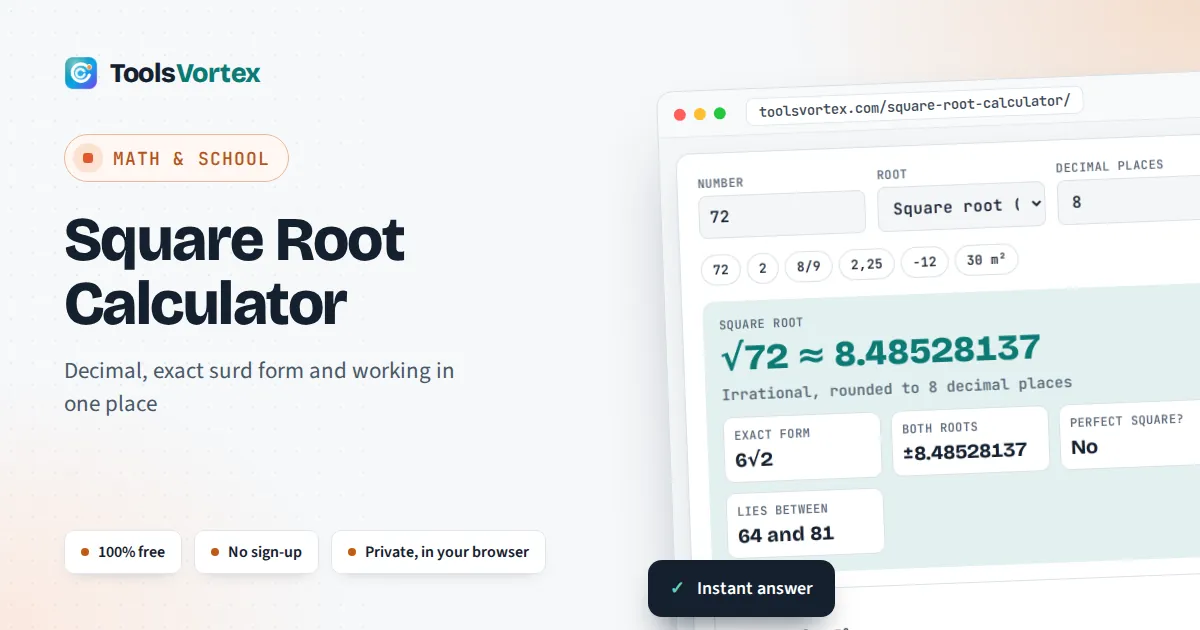
This square root calculator works out √x for students, teachers, engineers and anyone checking a measurement. Type a whole number, a decimal (2.25 or 2,25) or a fraction such as 8/9 and it returns the decimal root rounded correctly to up to 30 places, the exact surd form your maths teacher wants, the positive and negative roots, and the steps. Switch the root to work out cube, 4th or 5th roots with the same method.
How do you find the square root of a number?
The square root of a number x is the value that gives x when multiplied by itself, so √49 = 7 because 7 × 7 = 49. For a number that is not a perfect square, a square root calculator gives a decimal, such as √72 ≈ 8.4853, and the simplest surd form, 6√2.
How Does the Square Root Calculator Work?
It treats your input as an exact fraction, so 2.25 becomes 9/4 and nothing is lost to rounding before the root is taken. The decimal is found with whole number arithmetic, which means every digit shown is correct, not just the first 15 or so that ordinary floating point gives.
√(a × b) = √a × √b (a, b ≥ 0)
√(a / b) = √(a × b) / b
Simplest form: √x = k√m, where k² is the largest square factor of x
To find the simplest form, the calculator splits the number into prime factors, takes every pair of equal primes outside the root and leaves the rest inside. For 72 = 2³ × 3², one pair of 2s and one pair of 3s come out, giving 2 × 3 = 6, and a single 2 stays inside: √72 = 6√2. The fraction calculator is handy if you then need to add or divide surd results with fractional coefficients.
What Are the Square Roots of Common Numbers?
These are the non-perfect squares that come up most often in exams and in geometry, with the simplest surd form and the decimal to six places.
| Number | Simplest form | Decimal |
|---|---|---|
| 2 | √2 | 1.414214 |
| 3 | √3 | 1.732051 |
| 5 | √5 | 2.236068 |
| 8 | 2√2 | 2.828427 |
| 12 | 2√3 | 3.464102 |
| 18 | 3√2 | 4.242641 |
| 20 | 2√5 | 4.472136 |
| 27 | 3√3 | 5.196152 |
| 32 | 4√2 | 5.656854 |
| 45 | 3√5 | 6.708204 |
| 48 | 4√3 | 6.928203 |
| 50 | 5√2 | 7.071068 |
| 72 | 6√2 | 8.485281 |
| 75 | 5√3 | 8.660254 |
| 98 | 7√2 | 9.899495 |
| 200 | 10√2 | 14.142136 |
The perfect squares from 1 to 225 are 1, 4, 9, 16, 25, 36, 49, 64, 81, 100, 121, 144, 169, 196 and 225. Knowing them by heart makes simplifying much faster, because you can spot the largest square factor straight away.
How Do You Simplify a Square Root (Surd)?
You simplify a square root by writing the number as a perfect square times another number, then taking the square root of the perfect square outside: √48 = √(16 × 3) = 4√3. Always use the largest square factor. If you only pull out 4 from 48, you get 2√12, which still simplifies further.
A root of a fraction is simplified by rationalising the denominator, so that no root is left on the bottom. √(8/9) = √8 / √9 = 2√2/3, and √(1/2) = √2/2. In England, calculating exactly with surds, simplifying them and rationalising denominators is part of the higher tier GCSE maths content set by the Department for Education, and Ireland’s Junior Cycle maths specification covers operations with surds and the rule n1/2 = √n. The calculator shows the rationalised form automatically.
How Do You Find a Square Root by Hand?
The quickest method by hand is the Babylonian or Heron’s method: guess, divide the number by your guess, and average the two. Repeat until the answer stops changing. The number of correct digits roughly doubles with every round.
Worked example: the side of a 30 m² square room
Priya is planning a square home office with a floor area of 30 m² and wants the length of each wall. She needs √30. Since 5² = 25 and 6² = 36, the answer lies between 5 and 6, so she starts with 5.
- (5 + 30 ÷ 5) ÷ 2 = (5 + 6) ÷ 2 = 5.5
- (5.5 + 30 ÷ 5.5) ÷ 2 = (5.5 + 5.454545) ÷ 2 = 5.477273
- (5.477273 + 30 ÷ 5.477273) ÷ 2 = 5.477226
After three rounds she has 5.4772 m, which matches the calculator’s √30 = 5.47722558 m. Each wall is about 5.48 m, or 548 cm. For room areas in square feet, or to go the other way from wall lengths to floor area, use the square footage calculator.
What Is the Square Root of a Negative Number?
A negative number has no real square root, because any real number multiplied by itself is zero or positive. In complex numbers it does have one, written with the imaginary unit i, where i × i = −1. So √−12 = √12 × i = 2i√3, about 3.4641i. Cube roots and 5th roots of negative numbers are real, for example ∛−8 = −2, and the calculator handles both cases.
Why Are Some Square Roots Irrational?
The square root of any whole number that is not a perfect square is irrational: its decimal never ends and never repeats, so no fraction equals it exactly. That is why √2 is written as a surd in exact answers. People have still approximated it well for a very long time. The Babylonian clay tablet YBC 7289, dated to between 1800 and 1600 BC, gives √2 as 1;24,51,10 in base 60, about 1.41421296, which is correct to about six decimal digits. The √ sign itself first appeared in print in 1525, in Christoph Rudolff’s algebra book Coss.
Square roots also sit inside many everyday formulas: the diagonal of a square is its side times √2, Pythagoras’ theorem needs a square root to find a side, and the standard deviation calculator takes the square root of the variance.
How Do You Use the Square Root Calculator?
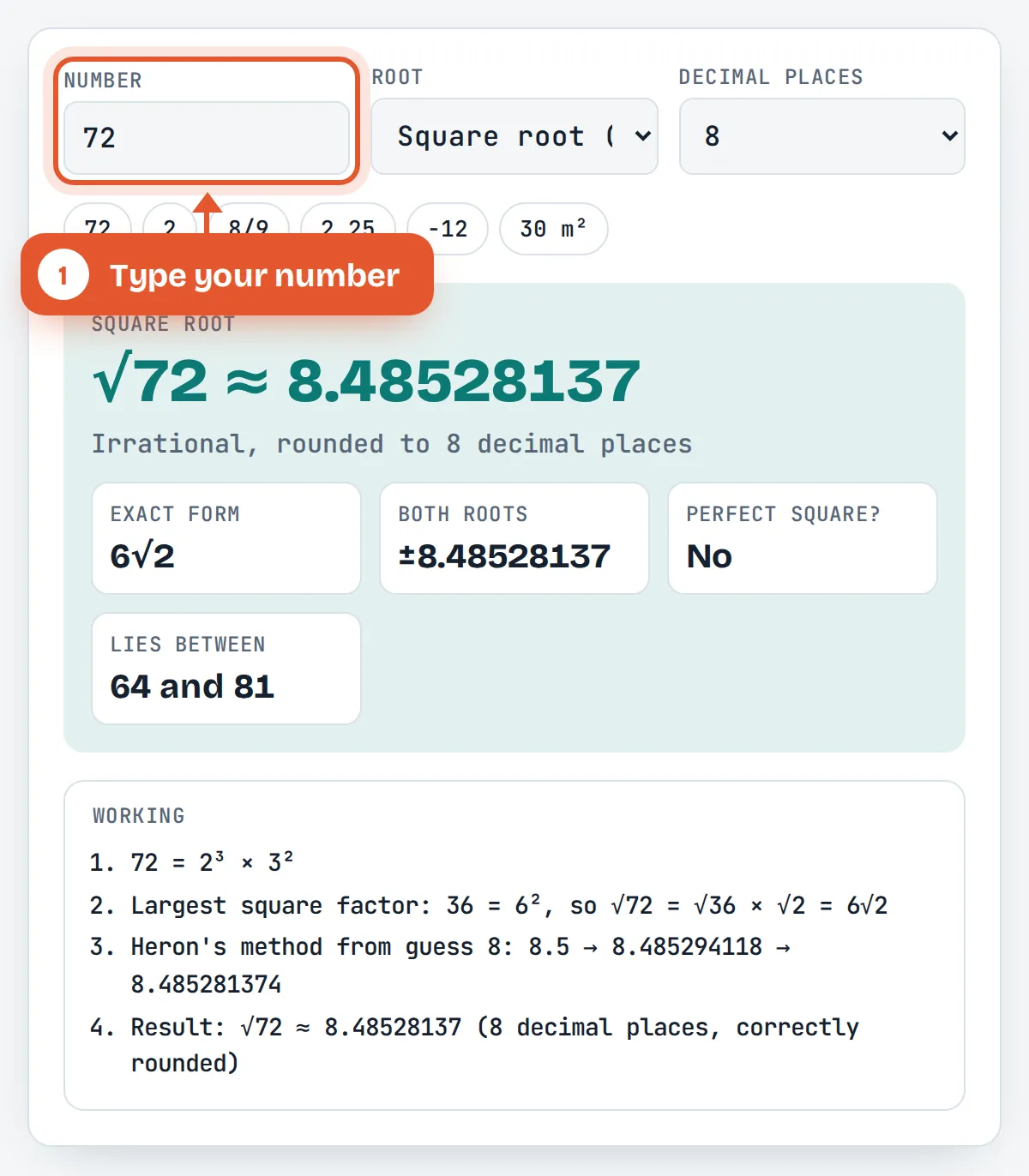
Type your number
Enter a whole number, a decimal with a point or a comma, a fraction such as 8/9, or a negative number. The result updates as you type.

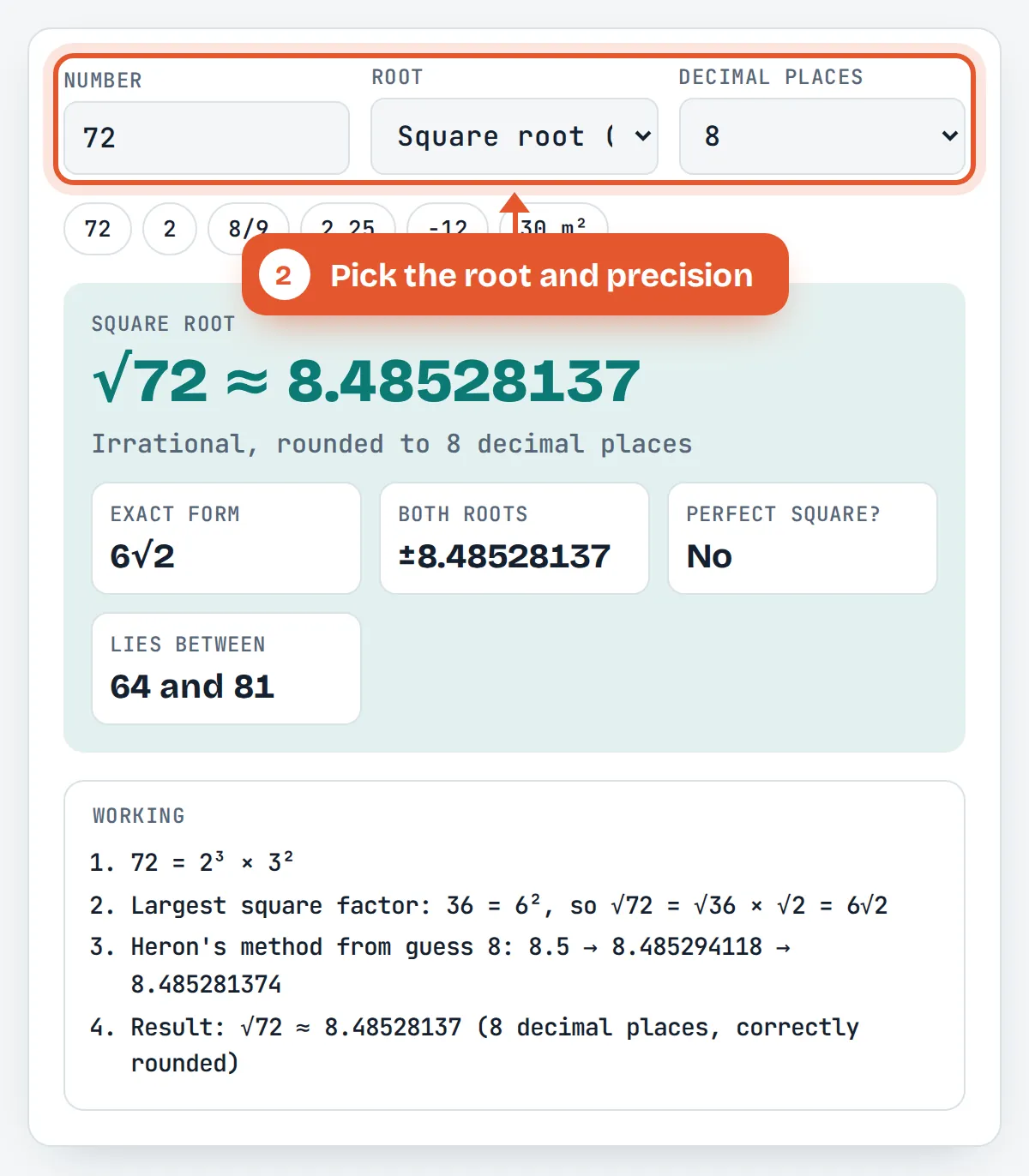
Pick the root and precision
Leave the root on square root, or choose a cube, 4th or 5th root. Choose how many decimal places you want, from 4 up to 30.
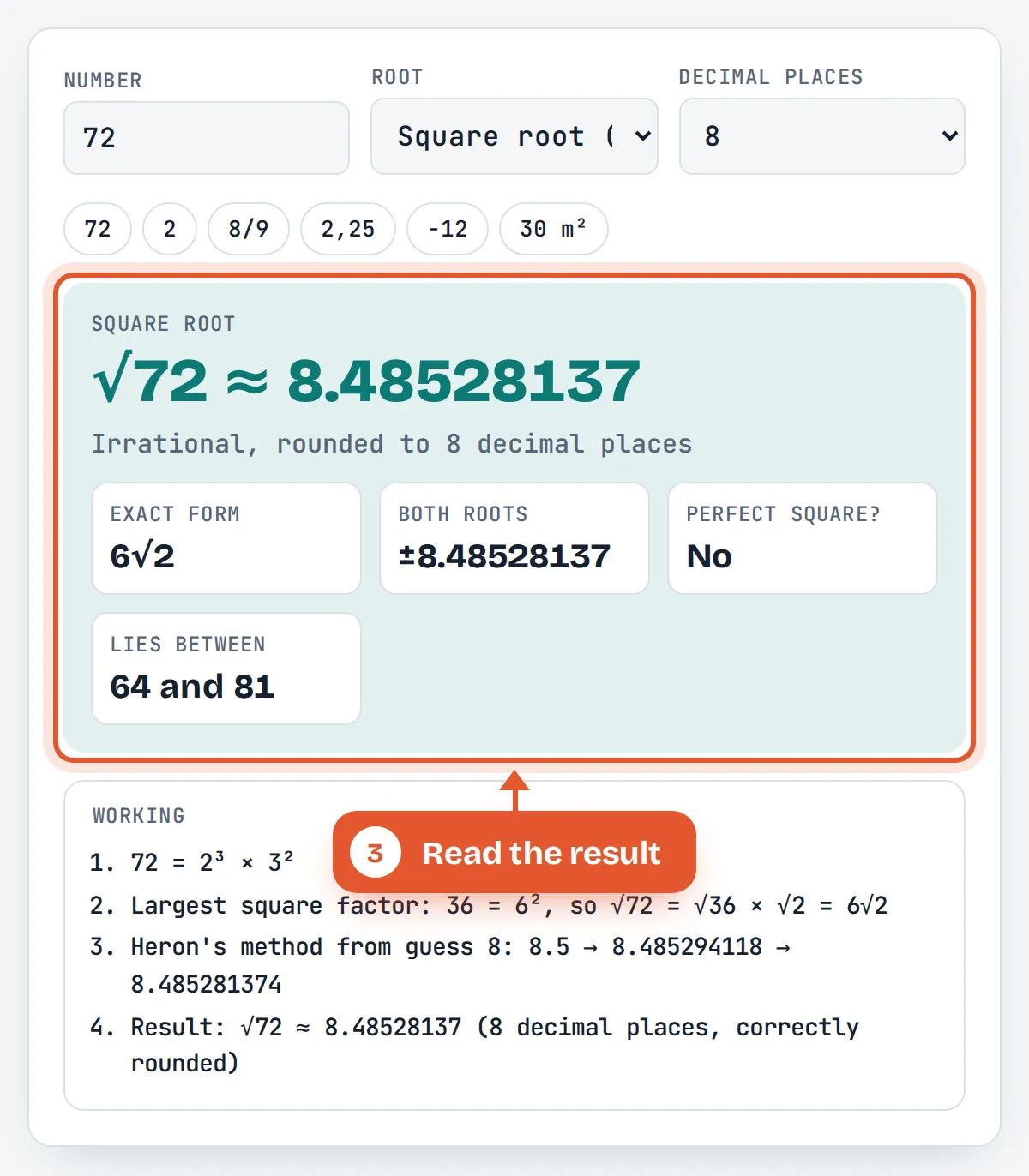
Read the result
The large figure is the principal root. Below it you get the exact surd form, both roots, whether the number is a perfect square and the perfect squares it lies between.
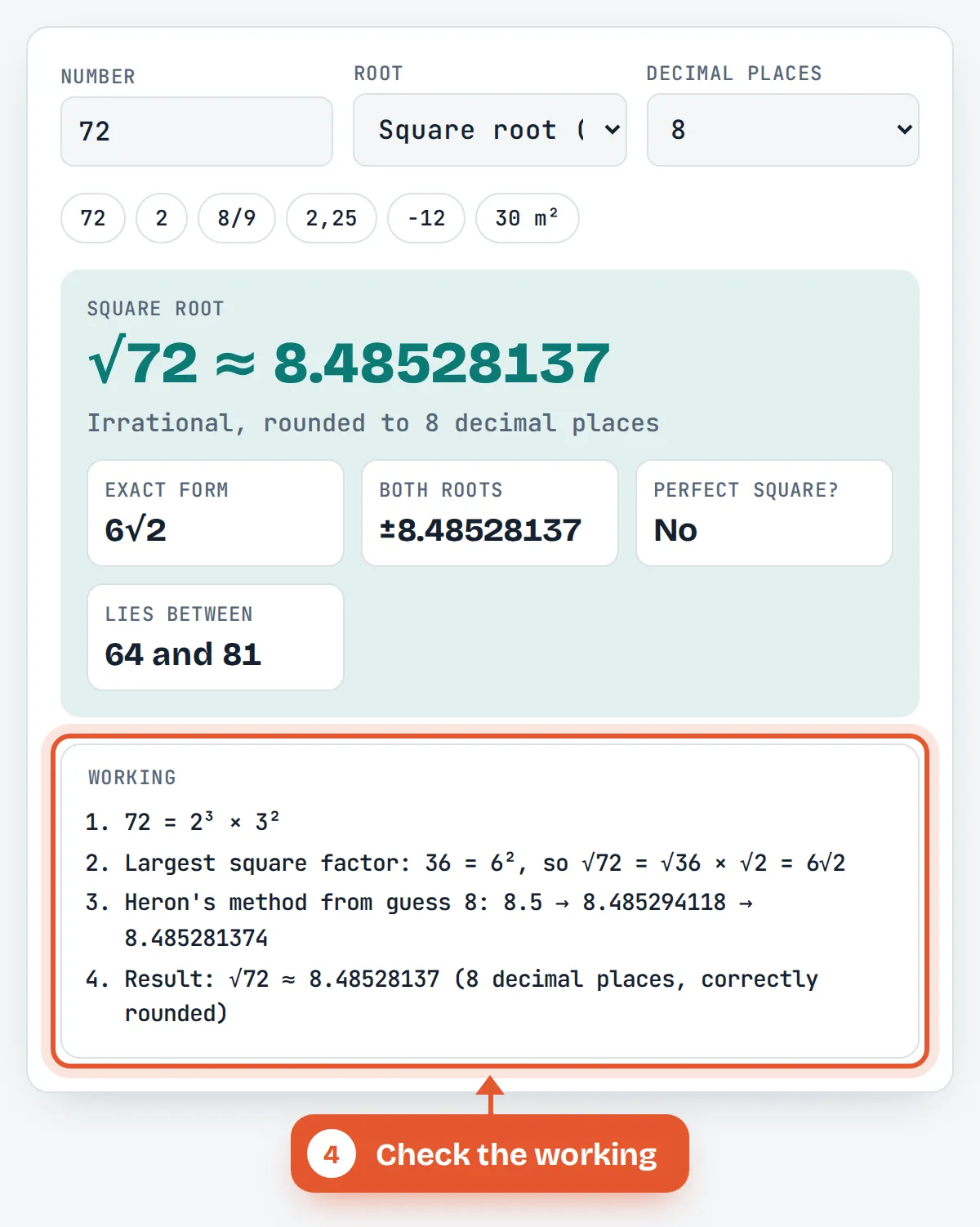
Check the working
The working lists the prime factors, the largest square factor and a few rounds of Heron’s method, so you can copy the method into your own answer.
Frequently Asked Questions
What is the square root of 2?
The square root of 2 is about 1.41421356. It is irrational, so its decimal goes on forever without repeating, and exact answers leave it as √2. It is also the ratio of the diagonal of a square to its side.
Does a square root have two answers?
Every positive number has two square roots, one positive and one negative: both 8 and −8 square to 64. The √ symbol means the principal, or positive, root, so √64 = 8. When solving x² = 64 you write x = ±8.
How do I know if a number is a perfect square?
A whole number is a perfect square if its square root is a whole number, such as 144 = 12². In its prime factorisation every prime appears an even number of times. The calculator tells you directly and shows the nearest perfect squares.
Can I enter a decimal with a comma?
Yes. A single comma followed by anything other than exactly three digits is read as a decimal comma, so 2,25 means 2.25, as written in most of Europe. A comma followed by three digits, such as 1,000, is read as a thousands separator.
What is √x as a power?
A square root is the same as raising to the power one half: √x = x^(1/2). In general the nth root is x^(1/n), so the cube root of 27 is 27^(1/3) = 3. This is useful when a calculator only has a power key.
How accurate is this square root calculator?
Every digit shown is correctly rounded. The calculator uses exact whole number arithmetic rather than ordinary floating point, so even at 30 decimal places the last digit is right. Inputs can have up to 30 digits in total.
Sources and Further Reading
- Square root, Wikipedia
- Square root algorithms (Heron’s method), Wikipedia
- GCSE mathematics: subject content and assessment objectives, Department for Education (GOV.UK)
Related Tools
Last reviewed: October 2026