Type a fraction or a mixed number and get its exact decimal. Repeating digits are found by long division and marked with a bar, plus the rounded value, percent and simplest form.
Runs in your browser. Nothing you type is sent anywhere.
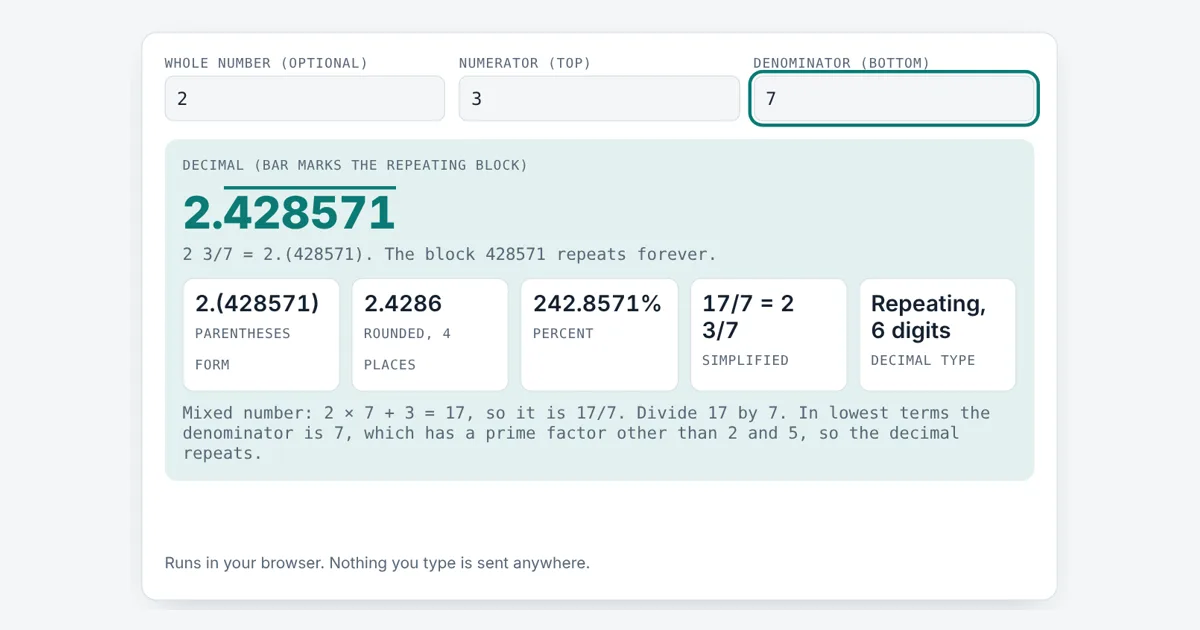
This fraction to decimal converter is for students, teachers and anyone working with recipes, measurements or prices written as fractions. Enter a proper fraction like 5/8, an improper fraction like 22/7 or a mixed number like 2 3/7, and you get the exact decimal with any repeating part clearly marked, not just a rounded guess.
How Do You Convert a Fraction to a Decimal?
To convert a fraction to a decimal, divide the numerator by the denominator. For example, 5/8 = 5 ÷ 8 = 0.625. For a mixed number such as 2 3/7, first make it 17/7, then divide: 17 ÷ 7 = 2.428571428571…, where the block 428571 repeats forever.
What Is the Difference Between Proper, Improper and Mixed Fractions?
A proper fraction has a top number smaller than the bottom number, so its value is less than 1, like 5/8 = 0.625. An improper fraction has a top number equal to or bigger than the bottom, like 22/7 = 3.142857…, so its decimal is 1 or more. A mixed number joins a whole number and a proper fraction, like 2 3/7. To convert it, multiply the whole number by the denominator and add the numerator: 2 × 7 + 3 = 17, so 2 3/7 = 17/7.
mixed a b/c = (a × c + b) ÷ c
How Do You Know if a Fraction Is a Repeating Decimal?
A fraction in lowest terms gives a terminating decimal only when its denominator has no prime factors other than 2 and 5; any other prime factor makes it a repeating decimal. So 3/40 ends (40 = 2 × 2 × 2 × 5) and gives 0.075, but 7/12 repeats (12 has the factor 3) and gives 0.58333… This is true because our number system is base 10, and 10 = 2 × 5. The tool checks this for you and finds the repeating block by tracking remainders during long division: as soon as a remainder appears a second time, the digits start to repeat. Every fraction is a rational number, so its decimal always either ends or repeats. To check the prime factors of a denominator by hand, the GCF calculator helps you reduce the fraction first.
How Do You Write a Repeating Decimal?
You write a repeating decimal by putting a bar, called a vinculum, over the digits that repeat, or by wrapping them in parentheses. So 1/6 = 0.1666… is written as 0.1 with a bar over the 6, or 0.1(6). The bar goes over the whole repeating block, which can be long: 1/7 repeats 142857 (6 digits) and 1/97 repeats a block of 96 digits. Some books also use dots over the first and last repeating digit. To go the other way, use the decimal to fraction calculator.
Common Fraction to Decimal Chart
Values checked with this tool. The parentheses mark the repeating block.
| Fraction | Exact decimal | Rounded | Percent |
|---|---|---|---|
| 1/2 | 0.5 | 0.5 | 50% |
| 1/3 | 0.(3) | 0.3333 | 33.3333% |
| 2/3 | 0.(6) | 0.6667 | 66.6667% |
| 1/4 | 0.25 | 0.25 | 25% |
| 3/4 | 0.75 | 0.75 | 75% |
| 1/5 | 0.2 | 0.2 | 20% |
| 1/6 | 0.1(6) | 0.1667 | 16.6667% |
| 1/7 | 0.(142857) | 0.1429 | 14.2857% |
| 1/8 | 0.125 | 0.125 | 12.5% |
| 1/9 | 0.(1) | 0.1111 | 11.1111% |
| 1/11 | 0.(09) | 0.0909 | 9.0909% |
| 1/12 | 0.08(3) | 0.0833 | 8.3333% |
Worked Example
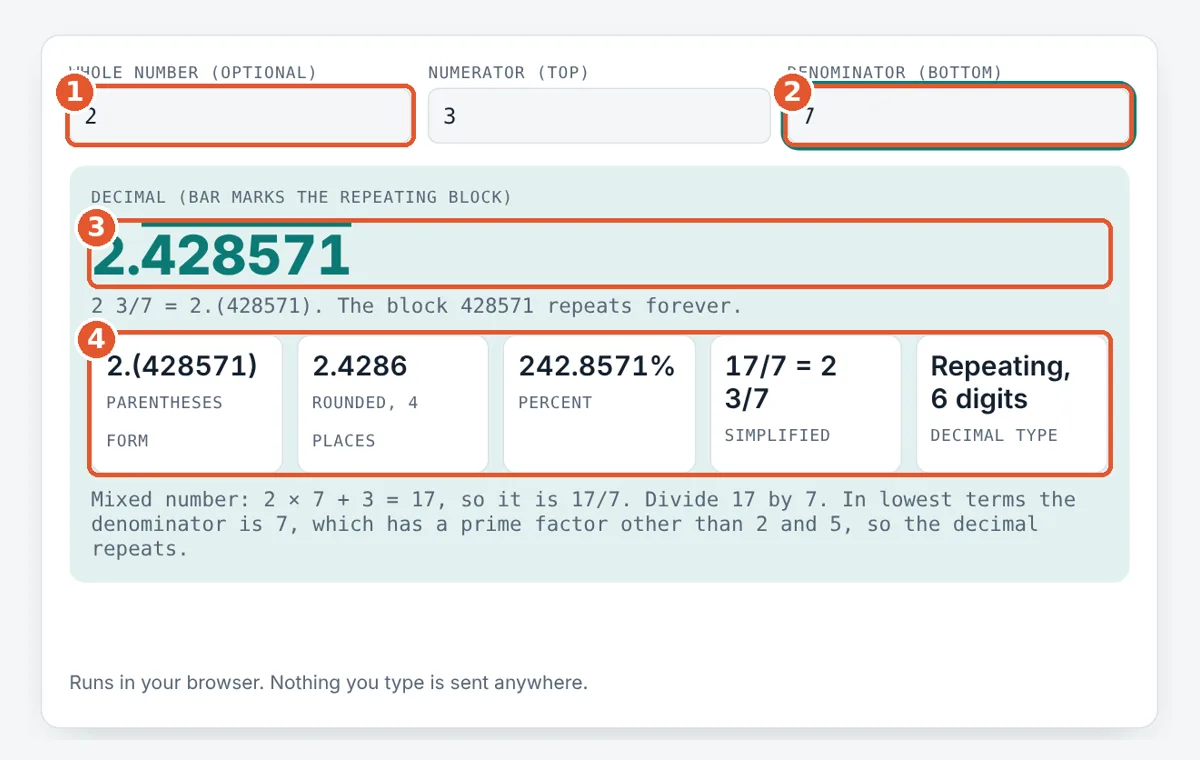
A recipe calls for 2 3/7 cups of flour and your digital scale wants a decimal. Enter 2 in the whole number box, 3 as the numerator and 7 as the denominator. The tool turns it into 17/7 and shows 2.(428571), with the bar over 428571 because those 6 digits repeat forever. Rounded to 4 places that is 2.4286, or 242.8571%. Change it to 5/8 with the whole box empty and you get 0.625, a terminating decimal, because 8 = 2 × 2 × 2. For percentages of a total, the percentage calculator takes it from there.
How Do You Use the Fraction to Decimal Converter?
Add a whole number if needed
For a mixed number such as 2 3/7, type 2 here. Leave it empty for 5/8 or 22/7.
Enter numerator and denominator
Type the top number and the bottom number. The result updates as you type.
Read the exact decimal
The big result shows the decimal, with a bar over the digits that repeat.
Check the other forms
The boxes show the parentheses form, a rounded value, the percent and the simplest fraction.
Frequently Asked Questions
What is 1/3 as a decimal?
1/3 as a decimal is 0.333…, where the 3 repeats forever. It is written 0.(3) or with a bar over the 3. Rounded to 2 places it is 0.33, and as a percent it is about 33.33%.
What is 22/7 as a decimal?
22/7 is 3.142857142857…, where the 6 digit block 142857 repeats. It is often used as an estimate of pi, which is 3.14159…, so 22/7 is a little too big, by about 0.00126.
Why does 1/7 have six repeating digits?
Dividing by 7 can only leave the remainders 1 to 6. Long division of 1 ÷ 7 uses all six before a remainder comes back, so the block 142857 has 6 digits. A denominator d can never repeat more than d − 1 digits.
Is 0.999… equal to 1?
Yes. 0.(9) equals exactly 1. One simple proof: 1/3 = 0.(3), and three times 1/3 is 3/3 = 1, while three times 0.(3) is 0.(9). So both are the same number written two ways.
How do I convert a negative fraction to a decimal?
Convert it as if it were positive, then put the minus sign in front. Type the minus in the whole number box for a mixed number, or on the numerator otherwise. For example, −3/4 gives −0.75.
Can every fraction be written as a decimal?
Yes, as long as the denominator is not 0. Every fraction of whole numbers gives a decimal that either stops, like 3/8 = 0.375, or repeats a block forever, like 5/11 = 0.(45). It never goes on with no pattern.
Sources and Further Reading
- Wikipedia: Repeating decimal (periods and notation)
- Wolfram MathWorld: Repeating Decimal
- Wikipedia: Vinculum (overline notation)
Related Tools
Last reviewed: October 2026