Type a number to see how many significant figures it has, with the significant digits highlighted, then round it to any number of sig figs in plain and scientific notation.
Type plain numbers like 1200. or 0.050, or scientific notation like 6.02e23 or 6.02 x 10^23.
Runs in your browser. Nothing you type is sent anywhere.
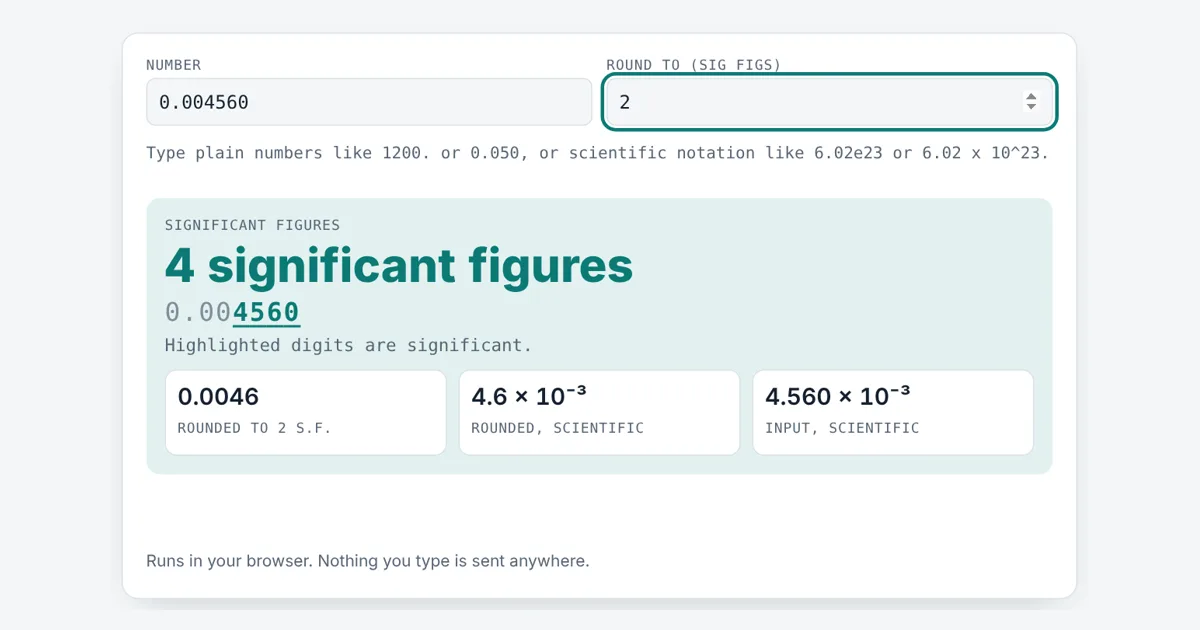
This significant figures calculator is for chemistry, physics and maths students, and anyone writing lab results. It counts the sig figs in a number using the standard rules for leading zeros, trailing zeros and scientific notation, shows which digits count, and rounds the number to the precision you choose.
How Do You Count Significant Figures?
Count every nonzero digit, every zero between nonzero digits, and trailing zeros only when the number has a decimal point. Leading zeros never count. For example, 0.004560 has 4 significant figures (4, 5, 6 and the final 0), while 1200 has 2 because its trailing zeros have no decimal point.
What Are the Rules for Significant Figures?
There are five rules: nonzero digits count, zeros between them count, leading zeros never count, trailing zeros count only with a decimal point, and in scientific notation every digit of the number in front counts.
Significant figures are the digits that carry real information about a measurement. They show its precision, which is how finely it was measured. Leading zeros, such as the zeros in 0.0045, only place the decimal point, so they are not significant. Trailing zeros are zeros at the end of a number. In 2.50 they count, because someone chose to write them. In 2500 they are unclear, so the usual rule treats them as not significant.
Scientific notation removes that doubt. Writing 2.500 × 10³ says 4 figures are known, while 2.5 × 10³ says only 2. Our scientific notation converter switches numbers between the two forms.
| Number | Sig figs | Why |
|---|---|---|
| 7 | 1 | One nonzero digit |
| 405 | 3 | Zero between nonzero digits counts |
| 0.050 | 2 | Leading zeros do not count, trailing zero after the point does |
| 0.004560 | 4 | 4, 5, 6 and the final 0 |
| 1200 | 2 | Trailing zeros without a decimal point |
| 1200. | 4 | The decimal point makes the zeros count |
| 100.0 | 4 | All zeros sit after a nonzero digit with a point |
| 6.02 × 10²³ | 3 | Only the digits in front of the power count |
How Do You Round a Number to Significant Figures?
To round to N significant figures, start at the first nonzero digit, count N digits, and look at the next digit: if it is 5 or more, add one to the last kept digit, then replace any dropped digits before the decimal point with zeros.
For example, 152.73 to 3 sig figs keeps 1, 5 and 2, the next digit is 7, so the answer is 153. This tool uses round half up, the rule taught in most schools, so 2.345 to 3 sig figs becomes 2.35. Some lab and engineering standards round an exact half to the nearest even digit instead, which would give 2.34. If you only need a fixed number of decimal places, use the rounding calculator.
Why Do Significant Figures Matter in Science?
Significant figures matter because a result cannot be more precise than the measurement it came from. If a ruler reads to 0.1 cm, writing 12.3456 cm claims precision you do not have. Guides such as the NIST Guide for the Use of the International System of Units ask writers to report values with a sensible number of digits. In multiplication and division, give the answer the same number of sig figs as the least precise input.
Worked Example
A chemistry student weighs a sample at 0.004560 g. Enter it in the tool: it shows 4 significant figures, with 4, 5, 6 and the last 0 highlighted. Setting Round to 2 gives 0.0046, or 4.6 × 10⁻³ in scientific notation. Now try 99.96 rounded to 3 sig figs: the tool gives 100. with a decimal point, also shown as 1.00 × 10², so both zeros are clearly significant. Typing 1200 gives 2 significant figures with a note about the trailing zeros, while 1200. gives 4.
How Do You Use the Significant Figures Calculator?
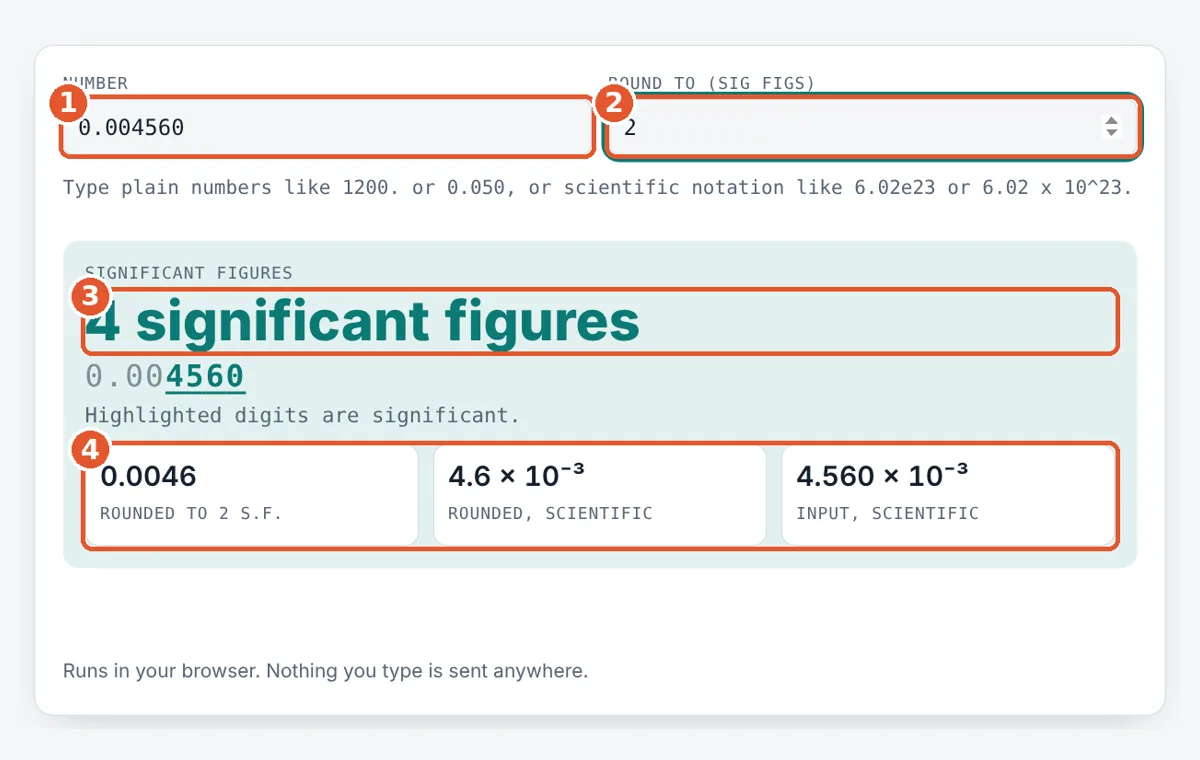
Enter the number
Type the value into the Number box. Plain numbers, 6.02e23 and 6.02 x 10^23 all work.
Choose sig figs to round to
Set how many significant figures you want in the rounded answer, from 1 to 20.
Read the count
The big line shows how many sig figs the number has, with the significant digits underlined.
Copy the rounded value
The boxes show the rounded number in plain form and in scientific notation.
Frequently Asked Questions
How many significant figures does 100 have?
100 has 1 significant figure under the standard rules, because its two trailing zeros have no decimal point. Written as 100. it has 3, and written as 100.0 it has 4. Scientific notation, such as 1.00 × 10², makes the count clear.
Do zeros after a decimal point count as significant?
Zeros after a decimal point count when they come after a nonzero digit, so 2.50 has 3 significant figures. Zeros before the first nonzero digit, as in 0.025, are leading zeros and never count, so 0.025 has 2.
How many sig figs is 0.0010?
0.0010 has 2 significant figures: the 1 and the final 0. The three zeros before the 1 are leading zeros that only place the decimal point. The trailing zero counts because the number has a decimal point.
Are exact numbers limited by significant figures?
No. Exact numbers, such as counted items or defined values like 100 cm in 1 m, have unlimited significant figures. They never limit the precision of a calculation. Only measured values decide how many sig figs your answer keeps.
How many significant figures should an answer have after adding?
For addition and subtraction, round the answer to the fewest decimal places among the inputs, not the fewest sig figs. For example, 12.11 + 0.3 = 12.41, which rounds to 12.4 because 0.3 has only one decimal place.
What is 3.14159 rounded to 3 significant figures?
3.14159 rounded to 3 significant figures is 3.14. Keep the first three digits 3, 1 and 4. The next digit is 1, which is less than 5, so the last kept digit stays the same.
Sources and Further Reading
- NIST Special Publication 811: Guide for the Use of the International System of Units
- Wikipedia: Significant figures
- Wikipedia: Scientific notation
Related Tools
Last reviewed: October 2026