Enter a base and an exponent to get a to the power n. Negative, decimal and fraction exponents work, huge answers switch to scientific notation, and the tool names the exponent rule it used.
Runs in your browser. Nothing you type is sent anywhere.
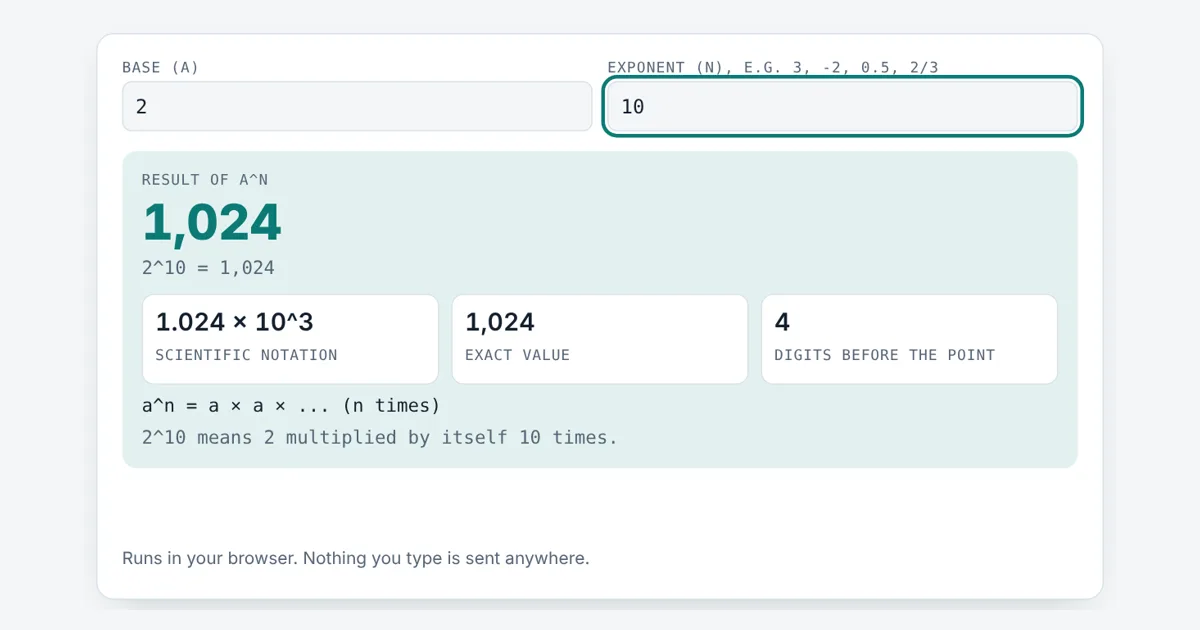
This exponent calculator is for students learning powers, and for anyone checking growth, science or computing numbers. You get the exact value when it fits (2^100 has all 31 digits shown), scientific notation for anything bigger, and a short line that explains the rule behind the answer.
How Do You Calculate an Exponent?
To calculate an exponent, multiply the base by itself as many times as the exponent says. For example, 2^10 = 2 × 2 × … × 2 (ten times) = 1,024. A negative exponent means one over the power, so 2^-3 = 1/8 = 0.125, and a fraction exponent means a root, so 8^(2/3) = 4.
What Do the Base and the Exponent Mean?
The base is the number being multiplied, and the exponent (also called the power or index) says how many times to use it. In 5^3 the base is 5 and the exponent is 3, so 5^3 = 5 × 5 × 5 = 125. Writing numbers this way is called exponentiation. A power of 10, like 10^6 = 1,000,000, is the basis of scientific notation, where any number is written as a value from 1 to 10 times a power of 10. That is how the tool shows huge answers: 9^999 has 954 digits, so it appears as 1.942079169 × 10^953. For more on that format, see the scientific notation converter.
What Are the Rules of Exponents?
The rules of exponents are a short list of shortcuts that let you multiply, divide and simplify powers without working them out. They follow from what a power means.
| Rule | Formula | Example |
|---|---|---|
| Product rule | a^m × a^n = a^(m+n) | 2^3 × 2^4 = 2^7 = 128 |
| Quotient rule | a^m ÷ a^n = a^(m−n) | 5^6 ÷ 5^4 = 5^2 = 25 |
| Power of a power | (a^m)^n = a^(m×n) | (3^2)^3 = 3^6 = 729 |
| Power of a product | (ab)^n = a^n × b^n | (2 × 5)^3 = 8 × 125 = 1,000 |
| Zero exponent | a^0 = 1 (a ≠ 0) | 7^0 = 1 |
| Negative exponent | a^−n = 1 / a^n | 10^−3 = 1/1000 = 0.001 |
| Fractional exponent | a^(p/q) = (q-th root of a)^p | 27^(2/3) = 3^2 = 9 |
What Does a Negative Exponent Mean?
A negative exponent means take the reciprocal: a^−n = 1 / a^n. So 2^−3 is not a negative number; it is 1 / 2^3 = 1/8 = 0.125. In the same way 10^−3 = 0.001, which is why a millimetre is 10^−3 metres. A negative base is different: (−2)^3 = −8 because an odd number of negative factors gives a negative answer, while (−3)^4 = 81.
How Do Fractional Exponents Work?
A fractional exponent combines a power and a root: the bottom of the fraction is the root and the top is the power. So 8^(2/3) means take the cube root of 8, which is 2, then square it to get 4. An exponent of 1/2 is a square root, so 16^(1/2) = 4, the same answer the square root calculator gives. A decimal exponent like 0.75 is read as 3/4, so 16^0.75 = (4th root of 16)^3 = 2^3 = 8. A negative base only has a real answer when the root is odd: (−8)^(1/3) = −2, but (−8)^(1/2) is not a real number. For any other decimal exponent, the tool uses the logarithm identity a^x = 10^(x × log10 a).
Worked Example
A savings balance grows by 5% a year, so after 10 years it is multiplied by 1.05^10. Enter 1.05 as the base and 10 as the exponent: the tool shows 1.62889462678, so $1,000 grows to about $1,628.89 before fees and tax. For a full plan with deposits, use the compound interest calculator. Now try base 2 and exponent 64, the number of different values a 64-bit computer number can hold: the result is exactly 18,446,744,073,709,551,616, or 1.844674407 × 10^19.
How Do You Use the Exponent Calculator?
Enter the base
Type the number to be multiplied, such as 2, -3 or 1.05.
Enter the exponent
Type a whole number, a negative, a decimal such as 0.5 or a fraction such as 2/3.
Read the result
The big number is the answer. Very large or very small answers use scientific notation.
Check the details
The boxes show scientific notation, the exact value and the digit count, plus the rule used.

Frequently Asked Questions
What is 2 to the power of 10?
2 to the power of 10 is 1,024. Multiply 2 by itself ten times: 2, 4, 8, 16, 32, 64, 128, 256, 512, 1,024. This is why a kibibyte in computing is 1,024 bytes, since memory sizes follow powers of 2.
Why is any number to the power of 0 equal to 1?
Because of the quotient rule: a^n ÷ a^n = a^(n−n) = a^0, and any nonzero number divided by itself is 1. For example 5^3 ÷ 5^3 = 125 ÷ 125 = 1, so 5^0 must be 1.
What is 0 to the power of 0?
Most calculators, algebra books and programming languages define 0^0 as 1, and this tool does too. In calculus it is called an indeterminate form because limits can approach different values, so the answer depends on the context.
Can the exponent be a decimal?
Yes. A decimal exponent is turned into a fraction where possible, so 0.5 means a square root and 0.75 means the 4th root cubed. 16^0.75 = 8 and 2^0.5 = 1.41421356237, the square root of 2.
How big a number can this exponent calculator handle?
Whole number powers of whole numbers are worked out exactly with big integer maths, so 2^100 shows all 31 digits. Larger answers are shown in scientific notation, for example 2^1000000 = 9.900656229 × 10^301029.
Is (-2)^2 the same as -2^2?
No. (−2)^2 = 4 because the brackets square the whole negative number. Written without brackets, −2^2 usually means −(2^2) = −4, since the power is done before the minus sign. Type −2 in the base box to get the bracketed meaning.
Sources and Further Reading
- Wikipedia: Exponentiation (definitions and identities)
- Wolfram MathWorld: Exponent Laws
- NIST: SI prefixes and powers of ten
Related Tools
Last reviewed: October 2026