Turn your daily calories into grams of protein, carbohydrate and fat. Protein is set by your body weight, fat by a share of your energy, and carbs fill the rest, in kcal and kJ with metric, stone or pound inputs.
An estimate for healthy adults, not medical advice.
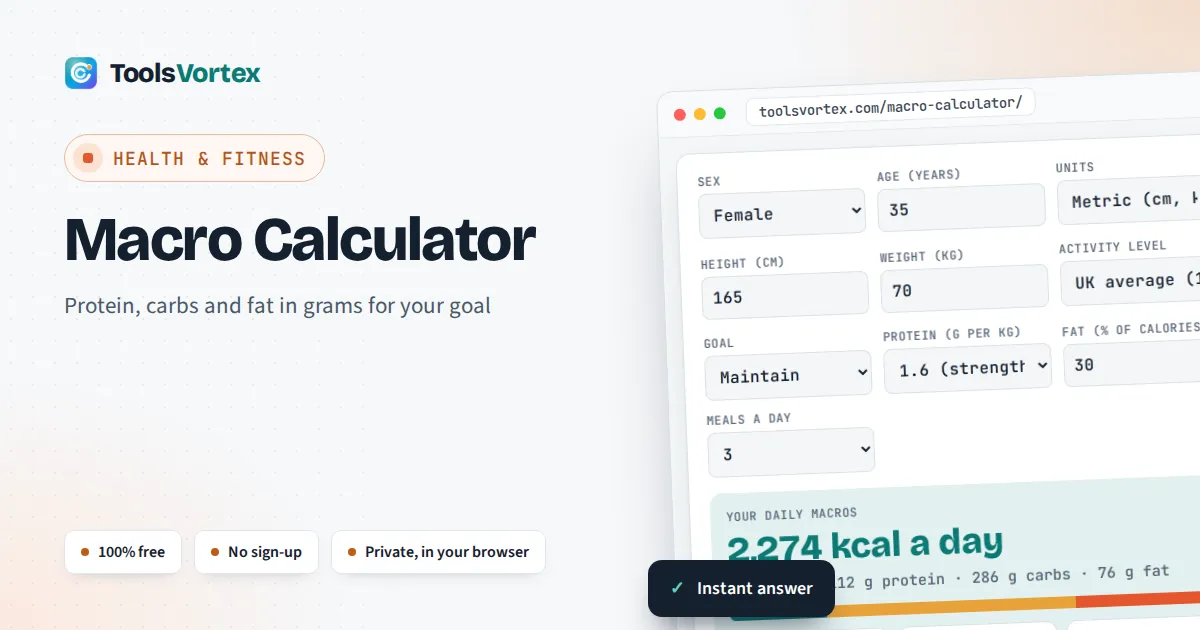
This macro calculator turns a daily calorie target into grams of protein, carbohydrate and fat, for adults who track food in an app or read nutrition labels and want numbers they can actually hit. It estimates your calories from your body size and activity, adjusts them for your goal, then splits them in a way that puts protein first. If you only need a calorie figure, the calorie calculator is quicker, and if protein is all you care about, the protein intake calculator goes deeper on that one nutrient.
How do you calculate your macros?
Set protein by body weight, often 1.4 to 2.0 g per kg if you exercise, give fat 20 to 35% of calories, then fill the rest with carbs. A macro calculator divides each share by its energy: 4 kcal per gram for protein and carbs, 9 for fat. At 70 kg and 2,000 kcal that is 112 g protein, 67 g fat and 238 g carbs.
How Does the Macro Calculator Work?
The tool works in three steps. First it estimates the calories you burn in a day. Then it moves that number up or down for your goal. Finally it splits the result into the three macronutrients, starting with protein because your needs depend on body weight, not on how much you eat.
2. Calories = BMR × activity level + goal adjustment
3. Protein (g) = body weight in kg × g per kg
Fat (g) = calories × fat % ÷ 9
Carbs (g) = (calories − protein × 4 − fat × 9) ÷ 4
The activity levels are physical activity level (PAL) values. The joint FAO, WHO and UNU expert report classes 1.40 to 1.69 as sedentary or light, and the UK Scientific Advisory Committee on Nutrition (SACN) uses a median of 1.63 for adults. The weight loss option takes off 600 kcal a day, the deficit used in UK NICE guidance for steady loss of about 0.5 to 1 kg a week. Energy is shown in kcal and in kJ (1 kcal = 4.184 kJ), because labels in the UK, Ireland and the EU print both. Under EU food information rules, labels count 4 kcal (17 kJ) per gram of protein or carbohydrate, 9 kcal (37 kJ) per gram of fat, 2 kcal (8 kJ) per gram of fibre and 7 kcal (29 kJ) per gram of alcohol.
What Macro Split Should You Use?
A split that keeps carbs between 45 and 60% and fat between 20 and 35% of your energy matches the ranges the European Food Safety Authority (EFSA) set for adults in 2010. EFSA also gives 25 g of fibre a day as adequate for normal bowel function. The calculator warns you when your split falls outside those ranges, which is fine for some planned diets such as low carb, but worth knowing.
The table shows how the grams change with your calorie target for a 70 kg adult eating 1.6 g of protein per kg with 30% of energy from fat. Protein stays fixed and carbs absorb the difference.
| Calories | Protein | Carbs | Fat | Carbs share |
|---|---|---|---|---|
| 1,600 kcal | 112 g | 168 g | 53 g | 42% |
| 1,800 kcal | 112 g | 203 g | 60 g | 45% |
| 2,000 kcal | 112 g | 238 g | 67 g | 48% |
| 2,200 kcal | 112 g | 273 g | 73 g | 50% |
| 2,500 kcal | 112 g | 326 g | 83 g | 52% |
| 2,800 kcal | 112 g | 378 g | 93 g | 54% |
Notice that at 1,600 kcal carbs drop to 42%, just below the EFSA range. On a low calorie target, a slightly lower fat share or a lower protein setting brings carbs back up if you prefer them.
Worked Example: What Are Tom’s Macros for Fat Loss?
Tom is 30, 180 cm tall and weighs 82 kg. He lifts weights four times a week and walks a lot, so he picks “Active most days” (1.78). He chooses “Lose (−600 kcal)”, eats four meals a day and chooses 2.0 g of protein per kg with 25% of calories from fat.
- BMR: 820 + 1,125 − 150 + 5 = 1,800 kcal
- Maintenance: 1,800 × 1.78 = 3,204 kcal
- Target: 3,204 − 600 = 2,604 kcal (about 10,895 kJ)
- Protein: 82 × 2.0 = 164 g (656 kcal)
- Fat: 2,604 × 25% ÷ 9 = 72 g (651 kcal)
- Carbs: (2,604 − 656 − 651) ÷ 4 = 324 g, which is 50% of his energy
Spread over four meals that is about 41 g of protein, 81 g of carbs and 18 g of fat per meal. If his weight has not moved after three or four weeks of accurate tracking, he can lower calories a little, taking it from carbs or fat rather than protein.
How Much Protein Should You Eat Per Meal?
About 0.25 g of high quality protein per kg of body weight, or 20 to 40 g, per meal is the dose the International Society of Sports Nutrition (ISSN) recommends, ideally every 3 to 4 hours. Its 2017 position stand says 1.4 to 2.0 g per kg a day is sufficient for most people who exercise, which is why the protein menu runs across that range. The “Per meal” box divides your daily grams by the number of meals, so you can check each meal lands near that 20 to 40 g window. For a closer look at protein by goal, age and diet, use the protein intake calculator.
How Do Your Macros Compare With Food Label Reference Intakes?
The “% RI” figures on UK, Irish and EU food labels are based on fixed reference intakes for an average adult, set in Annex XIII of EU Regulation 1169/2011: 8,400 kJ or 2,000 kcal of energy, 70 g of fat, 20 g of saturates, 260 g of carbohydrate, 90 g of sugars, 50 g of protein and 6 g of salt. They are labelling benchmarks, not personal targets. A person who trains will usually need far more than 50 g of protein, and someone on a 1,600 kcal plan will want less than 70 g of fat. Your own macros from this tool are a better yardstick when you read a label: if a meal gives 40 g of protein and your target is 120 g, that meal covers a third of your day.
How Accurate Is a Macro Calculator?
A macro calculator gives a sound starting point, but the calorie estimate behind it can be 10% or more out for one person, because predictive equations cannot see your exact muscle mass, daily movement or hormones. Treat the numbers as a first guess and adjust them using your weight trend over a few weeks. This is an estimate, not medical advice. Speak to your GP or a registered dietitian before changing your diet if you have diabetes, kidney disease or another long term condition, are pregnant or breastfeeding, are under 18, or have lost weight without trying. Very high protein diets in particular are not suitable for people with kidney problems. Your weight category from the BMI calculator can help you decide whether to aim for loss, maintenance or gain.
How Do You Use the Macro Calculator?
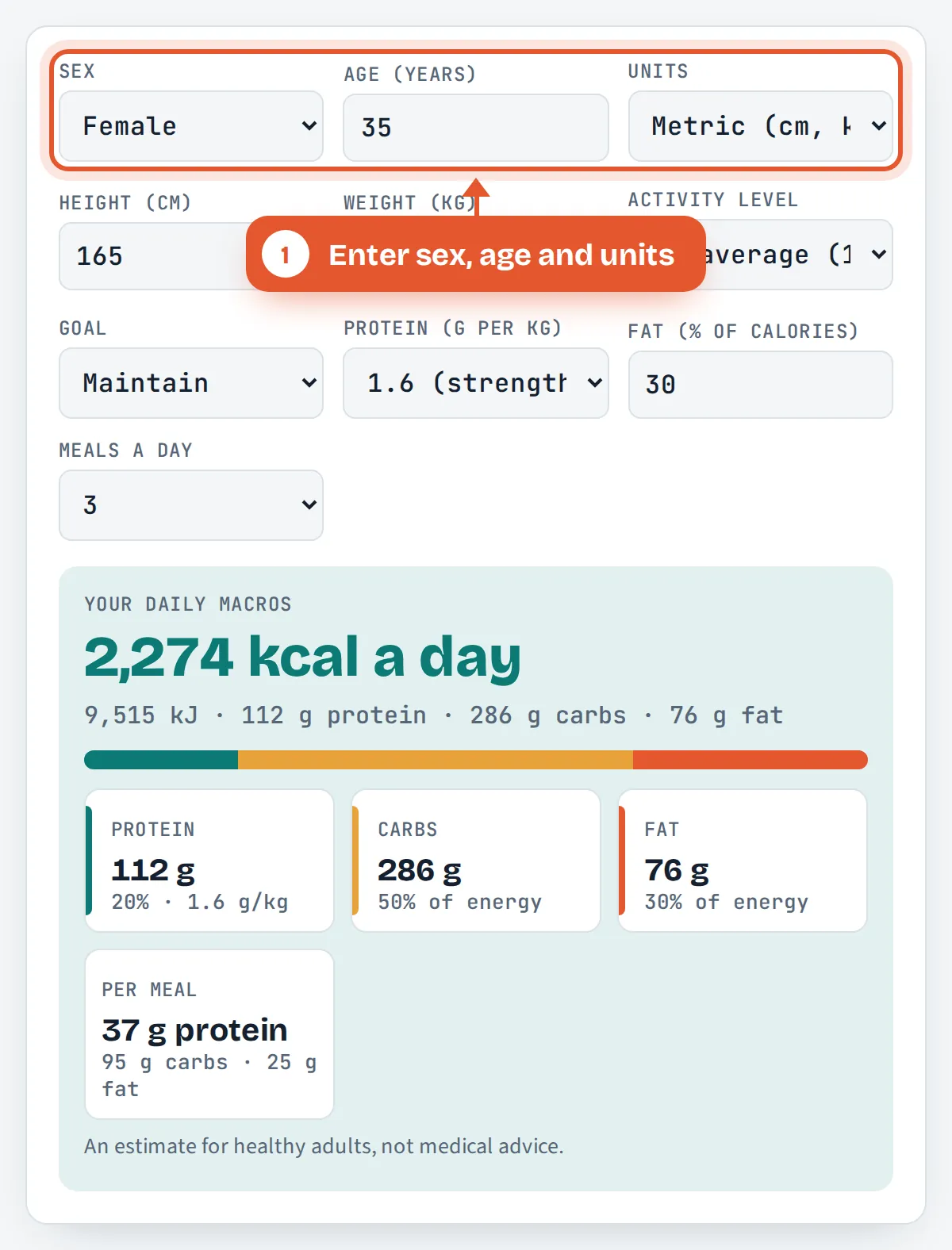
Enter sex, age and units
Pick your sex and age, then choose metric, UK (stone and pounds) or US units.

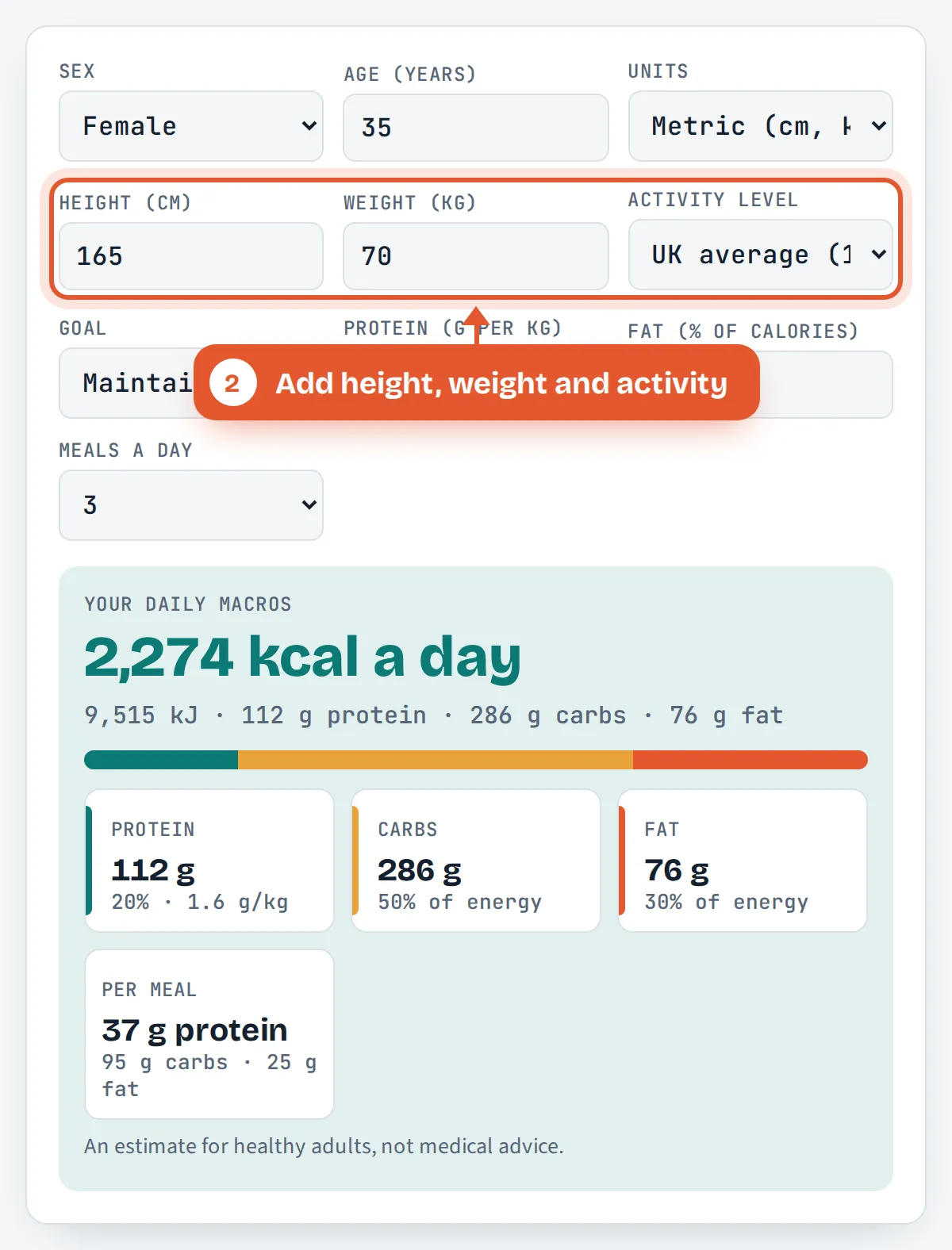
Add height, weight and activity
Type your height and weight, then choose the activity level that matches a normal week.
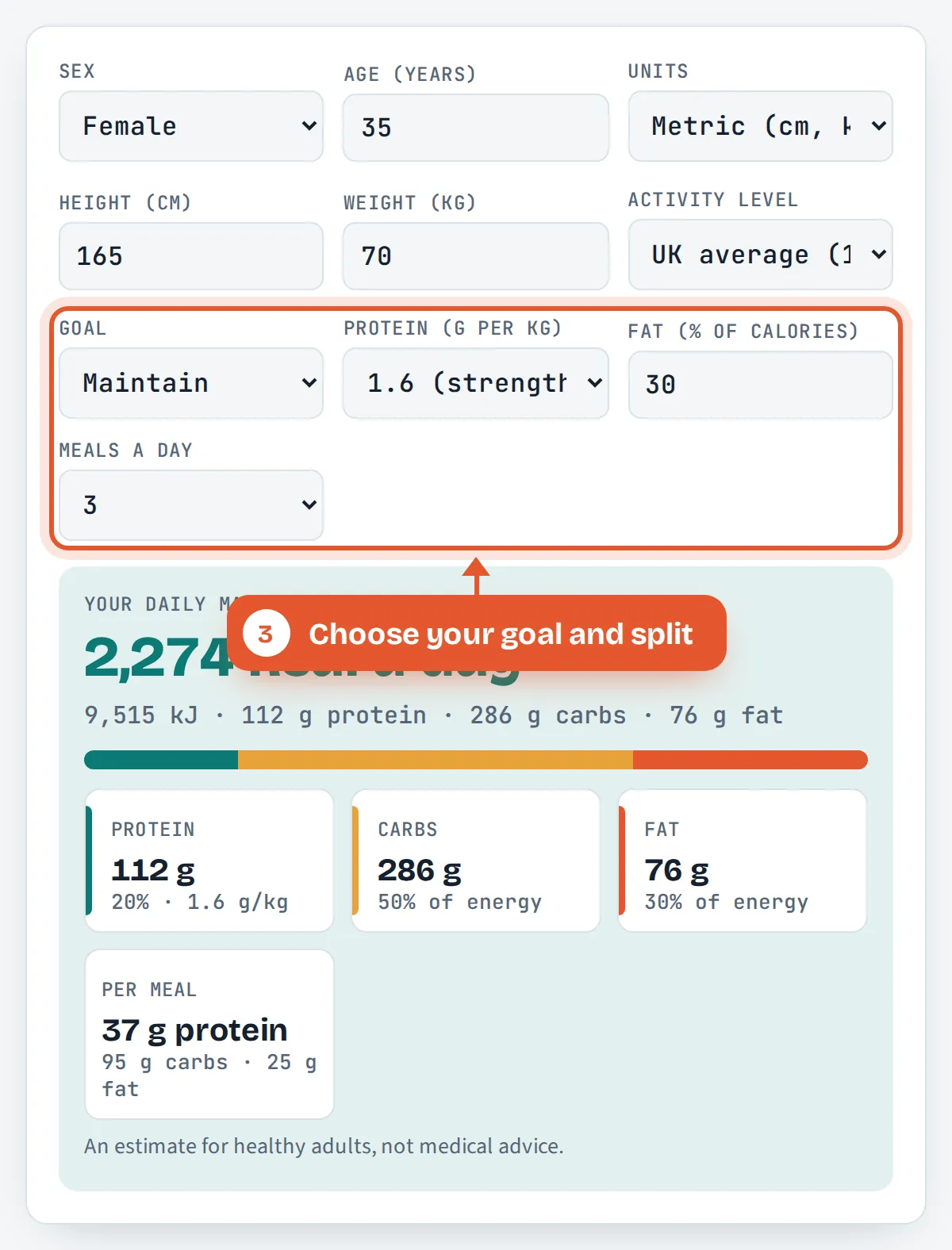
Choose your goal and split
Pick a goal or enter your own calories, then set protein per kg, fat percentage and meals a day.
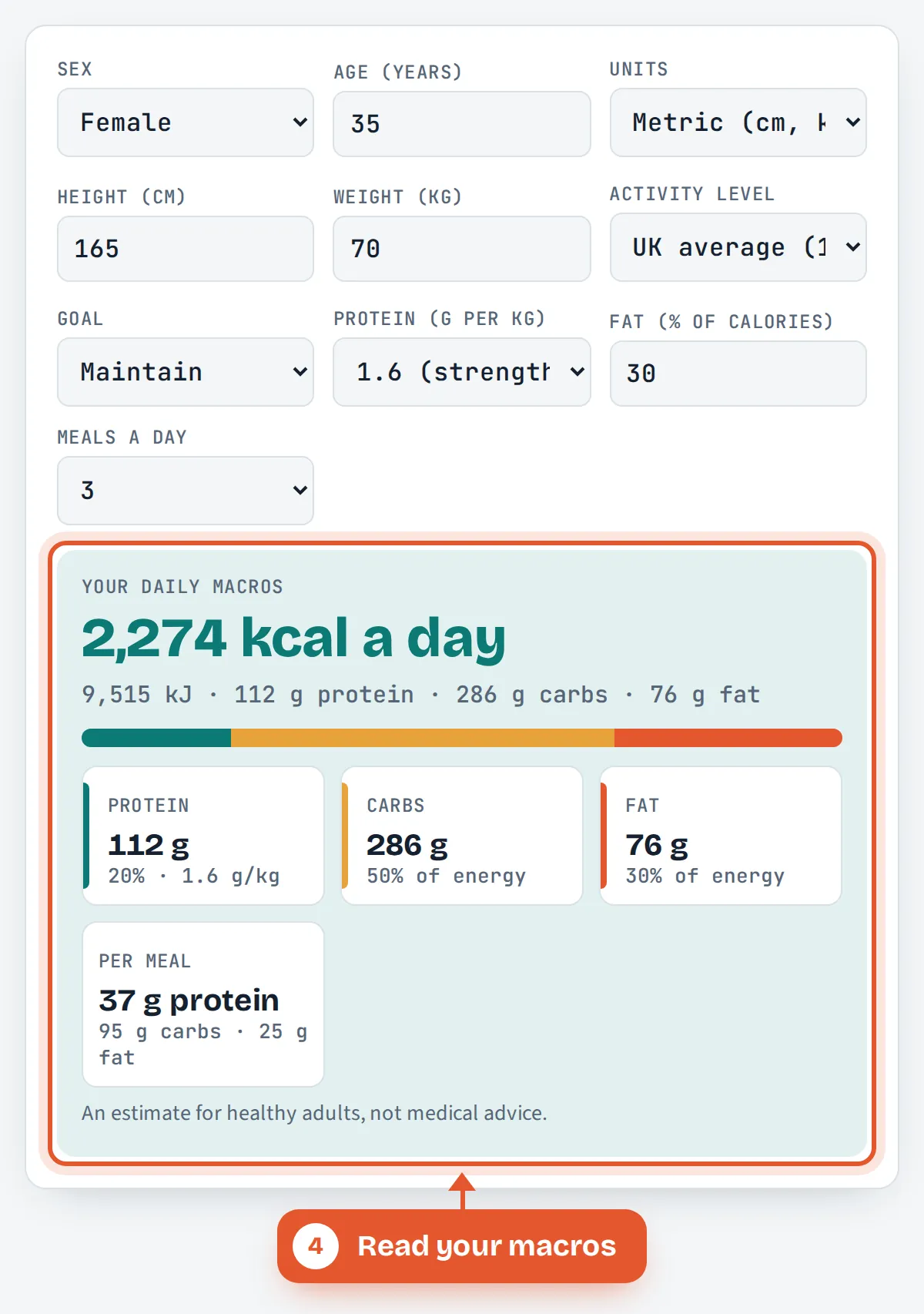
Read your macros
Your calories and grams of protein, carbs and fat appear at once, with percentages, kJ and amounts per meal.
Frequently Asked Questions
What is a good macro ratio for weight loss?
There is no single best ratio. A practical approach is to keep protein high, around 1.6 to 2.0 g per kg, keep fat between 20 and 35% of calories and let carbs fill the rest. The calorie deficit drives weight loss, while protein helps you keep muscle.
How many grams of protein, carbs and fat should I eat a day?
It depends on your calories and weight. A 70 kg adult on 2,000 kcal eating 1.6 g of protein per kg and 30% fat needs about 112 g of protein, 67 g of fat and 238 g of carbs. Enter your own details for exact numbers.
Should I count calories or macros?
Calories decide whether you lose or gain weight. Macros decide what that weight is made of and how full you feel. Counting macros includes calories automatically, since protein and carbs give 4 kcal per gram and fat gives 9 kcal per gram.
Does fibre count towards my carbs?
On UK and EU labels, fibre is listed separately and is not included in the carbohydrate figure, and it counts as 2 kcal per gram. In the US, fibre is included in total carbohydrate. EFSA considers 25 g of fibre a day adequate for adults.
Can I do a low carb or keto split with this calculator?
Yes. Raise the fat percentage and the carbs fall automatically. The tool will tell you when carbs drop below the EFSA range of 45 to 60% of energy. Very low carb diets are best discussed with a GP if you take medicine for diabetes.
How often should I recalculate my macros?
Recalculate after every 4 to 5 kg of weight change, or when your training changes a lot. Your protein grams follow your body weight, and your calories fall as you get lighter, so old numbers slowly stop matching your body.
Sources and Further Reading
- EFSA sets European dietary reference values for nutrient intakes, European Food Safety Authority (2010)
- Jäger R et al. International Society of Sports Nutrition Position Stand: protein and exercise (2017), University of South Carolina
- SACN Dietary Reference Values for Energy, GOV.UK (2011)
Related Tools
Last reviewed: October 2026