Enter a dividend and a divisor to get the quotient and remainder, the full written long division layout, and a plain English explanation of every divide, multiply, subtract and bring down step.
23 × 325 + 14 = 7,489
Runs in your browser. Nothing you type is sent anywhere.
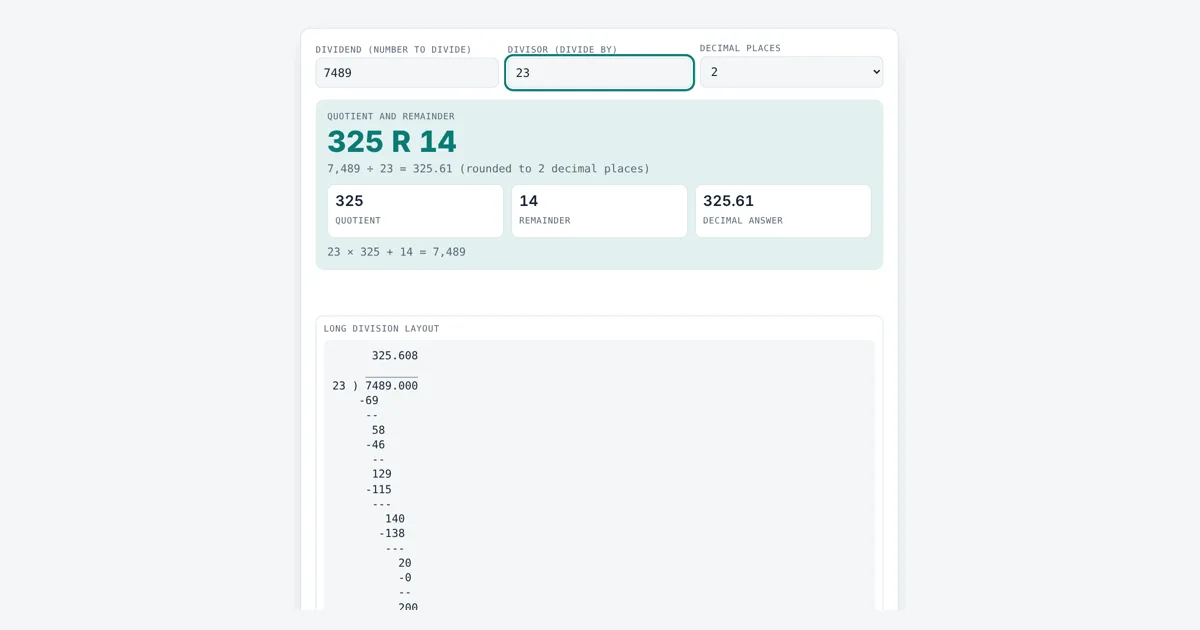
This long division calculator is for students checking homework, parents helping with it, and anyone who wants to see how a division really works. You get the quotient, the remainder, a decimal answer to the number of places you choose, and the same written layout a teacher would put on the board.
How Do You Do Long Division Step by Step?
Long division repeats four steps: divide, multiply, subtract, bring down. For 7,489 ÷ 23, 23 goes into 74 three times (69, leaving 5), into 58 twice (46, leaving 12), and into 129 five times (115, leaving 14). The answer is 325 remainder 14, or about 325.61.
What Are the Parts of a Long Division Problem?
A long division problem has four parts: the dividend, the divisor, the quotient and the remainder. The dividend is the number being split up (7,489). The divisor is the number you divide by (23). The quotient is the whole number answer written on top (325), and the remainder is what is left over because it is smaller than the divisor (14).
These four numbers always fit the division algorithm, also called Euclidean division:
7,489 = 23 × 325 + 14
The tool shows this check line under every answer, so you can confirm the result by multiplying back.
How Do You Turn a Remainder Into a Decimal?
To turn a remainder into a decimal, put a decimal point after the dividend, add zeros, and keep dividing. For 7,489 ÷ 23 the remainder 14 becomes 140, and 23 goes into 140 six times, so the first decimal digit is 6. Keep going and you get 325.6086… The tool works out one extra digit to round correctly, so 2 decimal places gives 325.61. Some divisions stop with a remainder of 0 (a terminating decimal) and some repeat forever, such as 1,000 ÷ 7 = 142.857142… To see a remainder as a fraction instead, write it over the divisor: 14/23. Our fraction calculator can simplify that, and the rounding calculator explains the rounding rules.
Long Division Examples Table
Each row was worked out with this tool. Decimals are rounded to 4 places.
| Division | Quotient R remainder | Decimal |
|---|---|---|
| 100 ÷ 4 | 25 R 0 | 25 |
| 84 ÷ 5 | 16 R 4 | 16.8 |
| 144 ÷ 12 | 12 R 0 | 12 |
| 250 ÷ 6 | 41 R 4 | 41.6667 |
| 365 ÷ 7 | 52 R 1 | 52.1429 |
| 1,000 ÷ 3 | 333 R 1 | 333.3333 |
| 1,000 ÷ 7 | 142 R 6 | 142.8571 |
| 7,489 ÷ 23 | 325 R 14 | 325.6087 |
| 9,876 ÷ 54 | 182 R 48 | 182.8889 |
Why Does Long Division Work?
Long division works because of place value: each digit of the dividend stands for ones, tens, hundreds or thousands, and you share out the largest place first. In 7,489 ÷ 23 the first step really asks how many 23s fit in 74 hundreds, which is 3 hundreds. The leftover 5 hundreds become 50 tens, and adding the 8 tens gives 58 tens. That is why you “bring down” the next digit. If a remainder ever comes out bigger than the divisor, the digit you chose was too small. Breaking a divisor into factors can make mental checks easier, and the GCF calculator helps when you want to simplify the matching fraction.
Worked Example
A school buys 7,489 pencils and shares them between 23 classrooms. Enter 7489 and 23: the tool shows 325 R 14, so each room gets 325 pencils and 14 are left over. The check line reads 23 × 325 + 14 = 7,489. Pick 2 decimal places and the answer becomes 325.61, with the layout extended to 7489.000 and the extra digit 8 used to round up.
How Do You Use the Long Division Calculator?
Enter the dividend
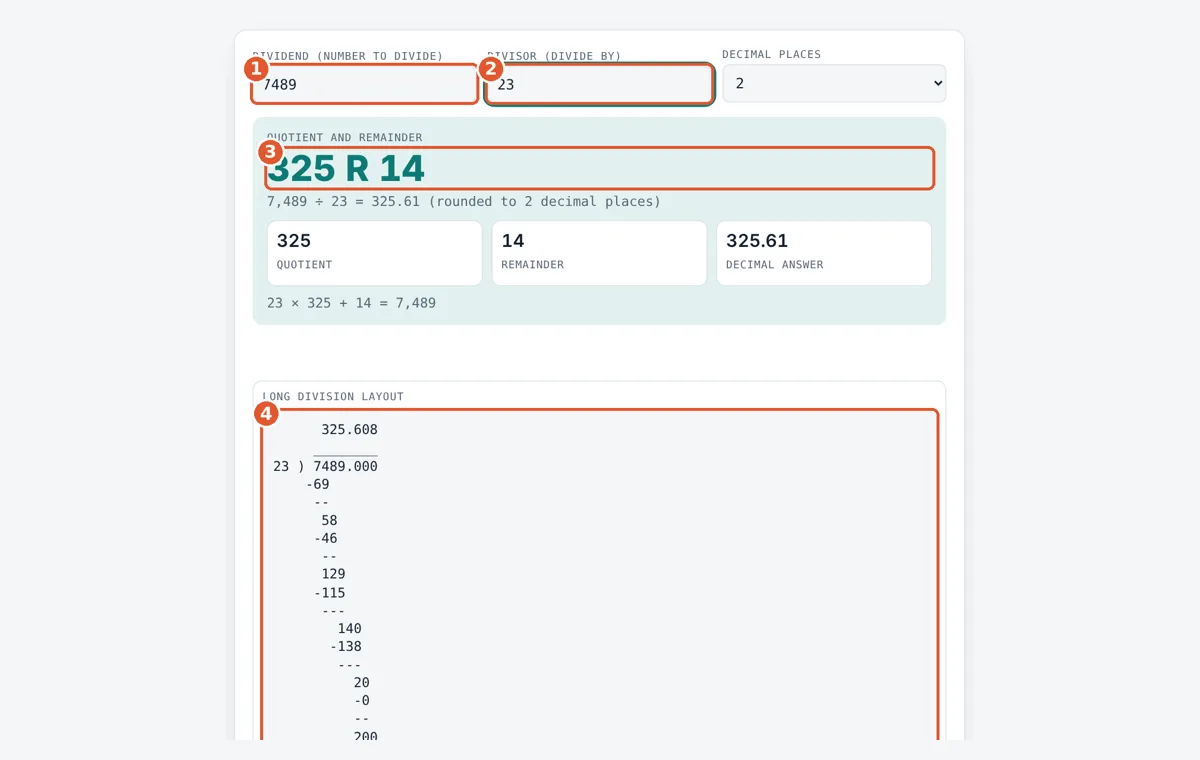
Type the number you want to divide into the first box, for example 7489.
Enter the divisor
Type the number you divide by, for example 23. It must be 1 or more.
Read quotient and remainder
The big result shows the answer as quotient R remainder, with a check line under it.
Follow the layout
The written layout and the numbered steps show every divide, multiply, subtract and bring down.
Frequently Asked Questions
What is 1,000 divided by 7 using long division?
1,000 ÷ 7 is 142 remainder 6. Seven goes into 10 once, leaving 3, into 30 four times, leaving 2, and into 20 twice, leaving 6. As a decimal it is 142.857142…, a repeating decimal that rounds to 142.8571.
What does R mean in a division answer?
R stands for remainder, the amount left over after sharing equally. In 365 ÷ 7 = 52 R 1, seven fits into 365 fifty two whole times and 1 is left, because 7 × 52 = 364 and 365 − 364 = 1.
Can the remainder be bigger than the divisor?
No. The remainder must always be smaller than the divisor. If you get a remainder of 25 when dividing by 23, the quotient digit was one too small, so add 1 to it and subtract 23 again.
How do I divide when the divisor is bigger than the dividend?
The quotient is 0 and the remainder is the whole dividend. For 5 ÷ 8 the answer is 0 R 5. Add a decimal point and zeros to keep going: 50 ÷ 8 = 6 R 2, then 20 ÷ 8 = 2 R 4, then 40 ÷ 8 = 5, giving 0.625.
How do you do long division with decimals?
Move the decimal point in the divisor to the right until it is a whole number, and move the dividend's point the same number of places. So 12.5 ÷ 0.5 becomes 125 ÷ 5 = 25. Then divide as normal with whole numbers.
How large can the numbers be?
The tool accepts dividends up to 15 digits and divisors up to 9 digits, which covers any homework problem. For example, 999,999,999,999,999 ÷ 7 gives 142,857,142,857,142 R 5 with every step shown.
Sources and Further Reading
- Wikipedia: Long division (method and history)
- Wikipedia: Euclidean division (quotient and remainder theorem)
- Wolfram MathWorld: Long Division
Related Tools
Last reviewed: October 2026