Choose a fasting plan and the time of your first meal to see your daily eating window, when to stop eating and when your fast ends. Times show in 12-hour and 24-hour format.
Not for under 18s, pregnancy, breastfeeding, type 1 diabetes or a history of eating disorders. Ask your doctor first if you take medicine.
Runs in your browser. Nothing you type is sent anywhere.
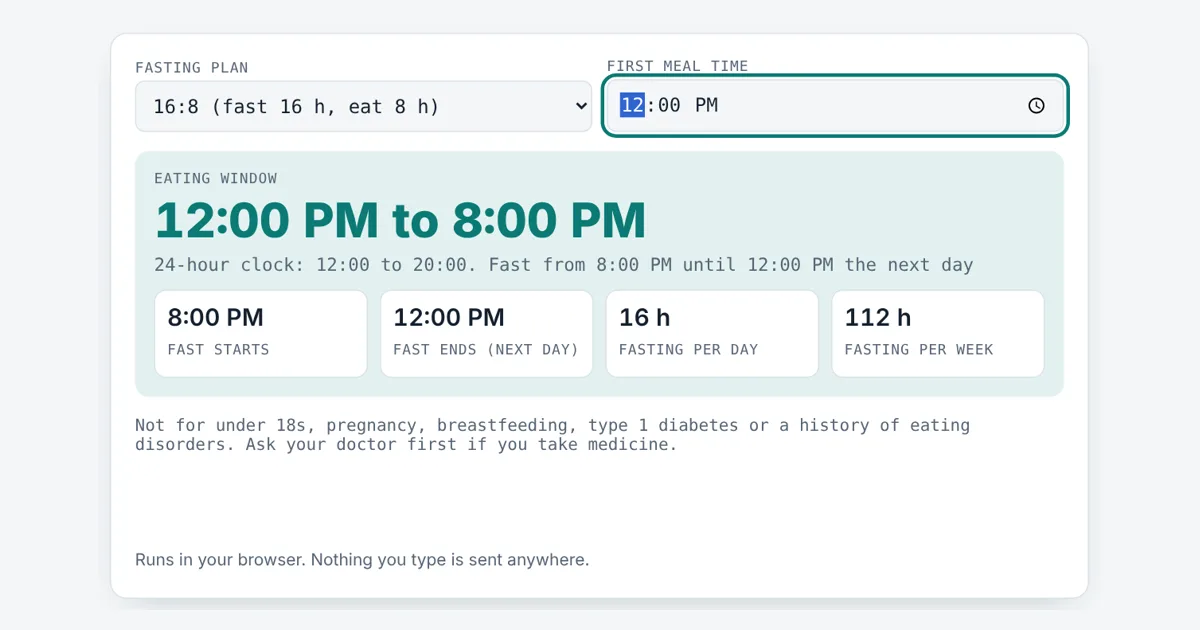
This intermittent fasting calculator is for anyone trying 16:8, 18:6, 20:4, OMAD or the 5:2 diet who wants a clear daily schedule. Enter when you like to eat first, and it shows your eating window, the time your fast starts and ends, and your fasting hours per day and week.
How Does a 16:8 Intermittent Fasting Schedule Work?
On a 16:8 schedule you eat all your food within 8 hours and fast for the other 16. If your first meal is at 12:00 PM, your eating window closes at 8:00 PM and your fast runs until 12:00 PM the next day. That adds up to 112 fasting hours a week.
What Is Intermittent Fasting?
Intermittent fasting is an eating pattern where you switch between set times of eating and set times of not eating, rather than changing what you eat. The most common type is time-restricted eating, where all your food fits into a daily window, such as 8 hours. The other main type is the 5:2 diet, where you eat normally on five days and keep two days very low in calories. During the fast, water, black coffee and plain tea are usually allowed.
Which Intermittent Fasting Schedule Is Best for Beginners?
For most beginners, 14:10 or 16:8 is the easiest schedule, because much of the fast happens while you sleep. You can start at 12 hours overnight and add an hour every few days. Here is how each plan looks with a first meal at 12:00 PM, as worked out by this tool:
| Plan | Eating window | Fast per day | Fast per week |
|---|---|---|---|
| 14:10 | 12:00 PM to 10:00 PM | 14 h | 98 h |
| 16:8 | 12:00 PM to 8:00 PM | 16 h | 112 h |
| 18:6 | 12:00 PM to 6:00 PM | 18 h | 126 h |
| 20:4 | 12:00 PM to 4:00 PM | 20 h | 140 h |
| OMAD (23:1) | 12:00 PM to 1:00 PM | 23 h | 161 h |
| 5:2 | Normal 5 days, about 500 to 600 kcal on 2 days | n/a | n/a |
OMAD means one meal a day. It is the strictest daily plan, and it can be hard to get enough protein, fibre and vitamins in a single meal.
How Do You Work Out Your Intermittent Fasting Window?
You work out your fasting window by adding the eating hours to your first meal time; that is when you stop eating, and the fast runs until the same first meal time the next day.
fast ends = first meal time, next day
Pick a first meal time that fits work, family meals and training. Eating earlier in the day lines up better with your circadian rhythm, the body clock that controls sleep and hormone cycles, and some studies suggest early windows help blood sugar control.
Does Intermittent Fasting Work for Weight Loss?
Intermittent fasting can help with weight loss, mainly because a shorter eating window makes it easier to eat fewer calories overall. Trials comparing it with ordinary calorie cutting have found similar weight loss for both. After several hours without food the body uses up stored glucose and burns more fat, a shift called metabolic switching. To set a calorie target for your eating window, use the calorie calculator, and to make sure meals carry enough protein, check the protein intake calculator. Drink enough water during the fast; the water intake calculator gives a daily goal.
This is a planning tool, not medical advice. Intermittent fasting is not suitable for children and teens, pregnant or breastfeeding women, people with type 1 diabetes or a history of eating disorders. Talk to a doctor first if you take medicine for diabetes or blood pressure.
Worked Example
Priya picks 16:8 and a first meal at 12:00. The tool shows an eating window of 12:00 PM to 8:00 PM (12:00 to 20:00), a fast that starts at 8:00 PM and ends at 12:00 PM the next day, 16 fasting hours a day and 112 a week. Her brother tries 18:6 with breakfast at 07:30: the tool shows 7:30 AM to 1:30 PM, then an 18 hour fast until 7:30 AM. A night shift worker on 16:8 with a first meal at 18:00 gets 6:00 PM to 2:00 AM, with the window crossing midnight.
How Do You Use the Intermittent Fasting Calculator?
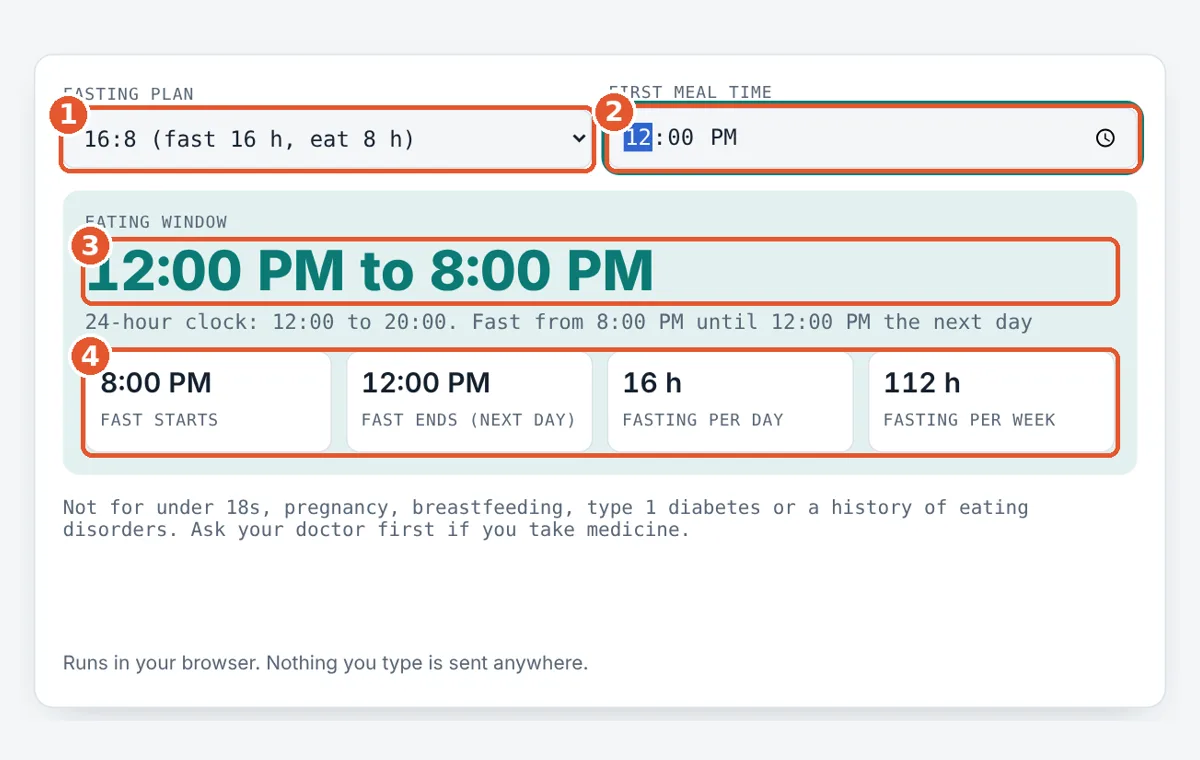
Choose a fasting plan
Pick 16:8, 14:10, 18:6, 20:4, OMAD or 5:2 from the list.
Set your first meal time
Enter when you usually want your first meal. The 5:2 plan does not need a time.
Read your eating window
The big text shows when you eat, in 12-hour time, with 24-hour time below.
Check fast times
The boxes show when the fast starts, when it ends and your fasting hours per day and week.
Frequently Asked Questions
Can I drink coffee during intermittent fasting?
Yes, black coffee, plain tea and water are generally fine during the fast because they have almost no calories. Adding milk, sugar or cream adds calories, which many people count as breaking the fast.
What breaks a fast?
Anything with meaningful calories breaks a fast, such as food, juice, milk or sugary drinks. Water, sparkling water, black coffee and plain tea do not. Many plans allow a small splash of milk, but strict plans do not.
Is 16:8 or 18:6 better?
Neither is clearly better for weight loss. 16:8 is easier to keep up for most people, while 18:6 shortens the eating window by two hours. The best plan is the one you can follow most days without overeating in the window.
How many calories should I eat on 5:2 fast days?
The usual 5:2 guide is about 500 kcal for women and 600 kcal for men on each of the two low days. Spread them over one or two small meals with protein and vegetables, and keep the two days apart.
Can I exercise while intermittent fasting?
Yes. Many people train near the end of the fast and eat soon after. Light exercise is fine while fasted, but hard sessions may feel tougher. Drink water and stop if you feel dizzy or faint.
What if my eating window crosses midnight?
That is fine for night shifts. For example, a first meal at 6:00 PM on 16:8 gives a window from 6:00 PM to 2:00 AM. The tool marks it as the next day so you can plan your sleep and meals.
Sources and Further Reading
- de Cabo R, Mattson MP. Effects of intermittent fasting on health, aging, and disease, N Engl J Med 2019 (PubMed)
- Johns Hopkins Medicine: Intermittent fasting, what is it and how does it work?
Related Tools
Last reviewed: October 2026