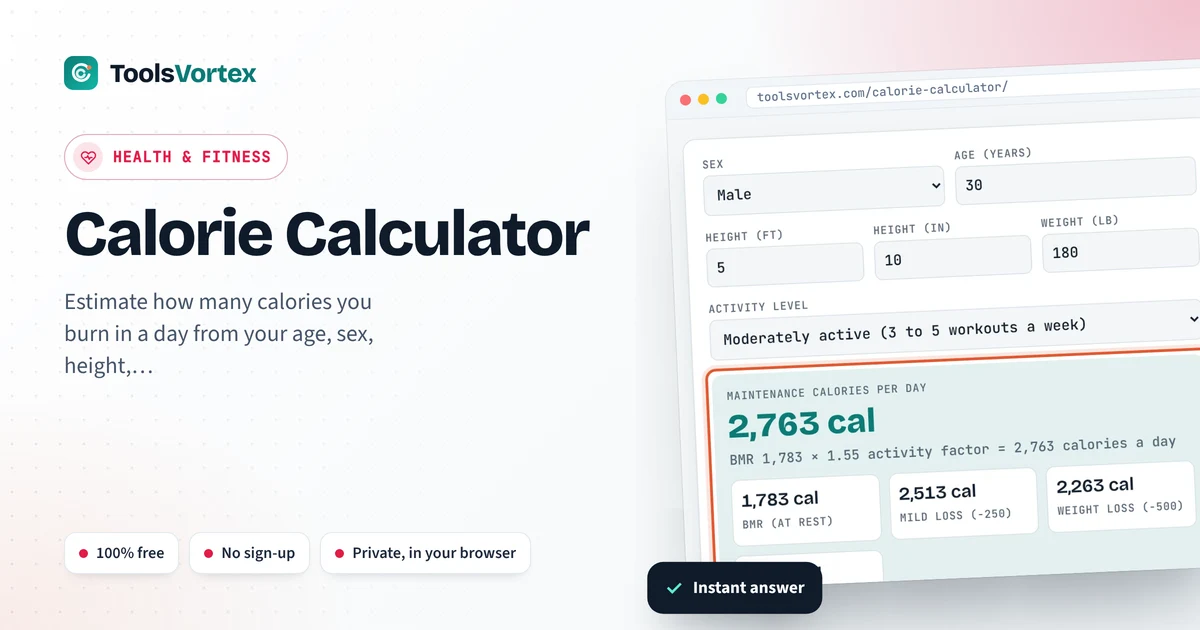
Type in your age, sex, height, weight and how active you really are. You’ll get the calories you burn in a day, plus numbers to eat if you want to lose or gain.

I use a calorie calculator the way some people use a bathroom scale they don’t fully trust. A rough opening bid. You burn fuel all day, even flat on the couch with a cooking show you aren’t watching. That floor is your BMR. Now add the dog walks. The stairs at the office, because the elevator’s been broken since March. Tuesday spin. That’s TDEE, the whole day. I picked Mifflin-St Jeor for the math since most dietitians grab it first. Fill it in. Then knock the activity level down one notch, just to see. Kind of humbling.
How many calories do I need a day?
Depends who’s asking, but most adults sit somewhere around 1,600 to 3,000. A calorie calculator gets you closer: BMR times an activity factor. My go-to example is a 30-year-old guy at 5 ft 10 in and 180 lb, BMR about 1,783, gym a few days a week so × 1.55. He needs roughly 2,763 calories a day to stay put. Want a pound a week off? Eat near 2,263, give or take a banana.
The formula (skip it if you like)
Women: BMR = 10 × weight (kg) + 6.25 × height (cm) − 5 × age − 161
Daily calories (TDEE) = BMR × activity factor
Kilos at 7 a.m.? No thanks. Type pounds and inches like a normal American and let the page fiddle with the conversion (1 lb is 0.4536 kg, 1 in is 2.54 cm).
Activity multipliers
| Activity level | Factor | 5 ft 10 in, 180 lb man, age 30 |
|---|---|---|
| Sedentary | 1.2 | 2,139 cal |
| Lightly active | 1.375 | 2,451 cal |
| Moderately active | 1.55 | 2,763 cal |
| Very active | 1.725 | 3,075 cal |
| Extra active | 1.9 | 3,387 cal |
Same guy. Same breakfast. And the number jumps by over 1,200 calories because of one dropdown. Honestly? I’d fuss over that dropdown more than anything else here.
Why I stop at 500 under
You’ve heard it. Cut 500 a day, lose a pound a week. True-ish, for a few weeks. Then a lighter you burns a bit less and the scale gets lazy. Maddening. Also normal. The NIH Body Weight Planner bakes that slowdown in, if you want fancy. Me, I’d rather do a small cut I’ll keep than a heroic one I quit by Friday. Don’t go under about 1,200 a day (women) or 1,500 (men) without a doctor in on it.
Is my number off? Probably a little
Formulas guess. Your body might run hot, might run cold. So test it. Eat right at maintenance for two or three weeks. Weigh in most mornings, and only trust the weekly average. If it’s flat, hey, you found your real number. If it creeps up I’d shave 100 or 200 off. Sliding down, add some back.
The mistakes are dull ones. Very active, because you jogged twice last week. One weigh-in, the morning after salty ramen, and panic. Ten pounds gone and you never ran it again. For our 180 lb guy that’s about 70 calories less maintenance at the same activity. Small. It piles up, though.
How to use the Calorie Calculator
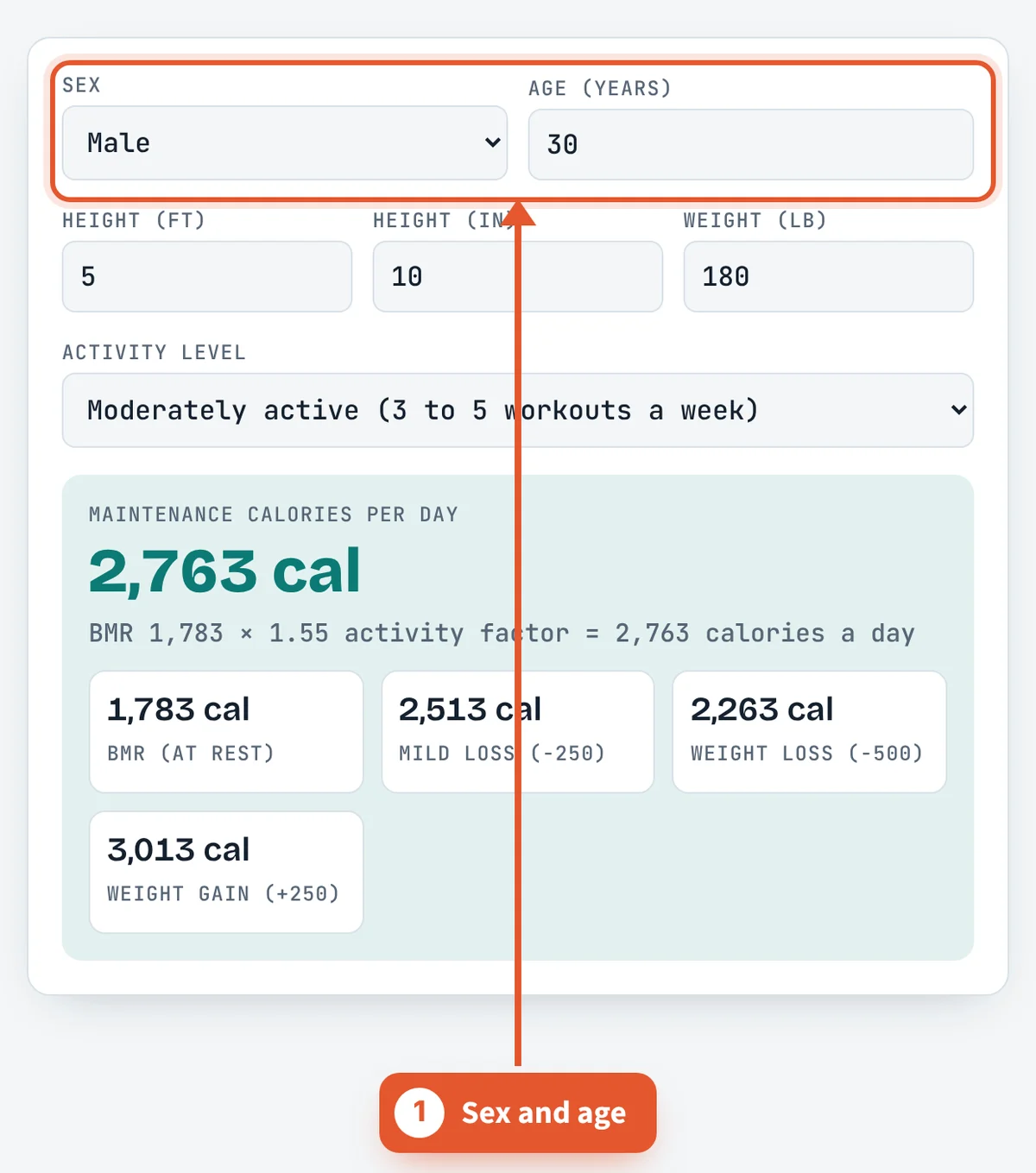
Sex and age first
Male or female, then your age. Both nudge the resting burn a little.

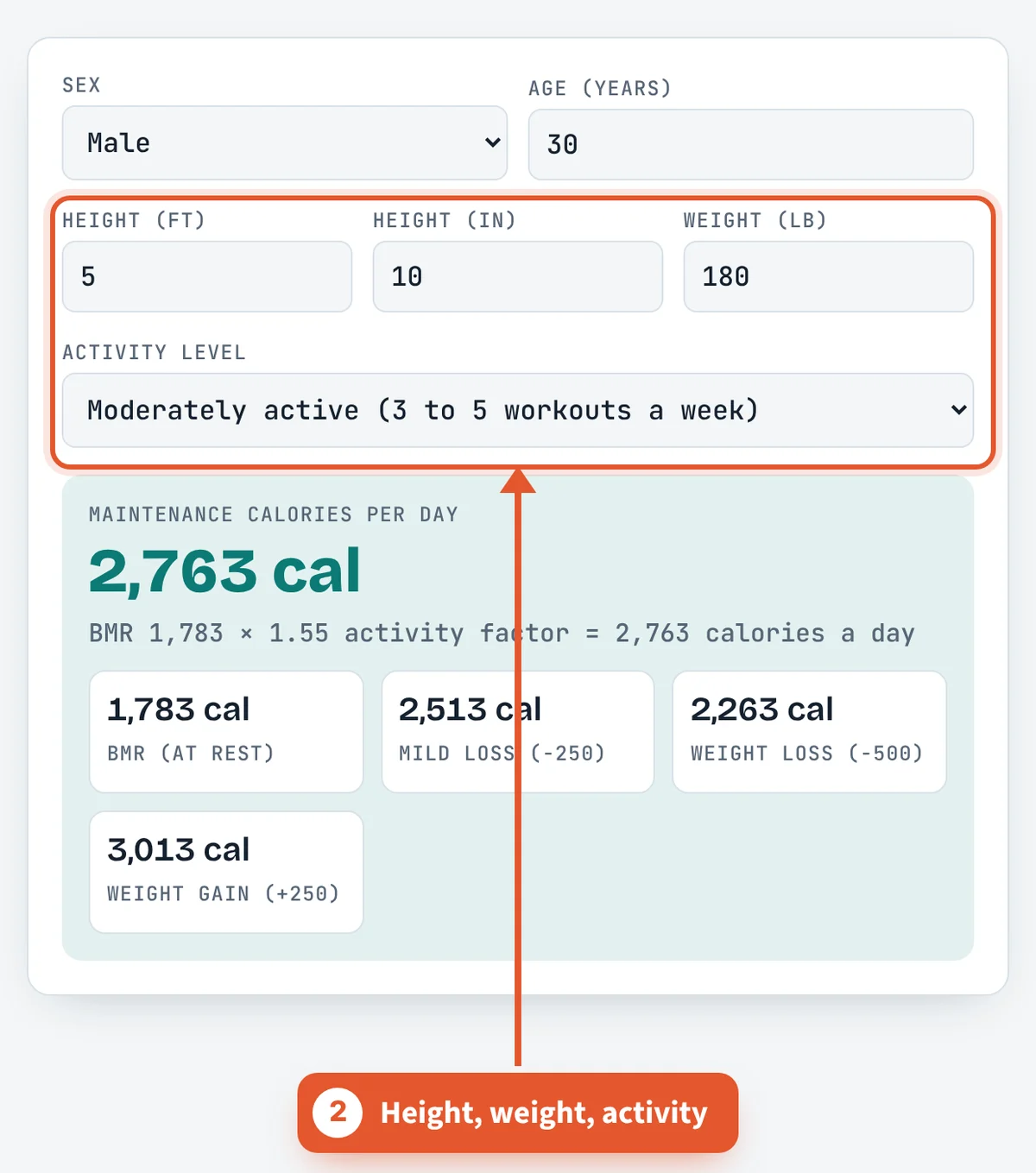
Then height, weight and how much you actually move
Feet and inches. Pounds. For activity, think of a boring normal week, not that one heroic week back in January.
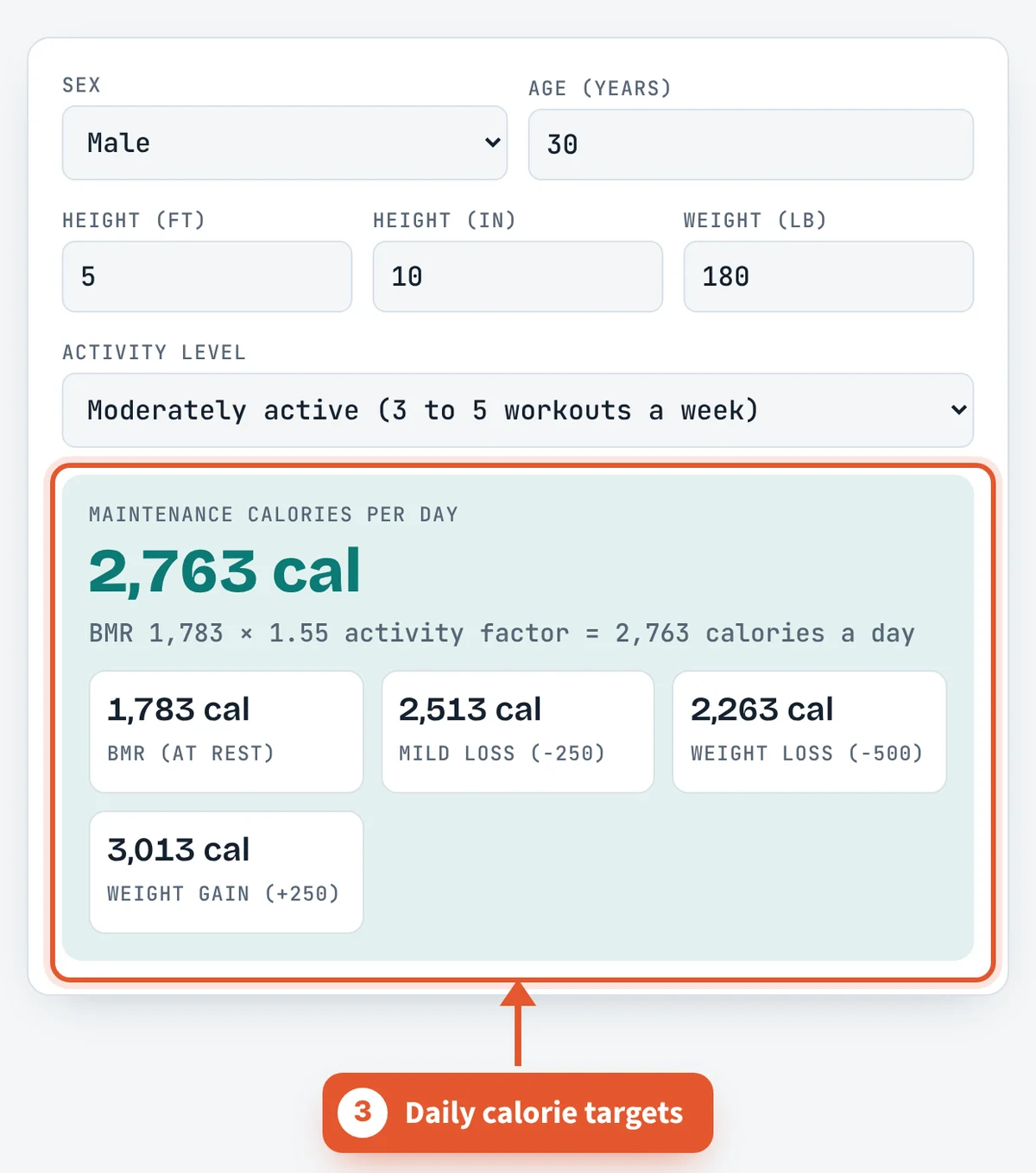
Read the numbers
Big number on top is maintenance. Under it: BMR, a gentle cut, a faster cut, and a small gain if you’re bulking.
Where do the calorie numbers on food labels come from?
Most labels are not measured by burning the food. They are calculated with the Atwater system, named after American chemist Wilbur Olin Atwater, who worked out average energy values for the main nutrients in the late 1800s:
| Nutrient | Calories per gram |
|---|---|
| Protein | 4 |
| Carbohydrate | 4 |
| Fat | 9 |
| Alcohol | 7 |
The “Calorie” on a label is really a kilocalorie, equal to 4.184 kilojoules, which is why labels outside the US often show kJ as well. A food with 20 g protein, 30 g carbohydrate and 10 g fat works out to 80 + 120 + 90 = 290 Calories.
Labels also carry some slack. Under the Food and Drug Administration labeling rule in 21 CFR 101.9, the actual calorie content can be up to 20% above the declared value before a product is considered misbranded. That margin, plus how much your body actually absorbs, is one more reason to treat your daily target as an estimate. To split that target into protein, carbs and fat, use the macro calculator.
Does cutting 3,500 calories always burn one pound of fat?
The 3,500 calorie rule comes from a 1958 paper by physician Max Wishnofsky, who estimated the energy stored in a pound of body fat. As a description of fat tissue it is reasonable. As a forecast of weight loss over months, it overpromises.
The reason is that your body changes as you lose weight. A smaller body burns fewer calories at rest and during movement, and some of the drop in energy use goes beyond what the lost weight alone explains. Researchers call this metabolic adaptation. Early losses also include water and stored glycogen, which is why the first week often looks better than the rule predicts and later weeks look worse.
Researcher Kevin Hall and colleagues at the National Institutes of Health built a dynamic model that accounts for these changes, and it powers the NIH Body Weight Planner. Its main lesson is that a fixed daily deficit produces fast loss at first and then a slowing curve, not a straight line.
In practice, recalculate your needs every 10 or so pounds lost. The BMR calculator shows how your resting burn falls with weight, and the calorie deficit calculator helps you set a new target.
Frequently asked questions
Is Mifflin-St Jeor any good?
Good enough that dietitians still reach for it. For most healthy adults it’s within about 10% of what a lab gets at rest. Bodybuilders, and people carrying a lot of extra weight, can be further off.
Which activity level should I pick?
Lower than your ego says. Desk job, three gym sessions a week? That’s often Lightly active. Think about the other 160-odd hours.
What do I eat to lose a pound a week?
Roughly 500 a day under maintenance. Seven days of that is the famous 3,500, the old pound-of-fat rule. It won’t stay that tidy past the first month, sadly.
Why is my BMR lower than I thought?
Because it pretends you lie there all day like a houseplant. No walking, no fidgeting. Everything you actually do gets stacked on top through the activity factor.
Should I eat back what my watch says I burned?
I wouldn’t. Your activity level already counts normal workouts, so that’s double counting. And watches are generous.
My weight loss stalled. Now what?
Annoying, right? You’re lighter, so you burn less, and the gap you started with quietly got smaller. Water plays tricks for a week or two as well. Put your new weight in, see what it says, and give it a couple more weeks before you cut harder.
Is this calorie calculator OK for teens or pregnant women?
Nope. A growing teenager, or someone pregnant or breastfeeding, needs different numbers than any adult formula gives. That’s one for your doctor or a registered dietitian.
Sources and further reading
Related tools
Last reviewed: October 2026