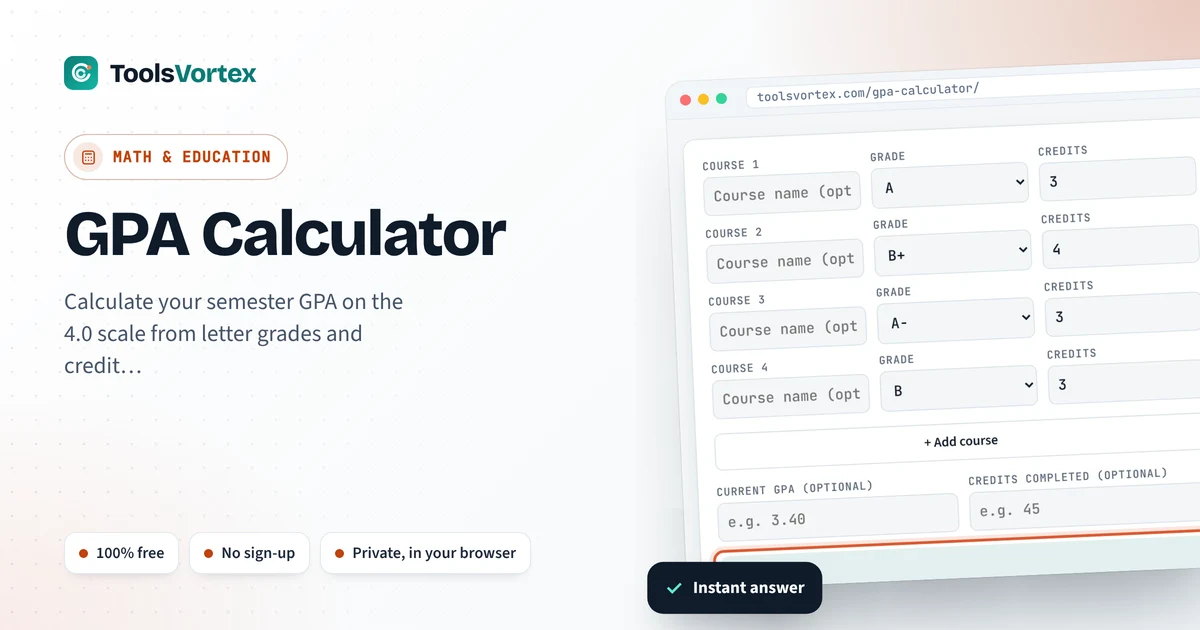
Calculate your semester GPA on the 4.0 scale from letter grades and credit hours, and combine it with your current GPA to get your cumulative GPA.

Your grade point average decides honors, scholarships, internships and graduate school offers, so it helps to know exactly where you stand before grades are posted. Add each course with its letter grade and credit hours to get your semester GPA on the standard US 4.0 scale, then add your current GPA to see your new cumulative GPA.
How do I calculate my GPA?
Multiply each course’s grade points by its credit hours to get quality points, add them up, and divide by the total credit hours. For example, an A (4.0) in a 3-credit class and a B (3.0) in a 4-credit class give (12 + 12) ÷ 7 = 3.43 GPA.
4.0 GPA scale
| Letter grade | Grade points | Letter grade | Grade points |
|---|---|---|---|
| A+ / A | 4.0 | C+ | 2.3 |
| A− | 3.7 | C | 2.0 |
| B+ | 3.3 | C− | 1.7 |
| B | 3.0 | D+ / D / D− | 1.3 / 1.0 / 0.7 |
| B− | 2.7 | F | 0.0 |
Cumulative GPA formula
Some schools give an A+ 4.33 points or weight honors and AP classes on a 5.0 scale. Check your registrar’s policy if your school uses a different scale.
How to use the GPA Calculator
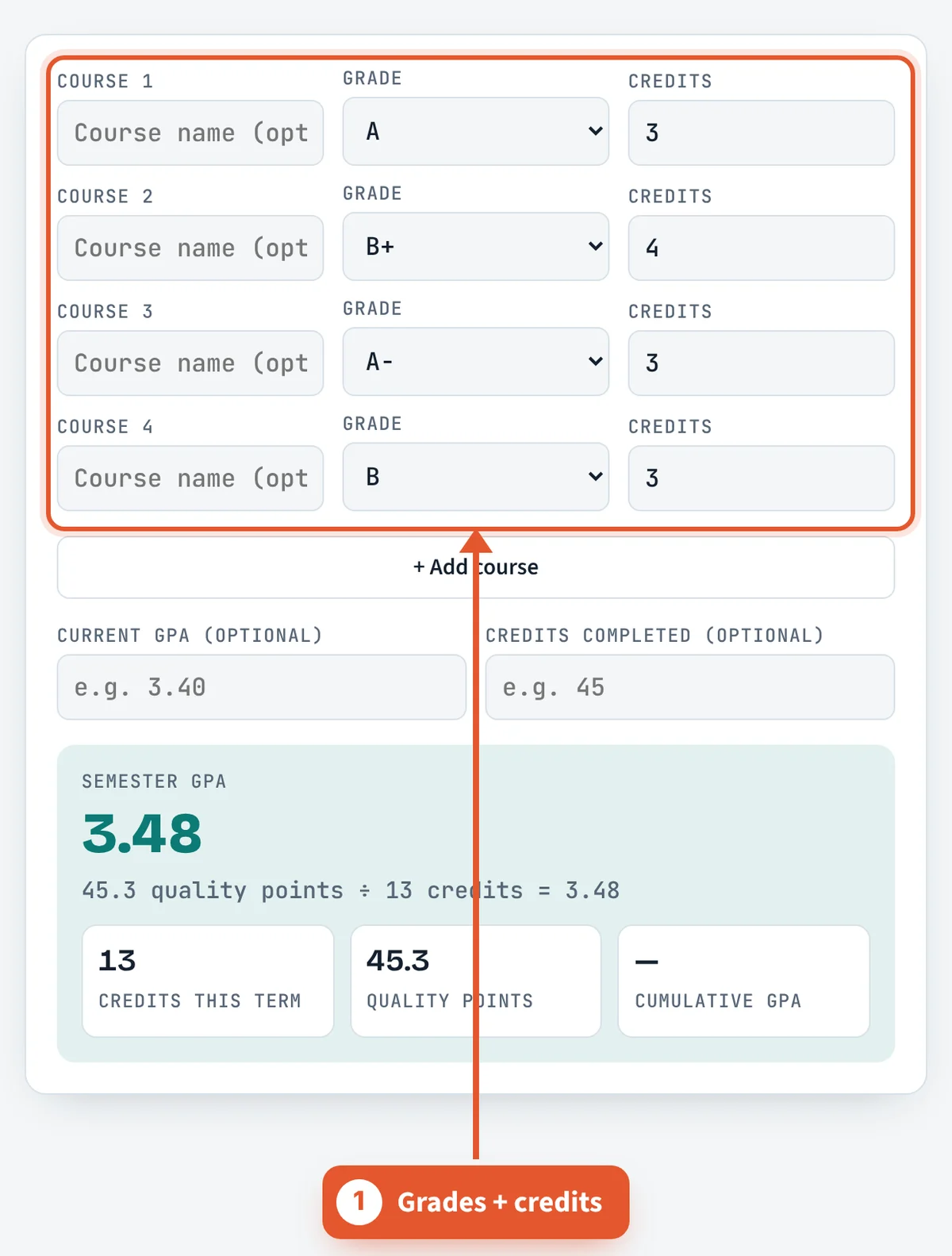
Add your courses
For each class, choose the letter grade and enter the credit hours. Use “Add course” for more rows.

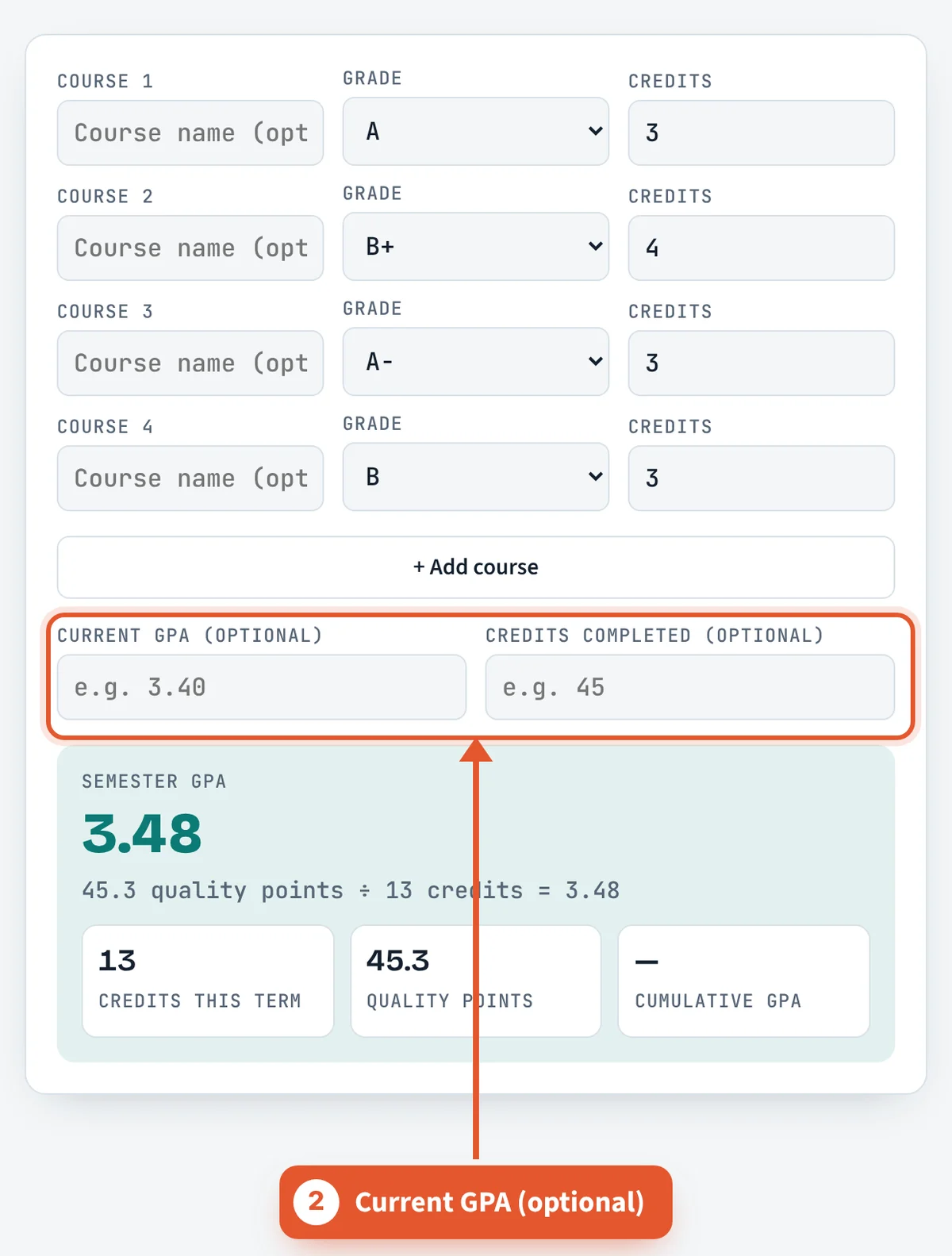
Add your current GPA (optional)
Enter your GPA so far and the credits you have completed to see your cumulative GPA.
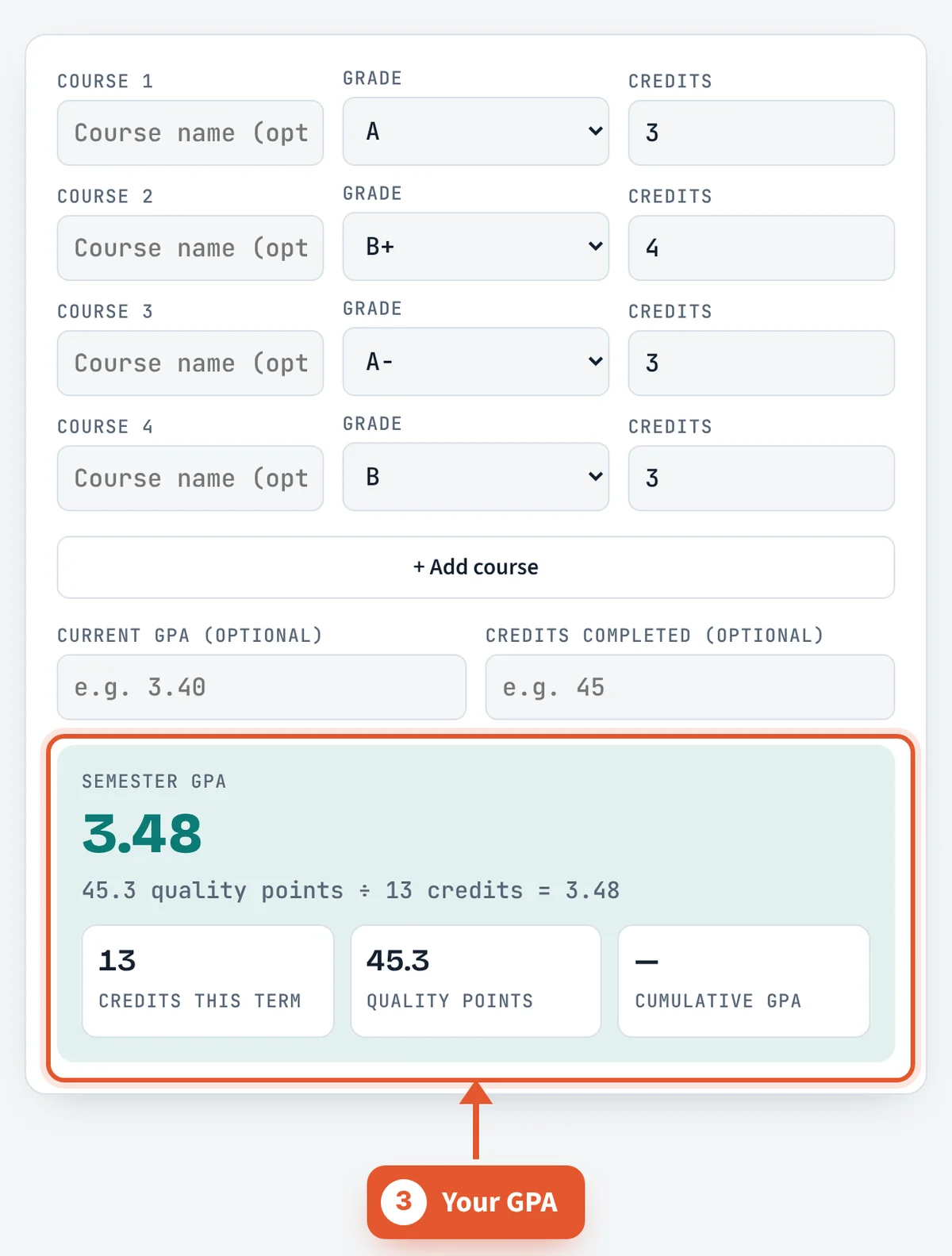
Read your GPA
Your semester GPA, total credits, quality points and cumulative GPA update instantly.
What is the difference between weighted and unweighted GPA?
An unweighted GPA uses the plain 4.0 scale, so an A is worth 4.0 whether it came from a standard class or the hardest course in the school. A weighted GPA adds extra points for more demanding classes. A common pattern adds 0.5 for honors courses and 1.0 for Advanced Placement (AP) courses run by the College Board and for International Baccalaureate (IB) Higher Level courses, which lets a weighted GPA reach 5.0. There is no national standard, so each high school sets its own rules.
Because policies vary, many colleges recalculate applicants’ GPAs using their own method, often counting only core academic subjects. When you compare yourself with a school’s published averages, check whether those figures are weighted or unweighted. If your school reports percentages or a letter scale instead, the grade calculator can help you work out where you stand in a single course before you average the results here.
How do pass/fail, withdrawals and repeated courses affect GPA?
Most colleges leave pass/fail courses out of the GPA: a pass earns credit but no grade points, although a fail may count as a zero at some schools. A W for withdrawal usually shows on the transcript but carries no grade points. Repeated courses vary the most. Some schools use grade replacement, where only the newer grade counts, while others average every attempt.
Graduate and professional applications often use their own rules:
- The Law School Admission Council (LSAC) converts every undergraduate grade to its own scale, where an A+ is 4.33, and includes repeated courses in the GPA it reports to law schools.
- The American Medical College Application Service (AMCAS), run by the Association of American Medical Colleges, also counts all attempts at a repeated course.
Students in systems that use a 10-point CGPA, such as India’s CBSE, can convert their result with the CGPA to percentage calculator.
Frequently asked questions
What is a good GPA?
A 3.0 is often the minimum for scholarships and internships, while 3.5 and above is considered strong for competitive programs.
How do credit hours affect GPA?
Classes with more credits count more. An A in a 4-credit class raises your GPA more than an A in a 1-credit class.
Is an A+ worth more than 4.0?
At most US colleges an A+ is capped at 4.0. A few schools give 4.33, so check your school’s scale.
How do I raise my cumulative GPA?
Take more credits with high grades. The more credits you have completed, the more new credits it takes to move the average.
Do pass/fail classes count?
Usually not. Pass/fail credits count toward graduation but not toward your GPA.
Sources and further reading
Related tools
Last reviewed: October 2026