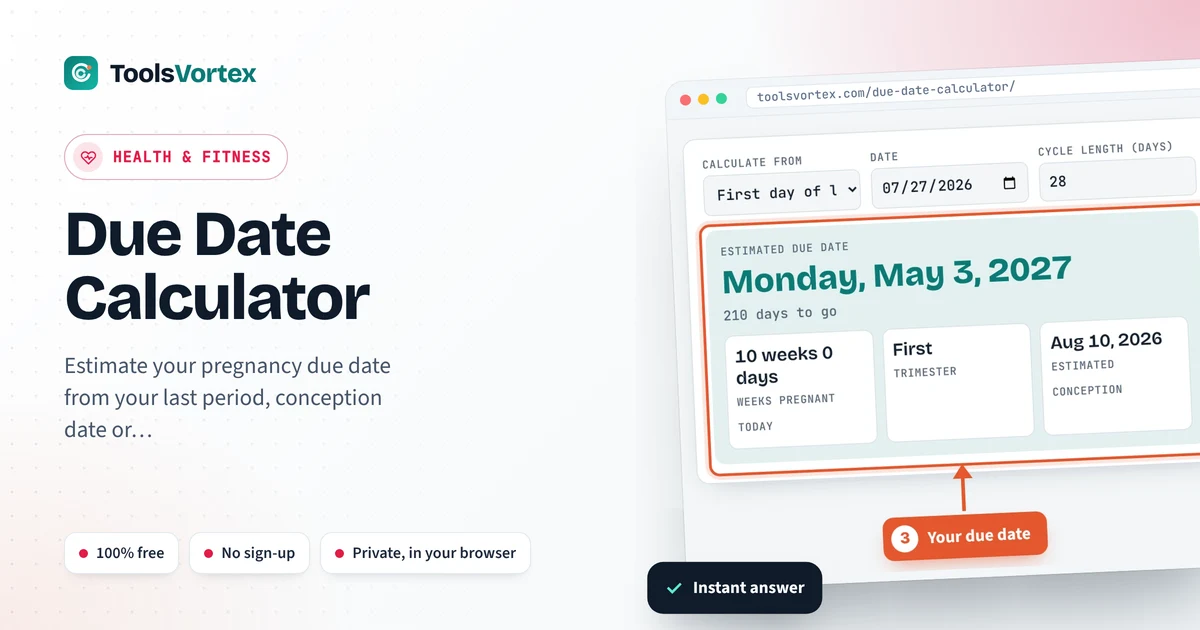
Estimate your pregnancy due date from your last period, conception date or IVF transfer date, and see how many weeks pregnant you are today.

A due date helps you plan prenatal appointments, screening tests, work leave and the arrival of your baby. This due date calculator uses the same methods doctors start with, Naegele’s rule for the last menstrual period, or the conception or IVF transfer date, and also shows how far along you are today. Only about 1 in 20 babies arrive exactly on their due date, so treat it as an estimate.
How is a due date calculated?
Add 280 days (40 weeks) to the first day of your last menstrual period. This is Naegele’s rule, which assumes a 28-day cycle. For example, if your last period started on January 1, 2026, your estimated due date is October 8, 2026. If you know the conception date, add 266 days instead.
Due date methods
| Starting date | Add |
|---|---|
| First day of last period (28-day cycle) | 280 days |
| Conception date | 266 days |
| IVF day-5 embryo transfer | 261 days |
| IVF day-3 embryo transfer | 263 days |
For cycles longer or shorter than 28 days, the calculator moves the due date by the difference, for example 2 days later for a 30-day cycle.
Trimesters
The first trimester runs to the end of week 13, the second from week 14 to the end of week 27, and the third from week 28 until birth. A pregnancy is considered full term from 39 weeks 0 days to 40 weeks 6 days.
This tool gives an estimate only. An early ultrasound is the most accurate way to date a pregnancy, so always follow the due date your doctor or midwife gives you.
How to use the Due Date Calculator
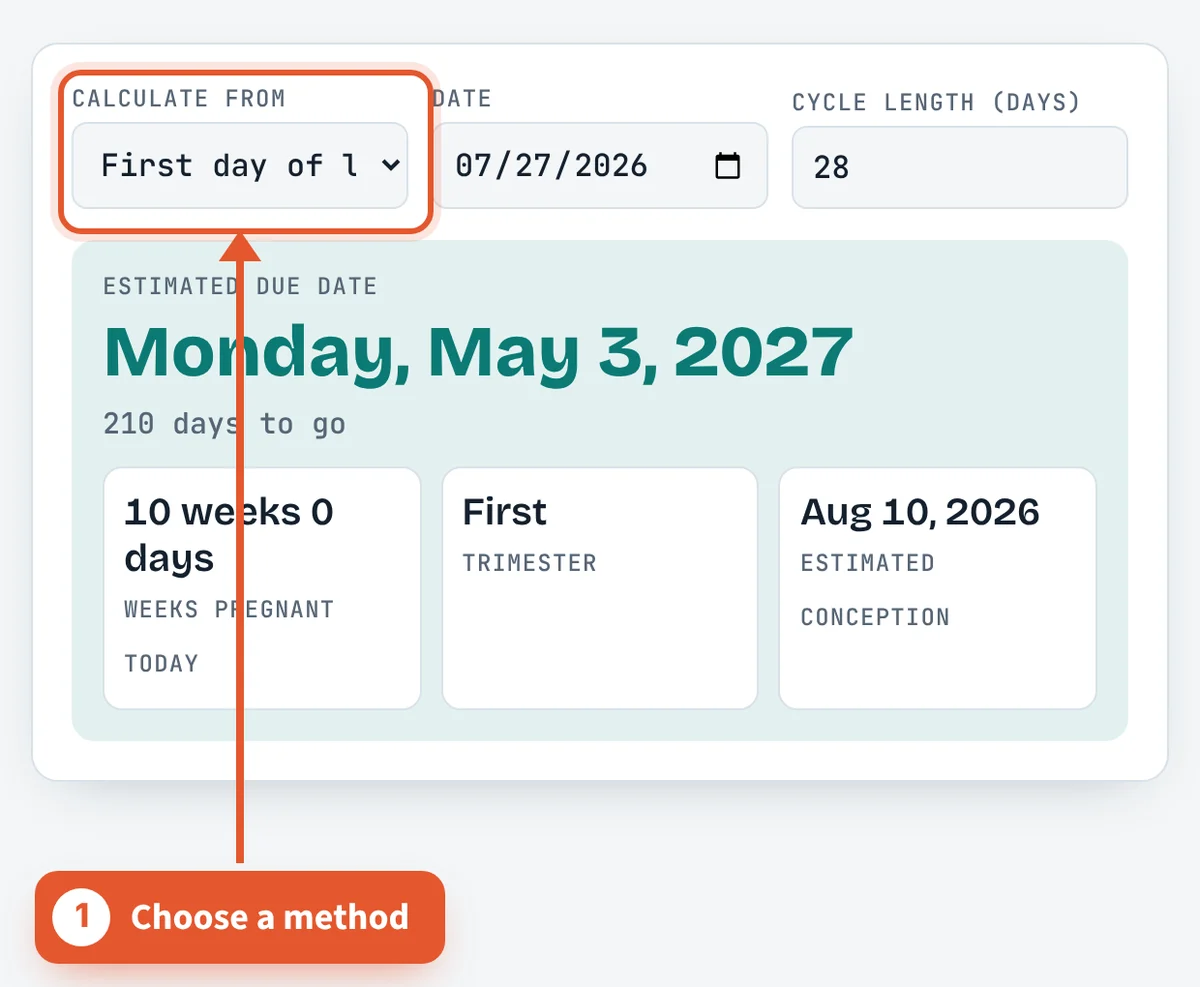
Choose your method
Pick last period, conception date or IVF transfer, depending on what you know.

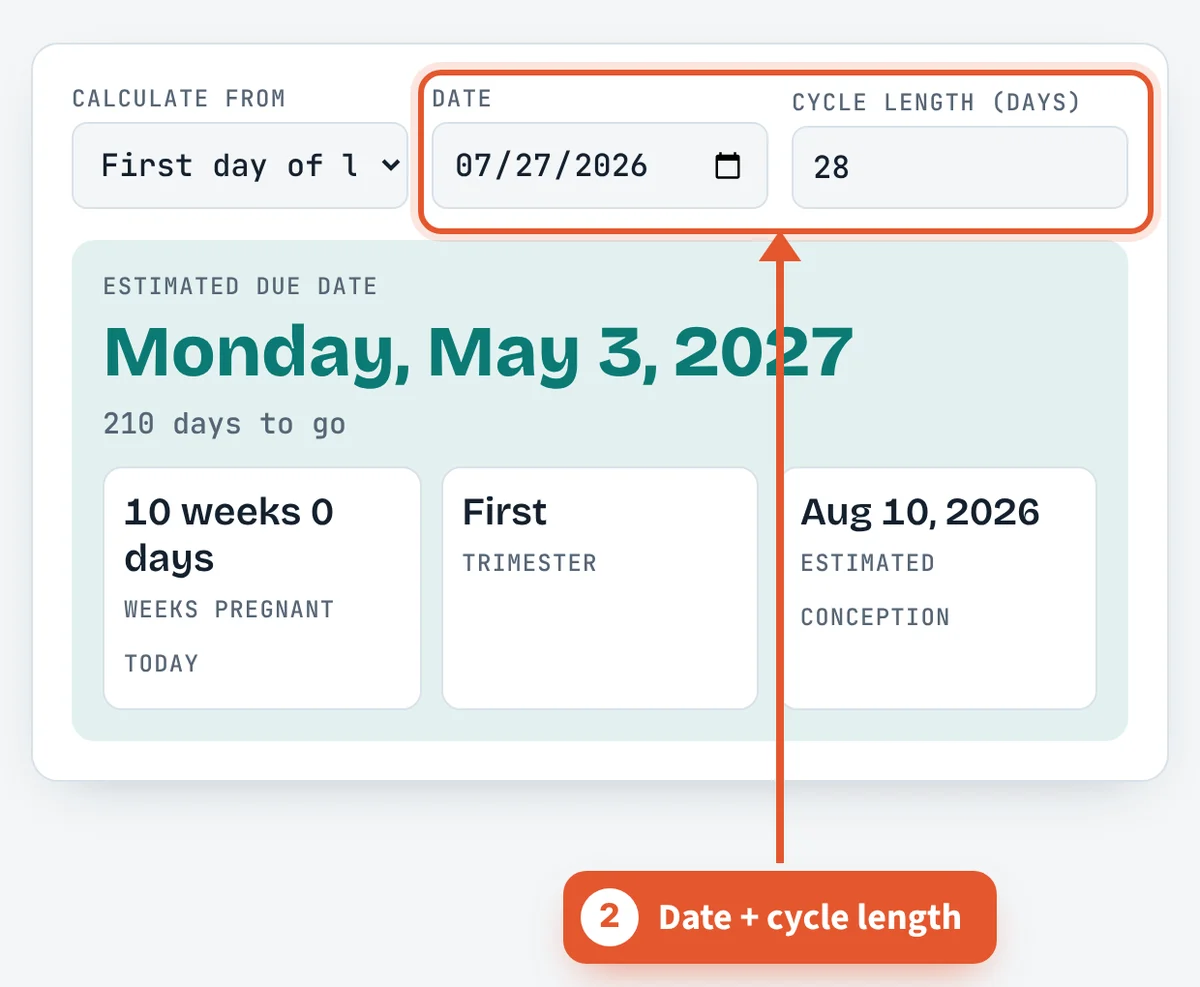
Enter the date and cycle length
Select the date. For the last period method, adjust the cycle length if yours is not 28 days.
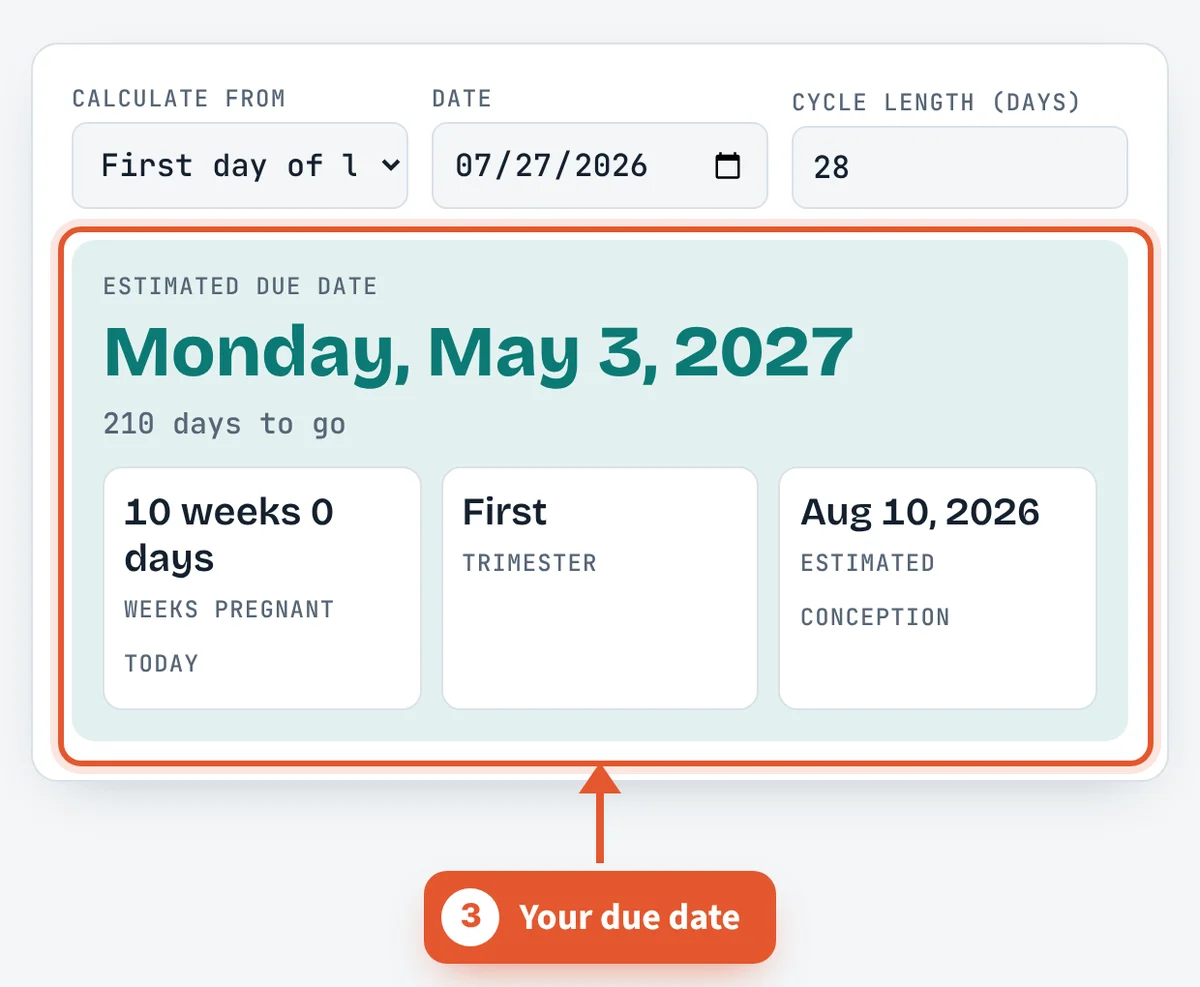
Read your due date
See your estimated due date, how many weeks pregnant you are today and your trimester.
Can an ultrasound change my due date?
Yes. The American College of Obstetricians and Gynecologists (ACOG), together with the American Institute of Ultrasound in Medicine and the Society for Maternal-Fetal Medicine, says an ultrasound in the first trimester is the most accurate way to set or confirm a due date. Up to 13 weeks and 6 days, the scan measures the crown-rump length, the distance from the top of the head to the bottom of the torso.
If that measurement differs from the date based on your last menstrual period by more than 7 days, ACOG advises changing the due date to match the ultrasound. The allowed gap is wider later in pregnancy because babies vary more in size as they grow. Once a due date is set by an early scan, later ultrasounds should not move it.
For pregnancies conceived through in vitro fertilization, the due date comes from the embryo transfer date: add 266 days minus the embryo’s age, which works out to 261 days after a day-5 blastocyst transfer and 263 days after a day-3 transfer. To see which week you are in today, use the pregnancy week calculator.
What do early term, full term and late term mean?
A due date marks 40 weeks, but ACOG defines a range of normal timing instead of a single day. These labels were set out in ACOG Committee Opinion 579 to replace the older idea that any birth from 37 to 42 weeks was simply “term”.
| Label | Gestational age |
|---|---|
| Preterm | Before 37 weeks 0 days |
| Early term | 37 weeks 0 days to 38 weeks 6 days |
| Full term | 39 weeks 0 days to 40 weeks 6 days |
| Late term | 41 weeks 0 days to 41 weeks 6 days |
| Postterm | 42 weeks 0 days and beyond |
The split matters because babies born in the early term window have higher rates of breathing and feeding problems than those born at full term. That is why ACOG advises against elective delivery before 39 weeks without a medical reason. If you are still trying to conceive, the ovulation calculator estimates your fertile days, and you can return here once you know your last period date.
Frequently asked questions
How accurate is a due date calculator?
It gives a good estimate, but only about 4 to 5% of babies are born on the exact date. Most arrive within two weeks either side.
Can my due date change?
Yes. Your doctor may update it after an early ultrasound, which is the most accurate way to date a pregnancy.
How many weeks is a full-term pregnancy?
Full term is 39 weeks 0 days to 40 weeks 6 days of pregnancy.
What if I do not know the date of my last period?
Use the conception date if you know it, or ask your provider about a dating ultrasound.
Is my information stored?
No. Everything is calculated in your browser and nothing is saved or sent anywhere.
Sources and further reading
Related tools
Last reviewed: October 2026