Enter a due date, or the first day of your last period and your cycle length, to estimate the most likely conception date and the fertile window around it.
An estimate, not medical advice. Runs in your browser; nothing you type is sent anywhere.
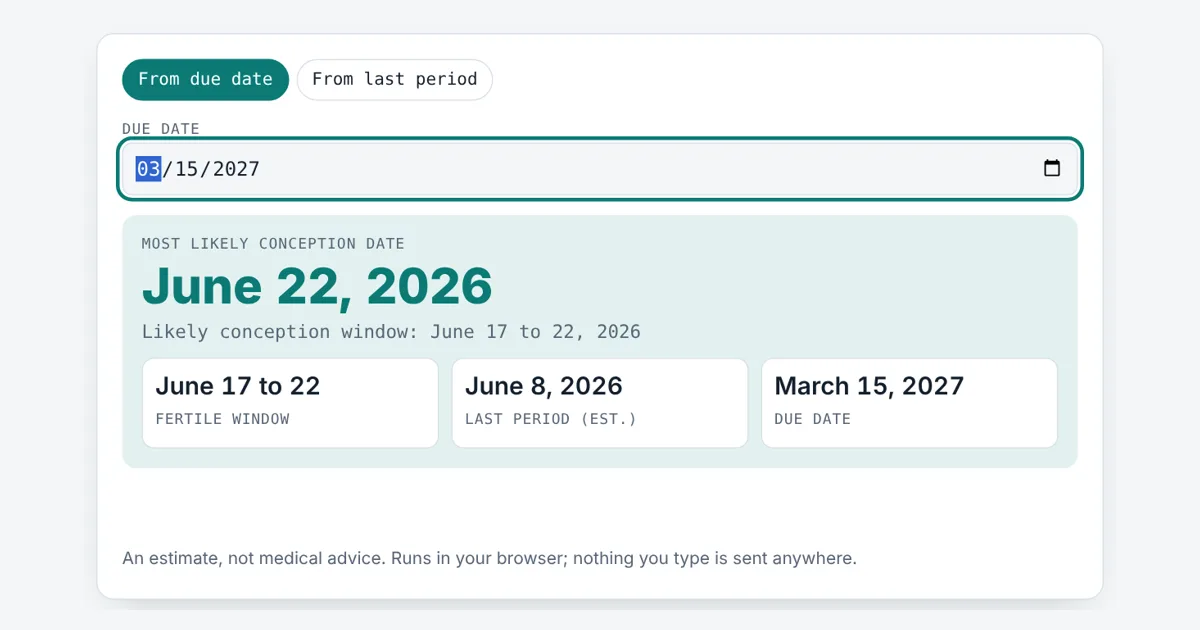
This conception date calculator is for expecting parents who want to know roughly when a pregnancy began. You get the most likely conception date, the six day fertile window that ends on it, the estimated last period and the due date. The answer is a medical estimate based on average cycles. It cannot prove the exact day or who the father is, and your doctor’s ultrasound dating comes first.
How Do You Calculate Conception Date From a Due Date?
Count back 266 days, or 38 weeks, from the due date to estimate the conception date, since a typical pregnancy lasts 266 days from conception. For a due date of March 15, 2027, the most likely conception date is June 22, 2026, and the fertile window runs from June 17 to June 22, 2026.
What Is the Formula for Conception Date?
Conception is estimated as 266 days before the due date, or 14 days after the first day of the last menstrual period in a 28 day cycle.
from last period: ovulation ≈ LMP + (cycle length − 14) days
fertile window = ovulation − 5 days to ovulation day
Doctors date pregnancy from the first day of the last menstrual period (LMP), not from conception. The usual due date rule, known as Naegele’s rule, adds 280 days (40 weeks) to the LMP. Ovulation, the release of an egg, happens about 14 days before the next period, so in a 28 day cycle it falls on day 14. That is why conception is placed 266 days, or 38 weeks, before the due date. With a longer cycle, ovulation and conception come later, and the tool shifts the date for you.
How Long Is the Conception Window?
The conception window is about six days: the five days before ovulation and the day of ovulation itself. A 1995 study by Wilcox and colleagues in the New England Journal of Medicine found that pregnancies came only from sex in this six day fertile window, because sperm can survive in the body for up to about five days while the egg lives for about a day. Fertilization, when sperm meets the egg, so happens on or soon after ovulation even if sex was a few days earlier. For future planning, the ovulation calculator predicts upcoming fertile days.
How Accurate Is a Conception Date Estimate?
It is usually accurate to within a few days, not to the exact day. Cycle length and ovulation day vary from cycle to cycle and from person to person, so any date based on the LMP carries a margin of several days. An early ultrasound that measures the embryo’s crown to rump length in the first trimester is the most accurate way to date a pregnancy, and the American College of Obstetricians and Gynecologists (ACOG) recommends using it to confirm or adjust the due date. For IVF pregnancies, the embryo transfer date gives an exact answer.
Conception Dates for Common Due Dates
Results from this tool, using a 28 day cycle:
| Due date | Likely conception | Fertile window |
|---|---|---|
| January 1, 2027 | April 10, 2026 | April 5 to 10 |
| March 15, 2027 | June 22, 2026 | June 17 to 22 |
| June 8, 2027 | September 15, 2026 | September 10 to 15 |
| December 25, 2026 | April 3, 2026 | March 29 to April 3 |
Worked Example
Priya’s doctor gives her a due date of March 15, 2027. With “From due date” selected, she enters that date and the tool shows a most likely conception date of June 22, 2026, a fertile window of June 17 to 22, and an estimated last period of June 8, 2026. Her friend Ana switches to “From last period”, enters September 1, 2026 and a 35 day cycle. Ovulation moves to day 21, so the tool shows September 22, 2026 as the likely conception date and June 15, 2027 as the due date, a week later than the 28 day rule. To see how far along a pregnancy is today, use the pregnancy week calculator, and to work out a due date from scratch, the due date calculator does the reverse sum.
How Do You Use the Conception Date Calculator?
Choose your starting point
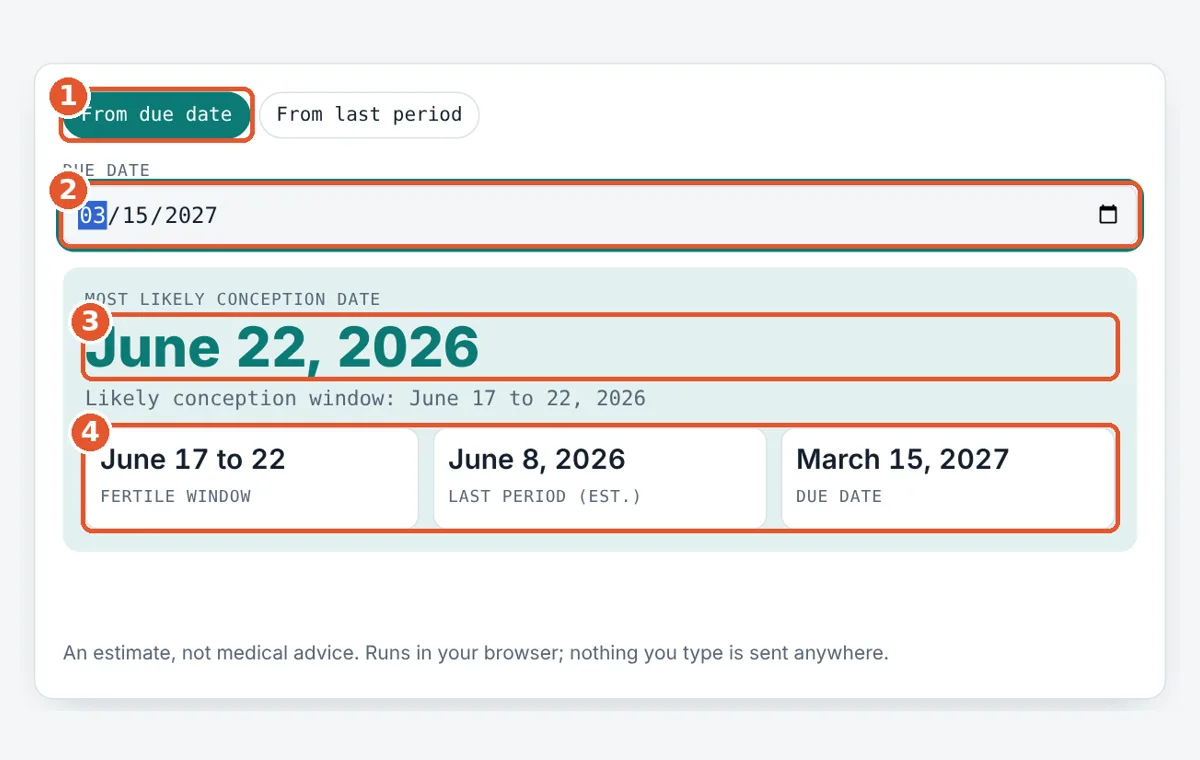
Tap From due date, or From last period if you know your LMP.
Enter the date
Pick the due date. In last period mode, pick the first day of your period and type your cycle length.
Read the conception date
The big date is the most likely day of conception.
Check the window and dates
The boxes show the six day fertile window, the estimated last period and the due date.
Frequently Asked Questions
How many weeks after conception is the due date?
The due date is about 38 weeks, or 266 days, after conception. Pregnancy is usually counted as 40 weeks because doctors start counting from the first day of the last period, about two weeks before conception.
If my due date is January 1, 2027, when did I conceive?
Most likely around April 10, 2026, with a fertile window from April 5 to April 10, 2026. That is 266 days before January 1, 2027, assuming a typical 28 day cycle.
Can a conception date calculator tell who the father is?
No. Because sperm can live for up to about five days and cycles vary, the estimate has a window of several days at least. Only a DNA paternity test can confirm who the biological father is.
Does a long cycle change the conception date?
Yes. Ovulation happens about 14 days before the next period, so a 35 day cycle moves ovulation to around day 21. That shifts conception and the due date about a week later than the 28 day estimate.
Is conception the same day as sex?
Not always. Fertilization happens within about a day of ovulation, but sperm can survive up to five days, so sex up to five days before ovulation can still lead to conception on ovulation day.
Which is more accurate, LMP or ultrasound dating?
A first trimester ultrasound is more accurate than the last period date. ACOG advises doctors to change the due date if the early scan differs from the LMP date by more than a set number of days.
Sources and Further Reading
- ACOG Committee Opinion 700: Methods for estimating the due date
- Wilcox, Weinberg and Baird 1995, NEJM: timing of intercourse in relation to ovulation
- StatPearls (NCBI Bookshelf): estimated date of delivery
Related Tools
Last reviewed: October 2026