Measure your neck, waist and height (plus hips for women) with a tape and get a body fat estimate from the US Navy circumference equations, with fat and lean mass if you add your weight.
Runs in your browser. Nothing you type is sent anywhere.
This navy body fat calculator is for anyone with a tape measure who wants a quick body fat estimate without calipers or a scan, from people tracking fitness at home to recruits checking where they stand. It uses the circumference equations developed by the US Navy and works in inches or centimeters.
How Does the Navy Body Fat Calculator Work?
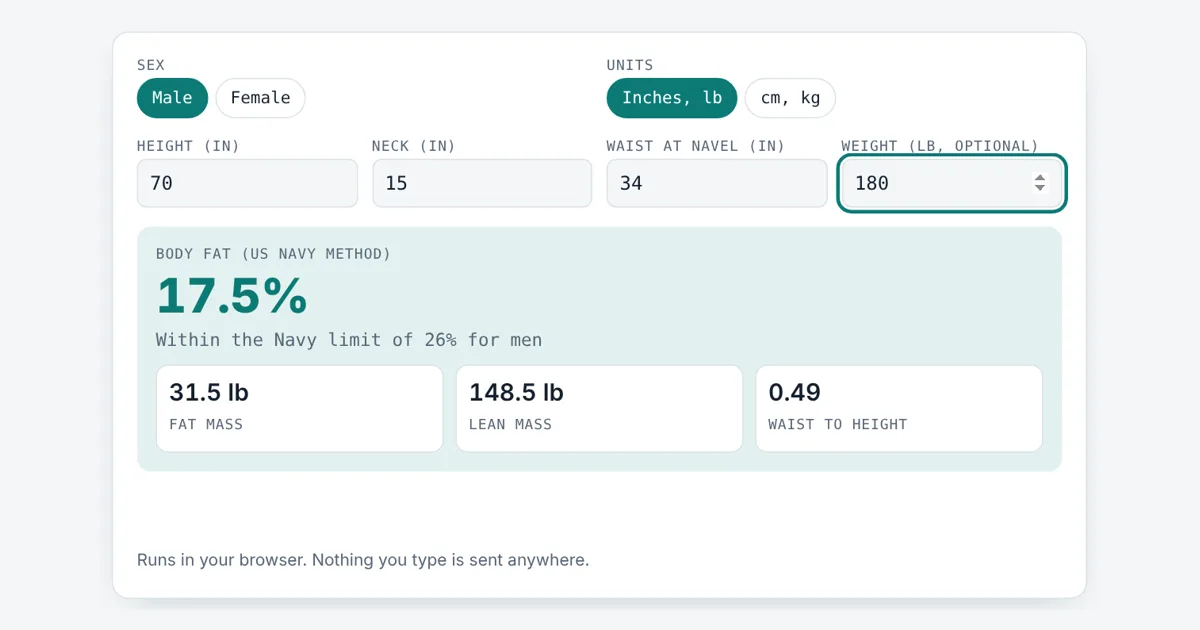
The US Navy method estimates body fat from tape measurements and height. For men it uses the waist minus the neck; for women it uses waist plus hips minus neck. A man who is 70 inches tall with a 15 inch neck and a 34 inch waist comes out at about 17.5% body fat.
What Is the US Navy Body Fat Formula?
The US Navy body fat formula is a pair of logarithm equations, one for men and one for women, that turn neck, waist, hip and height measurements in inches into a body fat percentage. A logarithm (log10) is the power you raise 10 to in order to get a number, and it lets the equation bend the way real bodies do.
Women: %BF = 163.205 × log10(waist + hip − neck) − 97.684 × log10(height) − 78.387
All measurements in inches
The equations come from the work of Hodgdon and Beckett at the Naval Health Research Center in San Diego, who in 1984 compared tape measurements against underwater weighing in hundreds of Navy men and women. Hodgdon and Friedl later reworked them to give body fat percentage directly. This style of estimate is called the circumference method, or simply the tape test. In the original study the equations were off by about 3.5 percentage points on average, so treat any result as a range.
Where Do You Measure Neck, Waist and Hips?
Measure the neck just below the voice box with the tape sloping slightly down toward the front, and keep the tape snug but not pressing into the skin. Men measure the waist level with the navel. Women measure the waist at its narrowest point and the hips at the widest part of the buttocks. Measure after a normal breath out, take each reading twice and use the average.
What Body Fat Does the Navy Allow?
The current Navy limit is 26% body fat for men and 36% for women, according to the Navy’s Physical Readiness Program Guide-4 dated December 2025. That guide also changed the steps: sailors are first screened with a waist-to-height ratio (waist divided by height), and a ratio below 0.55 passes. Only sailors at 0.55 or above go on to a body fat estimate, which the guide now reads from height, waist and weight tables rather than the neck and hip equation shown here. So this calculator gives the classic Navy tape estimate, not an official Navy score.
Navy Body Fat Results by Waist Size
Results from this tool for a man 70 inches tall with a 15 inch neck, and a woman 64 inches tall with a 13 inch neck and 38 inch hips:
| Waist | Man | Woman |
|---|---|---|
| 28 in | n/a | 26.6% |
| 30 in | n/a | 29.2% |
| 32 in | 13.4% | 31.7% |
| 34 in | 17.5% | 34.2% |
| 36 in | 21.3% | n/a |
| 38 in | 24.6% | n/a |
| 40 in | 27.8% | n/a |
To compare with a method that also uses your age, try our general body fat calculator. The waist to height ratio calculator shows the same 0.55 screening line the Navy now uses. This is an estimate, not medical advice.
Worked Example
Jordan is a man who is 70 inches tall, with a 15 inch neck, a 34 inch waist at the navel and a weight of 180 lb. The tool works out 86.010 × log10(19) − 70.041 × log10(70) + 36.76 = 17.5% body fat. With the weight added it shows 31.5 lb of fat mass and 148.5 lb of lean mass, and a waist to height ratio of 0.49. In centimeters, a man 178 cm tall with a 38 cm neck and 86 cm waist gets 17.3%. A woman 64 inches tall with a 13 inch neck, 30 inch waist and 38 inch hips gets 29.2%.
How Do You Use the Navy Body Fat Calculator?
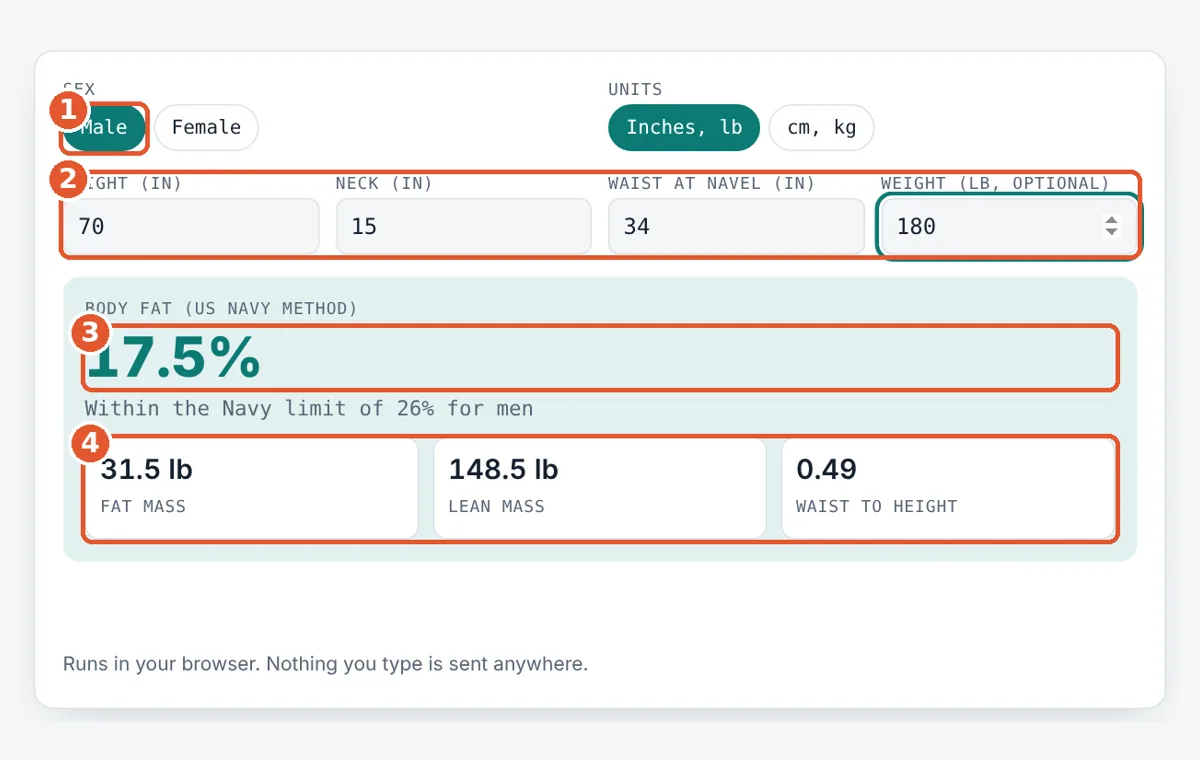
Pick sex and units
Tap Male or Female, then inches and pounds or centimeters and kilograms.
Enter your tape measurements
Type height, neck and waist. Women also add hips. Weight is optional.
Read your body fat
The big number is your body fat percentage, with a line comparing it to the Navy limit.
Check fat and lean mass
With weight entered, the boxes show fat mass, lean mass and your waist to height ratio.
Frequently Asked Questions
How accurate is the Navy tape method?
In the original Navy research the equations were off by about 3.5 percentage points on average compared with underwater weighing. So a result of 20% could really be anywhere from about 16.5 to 23.5%. Careful, repeated measuring keeps your own results consistent over time.
Why does the women's formula use hip measurement?
Women tend to store more fat around the hips and thighs, so a hip reading improves the estimate. The women's equation adds waist and hips, then subtracts the neck. For a woman 64 inches tall with a 13 inch neck, 30 inch waist and 38 inch hips, the result is 29.2%.
Is the Navy method the same as the Army tape test?
No. The Army moved to a one-site abdominal equation in 2023 that uses weight and waist only, and in 2026 replaced tape testing with a waist to height ratio. The Navy equations here use neck, waist, height and, for women, hips.
What is a good body fat percentage for men?
Many fitness guides put fit men at about 14 to 17% and average men at about 18 to 24%. The Navy's upper limit is 26% for men. A 70 inch man with a 15 inch neck needs a waist under about 39 inches to stay at or below 26%.
Can I use this calculator if I am very muscular?
Yes, but read the result with care. A thick neck from strength training lowers the estimate, and a large waist from muscle raises it. Very muscular people can be off by more than the usual 3 to 4 points, so a DEXA scan is a better check.
Do I enter measurements in inches or centimeters?
Either works. Tap the units button and the tool converts your numbers. The formula itself runs in inches, so centimeters are divided by 2.54 first. For example, an 86 cm waist becomes about 33.9 inches.
Sources and Further Reading
- Hodgdon JA, Friedl KE. Development of the DoD Body Composition Estimation Equations, Naval Health Research Center, 1999 (DTIC)
- US Navy Physical Readiness Program Guide-4: Body Composition Assessment (MyNavy HR)
Related Tools
Last reviewed: October 2026